According to a recent PwC report, adopting FinOps best practices could reduce budget planning efforts by 40%. With the majority of companies still struggling to manage cloud spending, FinOps continues gaining traction as organizations seek better control over cloud costs, improved financial efficiency, and smarter spending decisions.
Finout is a FinOps platform that claims to reduce cloud costs by 30% over a year and deliver 50% time savings for engineers. If those numbers hold, the natural follow-up is: what does Finout pricing actually look like?
This guide breaks down how Finout pricing works in 2026, what’s included in each plan tier, and how the platform compares to alternatives for teams evaluating cloud cost optimization tools.
What Is Finout?
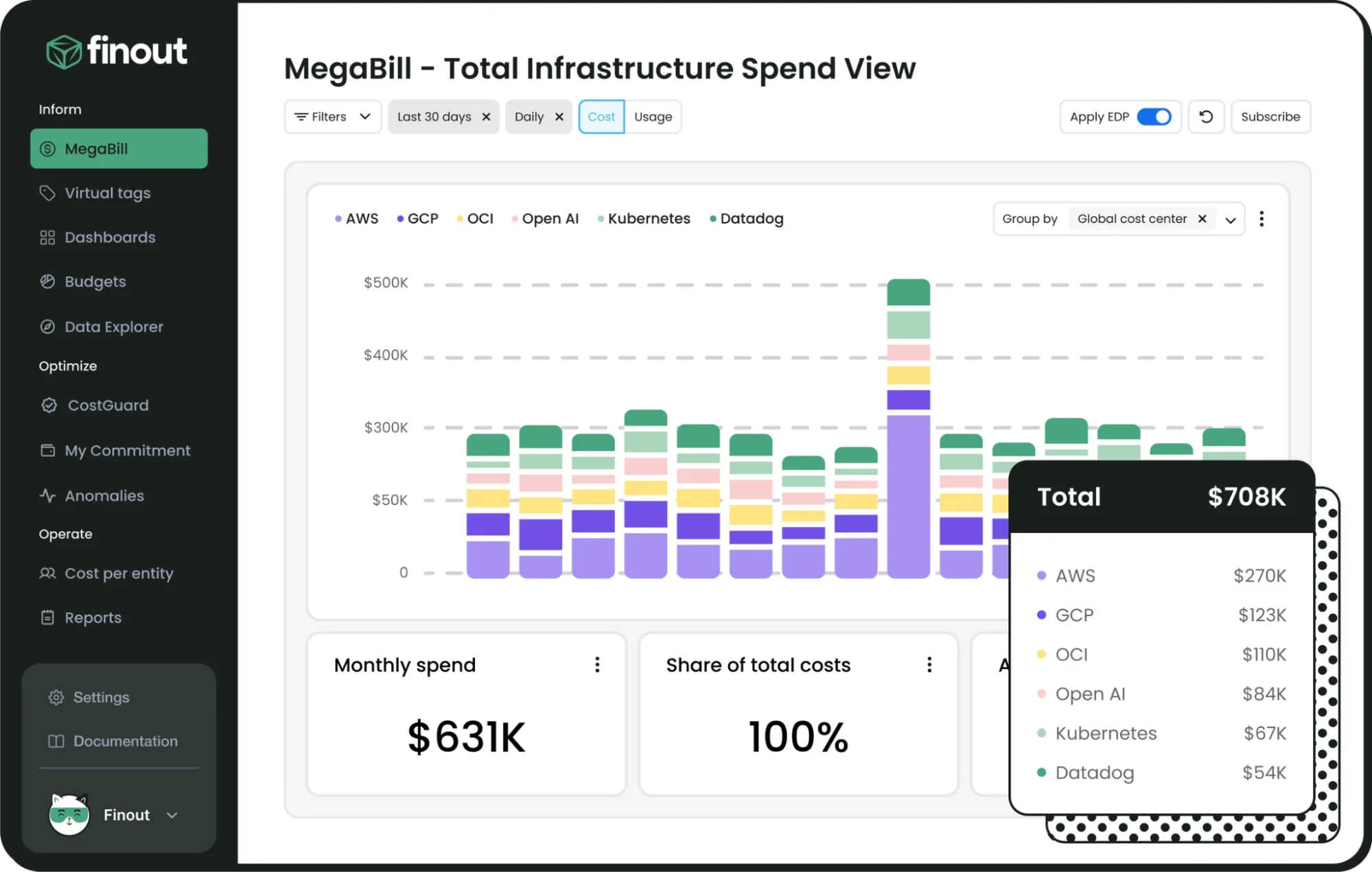
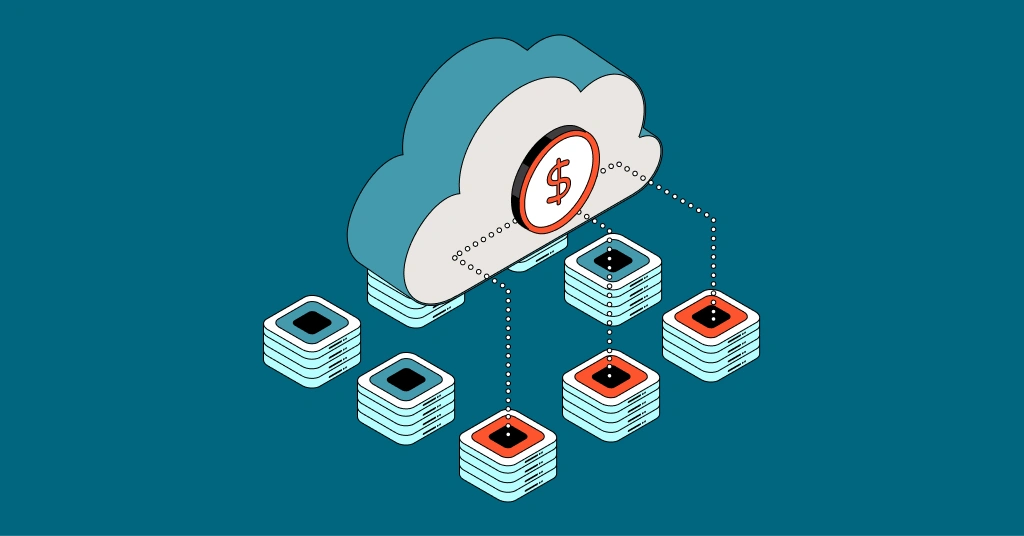
Finout consolidates cloud costs into one centralized dashboard through its MegaBill platform. Instead of navigating multiple billing portals, you get a unified view of your entire cloud spend. This includes costs from providers such as AWS, GCP, Azure, and OCI, as well as platforms like Kubernetes, Databricks, Snowflake, Datadog, and Confluent. Finout has also added integrations with AI providers including OpenAI and Anthropic, reflecting the growing importance of AI cost management.
With Finout, you can track metrics such as costs per cost center, namespace, and more through customizable FinOps dashboards.
Key FinOut features include:
- Finout’s virtual tagging system now uses AI to help businesses allocate cloud costs without altering existing cloud configurations. Branded as “AI-Powered VTags,” the feature enables users to create custom tags by team, project, or department, even if resources weren’t tagged correctly initially.
- Cloud services often involve shared resources, such as databases or load balancers, which serve multiple teams. Finout’s Shared Cost Reallocation ensures these costs are distributed fairly. Users can also define allocation rules based on usage, team size, or specific metrics.
- Through CostGuard, Finout proactively identifies waste in cloud environments by analyzing infrastructure to detect idle or over-provisioned resources. A companion feature called CostOptimizer complements this by providing actionable recommendations for Reserved Instances, rightsizing, commitments, and idle resource cleanup.
- Finout also leverages machine learning for anomaly detection. It alerts teams to issues in real-time, enabling them to act quickly and mitigate potential losses.
- Finout’s financial planning feature lets teams migrate Excel-based budget hierarchies, create scalable cloud budgets, generate forecasts, collect stakeholder input, and monitor actual vs. predicted spending. This is a newer addition that sits alongside dashboards and anomaly detection as part of Finout’s FinOps toolkit.
- The platform also offers fully customizable dashboards that enable users to tailor views to match their business needs. You can highlight metrics such as spending per team, service, or geographical region.
But how does Finout stand out in the crowded FinOps market?
2026 State of AI Spend Report
Why Finance Caps What It Can’t See
Learn how finance leaders are managing AI spend, and how they’re approaching FY2027
How Does Finout Compare To Other Cloud Cost Optimization Tools?
Finout is built with the modern multi-cloud environment in mind, making it highly adaptable to complex infrastructures. Here’s how it compares:
- Finout’s pricing model is based on a flat yearly fee tied to tiers of committed cloud spend, which provides more predictability than percentage-of-spend models used by some competitors.
- Shared resources often complicate cost allocation. While most tools provide fixed rules for distributing shared costs, Finout supports flexible, custom models to suit different business needs.
- Platforms like IBM Cloudability (formerly Apptio) tend toward pre-built reports and can lack flexibility for certain use cases. Finout’s adaptable dashboards adjust to your priorities and scale with your growth.
- With AI-powered VTags, teams can scale their tagging strategy without modifying existing cloud-provider tags directly.
- Finout supports a broad range of platforms including AWS, GCP, Azure, OCI, Kubernetes, Snowflake, Databricks, Datadog, Confluent, OpenAI, and Anthropic.
- Its ML-driven anomaly detection aims to reduce false alerts common in tools relying on static thresholds.
However, for businesses prioritizing engineering cost visibility across granular product dimensions, Finout may fall short. With a platform like CloudZero, teams can instantly see the cost impact of a single feature rollout — a level of specificity that Finout’s generalized tagging approach cannot replicate without extensive manual configuration.
In dynamic workloads, Finout’s dashboard-centric model may also delay action. CloudZero’s real-time anomaly alerts pinpoint spikes immediately, tying costs to specific engineering activities for faster resolution.
 to learn more about CloudZero.
Understanding Finout’s Pricing Model
Finout describes its pricing as “flat fee pricing based on tiers of committed spend.” The platform charges a yearly fee based on your forecasted cloud expenditure, with no overage charges tied to usage fluctuations. This approach gives finance teams more cost certainty compared to percentage-of-spend models.
The platform offers three plan tiers — Business, Pro, and Enterprise — each with unlimited users and varying levels of features and support. As of 2026, Finout no longer publishes specific dollar amounts on its pricing page; all three plans require requesting a quote.
Here is a quick overview of Finout plans:
|
Feature |
Business |
Pro |
Enterprise |
|
Pricing |
Request a quote |
Request a quote |
Request a quote |
|
Cost centers |
2 |
3 |
Unlimited |
|
Kubernetes |
25% price increase |
25% price increase |
Included |
|
Cost-per-customer |
+$250/mo |
+$500/mo |
Included |
|
SAML / SSO |
Not included |
Not included |
Included |
|
Dedicated Slack support |
Not included |
Not included |
Included |
|
Monthly business reviews |
Not included |
Not included |
Included |
|
Security compliance |
SOC 2, ISO 27001, GDPR |
SOC 2, ISO 27001, GDPR |
SOC 2, ISO 27001, GDPR |
All tiers include core features like MegaBill, Virtual Tags, Shared Cost, Financial Plans, CostGuard, CostOptimizer, Anomaly Detection, FinOps Dashboards, and in-app chat support.
Factors that influence Finout pricing
Several key factors influence the cost of utilizing Finout’s services.
- The number and complexity of integrations connected to your MegaBill may affect your quoted price, as more cloud providers and platforms demand additional resources and support.
- Kubernetes support carries a 25% price surcharge on Business and Pro plans. Enterprise includes it at no extra cost. Organizations running Kubernetes workloads should factor this into their tier evaluation.
- The cost-per-customer capability — useful for SaaS companies tracking margins — costs an additional $250 (Business) or $500 (Pro) per month. Enterprise includes it at no extra cost.
- The length of the contract term can influence pricing. Long-term commitments, such as annual or multi-year contracts, may provide cost benefits compared to shorter-term agreements.
- The level of support needed, including options like dedicated Slack support channels, may also influence the subscription cost.
- Dedicated Slack channels and monthly business reviews (MBRs) are exclusive to Enterprise, so organizations needing hands-on FinOps guidance should factor this into their evaluation.
Which Cloud Cost Optimization Platform Is Right For Your Organization?
The right cloud cost platform not only saves money but also boosts efficiency. On the flip side, the wrong choice can lead to overspending, inefficiencies, and wasted resources.
Here is what to consider.
- Data requirements. Identify how much data you manage and the complexity of your cloud environment. Ensure the platform supports your needs.
- Scalability. Opt for a tool that grows with your business. Consider future cloud and AI usage when evaluating plan tiers.
- Pricing model alignment. Compare flat-fee, percentage-of-spend, and tiered models to ensure they deliver value relative to your cloud bill size.
- Integration capabilities. Ensure smooth integration with your existing cloud providers, SaaS tools, and financial systems for smooth operations.
- Support and training. Look for robust customer support and training materials. A platform with responsive assistance can ease your team’s adoption.
- Customization and reporting. Look for advanced reporting and customizable dashboards that align with your specific business metrics.
What next?
Transform Your FinOps Strategies With CloudZero
CloudZero doesn’t just support FinOps — it redefines how organizations integrate financial accountability into their cloud operations.
Here’s how:
- Business-centric cost metrics. Unlike traditional tools, CloudZero focuses on cloud unit economics, such as cost per customer, product, or team. This approach directly aligns cloud spending with business outcomes, enabling actionable insights into profitability and efficiency.
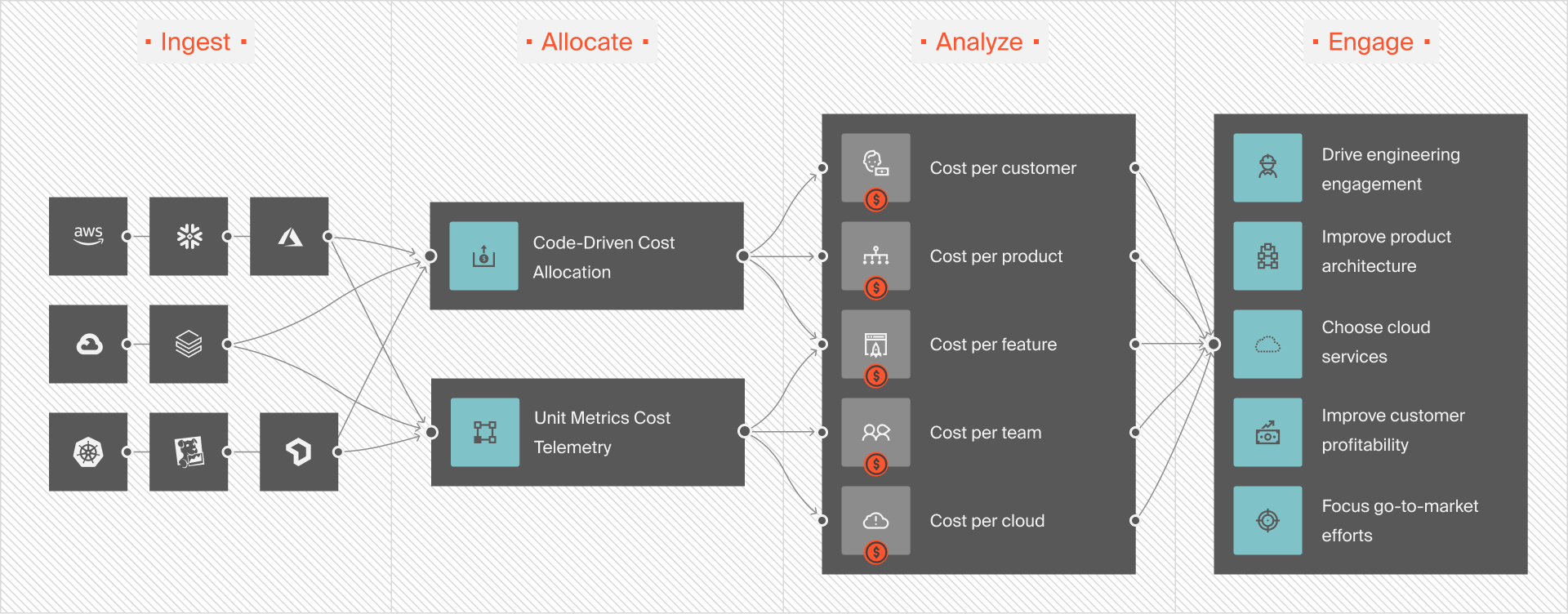
- Cost intelligence beyond tagging. CloudZero eliminates the dependency on perfect tagging, a common pain point in FinOps. The platform combines billing data, workload metadata, and algorithms to map costs to teams, features, or products. This ensures accurate allocation even with missing or messy tags.
- Real-time engineering visibility. CloudZero empowers engineers by providing real-time visibility into how their technical decisions impact cloud costs. This bridges the gap between finance and engineering, a critical FinOps goal.
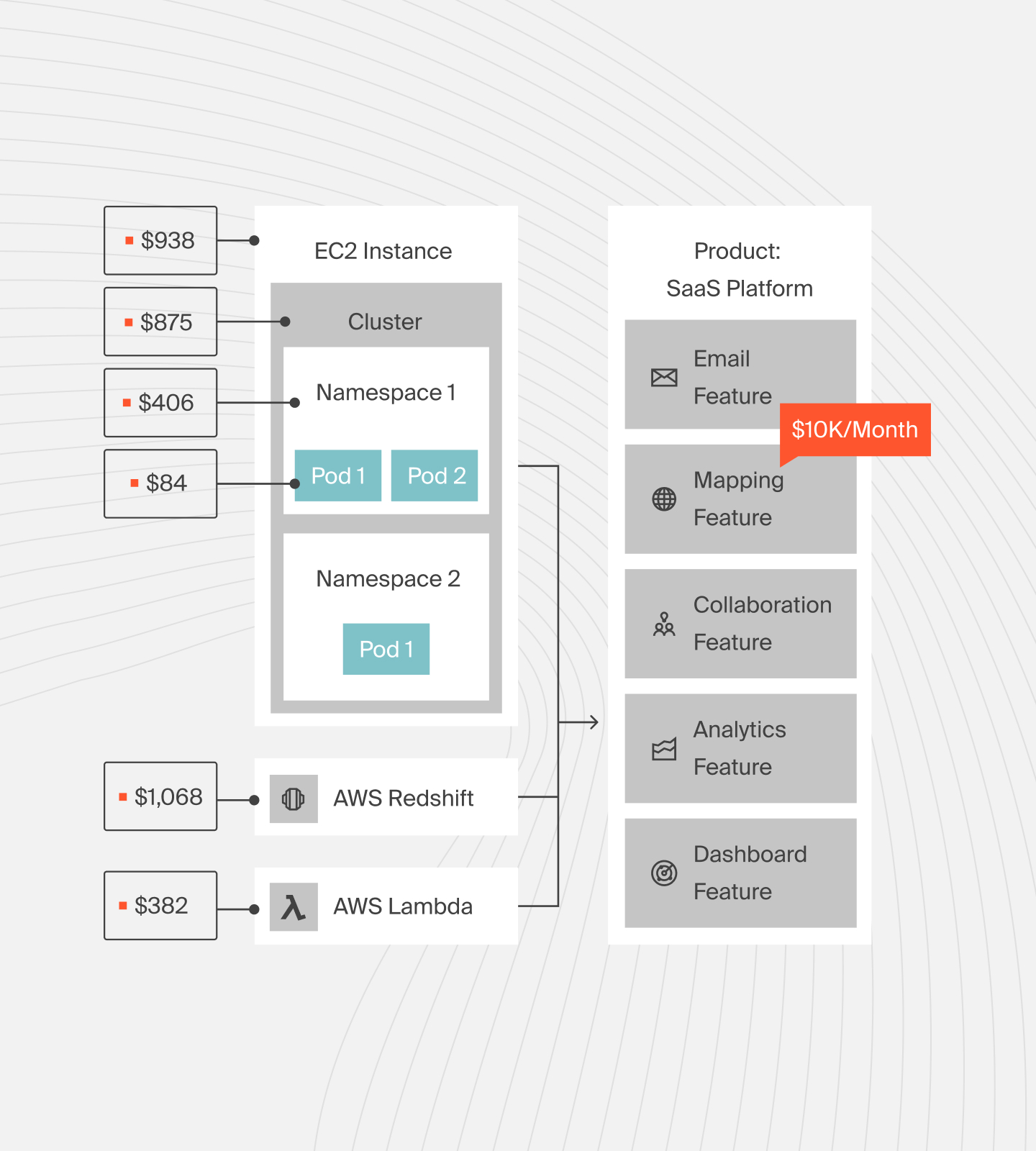
- Unmatched Kubernetes cost allocation. Kubernetes environments are notoriously challenging to track. CloudZero goes beyond surface-level tracking, delivering accurate, hourly-granular cost insights by clusters, namespaces, labels, and pods.
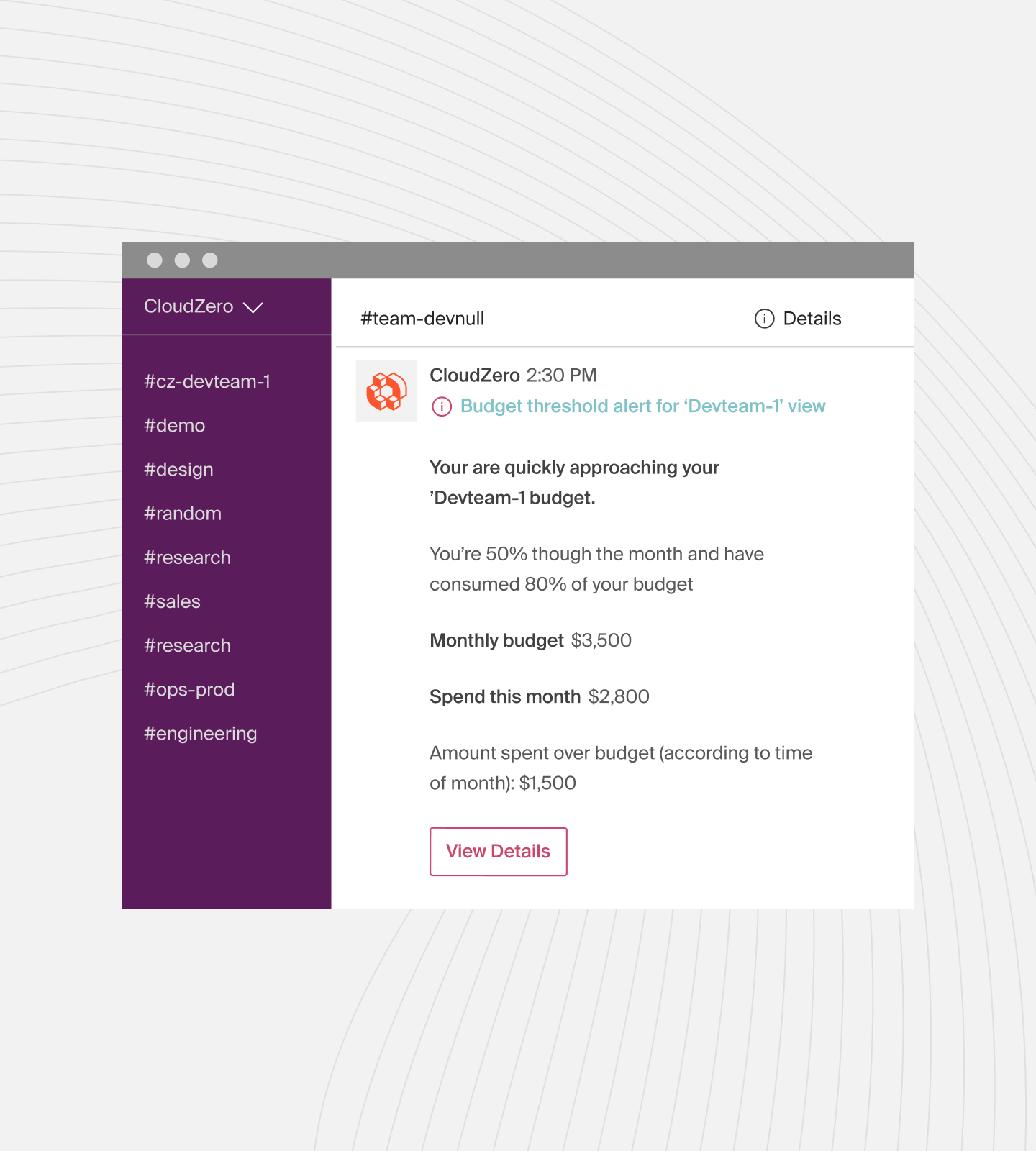
- Proactive FinOps with automation. CloudZero doesn’t just report costs — it proactively identifies inefficiencies and sends alerts on unusual patterns. This automation enables teams to take immediate action, which is critical for controlling cloud spend at scale.
- Expertise in FinOps implementation. CloudZero isn’t just a platform; it’s a partner in FinOps. Our team includes certified FinOps practitioners who help organizations implement best practices, ensuring maximum value and ROI.
Reading about CloudZero is one thing; seeing it in action is another. to see how ambitious brands save millions on cloud costs with CloudZero.
Frequently Asked Questions about Finout Pricing