You can already split AI spend by team and by model. But that’s not what your CEO asks in the QBR. The question is what you got for it: what did it cost to ship that feature, to launch that campaign, to serve that customer. And is the AI bet behind it paying off?
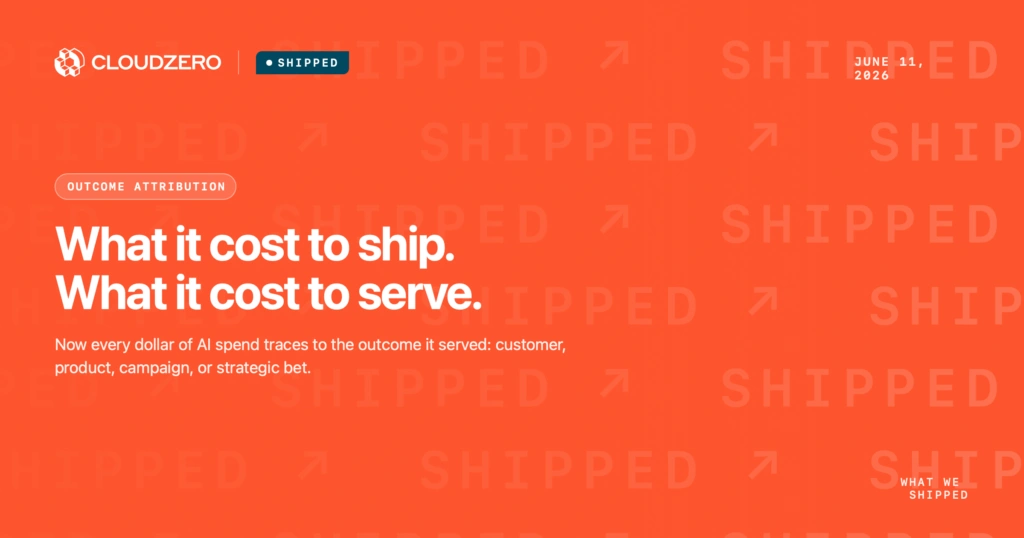
Now you can allocate AI spend to the outcomes you own: customer, product, feature, the strategic bet on the P&L. Not just the team that spent it. It also means cost per customer, cost per product, cost per any business dimension you’re measured on. The operational cut by model, provider, agent, and user lands in minutes; the full allocation across the business dimensions you track lands within hours, to finance-grade accuracy.
Tools that measure cost-per-PR or cost-per-bug are measuring how busy your engineers are. Tools that tag spans are measuring your infrastructure. Neither reaches the denominator a CFO owns: the business outcome.
Why this matters
Activity metrics like tokens, calls, and PRs merged tell you what was done, not what it was worth. And it isn’t only engineering: your marketers draft datasheets in Cowork, your CS team preps EBRs, your sales org builds proposals and of all that AI spend, none of it is tied to an outcome. Outcome attribution traces each dollar, four or more levels deep, to the customer, campaign, or bet it served. That’s real unit economics on your AI spend, the number finance actually runs on.
What we built
Multi-dimensional allocation, the part of CloudZero that’s allocated cloud spend for ten years, now runs on real-time AI data. It maps each dollar of inference to the business dimensions you’re measured on, so the number you carry into the room is an outcome, not an activity count.
How design partners use it
These views are in design partners’ hands now, and we run them ourselves. We pull in your business-context tags and allocate spend across them, using the same engine and dimensions you already use for cloud spend, so “what the platform team spent” becomes “what it cost to ship this.” The shift lands the moment a partner sees spend attributed to something they run the business by: a product line, a customer account, the campaign it supported, not a model or a token. Their finance leaders are in the room for it, because this is the number they’ve been missing.
Talk to us about the design partner program.