Quick Answer
CloudZero's Emily Allen and Brady Lenahan talked through how finance capitalizes AI spend and sets limits on it after a year of companywide AI adoption.
Picture your AI line item last fall. A few seats, one vendor, tucked inside the software budget. Now picture it today.
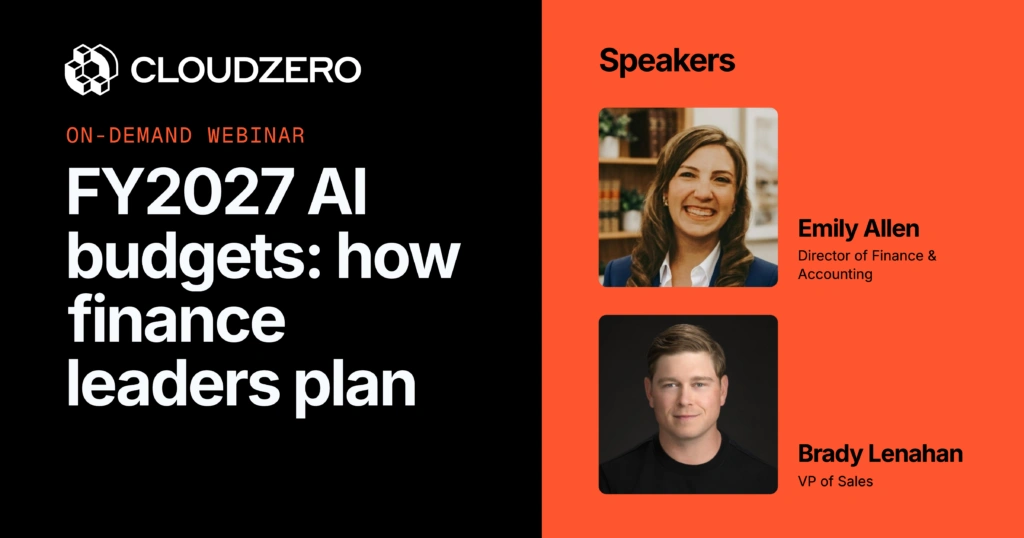
That’s the year Emily Allen, director of finance and accounting at CloudZero, walked through in our 30-minute webinar FY2027 AI budgets: how finance leaders plan on October 29, 2026. Emily is a CPA who started in public accounting and worked in accounting and FP&A at CarGurus and in FP&A at Roku before CloudZero.
Brady Lenahan, CloudZero’s vice president of sales, hosted. He’s been with the company for nearly eight years, since its first customer. They covered how Emily now capitalizes the AI spend that goes into building software, how finance sets limits on the rest of the bill, and what happened after CloudZero gave Claude to every employee.
None of it is based in theory. Emily had approved a budget bump for an engineering team that same morning, two days before quarter end.

Here are the top takeaways.
1. Can you capitalize AI spend used to build software?
Yes, you can. Emily herself splits engineering AI spend into capitalizable and noncapitalizable based on CloudZero’s accounting policy, which moves the AI cost of building software from the P&L to the balance sheet. Capitalization is one of the more material numbers on a finance team’s plate, and AI is muddying it.
The old method, Emily said, meant asking the chief product officer what share of engineering time went to new features and multiplying it by assumptions.
Instead, she gave CloudZero’s accounting policy to the internal team, and they built her a view in the platform. It sorts engineering AI spend by that policy, then down to the specific feature or internal-use software it went into. She takes a screenshot and uses it as support for the auditors.
Most teams don’t have that, Emily said. “A lot of finance teams have to figure this out using a really gray set of rules and methodology.”
In the Q&A, a webinar attendee asked whether she’d run it past any audit or tax firms. Emily said she presented the approach at a conference held at a Big Four firm, where the author of a white paper on the topic told her it was exactly what they’d been advising people to do: a systematic approach with as little judgment as possible. Her audit background shows in where she starts.
“We tie to the invoice.”
In short: reconcile to the invoice so you can trust the data underneath. Then use your accounting policy to understand the activity, and apply your own judgment before booking anything.
2026 State of AI Spend Report
Why Finance Caps What It Can’t See
Learn how finance leaders are managing AI spend, and how they’re approaching FY2027
2. Why do hard AI spend limits backfire?
Hard AI spend limits backfire in two ways, Brady said. People who hit the cap stop working, and people whose cap is too low move work into personal accounts finance can’t see. Most per-person AI limits start the same way. Claude lets you set a cap for each user, so finance picks a number.
Emily said most of the finance leaders she talks to land on that number by gut check, and she laid out the math:
“I have this many employees, I’m kind of comfortable with, worst case scenario, this amount going out the door if they use it in full.”
That protects the downside. It says nothing about what anyone does with the money.
Brady shared an anecdote of what happened with one customer that set a $600 cap. In Brady’s own words, some employees ran out with a few days left in the month and told the company they’d clean the garage or go golfing instead.
The reasoning, according to Brady: “’I already built my workflows around AI, I can’t really go back in a productive way to doing them without AI, so I’ll just wait for November’.”
The second failure is harder to spot. When a cap is too low, Brady said, people move the work into their personal accounts. An engineer whose AI is pointed at the company’s code repo can’t easily do that. Someone making a deck, analyzing a spreadsheet, building a model or prepping for a meeting can, and he called that a real pain point for the finance leaders he talks to.
So the cap meant to control spend pushes some of it to where finance can’t see it at all.
The gate-first reflex is common, too. In CloudZero’s FY2027 AI spend survey, 27% of finance leaders named new approval gates as their primary change to FY2027 AI budgeting, compared with 18% who named tying funding to demonstrated ROI.
3. What does a smart cap look like in practice?
Brady summed up CloudZero’s approach in one line: “Smart caps, not the hard guardrails.”
A smart cap is a per-person AI spend limit set by role, with alerts as people near it and increases tied to what the team is working on. It starts with a sensible baseline by role. A salesperson at CloudZero can spend a lot on AI, Brady said, just not as much as a front-end developer. Spend tied to a real company objective, like a feature release two weeks out or a big in-flight deal, gets judged differently from everyday run rate.
Then come the exceptions. Emily set up Slack alerts for teams that hit their limits often, firing at about 75% of the limit. When one lands, she looks at what the team is working on and raises the limit a little, rather than resetting every budget higher each month. The morning’s engineering request went much the same way. She opened the project in CloudZero, saw the spend going to feature development and bug testing, checked the tickets, and signed off.
“I was able to do that within 5 minutes, and just hit approve.”
Compare that with her days as an FP&A analyst at CarGurus, when an ROI analysis on the company’s engineers took about two weeks of pulling data from different sources and stacking assumptions.
Brady added a lever that doesn’t need finance at all. As people near their limit, he pushes his team to be choosier about which model they use. He said a recently released CloudZero feature flags skills that are probably running on a more powerful model than they need. It also points people to a colleague running a similar workflow at higher value or lower cost.
Companies rarely want to spend less on AI overall, Brady said. They want to find the waste and bring their lagging users up to the level of their best ones.
4. How do you prove what AI spend bought?
Emily proves what AI spend bought by tying it to a monetary outcome: revenue by product line for product work and meetings booked for sales. She compared AI spend to a consulting engagement. You’d never hire consultants, pay them and then have nothing to tell the board about what they delivered.
“You need to be able to say, okay, yes, each person has a limit, each person’s spending, but we need to be able to actually prove from a monetary perspective what that built, what that did.”
Saved time on an email doesn’t count by itself, in her view. Did that saved time lead to more meetings? Did running a variance analysis through Claude catch something she might have missed?
Plenty of finance teams can’t answer that yet. The FY2027 AI spend survey found 61% of finance leaders say they already spend more on AI than they can justify with measurable outcomes.
Emily shared two ways she’s closing that gap.
For product work, she ties revenue by product line in Campfire, the ERP CloudZero uses, to the feature development cost for that product line in CloudZero, then runs a simple ROI calculation.
For go-to-market, she worked with Brady’s team to line up every sales development rep’s (SDR’s) AI spend against the meetings each one booked. They found an interesting pattern:
“Just because someone’s spending the most in AI to help their meetings doesn’t mean they’re booking the most.”
5. Why doesn’t run-rate budgeting work for AI anymore?
Emily stopped budgeting AI on run rate and now builds the number bottom-up from the projects that drive the most AI spend. Last fall, AI was just another software line item in CloudZero’s operating plan, she said, and not a material one. Then 2026 happened.
The old approach took the current month’s bill, added 5% for next month and repeated it across every provider. Emily’s take: do that and you’ll get a variance-versus-forecast question every single month. So she changed the method.
“I’m now doing a bottoms-up analysis, saying, ‘These are the key projects that are most material to our AI spend’, and that is how I’m building my budget.”
Each project gets its own budget, the way an event or a webinar would. Brady asked whether that felt more like headcount planning than software planning. Emily said yes. A front-end engineer running agents is a heavier AI user, so the per-employee math changes.
Emily said she’s already developing a new set of KPIs. The finance community, in her view, needs to define what good looks like and start benchmarking it. A year from now, with a year of data behind her, she might look back at some of today’s approvals and reconsider.
6. Why is finance suddenly holding the AI bill?
Finance holds the AI bill because adoption expanded beyond engineering to every team in the company, Brady noted. He recalled the January and February leadership meetings where the worry was whether people would adopt AI at all. They did, of course. Engineering adopted first, as everyone expected, but Emily was surprised by how far it spread into sales, finance and the rest of the company.
The biggest spender, notably, was no longer engineering.
“Our customer success org actually has spent the most on Claude in the past several months,” Emily said.
The vendor whiplash is another factor, she said. CloudZero went all in on Claude earlier in the year. Then OpenAI shipped a new model and people asked to switch back. Marketing needed Gemini for images, and Brady’s team got hooked on Grokbot. Emily said the options change not quarterly, not monthly, but weekly, adding that she looks at each person’s usage across every provider as a single number rather than a vendor’s per-token price.
Brady put the stakes plainly: “Now, every single chat and inference call is a buying decision that finance has limited control over.”
That leaves finance in an odd seat. Emily said she was excited about what AI could do for her team, and that the other side of her shivered at the cost. She added that she doesn’t want to be seen as the financial police, but she has a fiduciary responsibility to the company.
Brady half-joked that his sales team has a name for Emily’s role on AI spend: judge, jury and executioner.
Where this leaves finance
Brady closed on a point most CFOs will recognize. AI is real money, and in no other part of the company does every employee get to spend whatever they want on whatever they want.
Emily’s answer is to budget AI by project and hold each project to an outcome she can show the board. Which AI dollars in your budget could you defend line by line today?
FAQ
Want to see how 252 finance leaders are budgeting for AI in FY2027? Read the FY2027 AI spend survey report
Ready to get visibility into your AI and cloud spend? Schedule a demo