CloudZero originated as a way to make sense of your cloud costs. Costs spread across bills with billions of line items belonging to resources that might or might not have been tagged (or taggable), spun up by engineers working across teams, on different microservices, features, and products, that served a wide range of customers. Kubernetes. Multi-cloud. Check, check, check.
Then, the cloud-driven world was hit by a hurricane of AI. AI has been profoundly destabilizing, reinventing business norms more quickly than any technology before it, requiring speedy evolution in a sink-or-swim environment. Businesses are racing to find AI’s most durable applications. Executives are experimenting with radically new organizational structures. AI costs are mounting at an exponential rate.
But as much as AI has been unprecedentedly disruptive, it also has the power to bring unprecedented clarity. Today, with the launch of AI Hub, this is exactly what CloudZero brings to AI costs.
CloudZero has long been the platform of choice for cloud-driven businesses looking to bring unit economic clarity to their vast, complex cloud environments. Our Real-Time Spend capability makes us the same for AI costs. And AI Hub is where it all comes together: a single resource, accessible via Claude Code, queryable in natural language, that integrates with every tool in your stack and serves up critical cost insights in minutes.
What the CloudZero AI Hub is
The CloudZero AI Hub comprises:
- Claude Code Plugin: A single install command to access our MCP Server and Claude Skills
- MCP Server: Several APIs that allow your AI to navigate through all of your cloud cost data
- Claude Skills: Several Claude Skills that teach your AI how to navigate your cost data
- Prompt Catalog: Pre-build prompts broken down by role, maturity level, and use case
Installation takes minutes. Once it’s done, you can ask Claude direct questions about your AI and cloud costs. Questions like:
- “Run an anomaly detection scan, then show me my top cost drivers and any trends.”
- “We had a cost spike last Tuesday. Investigate what caused it and recommend actions.”
- “Do a deep dive on our RDS costs and identify optimization opportunities.”
- “Generate a cost breakdown by team for Q4 including service details.”
- “Analyze our tag coverage and prioritize resources that need tagging.”
These are the same issues you’d have been able to tackle with CloudZero already. But now, instead of spending hours tabbing through Dimensions and dashboards, finding the right one, and manually generating an incident report, Claude can do that reasoning for you. We trained Claude to be a CloudZero expert. It’ll do all that work for you.
That’s powerful. But the maximum power of the AI Hub is unlocked when you feed CloudZero not just to your cost data, but any and all other data that can add context. That could include your Snowflake environment, your coding environment, your ticketing system, your Salesforce archives. This way, Claude + CloudZero will know not just how your costs are evolving, but for every incident, can determine what happened, when it happened, who did it, and what its cost and revenue outcomes were. You can surface all of this information with simple prompts like the ones above.
Once you determine the prompts that surface the most valuable, actionable insights, you can automate them — the prompts, and in certain cases, full remediation. This is how the fully automated remediation cycle looks:
- CloudZero detects an anomaly
- CloudZero + Claude kicks off a job that investigates it — at the code, infrastructure, and personnel levels
- CloudZero + Claude recommends an action to remediate the anomaly
- If you’ve granted the permissions to do so, CloudZero + Claude executes the remediation
Real-time AI spend
The AI Hub is further fueled by CloudZero’s AI telemetry agent, a one-of-a-kind solution for ingesting and allocating AI costs as they happen. Just have your engineers install CloudZero’s agent locally on their computers, and CloudZero will automatically track their AI usage, feed that data into your cost environment, and make it queryable alongside all other data sources you’re using CloudZero to track.
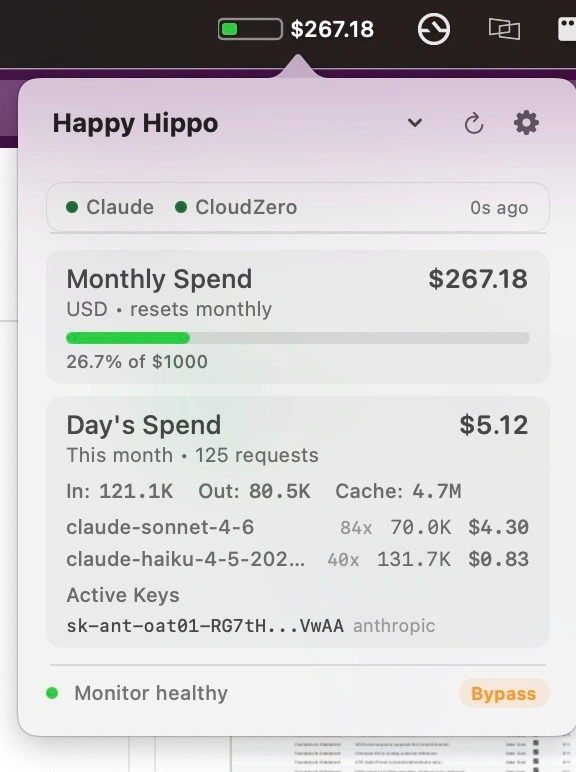
This way, CloudZero feeds accurate, real-time AI cost data into unit economics calculations, which Anthropic, OpenAI, and AI providers are structurally unable to do. As in the cloud, where AWS can’t capture usage or cost data from Azure, GCP, Snowflake, or whatever else you might be using, individual AI providers can’t capture this data from each other, so they can’t deliver a complete picture of your investment. CloudZero collects it all in real time — not near-real-time, not a day later, but the moment anyone in your organization incurs new AI costs.
From reports in hours to remediation in minutes
In the old days: The person most directly accountable for cloud cost efficiency would open a cost intelligence tool and notice that costs had gone up. They’d apply some filters and see that a Snowflake warehouse had risen by $x. They’d then have to investigate why it had risen, which would involve identifying the responsible engineer, pinging them, waiting for the engineer to dig through their backlog of PRs, figuring out whether the cost spike was called for, and if not, figuring out what they could do to remediate it. Optimistically, this would take hours.
Now: Anyone and everyone who’s connected to CloudZero can do this in minutes. Ask about cost trends. Surface the context around cost spikes. Identify the who, the what, the when, the why, and how, if possible, you can remediate it. Execute the how, or make Claude do that for you, too. Autonomy. Automation. A full cycle, done in minutes.
Hurricane AI is still roiling the ocean of business operations — and the bills companies have to foot as they navigate the waves. CloudZero’s AI Hub, combined with our AI telemetry agent, gives companies an essential, exhaustive financial control plane with which to master the surf.
Curious to learn more? Reach out here.