Quick Answer
LLM cost optimization is the practice of cutting what you spend on large language models, mostly inference, without losing the quality that makes the AI worth running. The biggest levers are routing requests to cheaper models, caching repeated tokens, batching anything that can wait, trimming prompts, right-sizing models, cutting calls you do not need, and putting one gateway and cost view in front of all of it. Done well, teams commonly cut 40 to 70% on routed requests and up to 95% on batched, cached workloads while protecting AI ROI.
Key takeaways
- LLM costs scale with tokens and usage, not with how clever your app is, which is why bills grow even as per-token prices fall.
- The highest-leverage LLM cost optimization strategies are model routing, prompt caching, and batching. Each is well documented and most are a configuration change, not a rewrite.
- Anthropic’s Batch API is a flat 50% off input and output, and prompt caching cuts cached input by about 90%. Stacked, that is roughly 95% off on the right workload, per Anthropic’s batch docs.
- The point is not the cheapest possible bill. It is the lowest cost per AI outcome, the number finance can actually defend.
- Proving the return is the hard part. Most finance teams still cannot tie their AI spend to outcomes, and the ones who can are the ones who keep getting budget.
Every finance leader has now lived some version of the same story. A team ships a clever AI feature. The proof of concept costs about as much as a sandwich, so nobody worries.
Six months later it is a five-figure line on the monthly bill. Nobody can say which feature or customer is driving it. Then someone in a board meeting asks the question that ruins quarters: is this thing actually paying for itself?
That is the problem LLM cost optimization solves. Not by turning the AI off, but by making it cheaper to run and easier to tie to revenue.
This guide covers the levers that actually move the bill and the savings each one tends to deliver. Then it translates all of it into the only metric finance really cares about: cost per AI outcome, and whether that outcome is worth it. CloudZero is the AI ROI company, so that lens runs through everything here.
Report
Finance needs to prove AI’s return: CloudZero report
260 senior finance leaders (more than half CFOs) told us why the speed of seeing AI spend, not the size of it, separates who pulls ahead on AI from who gets burned.
What is LLM cost optimization?
LLM cost optimization is the set of techniques used to reduce the cost of running large language models in production while preserving output quality. In practice that means reducing LLM costs across three places the money goes: the tokens you send and receive, the model you send them to, and the infrastructure around the calls.
It sits next to two related ideas. LLM cost management is the ongoing discipline of tracking, allocating, and governing that spend, the broader practice covered in our guide to managing AI spend end to end.
Inference cost is the narrower idea: the specific compute you pay every time a model generates a response, which we break down in the complete guide to AI inference cost. This page is about the doing: the concrete moves that cut LLM costs.
Why LLM costs climb faster than anyone budgets for
LLM providers charge by the token, not by the request, and definitely not by how much value the request created. A token is roughly four characters, about three quarters of a word. You pay for every token in and every token out.
The input side hides a trap. Your prompt, the system instructions, and the whole conversation history get re-sent on every turn. So in multi-turn and agent workflows, LLM API costs compound with length, and you can pay for the same opening context hundreds of times in one session.
Most production spend is inference, not training. Training a frontier model costs millions, but that is a one-time research expense for the handful of labs that do it. For everyone building on top, the operational bill that scales with your traffic is inference, which is exactly why reducing AI inference costs is where optimization pays off.
Here is the counterintuitive part, and the reason “we will just wait for prices to drop” is a bad plan. Prices are dropping, fast. And yet your bill keeps going up, because usage is growing faster than prices are falling.
Enterprise LLM spend more than doubled in the first half of 2025 alone, from $3.5 billion to $8.4 billion, according to Menlo Ventures.
Cheaper tokens times far more tokens equals a bigger invoice. The savings do not capture themselves. You have to go get them, which is what the rest of this guide is about.
The strategies that actually cut LLM spend
There are seven LLM cost optimization techniques worth knowing, and you do not need all of them on day one. Start at the top. The first three deliver most of the savings for the least effort, and they are the fastest way to reduce your LLM API costs.
The seven strategies, in order of impact-to-effort:
- Route each request to the cheapest model that can handle it (40-70% on routed requests)
- Cache repeated prompt content (~90% off cached input)
- Batch anything that can wait 24 hours (flat 50% off)
- Trim prompts and compact context (10-40%)
- Right-size and quantize models (varies, often large)
- Cut calls that don’t need to happen (often the largest single saving)
- Put one gateway and cost view in front of everything (enables the rest)
1. Route each request to the cheapest model that can handle it
Model routing is the single highest-impact move, and the logic is almost insultingly simple. Most apps send every request to one model, usually the most capable and most expensive one available. But the question “what are your business hours” does not need a frontier reasoning model any more than you need a structural engineer to hang a picture frame.
A router reads each prompt, judges its difficulty, and sends easy work to a small cheap model while saving the expensive model for genuinely hard tasks. Since most real-world requests are routine, the blended cost drops sharply.
Routing savings are commonly reported in the 40 to 70% range, and the price gaps are real: the cheapest capable model often costs a fraction of the flagship for the same simple task. Pair routing with a regular model review, because the right cheap model changes every few months.
| Request type | Example | Model class | Why it fits |
| Simple | Classification, FAQ replies, formatting | Small, cheap | Routine and high volume |
| Medium | Standard generation, summarization, refactors | Mid-tier | Balance of cost and quality |
| Hard | Complex reasoning, multi-document synthesis | Frontier | Quality directly drives the outcome |
2. Stop paying for the same tokens twice with caching
If your requests share content, a long system prompt, a knowledge base, a set of tool definitions, you are otherwise paying full price to send those identical tokens on every single call. Prompt caching fixes that. With Anthropic, a cache hit bills cached input at about 0.10 times the standard rate, a roughly 90% discount on the repeated portion, per Anthropic’s pricing docs.
Semantic caching goes one step further by returning a stored answer when a new question is close enough to one you have already answered, which works well for support bots and FAQ-style traffic where the same things get asked a hundred different ways. Caching is one of the rare optimizations that cuts cost and latency at the same time.
3. Batch anything that does not need an answer this second
Both Anthropic and OpenAI offer a batch API that processes requests asynchronously, within 24 hours, at a flat 50% off both input and output tokens, per Anthropic’s batch docs. OpenAI’s Batch API matches that 50% discount.
The mental test is one question: would it be fine for this result to arrive within 24 hours instead of right now? If yes, LLM batching is close to free money. Evaluation runs, nightly reports, data labeling, bulk content generation, document extraction, it all qualifies.
Better still, batching stacks with caching. On a workload where requests share a system prompt, the two together get you to roughly 95% off the standard rate. That is not a typo.
To make that concrete, take a non-urgent summarization pipeline running 100 million input tokens a month at an illustrative Sonnet-class rate of $3 per million tokens. The discount rates are real; the volume is illustrative, so run your own through an LLM cost calculator before you bank it.
| Setup | Effective input rate | Monthly cost |
| Standard pricing | $3.00 / M | $300 |
| Batch API (50% off) | $1.50 / M | $150 |
| Batch + caching on the shared prompt (~95% off) | ~$0.15 / M | ~$15 |
4. Trim the prompt and compact the context
Because you pay per token, the prompt itself is a cost lever. Prompt optimization means cutting filler, redundant instructions, and stale context, then telling the model to be brief (“answer in under 100 words,” “return JSON only”), which controls expensive output tokens.
For long agent sessions, context compaction removes low-signal tokens from the conversation history before each call, so you stop re-paying for noise on every turn. These are small edits with compounding returns.
5. Right-size and quantize the model
You do not always need the biggest model, and when you self-host, you do not always need full precision. Smaller and quantized models (int8, int4) can run substantially cheaper than full-size, full-precision versions with little quality loss on many tasks.
The honest move is to benchmark the cheaper option against your actual task rather than assume the expensive one is necessary.
Often it is not.
6. Question whether the call needs to happen at all
The cheapest token is the one you never send. Some of the largest savings come from asking whether a feature needs AI at all, or whether plain software, a rule, a regex, or a lookup, does the job for free. This is the lever finance loves most, because it is the one engineers reach for last.
7. Put one gateway and one cost view in front of everything
You cannot optimize what you cannot see, and right now most LLM spend is scattered across providers, teams, and features with no attribution. An LLM gateway routes all traffic through a single control point so every call gets logged, priced, and attributed.
That is the foundation of real LLM cost tracking and ongoing LLM cost monitoring, and the prerequisite for every other lever here. Without it, you are optimizing in the dark and hoping.
Here is how the levers compare:
| Lever | Typical savings | Effort | Tradeoff |
| Model routing | 40 to 70% | Low | Needs a classifier or router |
| Prompt caching | ~90% on cached input | Low | Best with shared context |
| Batch API | 50% flat | Low | Up to 24-hour latency |
| Prompt and context trimming | 10 to 40% | Low | Ongoing maintenance |
| Right-sizing and quantization | Varies, often large | Medium | Requires task benchmarking |
| Cutting unnecessary calls | Varies, often largest | Medium | Product decisions, not just code |
| Gateway and attribution | Enables all of the above | Medium | Setup and governance |
Savings figures for routing, caching, and trimming are ranges commonly reported across vendors and researchers. Batch and caching discounts are from Anthropic and OpenAI documentation. Benchmark your own workload before banking any number.
What LLM cost optimization means for your AI budget
Here is the lens the whole guide is built on: the number that matters in LLM cost optimization is not cost per token, it is cost per AI outcome.
A model call is cheap or expensive only relative to the value it produces. Shaving a tenth of a cent off a request that drives no revenue is not a win. Spending more on a request that closes a deal is not a loss.
For finance, that reframes the work into three moves.
- Forecast on unit cost, not totals. Translate LLM spend into cost per request, per customer, per AI feature, and per resolved outcome (a closed ticket, a generated report, a completed transaction). Once you know cost per outcome, you can predict the bill from your growth plan instead of being surprised by it. This is the same unit economics discipline that governs the rest of the business.
- Tie every model call to AI ROI. The real question is never “what does this LLM cost,” it is “does the workflow it powers earn more than it spends.” In CloudZero’s 2026 survey of 260 finance leaders, 87% said they need to tie AI spend to business outcomes within the year, but only 22% can do it today. The teams in that 22% are the ones who keep their budget. The rest tend to find out the hard way, which we cover in the AI spend crisis.
- Make engineering choices visible to finance. The decision between a frontier model and a small one, between real-time and batch, between caching and not, is a budget decision wearing an engineering costume. When finance and engineering read the same numbers, those calls get made on purpose instead of discovered on the invoice. For the wider context, see how much AI actually costs and how AI pricing works.
How to track and control LLM spend
Every lever above depends on one thing: seeing your LLM costs clearly, broken down by who and what is driving them. That is hard when an invoice arrives as one big number at the end of the month, long after the spending decisions were made.
CloudZero allocates LLM and inference spend to the teams, products, features, and customers generating it.
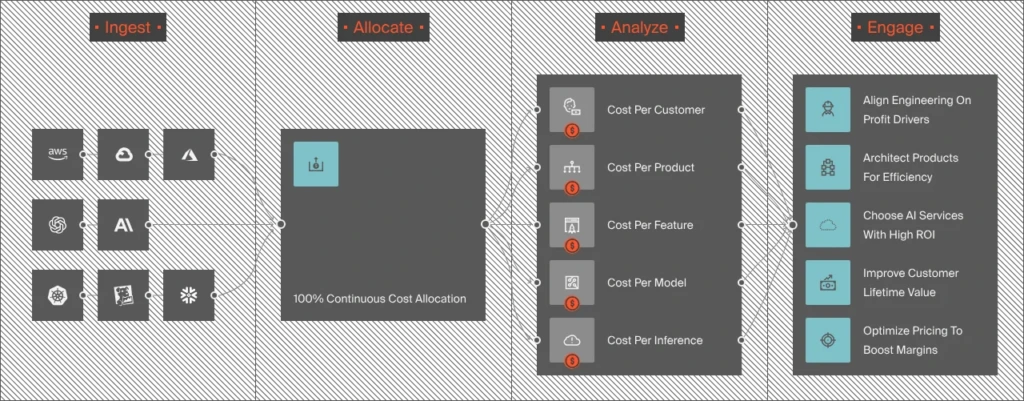
So engineering sees workload detail, product sees feature-level margin, and finance sees cost per customer, all from the same data. It is the same approach we bring to cloud cost optimization and cloud cost management across the rest of your stack, now pointed at AI.
The results show up fast. PicPay used CloudZero to find and cut $18.6M in cloud and AI spend, and a global platform running more than 50 LLMs surfaced over $1M in immediate inference savings. Teams like Toyota, Duolingo, and Grammarly run on the same visibility.
As CloudZero co-founder and CTO Erik Peterson puts it, most companies right now are making “lots of bets, not a lot of clarity.” Optimization is how you keep the bets and add the clarity.
If you want that clarity for your own AI spend, you can  , take a self-guided product tour, or run a free cloud cost assessment to see where you stand today, all from CloudZero, the AI ROI company.
Frequently asked questions
The bottom line
Optimizing LLM costs comes down to a short list: route to the right model, cache what repeats, batch what can wait, trim what you send, right-size what you run, cut what you do not need, and put one cost view in front of all of it. Most of these are configuration changes, not rewrites, and the documented savings are large enough that ignoring them is a budget decision in itself.
But keep asking the one question that ties all of it to AI ROI: not what your LLMs cost per token, but what they cost per AI outcome, and whether that outcome is worth it. That is the question CloudZero, the AI ROI company, exists to answer.
Real LLM cost reduction is not one heroic cut. It is seven small disciplines, applied on purpose. Reverify every provider price against its source before you act on it, because in AI pricing, this month’s number is the only one that counts.