Quick Answer
How much does AI cost? Most businesses spend between $40,000 and $400,000 on their first AI project, with ongoing monthly costs of $3,000 to $80,000 depending on scale. Lightweight API integrations can start below $5,000, while complex enterprise systems exceed $500,000. The biggest variables are data readiness, integration work, and infrastructure choices, not the AI technology itself.
How much does artificial intelligence cost to deploy in a real business environment? It depends entirely on what you’re building and how you’re building it.
Gartner forecasts worldwide AI spending will hit $2.52 trillion in 2026, a 44% increase over the prior year. AI infrastructure alone will add $401 billion in new spending as providers build out AI-optimized data centers and hardware. These are staggering numbers at the macro level, but they don’t answer the question that matters to your organization: what will this cost us, and is AI expensive relative to the value it delivers?
This guide breaks down every layer of AI cost so you can build a realistic budget before committing resources.
What Drives AI Implementation Costs
Several variables determine whether the cost of implementing AI lands at $5,000 or $5 million.
Understanding these before you budget prevents the overruns that sink most AI projects.
1. Model complexity is the first cost multiplier
Connecting a hosted AI service to a customer support workflow requires minimal development. Building a custom model trained on your proprietary data requires months of engineering, data labeling, and iterative testing. Model complexity alone accounts for 30–40% of total project cost.
2. Data readiness is the most underestimated factor
Data preparation consumes 25–35% of total project budget in direct costs but accounts for 50–70% of total project time. If your data is fragmented, poorly labeled, or locked in separate systems, expect significant added cost before any model work begins.
3. Infrastructure requirements scale with your use case
Running a pre-trained model through an API costs pennies per request. Training a custom model on GPU clusters can cost thousands per day. The infrastructure decision (cloud, on-premise, or hybrid) has a multiplier effect on every other cost category.
4. Integration depth determines how much engineering time the project demands beyond the AI itself
Connecting AI to existing CRM, ERP, or data warehouse systems requires custom work for authentication, data mapping, and access controls. For enterprise deployments, integration engineering and quality testing together often account for 40–60% of total build cost.
5. Talent and expertise remain at a premium
Deloitte’s State of AI in the Enterprise 2026 survey of 3,235 senior leaders identified the AI skills gap as the single biggest barrier to enterprise AI integration. Organizations without in-house expertise typically pay $150–$300 per hour for external development.
6. Ongoing operations are where budgets quietly break
Annual maintenance runs 15–25% of the initial build cost, covering monitoring, retraining, and infrastructure management. This is not a one-time capital cost. It is a permanent operating line item.
Report
Finance needs to prove AI’s return: CloudZero report
260 senior finance leaders (more than half CFOs) told us why the speed of seeing AI spend, not the size of it, separates who pulls ahead on AI from who gets burned.
AI Development Cost: Build Versus Buy
The most consequential decision affecting your AI development cost is whether to build custom AI or purchase existing solutions. Here’s how the 2026 landscape looks according to multiple sources:
|
Approach |
Average cost range |
Timeline |
Best for |
|
API integration (hosted AI service) |
$5,000–$50,000 |
2–8 weeks |
Chatbots, content generation, document processing |
|
Low-code/no-code AI platforms |
$10,000–$75,000/year |
2–6 weeks |
Predictive analytics, basic automation |
|
Custom development (mid-complexity) |
$40,000–$250,000 |
3–9 months |
Domain-specific models, proprietary workflows |
|
Enterprise AI system (high complexity) |
$250,000–$1M+ |
6–18 months |
Multi-model architectures, large-scale automation |
|
Frontier model training (from scratch) |
$500,000–$100M+ |
6–24+ months |
Foundation model R&D (research labs only) |
So how much does it cost to build an AI system from scratch? For a mid-complexity custom project, plan for $40,000–$250,000. But for most businesses, building from scratch is the wrong starting point.
McKinsey’s State of AI 2025 report found that 72% of organizations now use generative AI, more than double the 33% reported in 2023. Yet only about 6% qualify as “AI high performers” capturing measurable business value.
MIT’s GenAI Divide study put a finer point on it: despite $30–$40 billion in enterprise AI investment, 95% of pilot programs delivered no measurable impact on profit and loss.
The organizations succeeding tend to be the ones buying commercial AI solutions and focusing investment on integration and data quality. MIT found that companies purchasing from specialized vendors succeed about 67% of the time, while internal builds succeed only one-third as often.
Gartner reinforces this: CIOs in 2026 are cutting back on self-development and proof-of-concept projects, choosing instead to adopt AI features embedded in their existing software. As Gartner Distinguished VP Analyst John-David Lovelock noted in January 2026, AI in 2026 “will most often be sold to enterprises by their incumbent software provider rather than bought as part of a new moonshot project.”
If you’re wondering how much does it cost to build an AI that delivers real returns, the honest answer is: less than you think for the technology, more than you expect for everything around it.
How Much Does AI Software Cost
AI software cost depends on whether you’re paying per use, per seat, or per outcome. The pricing model you choose affects total spend at scale more than the sticker price suggests.
API pricing is the most common model for AI-powered features. Providers charge per “token,” a unit of text roughly four characters long. As of Q1 2026, representative AI pricing across model tiers based on published rates from major providers:
|
Model tier |
Average input cost (per 1M tokens) |
Average output cost (per 1M tokens) |
Use case |
|
Budget/lightweight |
$0.05–$1.00 |
$0.40–$5.00 |
Simple classification, high-volume tasks |
|
Mid-tier (general purpose) |
$1.75–$3.00 |
$10.00–$15.00 |
Content generation, analysis, most production work |
|
Frontier (advanced reasoning) |
$5.00–$30.00 |
$25.00+ |
Complex reasoning, multi-step planning |
Pricing based on published API rates from OpenAI, Anthropic, and Google as of Q1 2026. Rates change frequently; check provider pricing pages for current figures.
These per-use costs look small individually but compound fast. A production AI feature processing thousands of daily requests can generate high monthly API bills, particularly when large volumes of input data are sent with each request.
SaaS AI tools for content, analytics, or workflow automation generally charge per-user monthly fees at business tiers, with enterprise contracts scaling into six figures annually depending on feature depth and support level.
Fine-tuning, which means customizing an existing AI model on your own data, is a middle path. Based on current market pricing, lightweight approaches run $300–$5,000 while full customization of a large model can exceed $50,000. For most use cases, well-designed prompts combined with your own data sources deliver strong results at a fraction of that cost.
AI pricing is also falling rapidly. The 2024–2026 period brought an aggressive price war among providers. Gartner predicts that by 2030, running a trillion-parameter model will cost providers over 90% less than in 2025.
Today’s AI software prices are likely the highest they will ever be for equivalent capability.
What Does AI Infrastructure Cost
AI infrastructure cost is the layer most organizations understand least. What you need depends on whether you’re using a pre-built service, customizing a model, or training one from scratch.
- Cloud GPU pricing has dropped. Major cloud providers cut prices on high-end AI hardware by roughly 40–45% in mid-2025 as next-generation chips expanded supply. On-demand rates for top-tier AI hardware now run approximately $3–$4 per GPU-hour. Longer-term commitments bring effective rates below $2 per GPU-hour.
- On-premise hardware is a major capital investment. Enterprise-grade AI processors (such as the NVIDIA H100) cost approximately $25,000–$35,000 per unit depending on variant and purchasing context, with additional infrastructure costs for power, cooling, and networking. A full AI server system with eight processors, networking, storage, and management software runs in the range of $400,000–$500,000 for current-generation configurations. AI server cost for even a small on-premise cluster with multiple systems can approach $1 million or more before ongoing operational costs.
- Training costs for frontier models remain extreme. The Stanford AI Index Report estimates GPT-4’s compute cost at approximately $78 million. Epoch AI estimates Google’s Gemini Ultra at roughly $191 million. These figures represent the ceiling, not the norm. Customizing an existing model costs a tiny fraction of training from scratch.
- Running AI in production (called inference) is the dominant ongoing infrastructure cost. Every prediction, text generation, or classification the model performs has a per-request compute cost. At enterprise scale, this recurring cost can exceed the original development investment within months. Optimization techniques like compressing models and batching requests can deliver two- to six-times cost reductions according to industry benchmarks, without reducing output quality. For a deeper look, see CloudZero’s guide to inference cost.
The question that matters most isn’t “how much does a GPU cost?” It’s “how much compute does our actual workload consume, and are we paying for capacity we never use?” That gap between purchased and utilized capacity is where most AI cost waste lives.
Hidden costs most AI budgets miss
The costs that sink AI projects are rarely in the original estimate. Five categories consistently surprise organizations.
- Data preparation and labeling is the biggest gap between planned and actual cost. Annotation costs vary enormously based on task complexity: simple image classification runs a few cents per label, while specialized domains like medical imaging or manufacturing inspection can cost three to five times more. For a dataset of 100,000 samples, total labeling costs can range from a few thousand dollars to well into six figures depending on the domain. Beyond labeling, cleaning, restructuring, and validating data consumes engineering time that rarely appears in initial budgets.
- Security, compliance, and governance are growing fast. Gartner projects AI governance spending will reach $492 million globally in 2026 and surpass $1 billion by 2030. Organizations with dedicated governance platforms are 3.4 times more likely to achieve high governance effectiveness, per a Gartner 2025 survey of 360 organizations. This is real cost, but it is also real risk reduction.
- The pilot-to-production gap is where most budgets fracture. Gartner found that high-accuracy requirements alone — moving from 90% to 99% — can multiply implementation effort by three to five times. Add reliability engineering, monitoring, scaling, and support on top of the pilot build, and a $60,000 proof-of-concept can easily become a $250,000 production system.
- Talent costs extend beyond the AI team itself. Deloitte’s 2026 survey found that education, not role redesign, was the primary way companies adjusted their talent strategies for AI. Even when development is outsourced, internal teams need training to evaluate, manage, and maintain AI systems over time.
- Model maintenance is a permanent cost. AI models degrade as the real world changes around them. Customer behavior shifts, product catalogs evolve, market conditions move. Models trained on last quarter’s data make increasingly poor predictions about this quarter’s reality. Ongoing monitoring and retraining are not optional. They are the price of keeping AI useful.
How Much Does AI Cost Per Month To Operate
Ongoing costs, not the initial build, determine if AI delivers positive returns. Here’s what monthly operating costs look like across categories:
|
Cost category |
Average monthly range |
What drives it |
|
API and compute costs |
$500–$50,000+ |
Request volume, model tier, data volume per request |
|
Cloud infrastructure |
$1,000–$25,000+ |
Processing, storage, networking |
|
Monitoring and maintenance |
$500–$5,000 |
Performance tracking, retraining, drift detection |
|
Security and compliance |
$500–$2,000 |
Access controls, audit logging, governance |
|
Total range |
$3,000–$80,000+ |
Scales with usage, number of models, and complexity |
Ranges are estimates based on published API pricing, cloud GPU rates, and industry benchmarks referenced elsewhere in this guide. Actual costs vary widely by use case, provider, and scale.
So how much does AI cost per month for the average organization?
CloudZero’s FinOps in the AI Era report, based on responses from 475 senior leaders, found that 40% of companies already spend at least $10 million annually on AI. That figure is close to the 47% spending $10 million or more on cloud infrastructure after 13 years of general access. AI has reached cloud-level spending in roughly three years.
The same report found that formal cloud cost programs now exist at 72% of organizations, nearly double the 39% from the prior year. Yet cloud efficiency dropped 15% year-over-year across all segments. The primary cause: AI workloads growing faster than organizations can track and control.
This highlights a critical challenge. Most AI spending doesn’t appear as “AI” on anyone’s cloud bill. The processing power, storage, and data transfer behind AI workloads are embedded in general infrastructure costs. Organizations budgeting based only on AI-labeled line items are seeing a fraction of their true cost of AI for business operations.
How To Estimate Your AI Costs
Wondering how much does AI cost to make for your specific situation? Start with the business outcome, not the technology.
- Define the use case and success metric. “Reduce support ticket resolution time by 40%” is a budgetable goal. “Implement AI” is not. Narrow scope is the single most reliable way to control cost.
- Assess data readiness. Clean, labeled, accessible data? Budget 10–15% of total project cost for data work. Fragmented, inconsistent, siloed data? Budget 25–40%. Data readiness is the most accurate predictor of whether AI projects finish on time.
- Choose your approach. Match the cost ranges in the development section above to your specific need. For most organizations, starting with API integration or a SaaS tool and graduating to custom work only when those solutions hit a clear ceiling is the lowest-risk path.
- Budget for operations from day one. Plan for 15–25% of initial build cost as annual operating cost. AI systems that aren’t monitored and maintained degrade over time. This is a running cost, not a line item you retire.
- Build cost visibility into your architecture. This is where the fundamental question gets answered: how much is AI worth to your business? If you can’t attribute AI costs to the teams, products, or customers driving them, you can’t calculate unit economics. You can’t tell whether your AI investment is generating $5 of value per dollar spent or $0.50.
That last point, cloud cost visibility, is where most organizations hit a wall. And it’s the exact problem CloudZero was built to solve.
How CloudZero Turns AI Cost Confusion Into Clarity
The challenge isn’t just understanding the cost of AI in the abstract. It’s knowing what AI costs your organization, in real time, attributed to the business dimensions that actually matter.
CloudZero’s FinOps in the AI Era report found that 49% of organizations aren’t confident they can calculate AI ROI. The reason: AI spending is scattered across cloud providers, GPU services, API vendors, and SaaS tools, with no two billing formats alike. The State of AI Costs report digs deeper into the data behind this visibility gap.
CloudZero solves this by pulling all AI and cloud spending into a single platform with full attribution and real-time alerting.
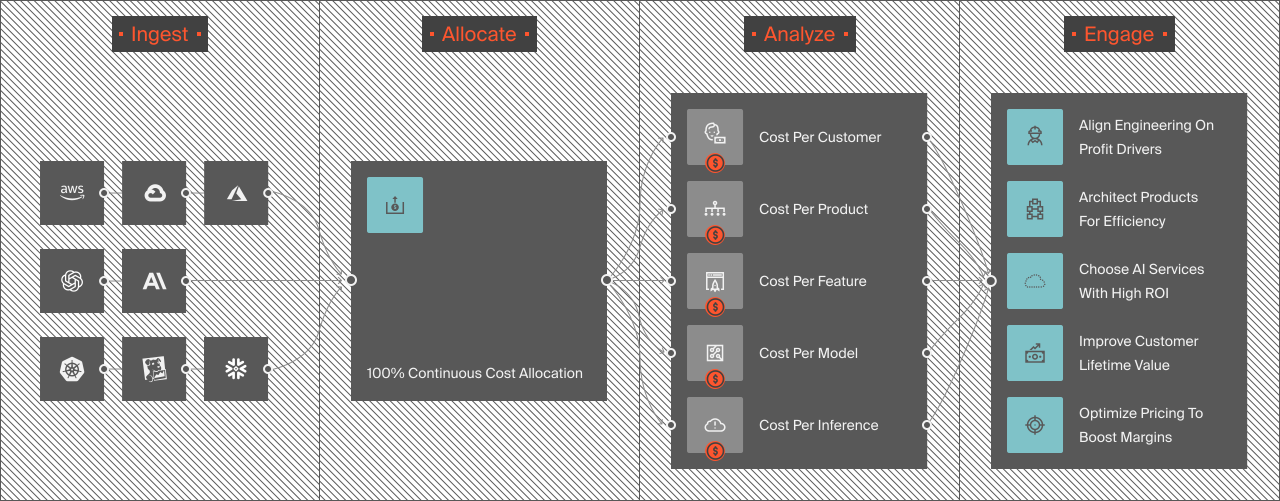
With CloudZero, you can:
- See exactly where AI money goes. CloudZero’s allocation engine attributes 100% of AI spending to the correct teams, products, features, and customers, even for shared or untagged resources. This eliminates the “black box” where AI costs hide inside general cloud bills.
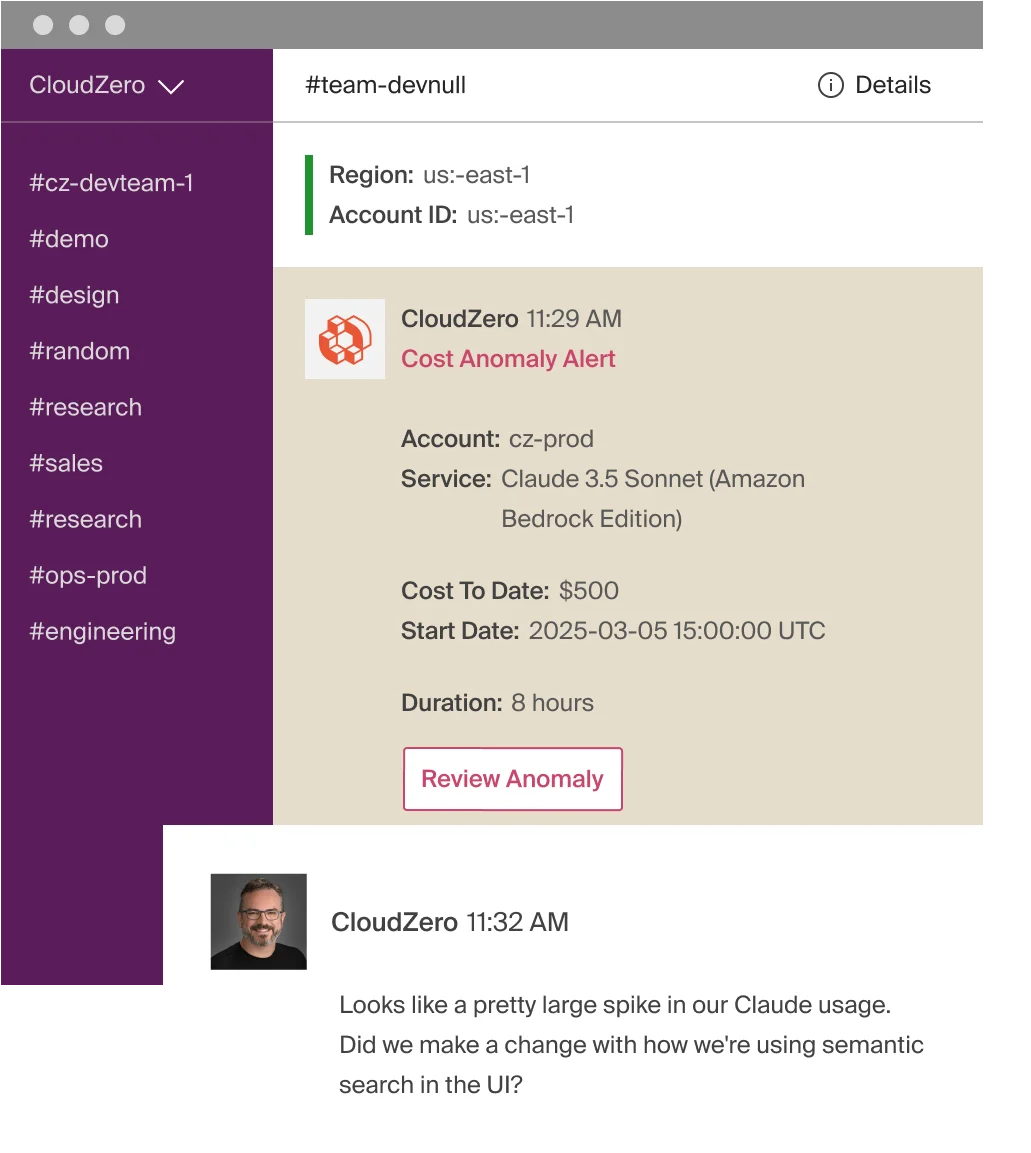
- Catch problems before they become budget crises. When AI spending spikes from a runaway job, unexpected API usage, or misconfigured scaling, CloudZero alerts the responsible team with hour-level detail. One CloudZero customer running more than 50 AI models saved over $1 million by optimizing how requests are processed and caching repeated inputs.
- Understand cost per outcome. CloudZero connects spending data to custom unit cost metrics: cost per AI-generated response, cost per customer, cost per feature. How does AI reduce costs in practice? By making the relationship between spending and outcomes measurable. Over 90% of CloudZero customers already track AI spend on the platform, and those using dedicated cost platforms report higher confidence in calculating AI ROI.
CloudZero also manages more than $15 billion in cloud and AI spending for organizations including Toyota, Duolingo, Grammarly, DraftKings, Moody’s, and more.  to see CloudZero in action.
Frequently Asked Questions About AI Cost