If you spend even fifteen minutes reading about AI’s impact on the future of work, you’ll take in a lot of fear-based analysis. The fears are real — 40% of workers fear losing their jobs (Metaintro), 60% believe AI will eliminate more jobs than it creates (Yardi Kube), and 52% generally worry about the impact of AI in the workplace (Pew Research) — but the analysis is all wrong.
It’s not that AI won’t revolutionize how we work (it already has) or how we structure our organizations (it already has). As with all technological revolutions, several of which my colleague Brady Lenahan has recounted in a series of fascinating historical blog posts, AI has and will continue to disrupt workplace status quos. But concluding that it will break talent pipelines, cause mass unemployment, or wreak some other talent apocalypse is a bridge too far, too soon. If implemented unthoughtfully, AI can and will have negative effects. But conscientious people leaders have a golden opportunity to use AI to do just the opposite: improve upon existing norms while keeping human beings, and their wellbeing, at the center.
I’ll be exploring this topic in blog form for the foreseeable future. In this first installment, I look at the topic of org structures: how the pyramid, the de facto structure ever since Henry Ford used it as the blueprint for his automotive empire, is giving way to the pentagon — and how to prevent it from giving way to the less sturdy diamond.
What is a pentagon-shaped organization?
Much of the commentary around AI’s knowledge work impact focuses on entry-level talent. Entry-level jobs are often heavy on repetitive, rote tasks like data entry, email drafting, proofreading, code debugging, CRM populating, etc. As AI is especially good at automating process-oriented work, analysts worry that AI will destroy that lowest layer of the pyramid, rendering organizations diamond-shaped: balanced precariously on a razor-thin tip of entry-level talent.
But that’s a dire prediction that won’t necessarily come true. AI can both render the pyramid obsolete and leave organizations even stronger. The goal is not to obliterate that lowest layer, but to trim its edges.
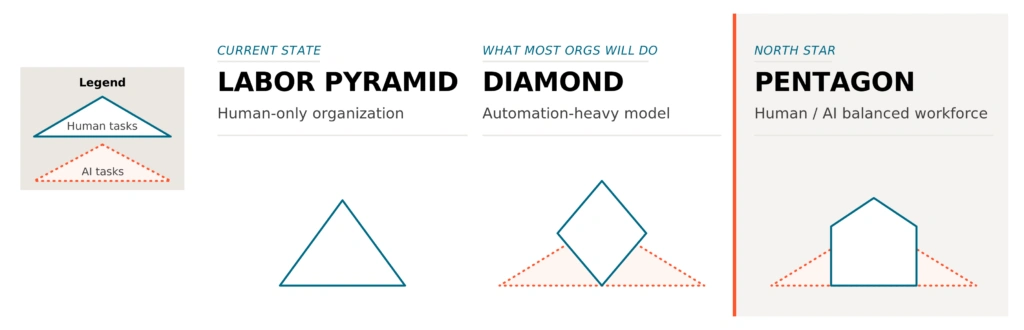
The pentagon shape offers a best of both worlds: It preserves a sturdy base of entry-level talent and it delivers efficiencies that will define organizational competitiveness in the AI era. Today’s entry-level workers are tomorrow’s leaders; “If we don’t protect and modernize the EIC pipeline,” wrote Jacqui Canney, ServiceNow’s chief people and AI enablement officer, in Fast Company, “we risk widening the skill gaps and stalling the impact and ROI of AI solutions.”
Report
Finance needs to prove AI’s return: CloudZero report
260 senior finance leaders (more than half CFOs) told us why the speed of seeing AI spend, not the size of it, separates who pulls ahead on AI from who gets burned.
How do you smooth the transition to a pentagon structure?
As people leaders embark on this transition, it’s critical to focus on high-ROI activities. Simply provisioning tools and letting your people loose on them won’t work. Here are a few tips for leaders hoping for a successful transition:
1. Build AI-assisted mentorship pipelines
Since the pentagon model depends on a thinner entry-level layer still developing into strong mid-career talent, use AI to scale the mentoring you can’t scale with headcount. Platforms can identify AI power users through skills assessments, usage patterns, or manager nominations and systematically pair them with employees who’d benefit most from their expertise — turning a handful of strong performers into force-multiplying mentors rather than requiring an army of external trainers or consultants.
2. Invest in reskilling assessments, not generic training
Broad AI training budgets often go to waste. Instead, invest in tools that identify the shortest learning bridge between roles. Two employees with identical starting knowledge can have drastically different learning potential, and predicting who will reskill fastest is now a genuinely valuable organizational capability. Pair that with training built on your own data: curricula built around your organization’s actual data and use cases that teach employees to apply concepts immediately, rather than the generic-dataset training that produces generic skills.
3. Fund AI governance and judgment training, not just tool literacy
As AI absorbs more task-level work, governance tasks like bias detection, data privacy, and ethical deployment will be a fertile area for upskilling investment. Because they’re judgment- and intuition-heavy, they’re the kinds of tasks humans will own for the foreseeable future, and exactly the kind of work a pentagon’s fortified middle layer is supposed to own.
4. Treat and budget reskilling as retention infrastructure
Reskilling is no longer a cost center, it’s a competitive advantage: Organizations investing in workforce development see stronger retention, productivity, and innovation. Think of AI training not as a defensive cost but a strategic lever, a useful framing when getting buy-in from the C-suite who’ll fund training and the employees who’ll receive it.
5. Foster a culture of collaborative, fluid experimentation
No one gets everything right the first time, especially when organizational norms are changing in real time. Navigating AI-related transitions will involve a lot of experimentation, a fluid understanding of roles, and a willingness among employees to share knowledge and grow together. It’s critical that, alongside whatever tooling and training people leaders adopt, that they prioritize fostering a culture where all people feel empowered to experiment collaboratively and forge new norms together — without judgement.
Take an outcome-oriented approach to change
Changing the underlying shape of an org structure is no mean feat. It requires both art and science, and simply buying tools and hoping for the best won’t work. In fact, tooling without training is a primary reason why just 1 in 50 AI investments produce meaningful ROI.
Transitioning to a pentagon structure isn’t as simple as cutting roles and hoping for the best. It requires a staunchly outcome-oriented mindset:
- What bets are we making? Where are we making changes, what will those changes cost us (i.e., how much are we spending on AI)?
- What do we expect to see in return? What metrics can we use to evaluate our investments, and what level of ROI would constitute success?
- Where should we double down, and where should we fold? As ROI does or doesn’t match up to our expectations, when and how do we ramp our investments up or down?
- Through it all, how do we foster and amplify the right behaviors? Transitioning into a new mode of work doesn’t just mean changing the underlying scaffolding. Some things never change: People need to feel understood and supported during transitional periods more than ever. People-centric leaders who know how to navigate and engage with both machine and human psychology will win the day.
At the end of the day, all of this is a capital allocation challenge. How much capital do we have at our disposal? What should we invest in to bring about our ideal change? How do we measure those investments so that we’re always on top of — and in control of — the most and least successful?
This is where CloudZero comes into play. CloudZero is the AI ROI company. We built the financial control plane for AI: the system finance, IT, and engineering use to connect every AI dollar to the outcome it produced, across every provider, in real time. CloudZero is the only platform that ingests 100% of companies’ AI spend (alongside all their cloud, PaaS, and SaaS spend); allocates it to the agent, workflow, feature, team, and customer that drove it; and connects it to business-level outcomes, showing people leaders the business impact of every dollar they spend on AI.