Quick Answer
Perplexity vs. ChatGPT comes down to the job, not the hype. Perplexity is a cited, real-time answer engine built for research you can actually verify. ChatGPT is a general-purpose reasoning, writing, and coding machine that now behaves like an agent. Both start at $20 a month. For a finance leader, the sharper question is not which is better, it is which one earns its seat, and whether you can prove the AI spend is producing a return.
Somewhere in your company right now, three people are paying $20 a month for ChatGPT, two are paying $20 a month for Perplexity, one ambitious soul is expensing both, and nobody in finance signed off on any of it. That is AI spend in 2026: the tools are cheap, the receipts are invisible, and the bill runs ahead of the pilot.
That is exactly why the Perplexity vs. ChatGPT question matters to a CFO and not just a curious engineer. These two tools are quietly becoming standard line items across sales, research, marketing, and finance itself. Before you approve another wave of seats, or an enterprise contract with a comma in it, you deserve a straight answer on what each one does, what it costs, and, using real companies that already bet big, what happens when the spend is not tied to an outcome.
Let’s settle it, with actual numbers and two cautionary tales that will make any budget owner wince.
What is the difference between Perplexity and ChatGPT?
The core Perplexity vs. ChatGPT differences come down to purpose, and however you phrase the question, the answer is the same.
Perplexity is an answer engine: it searches the live web, synthesizes a response, and shows inline citations for every claim.
ChatGPT is a general assistant: it reasons, writes, codes, generates images and video, and runs agentic tasks, drawing mostly on its trained knowledge plus optional browsing.
If you still wonder how is Perplexity different than ChatGPT in one sentence, here it is: Perplexity is built to show you where the answer came from, and ChatGPT is built to do the widest range of things with the answer once it has it.
That difference is not academic. It changes who on your team should use which tool, and it changes the risk profile. An analyst citing a number in a board deck needs Perplexity’s receipts. A marketer drafting fifty ad variants needs ChatGPT’s range. Pay for the wrong one at scale and you are funding a very expensive mismatch.
Perplexity leans on a clever trick: it does not build its own frontier models. It routes each query to whichever model fits best, including OpenAI’s GPT, Anthropic’s Claude, Google’s Gemini, and NVIDIA’s Nemotron.
ChatGPT runs OpenAI’s own models only. So when you use Perplexity, you are sometimes using ChatGPT’s engine anyway, wrapped in a search and citation layer.
Report
Finance needs to prove AI’s return: CloudZero report
260 senior finance leaders (more than half CFOs) told us why the speed of seeing AI spend, not the size of it, separates who pulls ahead on AI from who gets burned.
Perplexity vs. ChatGPT: the side-by-side comparison
Here is the Perplexity AI vs. ChatGPT breakdown finance and procurement teams actually ask for. This Perplexity vs. ChatGPT comparison table is the fastest way to see where each tool wins before anyone argues about it in Slack.
| Capability | Perplexity | ChatGPT |
| Core job | Cited, real-time answer engine for research | General reasoning, writing, coding, and agents |
| Citations | Inline sources on every answer | Not native, lighter attribution when browsing |
| Real-time web | Yes, central to the product | Yes, via browsing |
| Underlying models | Model agnostic: routes to GPT, Claude, Gemini, Nemotron | OpenAI models only (GPT-5 series) |
| Writing and coding | Serviceable, not the strength | Strong, with the Codex agent for developers |
| Images and video | Via integrations, more on Max | Native (Sora video, image generation, voice) |
| Agentic tools | Comet browser, Perplexity Computer | Agent mode, custom GPTs, 60+ connectors |
| Ads | None, on any tier | Ads on Free and Go tiers since February 2026 |
| Best for | Research, competitive intel, market and financial analysis | Content, code, automation, multimodal work |
The honest read on this ChatGPT vs. Perplexity AI comparison: they overlap in the middle, where both can answer a quick question competently, and they separate at the edges.
Perplexity owns “trust but verify.” ChatGPT owns “do a hundred different things.” Most teams end up wanting a little of both, which is precisely how the AI spend creeps up on you.
One newer front in this fight is the browser itself. Perplexity’s Comet and ChatGPT’s Atlas both turn your browser into an AI agent that can click, read, and act on your behalf, so the ChatGPT atlas vs. Perplexity comet matchup is fast becoming its own question.
The same split holds: Comet leans on cited research, Atlas leans on OpenAI’s broader agentic and multimodal muscle. For finance, it is one more agent with access to your systems, and one more thing to put on the AI spend map before it sprawls.
How much do Perplexity and ChatGPT cost?
At the entry tier, this is a dead heat, and that surprises people. Perplexity Pro and ChatGPT Plus both cost $20 a month, so price is not the tiebreaker at the individual level.
The real money question shows up at the team and enterprise tiers, where the two diverge sharply. All figures below were verified against each vendor’s pricing, and AI pricing changes constantly, so reconfirm before you sign anything.
| Tier | Perplexity | ChatGPT (OpenAI) |
| Free | $0, ad-free, around 5 Pro searches per day | $0, now with ads |
| Entry paid | Pro, $20/mo ($200/yr) | Plus, $20/mo (Go tier is $8/mo) |
| Power user | Max, $200/mo ($2,000/yr) | Pro, $100/mo or $200/mo |
| Team | Enterprise Pro, $40/seat/mo | Business, $20/seat/mo annual ($25 monthly) |
| Top enterprise | Enterprise Max, $325/seat/mo | Enterprise, custom |
| Student | Education Pro, $10/mo | Nonprofit and education discounts |
Two numbers deserve a finance leader’s attention.
First, ChatGPT Business at roughly $20 to $25 a seat undercuts Perplexity Enterprise Pro at $40 a seat, so if you standardize on Perplexity for a big team, you are paying a premium for cited research.
Second, Perplexity Enterprise Max at $325 a seat is more than 8 times its own Enterprise Pro tier, a gap so wide it is basically an invitation to negotiate.
Here is the part the pricing pages will not tell you: the sticker price is the smallest number in this whole equation. A hundred seats at $40 is $48,000 a year, which is real but manageable. The uncontrolled version, where seats multiply across departments, power users quietly upgrade to Max, and nobody maps the spend to a result, is how a tidy line item becomes a budget line you have to explain.
That is a visibility problem, and visibility problems become margin problems. It is the reason we built CloudZero around AI ROI rather than raw spend: for a finance team, the number that matters is not what a seat costs, it is whether that seat is producing a return you can point to.
Perplexity Pro vs. ChatGPT Plus: which $20 plan actually wins?
The Perplexity pro vs. ChatGPT plus matchup is the one most individuals and small teams actually face, because both premium tiers cost the same $20 a month. The price cancels out, so the decision comes down to what you do all day.
Pick Perplexity Pro if your work is research. You get unlimited Pro searches, 20 daily deep research reports, per-query model switching across GPT, Claude, and Gemini, and inline citations on every answer. Pick ChatGPT Plus if your work is creation. You get deeper reasoning, the Codex coding agent, Sora video, image generation, voice, and custom GPTs.
Here is the honest tiebreaker for a finance team. If your analysts live in sourced research, the Perplexity seat pays for itself in citations you can actually defend in a board deck. If your people mostly write, build, or code, ChatGPT Plus already covers them, and a second $20 subscription is spend without a return. Most organizations land on ChatGPT Plus as the default and Perplexity Pro for the research-heavy roles, which is a portfolio decision, not a coin flip.
The day and the night: what happened when real companies bet big on these two
Enough theory. The most useful way to understand the Perplexity vs. ChatGPT decision is to watch what happened to companies that already made huge bets on this technology, in public, with their names attached. Two of these stories are triumphs. One is the most famous AI walkback in business. All three teach the same finance lesson.
1. Morgan Stanley bet on ChatGPT’s engine, and did it right
Morgan Stanley is the textbook case of an AI rollout that worked, and it worked because the firm treated it like an investment, not a gadget. Partnering with OpenAI as its only wealth-management strategic partner starting in spring 2023, the firm built the AI @ Morgan Stanley Assistant on GPT-4 and put it in front of its financial advisors that September.
The results are the kind finance leaders dream about. Over 98% of advisor teams actively use the assistant, a figure the firm first reported in 2024 and reaffirmed in late 2025. Advisors’ practical access to the firm’s research library jumped from 20% to 80%, turning 30-minute document hunts across roughly 350,000 documents into seconds. As Jeff McMillan, Morgan Stanley’s head of firmwide AI, put it, the technology “makes you as smart as the smartest person in the organization.”
Crucially, the firm tied it to money. Analysts have connected the wealth-management AI push to a record $64 billion in net new assets in a single quarter, and the firm built a rigorous evaluation framework plus human oversight before scaling. That is the whole point: they could prove the return. They did not deploy AI and hope. They measured it, governed it, and expanded only once the numbers held.
2. Klarna bet on the same engine, and had to walk it back
Now the cautionary tale, and it is a doozy. In February 2024, the Swedish fintech Klarna announced that its OpenAI-powered assistant had, in its first month, handled 2.3 million conversations, done the work of 700 full-time agents, cut resolution time from 11 minutes to under 2, and was on track to add $40 million in profit that year. CEO Sebastian Siemiatkowski declared that “AI can already do all the jobs we humans do.” The tech press was euphoric. Klarna’s headcount fell from about 5,500 to 3,400.
Then came the night. In May 2025, Siemiatkowski told Bloomberg the company had gone too far. His words became an industry inflection point: “We focused too much on cost. The result was lower quality,” a reversal widely covered at the time. Klarna started rehiring humans for the complex, emotional, high-stakes conversations the bot fumbled, moving to a hybrid model where AI handles the routine volume and people handle the value cases.
Here is the nuance that makes this a finance story and not just a headline. The AI never actually failed, and it is still running, doing the work of 853 agents and around $60 million in savings by late 2025. What broke was the story. Klarna optimized for the lowest possible bill and watched the average satisfaction score while the distribution quietly rotted on the hard cases.
The lesson is not “AI is bad.” It is that cost savings without a quality and outcome measure is a mirage, and the correction always arrives after the board has already celebrated.
3. Perplexity’s own rocket ride hit a legal wall
The Perplexity side has its own day and night, except this time the company is the protagonist.
The day was spectacular. Founded in 2022 by a former OpenAI researcher, backed by Jeff Bezos, NVIDIA, and SoftBank, Perplexity rocketed from a $3 billion valuation in mid-2024 to reportedly around $18 to $20 billion, processing 169 million queries a month and signing more than 7,000 Enterprise Pro customers including NVIDIA, Databricks, and Stripe.
The night was the bill for how it grew. Forbes accused Perplexity of plagiarism in 2024, a Wired investigation was brutal, and lawsuits piled up from News Corp, the New York Times, the Chicago Tribune, Encyclopedia Britannica, and Merriam-Webster, the last of which alleged Perplexity had copied the definition of the word “plagiarize” itself.
A Copyleaks analysis found a single Perplexity summary paraphrased 48% of a Forbes article. And because Perplexity does not own the models it runs on, some analysts argue it has little leverage to settle, unlike OpenAI or Google. As CEO Aravind Srinivas frames the bigger ambition, “an AI operating system takes objectives,” but for a finance buyer, the trust and legal questions sit right next to the certifications in any due diligence.
The finance lesson hiding in all three
Three companies, three very different tools and outcomes, one identical takeaway: the tool was never the deciding factor. Morgan Stanley won because it measured the return. Klarna stumbled because it chased cost without watching quality. Perplexity is thriving and getting sued at the same time because it scaled faster than its foundations.
In every case, the winners and losers were separated by whether they could see and prove the value of what they were spending.
This is not a rare blind spot. CloudZero’s 2026 AI ROI survey of finance leaders found that 42% approved AI spending without reliable cost projections. Which is a polite, survey-worded way of saying nearly half of finance teams did their own smaller version of the Klarna bet, funding AI on vibes and hoping the numbers would show up later. Some do. Many do not.
Is Perplexity better than ChatGPT?
For research with sources you can trust, yes, Perplexity is usually better. Its citations, real-time web access, and per-query model switching make it the stronger pick for analysts, researchers, and anyone whose work has to be verifiable. For everything else, writing, coding, agentic automation, image and video generation, ChatGPT is better because it does more.
So the true answer to is Perplexity better than ChatGPT is: better at what, and for whom. This is why the comparison never ends in a clean knockout. It is a specialist versus a generalist, and most organizations quietly need both, which brings us right back to the spend.
Perplexity vs. ChatGPT: Which is better for research, writing, and coding?
Match the tool to the task and the choice gets obvious. When you line up the Perplexity ai features compared to ChatGPT, the split is consistent.
For research, competitive intelligence, market analysis, and anything a finance team needs sourced, Perplexity wins on citations and live data, and its finance data tools now pull from more than 40 sources including SEC filings.
For writing, coding, and building automations, ChatGPT wins on reasoning depth, the Codex developer agent, and native multimodal tools like Sora.
The trap is assuming one tool must win the whole company. It rarely should. A research-heavy team can justify Perplexity seats while the wider org runs on ChatGPT, and a developer team may never touch Perplexity at all. The right answer is a portfolio, deliberately chosen, not a religious war settled by whoever complained loudest.
Perplexity vs. ChatGPT: which should your finance team actually pay for?
Stop asking which tool is better and start asking which one earns its seat for each job:
| If your team mainly | Pick | Why it earns the spend |
| Does research, market and financial analysis with sources | Perplexity Pro or Enterprise | Cited, real-time, model choice, finance data connectors |
| Writes, codes, builds agents, makes media | ChatGPT Plus, Business, or Enterprise | Reasoning, Codex, Sora, custom GPTs, connectors |
| Needs both but wants one primary bill | ChatGPT Business, plus a few Perplexity Pro seats for researchers | Standardize the org, specialize the researchers |
| Operates under strict privacy or compliance | Either vendor’s enterprise tier with zero data retention | Both offer it, verify the certifications yourself |
Notice what this framing does. It turns an emotional tool debate into a spend decision with a rationale attached to every seat. That is the difference between a finance team that controls its AI spend and one that finds out about it after the money is gone.
Perplexity vs. ChatGPT vs. Claude vs. Gemini: which fits which job?
Plenty of teams are not choosing between two tools, they are choosing among four, so the Perplexity vs. ChatGPT vs. claude and Perplexity vs. ChatGPT vs. gemini question deserves a straight answer. The short version is that each one has a lane, and the expensive mistake is buying all four for everyone.
| Tool | Best at | Watch for |
| Perplexity | Cited, real-time research and competitive intel | Not a writing or coding workhorse |
| ChatGPT | General reasoning, writing, coding, agents, and media | Citations lighter than Perplexity |
| Claude | Careful analysis, long documents, and coding | No real-time web search by default |
| Gemini | Google Workspace integration, long context, multimodal | Best value only if you already live in Google |
For a finance leader the takeaway is not which single tool wins, it is that your company is probably paying for two or three of these at once, across different teams, on different cards. The models are easy to buy and hard to govern, which is exactly the gap where the spend outruns the results.
The real question is not Perplexity vs. ChatGPT, it is whether the spend pays off
Here is the uncomfortable truth underneath this entire comparison: whichever tool you pick, you have just added another meter to a bill that already has a dozen meters running.
ChatGPT here, Perplexity there, Claude for the developers, Gemini bundled into Workspace, plus the API calls quietly humming underneath all of it. Every one of those is AI spend, and almost none of it is mapped to an outcome by default.
This is where CloudZero comes in, and it is why we call ourselves the AI ROI company rather than another dashboard. CloudZero connects AI spend to business value, breaking it down by model, feature, team, product, and customer, so you can answer the question Klarna could not: is this specific spend producing a specific return. It works across the major AI and cloud providers, no tagging required, which matters when your Perplexity seats, your OpenAI usage, and your cloud bill all live in different corners of the company.
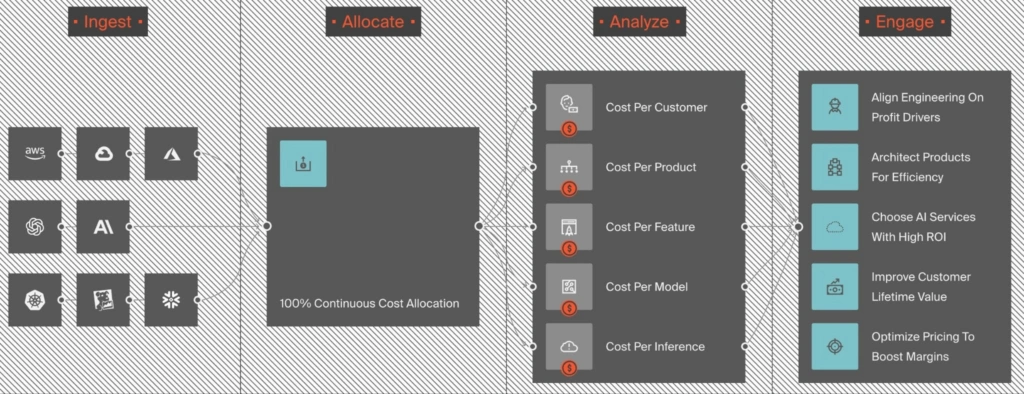
The mechanics are the point. Instead of a monthly invoice that says “AI: a lot,” you see cost per feature, cost per customer, and cost per outcome, the same way Morgan Stanley tied its rollout to net new assets.
Ready to see what your AI actually costs, and whether it is paying off? Schedule a demo to see how CloudZero connects AI spend to business value, or get a free cloud cost assessment to see where your AI and cloud spend stands today.
Frequently asked questions about Perplexity vs. ChatGPT