AI agents are undoubtedly exciting. What company would turn down the opportunity to use an intelligent bot that can make decisions, perform complex tasks, and take on the tedious work employees would normally have to deal with? On paper, AI agents sound like tremendous time and money-savers.
The reality, however, is a bit different from the fantasy.
If you’ve built and sold your first AI agents and were subsequently shocked to receive an astronomically high cloud bill, you know exactly what I’m talking about. It’s all too common to invest in a promising new AI agent that’s sure to bring in tons of revenue for your business, only to see that profit drained on the other end when your cloud bill comes back higher than expected.
Whether you’ve found yourself in this situation — or if you’re just beginning to explore the idea of developing and selling agents — this article is for you.
Keep reading to learn the details about AI agents and how you can adopt this exciting new tech without blasting past your budget limit.
But first, let’s talk more about what makes them so surprisingly expensive.
What Makes AI Agents So Expensive
To understand the costs behind AI agents, you first must understand how agents work compared to other AI programs you may be used to.
AI agents are programs that can perform actions using their own decision-making skills, which they typically derive from machine learning (ML) and large language models (LLMs).
These days, AI agents are typically used as:
- Customer support assistants and chatbots (think ChatGPT)
- AI copilots (coding assistants like GitHub Copilot)
- Automation tools (such as scheduling assistants and data analysis bots)
- E-commerce assistants (for example, personalized shoppers)
The key is that AI agents can interact with users or with other systems to accomplish more complex tasks than your average menu-based chatbot or tool. This capability is worlds different from the typical AI-based program that follows a pre-defined set of rules coded by developers.
Agents, to a certain extent, think for themselves about what actions to perform next.
This versatility is both a blessing and a curse.
While AI agents can adapt based on user inputs and learn to make better decisions over time, they also don’t follow many (if any) hard-coded rules. They’re dynamic and constantly evolving, not to mention relatively autonomous. This makes pricing them challenging.
Costs change as usage scales, and your agent may decide to perform actions you can’t necessarily predict ahead of time.
Why Agent Autonomy Changes the Pricing Equation
Traditional SaaS pricing works because usage is predictable: a user logs in, clicks around, and leaves. AI agents break this pattern because their autonomy introduces cost variance that’s difficult to model.
A single customer request might trigger an agent to chain together five API calls, query a database, and generate a multi-page report — or it might resolve in a single step. That variance means your cost-to-serve can swing dramatically from one interaction to the next, even for the same customer.
This is why conventional per-seat pricing often falls short for agentic AI pricing. The cost isn’t tied to how many people use the agent — it’s tied to what the agent does, and that changes every time.
AI agents can dramatically increase cloud costs if you’re not careful
To start, all models (especially LLMs) require heavy GPU compute power.
Every AI request also involves processing, memory, and storage, even for simple queries.
Finally, training and fine-tuning the AI model requires massive datasets and numerous compute hours, both of which eat into your budget.
This table can help you anticipate the costs you’ll incur:
|
Cloud Expense Category |
How AI Agents Affect Costs |
|---|---|
|
Compute (GPUs/TPUs) |
AI workloads demand expensive hardware |
|
Storage |
AI models store large datasets for training |
|
Data Transfer |
If AI interacts across regions, it can cause high egress fees |
|
Inference Costs | AI models charge per request or per token, with costs varying widely by model — from fractions of a cent for lightweight models to over $1 for complex multi-step queries |
Report
Finance needs to prove AI’s return: CloudZero report
260 senior finance leaders (more than half CFOs) told us why the speed of seeing AI spend, not the size of it, separates who pulls ahead on AI from who gets burned.
AI Agent Pricing Models: Choosing What’s Best For You
Since AI agents can stack up a number of different costs, there’s no one best way to charge for the resources they use.
Most SaaS companies use one of the following five pricing structures, each with its benefits and drawbacks:
1. Pay Per Use (Also called Consumption-Based Pricing)
With this model, pricing depends on how much the agent is used. Costs are typically incurred per API call, per token (common in LLMs), or per minute of usage. For example, OpenAI charges users for every 1,000,000 tokens processed.
What to watch out for: This model can be great for businesses with fluctuating demand, but be cautious that your costs don’t skyrocket during times of heavy usage.
2. Subscription Pricing
With this model, you’ll charge your users flat monthly or yearly fees — much like Netflix or a gym membership. You can provide unlimited usage or cap usage, depending on your preferences.
What to watch out for: Subscription pricing can be great if you want steady, predictable income and you don’t want to have to worry about that income changing with your customers’ usage. But — also just like Netflix and a gym membership — you’ll need to watch out for power users who churn through resources and still get to pay the same flat fee as everyone else.
3. Outcome-Based Pricing
If your main concern is ROI, consider an outcome-based model. Here, costs are tied to specific, measurable business results — not just activity. The difference matters: you’re not charging per task completed, but per result delivered.
For example, Zendesk charges only when a support ticket is fully resolved by its AI agent. Vantage charges 5% of actual savings delivered on AWS storage costs. In both cases, the customer pays for value received, not effort expended.
What to watch out for: Defining what counts as a “successful outcome” requires careful upfront work. You’ll need clear attribution rules, agreed-upon baselines, and audit trails so both sides can verify results. Without that clarity, disputes are inevitable.
4. Value-Based Pricing
With value-based pricing, you anchor your price to the perceived business value your agent creates — time saved, errors avoided, revenue generated — rather than to your costs or usage volume.
This approach works well when your agent delivers measurable ROI that far exceeds your cost to serve. For instance, if your AI agent saves a customer 200 hours of analyst work per month, pricing at a fraction of that labor cost is both profitable for you and easy for the customer to justify.
What to watch out for: Value-based pricing requires strong evidence of ROI. You’ll need benchmark studies, variance analyses, or pipeline influence reports to back up your claims. Without data, “value” becomes a negotiation, not a pricing strategy.
5. Hybrid Pricing
Hybrid models are a mix of any two or more of the above.
What to watch out for: Hybrid models can be good when you need flexibility, but they can also make it harder to accurately forecast your income and expenses.
|
Pricing Model |
Cost Predictability |
Scalability |
Best For |
Key Risk |
|---|---|---|---|---|
Usage-based |
Low |
High |
Variable workloads |
Unpredictable expenses |
|
Subscription-based |
High |
Moderate |
Stable usage |
Paying for unused capacity |
Outcome-based |
Medium |
Varies |
ROI-focused businesses | Hard to define and track outcomes |
| Value-based | Medium | High | High-ROI agents | Requires strong evidence of value |
|
Hybrid |
Varies |
High |
Mixed needs |
Complexity in tracking |
Here’s how to choose the best AI agent pricing model for your needs
First and foremost, understand your unit costs.
No matter which pricing model you choose, one thing is non-negotiable:
You need to know your AI and cloud infrastructure costs down to the penny.
Every API call, inference, and database query adds up quickly. You need to know:
- How much each API call costs
- How much inference costs per model
- How storage and data transfer fees impact margins
Clear visibility into your compute, storage, and API costs is the only thing that will prevent you from underpricing your AI agent and losing money, overpricing it and driving customers away, or failing to scale profitably.
Without this knowledge, any pricing strategy you come up with will just be guesswork.
Use this decision matrix to help you choose the best pricing model.
Pick your top priority and go from there:
|
Priority Business Consideration |
Recommended Pricing Model |
Rationale |
|---|---|---|
|
Variable usage | Usage-based |
Aligns costs with demand |
|
Predictable costs needed |
Subscription-based | Fixed costs make budgeting easier |
|
Outcome-oriented projects | Outcome-based | Costs tied directly to results |
| High demonstrable ROI | Value-based | Anchors price to customer value, not your costs |
|
Diverse needs |
Hybrid |
Flexibility across different use cases |
If you’re stuck between two choices or unsure what your top priority is, start with a pay-per-use or hybrid model. Track your unit costs closely over the next few months, and use that information to help you commit to the fixed pricing structure that will save you the most money.
Not happy with the pricing model you’ve chosen? Here’s how to adjust course
If any one or two of the below categories are causing your bill to skyrocket, you might want to consider switching to a different pricing model that will allow you to offset some of these frequently underestimated costs.
Cloud Compute Costs
AI workloads run on GPUs, and GPUs are expensive.
For example, inference costs vary significantly depending on the model you use — lightweight models can cost fractions of a cent per query, while frontier models can run significantly higher, especially for long or multi-step interactions. Even if you’re using a third-party API, those compute costs are baked into what you pay. (For a detailed breakdown of current model pricing, see our OpenAI API cost guide.)
If your usage-based model isn’t covering AI compute costs, you may need to pass those costs through to your customers more directly or introduce usage tiers to avoid eroding your margins.
Data Transfer/Egress Fees
If your AI agent sends a lot of data to users or between cloud regions, you might get hit with data egress fees. As an example, AWS charges up to $0.09 per gigabyte of outbound data transfer.
If egress fees are stacking up on your bill, you might want to look into switching to a provider that charges less for data transfers. For example, Cloudflare R2 removes egress fees for data retrieval, offering a more cost-effective alternative to traditional cloud storage solutions.
Basically, if your agent is bandwidth-heavy, your pricing should reflect that. Consider charging based on data usage or limiting certain features to higher tiers.
Latency And Performance Issues
Some AI vendors throttle requests or impose rate limits, both of which cause delays that can impact user experience. OpenAI, for example, limits API requests per minute for non-enterprise customers.
Since this affects the customer experience, it may also impact how much you can charge for your AI features. If this is a problem you frequently encounter, it may be worth switching to a plan without a usage cap or throttle.
Overpaying For Unused Capacity
If you charge a flat subscription fee but projected usage hasn’t materialized, you may be sitting on underutilized infrastructure or vendor commitments.
For example, if you prepaid for 100,000 API calls per month but only average 50,000, you’re losing margin on unused capacity. Right-sizing your backend spend — or shifting to a usage-based or hybrid model — can help maintain profitability as your customer usage patterns stabilize.
Model Degradation And Drift
AI models degrade over time and need ongoing tuning. That’s a cost you’ll bear — even if customers don’t see it.
To stay profitable, ensure your pricing accounts for ongoing model maintenance and retraining, especially for use cases where accuracy is business-critical.
Accurately Forecast And Manage Your AI Agent Costs With A Cost Optimization Platform
Pricing AI agents isn’t just about picking a number that looks the best for your budget. To truly master your AI spend, you need to know exactly what each interaction will cost you — and that means measuring your unit costs with a cost management platform like CloudZero.
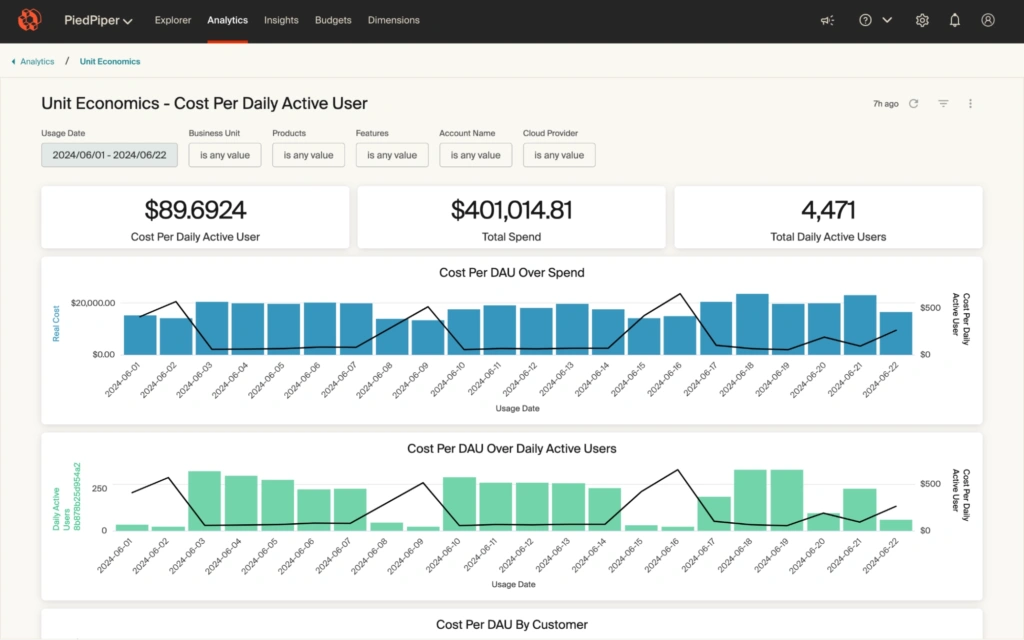
If you try to price AI agents without a clear view of your unit costs, you could wind up losing money on every single transaction. AI workloads are so unpredictable, you need visibility into the true cost of every action; otherwise, you’re just guessing at your margins.
The right cloud cost optimization platform helps you track AI-related costs down to the penny. This granularity means you’ll be able to price your services confidently and ensure that your AI features remain profitable.
How can you tell if a cloud cost platform provides what you need to effectively manage your AI costs?
A good cost optimization platform should provide deep visibility and insight into your unit costs. Look for the following features if you want to shop around:
- Granular Cost Allocation: You want to see AI-related costs broken down to the unit level and displayed by the hour across teams, products, and customers. This will help you understand what you’re spending on compute, storage, API calls, and data transfer.
- Real-Time And Predictive Insights: AI workloads are notoriously unpredictable. Look for a tool that provides real-time cost monitoring and advanced predictive forecasting features to detect cost spikes early and plan for future expenses.
- Multi-Cloud And AI Service Visibility: If your AI agents run across multiple cloud providers or utilize APIs from OpenAI, Anthropic, or other third-party AI models, your cost tool should consolidate all that data in one place.
- Automated Cost Anomaly Detection: When costs spike, you want to know as soon as possible so you can fix the problem before your costs snowball. A good cost platform will send alerts when AI costs deviate from expected patterns.
- Optimization Recommendations: In addition to tracking costs, the right tool will provide actionable insights on how to reduce your costs. Recommendations for when and how to right-size instances, optimize API calls, or adjust data transfer strategies can help you dial in your AI spend over the long term.
- Business Context Alignment: Do you want to see your raw cost data without context, or would you rather see your numbers connected to real business outcomes? A good platform will align your cost data and recommendations with your priorities, so you can view your costs per AI interaction, cost per customer, and cost per revenue dollar and use that information to make strategic pricing and scaling decisions.
If you want a product that does all of the above and more, try CloudZero. Our platform gives you the deep, granular data and robust business insights you need to control your AI agent costs, maximize efficiency, and keep your pricing strategy profitable, even when conditions change in your business.
Schedule a demo to see what CloudZero can do for you.
Software and pricing information last verified May 2026. Features, pricing, and availability may have changed. Please verify current details with vendors before making decisions.