Quick Answer
AI cost management software gives finance and engineering one view of AI spend, ROI, and cost per inference. Here is how to evaluate, choose, and buy the right AI tool in 2026.
What is AI cost management software?
AI cost management is the practice of giving finance and engineering a shared, real-time view of AI spend so they can prove return on investment instead of hoping for it. The software exists because AI bills are scattered across cloud providers, GPU services, model APIs, and SaaS tools, and no two invoices speak the same language.
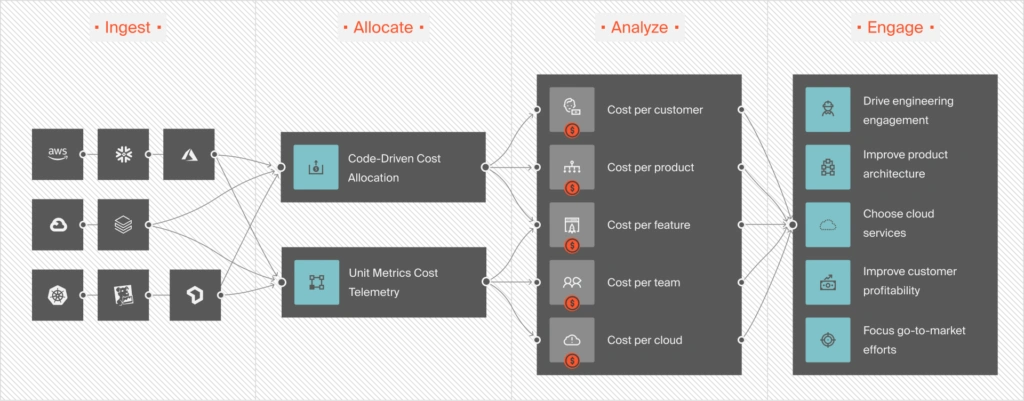
An AI cost management platform ingests cost and usage data from every place your AI runs, then attributes it to the people and products responsible. It answers three questions traditional billing cannot: what did this AI feature cost, who owns it, and is it making money.
The category sits beside cloud cost management, which tracks servers, storage, and networking. AI cost management adds the layer on top: tokens, model tiers, inference calls, GPU hours, and vendor APIs that bill in formats invented recently. More on that distinction below. For the deeper how-to on tracking and allocation, see CloudZero’s guide to AI cost management.
2026 State of AI Spend Report
Why Finance Caps What It Can’t See
Learn how finance leaders are managing AI spend, and how they’re approaching FY2027
Why AI cost management matters in 2026
In its May 2026 forecast, Gartner projected worldwide AI spending will hit $2.59 trillion in 2026, up 47% year over year, with AI infrastructure alone making up more than 45% of that total. That is not a line item anymore. That is a tectonic plate.
Zoom into one company and it gets personal. CloudZero’s State of AI Costs report found average monthly AI spend climbed from $62,964 in 2024 to a projected $85,521 in 2025, a 36% increase. The share of companies planning to spend over $100,000 a month on AI more than doubled, from 20% to 45%.
Yet only 51% of organizations in that research could confidently evaluate the return. As Erik Peterson, CloudZero’s co-founder and CTO, put it, AI spend today is “lots of bets, not a lot of clarity.”
An independent February 2026 Sapio Research survey of 500 finance leaders at large enterprises sharpened the point: 79% hit AI cost overruns in the past 12 months, and just 15% could calculate AI ROI without significant bottlenecks. Everyone is spending. Almost no one can show the receipts.
Gartner calls 2026 the inflection year, when enterprises (not just hyperscalers) start spending in earnest, and Sapio found 83% of finance leaders expect quantifiable AI returns within 12 months. The patience window is closing, so learning to manage AI costs is now how you keep your budget.
Signs you have outgrown spreadsheets
You do not need a tool the moment you touch AI, only when AI spend stops behaving. Most teams recognize at least three of these tells right away.
- Your AI costs live in a different universe from your cloud bill, and reconciling them is somebody’s least favorite Friday. That visibility gap is where overruns breed.
- You cannot say what a single AI feature costs without a meeting, a spreadsheet, and a small prayer. AI cost tracking at the feature level is the difference between margin and mystery.
- A runaway job or a misconfigured retry loop spikes your spend, and you find out on the invoice. AI cost monitoring with real-time anomaly alerts turns that surprise into an alert instead of an audit.
Finance and engineering define AI success differently, so every budget meeting becomes a translation exercise. Sapio found this definition gap named by 37% of respondents, and 43% of the C-suite, as a top barrier to measuring ROI.
The features that actually matter
A buyer’s guide is only useful if it tells you what to ignore, and plenty of AI cost management tools ship dashboards that look impressive and explain nothing. Use the list below as a vendor scorecard: if a platform cannot do the things in the first column, the rest of the demo is decoration.
| Must-have capability | Why it matters | Question to ask the vendor |
| Unit cost attribution | Total spend is a lagging indicator. Cost per inference, per feature, and per customer is where decisions live | “Can you show cost per customer for a single AI feature?” |
| Full allocation, including untagged spend | AI costs hide in shared and untagged resources. Partial attribution is a blind spot with a UI | “What percentage of spend do you leave unallocated?” |
| Real-time anomaly detection | Overruns you find next month are overruns you already paid for | “How fast after a spike does the right team get alerted?” |
| Multi-source ingestion | Your AI runs across clouds, GPU services, and model APIs that all bill differently | “Which model and GPU providers do you natively integrate?” |
| Margin and ROI analytics | Cost without revenue context tells half the story, usually the scary half | “Can you tie AI cost to the revenue it supports?” |
| Engineering-friendly delivery | If only finance can read it, engineers will not act on it | “Do engineers see cost context inside their own workflow?” |
The throughline is AI cost control that engineers will actually use. Sapio found accountability for AI spend split almost evenly between technology leaders at 55% and finance at 53%, so a tool that serves only one of them serves neither.
Categories of AI cost management tools
Not every tool that claims AI cost optimization solves the same problem. The market splits into a few categories, and knowing which you are looking at saves you from buying a screwdriver when you needed a wrench.
- Native cloud cost tools. AWS Cost Explorer, Azure Cost Management, and Google Cloud billing show aggregate spend for their own platform: free, fine to start, and blind to multi-cloud and model-level detail.
- Observability platforms with cost add-ons. Strong on performance signals, weaker on financial attribution, so cost arrives as a metric rather than a decision.
- Cloud cost optimization platforms. These mature on infrastructure spend and increasingly add AI coverage, so cloud cost management software in this bucket fits if your pain is mostly compute and storage.
- Procurement and spend analytics tools. Focused on vendor contracts and AI in spend analytics for purchasing. Useful for sourcing, but not built for the per-token reality of production AI.
- AI spend intelligence platforms. The newest category, built to treat AI as a unit economics problem from day one. CloudZero sits here as the AI ROI company.
Quick gut check: for one cloud provider’s total, the native tool is enough. The moment you span multiple providers and model APIs, and someone asks whether a feature is actually profitable, you have outgrown the free tier and the bolt-on.
AI cost management vs cloud cost management
People conflate these constantly. Cloud cost management governs the infrastructure layer: compute, storage, networking, and reserved capacity.
AI cost management governs the layer above: model selection, token efficiency, inference architecture, batching, and caching. The two overlap because most AI runs on cloud, but the levers and the savings differ.
CloudZero research makes the stakes concrete. Formal cloud cost programs now exist at 72% of organizations, nearly double the prior year, yet mean cloud efficiency still fell from 80% to 65%, with unmanaged AI spend the primary culprit.
Companies got better at watching the old bill while a new one quietly lapped them. A mature cloud cost optimization practice is a great foundation, but AI is the gap it does not yet cover.
Related Reads:
How to evaluate and choose a tool
Buying AI spend management software is less about feature checklists and more about whether the tool changes behavior. A platform whose numbers nobody trusts costs more than no platform at all. Six steps keep the decision honest.
Step 1: Align on the definition first. Get finance and engineering to agree on what “AI success” means before you demo anything. Sapio called this the single most fixable barrier, and the one that needs no new tooling.
Step 2: Map where your AI spend lives. List every cloud provider, GPU service, model API, and AI-powered SaaS tool. If a vendor cannot ingest one of them, you have found tomorrow’s blind spot today.
Step 3: Test attribution depth, not dashboard polish. Ask for cost per inference and cost per customer on a real feature. Anyone can show a pie chart of total spend. Few can break it to the unit.
Step 4: Pressure-test the alerts. Simulate a spike and time the response. Real-time AI cost monitoring is measured in minutes and hours, not in next month’s report.
Step 5: Check who can use it. If engineers need a finance translator to read the tool, adoption dies quietly. The best LLM cost management workflows put cost context where engineers already work.
Step 6: Confirm it connects cost to value. The goal is not to spend less, it is to spend where it pays. Only 15% of finance leaders can calculate AI ROI without major bottlenecks, per Sapio. A tool that only counts cost leaves you in the other 85%.
How much does AI cost management software cost?
Pricing varies. Most vendors charge a percentage of managed spend, a flat platform fee, or a tiered subscription by data volume and integrations. The honest framing is that the tool should cost a fraction of the waste it surfaces.
The math is friendly. With 79% of enterprises overrunning AI budgets and the most instrumented organizations overspending by a mean of 30.9%, recovering even part of that pays for the platform fast.
CloudZero customers have attributed over $1 million in savings in part to token caching alone.
For the broader picture on AI pricing, see CloudZero’s guide on how much AI costs.
Where CloudZero fits
CloudZero is the AI ROI company, built for exactly this problem: connecting every dollar of AI and cloud spend to the teams, products, features, and customers behind it.
Its allocation engine attributes 100% of spend, including shared and untagged resources, so AI costs stop hiding in the general cloud bill.
Per-token prices have fallen roughly a thousandfold in three years, yet aggregate AI spend keeps climbing. CloudZero co-founder and CTO Erik Peterson argues this is structural: hidden reasoning tokens, tokenizer gaps, and agent overhead consistently burn more than teams budget for.
During his QConAI keynote in June 2026, Peterson walked through real-world postmortems – including a stolen Google Gemini API key that ran up more than $82,000 in charges in roughly 48 hours, and a team whose annual AI budget vanished in weeks.
The differentiator is the unit metric. CloudZero surfaces cost per inference, the foundational AI unit economic measure, alongside real-time anomaly detection and margin analytics. It is becoming standard: in the Sapio survey, 26% of finance leaders had already adopted per-unit AI cost tracking and another 34% planned to within six months.
Both sides of the house trust the numbers. CloudZero research found more than 90% of companies tracking AI costs in a third-party platform reported high confidence in calculating AI ROI, versus only about half of organizations overall.
Teams at global leading organizations such as Toyota, Duolingo, Grammarly, Skyscanner, and Upstart use CloudZero to run AI and cloud spend as a unit economics discipline, not a monthly fire drill. For how granular that gets, see CloudZero’s OpenAI and Anthropic cost integration.
Ready to see where your AI spend stands? Book a CloudZero demo, take the self-guided product tour, or start with a free cloud cost assessment to find waste before your board does.
Frequently asked questions about AI cost management software