FinOps has moved well beyond buzzword status. What started as a way to bring financial discipline to cloud spend has evolved into a full operational framework, and the scope keeps expanding. According to the FinOps Foundation’s 2026 definition, FinOps is “an operational framework and cultural practice which maximizes the business value of technology, enables timely data-driven decision making, and creates financial accountability through collaboration between engineering, finance, and business teams.”
The shift from “cloud” to “technology” in that definition is telling. The State of FinOps 2026 report, which surveyed over 1,100 practitioners managing $83 billion in annual cloud spend, found that 98% of respondents now manage AI spend (up from just 31% two years earlier) and 90% manage or plan to manage SaaS costs. FinOps best practices need to account for this broader landscape.
Unlike traditional on-premise systems, where the cost of developing software products can be tracked to physical infrastructure, operating in the cloud is a lot more variable and difficult to grasp.
Most cloud service providers offer a pay-as-you-go model, and services scale almost infinitely as workloads increase. In addition, multi-tenant systems and containerized infrastructure such as Kubernetes add complexities that obscure cloud costs and make allocation a challenge.
The end result is twofold: finance teams cannot understand how money is spent in the cloud, and engineers and product teams have no idea how their activities impact cloud costs. These cloud cost optimization best practices can help your organization tackle those barriers and start using cloud spend as a strategic lever rather than a line item to fear.
Here are some FinOps best practices to get you started — and help you make the most of every dollar you spend in the cloud.
5 Cloud FinOps Best Practices To Optimize Your Costs
1. Design your team responsible for FinOps
This is by far the most crucial step when adopting a FinOps approach.
Some companies call this team a Cloud Center of Excellence, while others call it the FinOps Team. For many, the team may not have a special title, and it could include a cross-functional team dedicated part-time.
This group should be a governing body that provides best practices and develops KPIs and metrics to help teams understand the unit economics of the business.
This team usually includes a dotted line to executive leadership. Depending on their involvement with cloud activities, it should consist of representatives from finance, product, and technology or engineering.
For example, you may have a finance manager who owns the budget, a cloud owner on the engineering side, and a product owner who manages all the products. Practitioners who secure executive alignment tend to have significantly more influence over technology selection decisions, so that dotted line matters. This team will define the practices that serve as the organization’s guardrails: tagging policies, commitment discount strategies, anomaly response playbooks, and the KPIs everyone reports against (such as cost per customer, commitment utilization rate, or budget variance).
2. Improve cloud visibility across your organization
A major challenge when operating in the cloud is that teams whose activities contribute to cloud cost need insight into cloud cost drivers. So, an integral FinOps practice is ensuring cloud cost visibility for everyone involved in the cloud. Affected teams need visibility and a clear understanding of how their activities impact cloud costs.
Keep in mind that different groups will have different nuances or understanding of cloud costs, so it’s important to provide cost information in a language they understand.
For example, finance may be interested in how cloud costs compare to the forecast. Engineers and developers, on the other hand, want to see how much it costs to create an architecture or product feature and how changes to that architecture impact cloud costs.
For them, it is critical to find answers to questions like “If we scaled or increased compute or memory, how will that impact cloud costs?” The product team is interested in how new customer contracts or an increase in the scope of a particular product impact cloud costs.
Once visibility is established, the next step is ensuring group communication. This brings us to the next point.
The foundation of visibility is cost allocation, and that starts with a solid tagging strategy. Define required tags (team, environment, product, cost center) and enforce them at deployment through policy-as-code. For resources that resist tagging, such as shared infrastructure, Kubernetes clusters, or multi-tenant services, consider allocation approaches that go beyond native tagging. CloudZero’s CostFormation engine, for instance, uses a code-driven approach to organize 100% of cloud spend regardless of tagging quality, giving teams immediate visibility without waiting for a perfect tagging rollout.
3. Create a single source of truth
Establish a single go-to place for looking at your cloud costs. When teams start with AWS, the default tool is usually AWS Cost Explorer. While that is a reasonable starting point, it has well-documented limitations: data delays of up to 24 hours, hourly granularity limited to 14 days, a 13-month data retention window, and no built-in real-time alerting. It also stops at aggregate cost views and cannot show you cost per customer, per feature, or per deployment.
Larger businesses may use three to four different tools for managing cloud costs, with each team using a different tool. This creates a problem because each team looks at costs differently, with inconsistent numbers. The lack of a shared source of truth makes productive budget conversations almost impossible.
A centralized cost intelligence platform gives each team the information it needs to make decisions. Engineering, finance, and product teams can all view costs through the unique lens of their role, breaking down the silos around cloud spend and creating the transparency that productive FinOps conversations require.
4. Leverage cost savings and waste reduction strategies
Once you have all three items above, use the low-hanging fruits, such as reserved instances (RIs) and savings plans, to optimize costs. Depending on the type of services you use, you could also consider private pricing deals.
Next, look for ways to reduce waste. Remove any legacy resources that are not being used. A $100 per month storage bucket that has not been used in four years costs $1,200 per year, nearly $5,000 over the full period. While this might seem insignificant for a multi-million dollar business, multiple instances of such idle resources compound into meaningful expense. Rightsizing is equally important: match the type, size, and amount of cloud resources to your actual workload patterns, not the peak capacity you provisioned for months ago.
Where possible, automate these optimizations. Automated scheduling for non-production environments, auto-scaling policies aligned to demand patterns, and automated anomaly detection can catch waste before it compounds. The State of FinOps 2026 report notes that practitioners have already tackled the obvious large-scale waste and now face many smaller, harder-to-capture savings, which makes automation essential for continued progress.
The last option for cost savings is to consider rearchitecting your application. Most companies do a lift and shift when moving to the cloud. But once you have established a central governing body and cost visibility, an important step is to rearchitect your application to adopt cloud-native services and unlock even more savings.
5. Measure unit cost to understand cloud efficiency
The cloud is supposed to fuel innovation, so cutting costs for the sake of always saving money likely isn’t a good use of time for your engineering team. Likewise, increasing cloud spending isn’t bad when your business grows and adds new features. Instead, it’s important to understand whether you’re using the cloud efficiently in the context of your business.
Unit cost puts cost into the context of your growing and changing business. For example, instead of focusing on your overall costs going up 10%, you can measure your average cost per customer, user session, transaction, etc. It’s usually a good idea to start with a single metric representing your business. From there, you can get more granular and advanced and track unit costs for different products, market segments, and more.
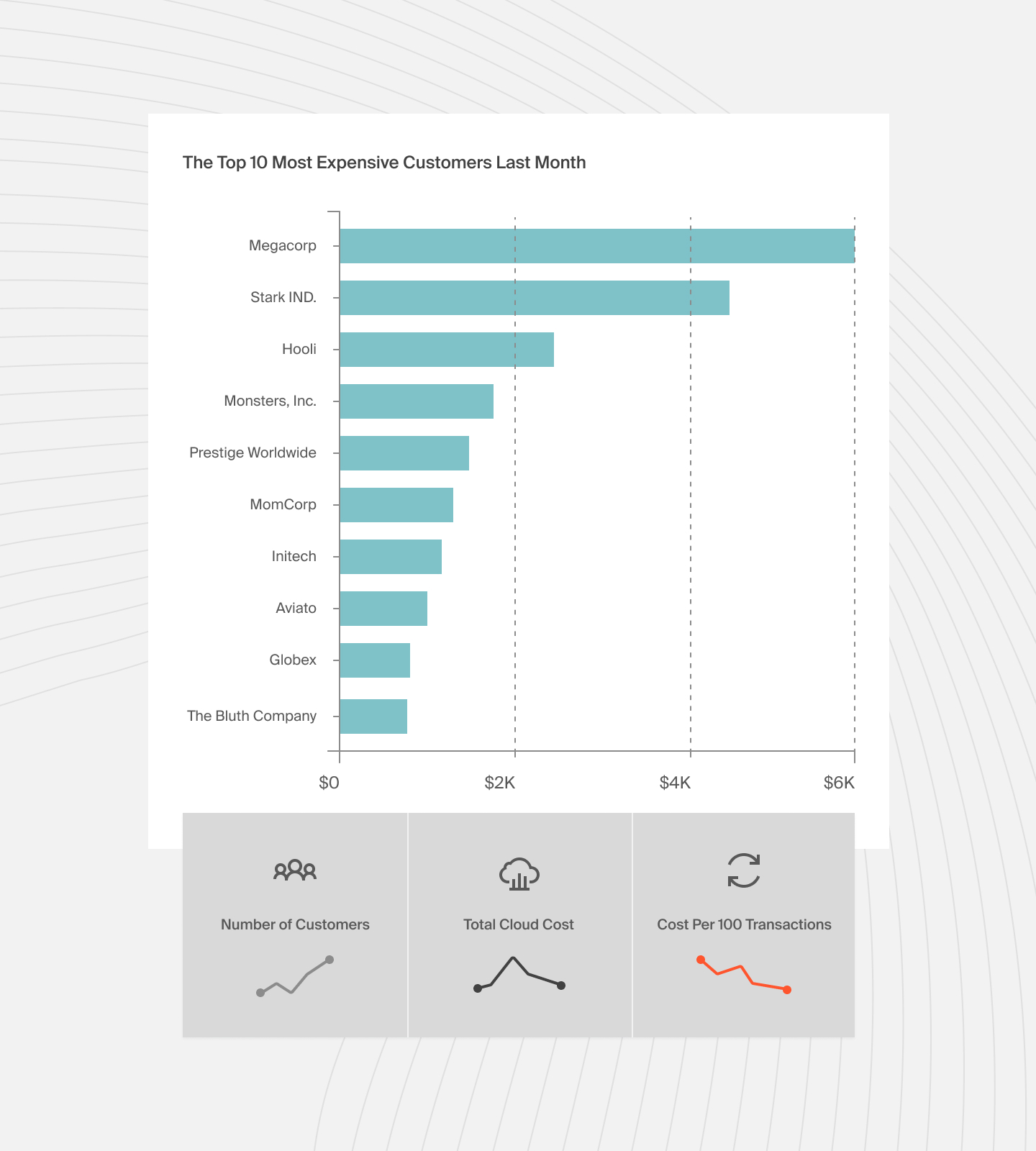
If you are looking for a single starting metric, try the cloud efficiency metric.
This matters even more as AI workloads enter the picture. With 98% of FinOps practitioners now managing AI spend, understanding cost per inference, cost per model training run, or cost per AI-powered feature is becoming a core FinOps capability. Unit economics gives your team the language to evaluate whether that new ML pipeline is delivering value proportional to its cost, rather than just flagging a GPU spend increase.
Report
Finance needs to prove AI’s return: CloudZero report
260 senior finance leaders (more than half CFOs) told us why the speed of seeing AI spend, not the size of it, separates who pulls ahead on AI from who gets burned.
Get Started With CloudZero
These FinOps best practices can help lower cloud costs and increase profitability. CloudZero is a cost intelligence platform that ingests data from over 50 cloud, data, and AI providers to give engineering, finance, and product teams a unified view of spend. Use it to streamline cloud cost management and accelerate your FinOps journey.
 to learn how CloudZero empowers you to build an effective FinOps program.