Quick Answer
CloudZero, IBM Cloudability, CloudHealth, Finout, Vantage and Datadog are the Flexera alternatives that report on cloud and AI spend. nOps, Usage.ai, Cast AI, Kubex and Harness automate savings instead. ServiceNow is the closest alternative for software license audits. Which one fits depends on what you need counted: a fuller inventory of spend, a lower rate on it, or proof of what it returned.
In October 2026, 30.1% of the 430 companies in CloudZero’s AI Economics Pulse panel spent at least 10% of their cloud bill on AI, and 9.8% spent at least a quarter of it. A year earlier that top group was 2.2%. This is the spend now landing on Flexera quotes, and Flexera’s terms count it.
| Tool | Best for | Part of Flexera One it replaces | Fee is based on | AI spend, per the vendor |
|---|---|---|---|---|
| CloudZero | Showing what AI and cloud spend earned | Cloud cost and AI spend | One subscription, by quote | By person, team, model and the work it paid for |
| IBM Cloudability | Companies that buy through IBM | Cloud cost | Annual cloud spend bands | AI connectors, plus Apptio AI Value and ROI since November 2026 |
| CloudHealth | Policy across many accounts | Cloud cost | Monthly spend bands | Cost per million tokens, by model, user, team or project |
| Finout | Every bill in one dataset, fast | Cloud cost | Flat annual fee by tier | OpenAI, Anthropic and Cursor bills on every plan |
| Vantage | A price you can see before the call | Cloud cost | Tracked spend tiers | Anthropic, OpenAI, Cursor and OpenRouter bills |
| Datadog Cloud Cost Management | Teams already in Datadog | Cloud cost | $5 or $10 per $1,000 of spend a month | Not stated on its price list |
| nOps | Automated cloud commitments | Commitment management | Share of realized savings | Outside its scope |
| Usage.ai | Commitments without over-committing | Commitment management | Share of realized savings | Outside its scope |
| Cast AI | Kubernetes and GPU capacity | Container optimization | Compute usage, by quote | Finds GPU capacity across clouds |
| Kubex (formerly Densify) | Oversized clusters and GPUs | Container and workload optimization | $1 per vCPU a month | GPU tools on its Enterprise plan |
| Harness | Idle non-production resources | Workload optimization | Free plan excludes the cost product; paid tiers by quote | Sold as Cloud and AI Cost Management |
What is Flexera, and what does each part of Flexera One count?
Flexera is a software company that tracks what a business owns and spends on technology. Its platform, Flexera One, covers software licenses, SaaS subscriptions and cloud. Flexera started in software licensing and built most of its cloud side by acquisition, so each part of the suite arrived with its own meter.
| Part of Flexera One | Where it came from | What the license counts |
|---|---|---|
| IT Asset Management | Flexera’s original business, plus Snow Software (February 15, 2024) | Clients, servers and containers |
| Flexera One SaaS Management | Flexera and Snow | Users, including service accounts, bots and AI agents |
| Flexera One Cloud Cost Optimization | Flexera | Spend under management |
| Flexera One Cloud Commitment Management | Spot Eco (March 3, 2025) and ProsperOps (January 6, 2026) | |
| Flexera One Container Optimization | Spot Ocean (March 3, 2025) | |
| Flexera One Virtual Machine Optimization | Spot Elastigroup (March 3, 2025) | |
| Data cloud optimization | Chaos Genius (January 6, 2026) | Spend under management |
| Cloud License Management | Flexera | Cloud instances |
| CloudCheckr | Bought from NetApp with Spot (March 3, 2025) | Its own contract terms |
The meters come from Flexera’s license metrics document, effective October 15, 2026. The dates come from the Spot and ProsperOps releases. Flexera sells the cloud products together as Flexera One FinOps. Its Kubernetes cost optimization is Spot Ocean, and its Snowflake cost optimization is Chaos Genius.
ProsperOps, Spot and CloudCheckr still show up on lists of Flexera alternatives. All three belong to Flexera now. Flexera says ProsperOps manages $6 billion of annual cloud usage and will keep its own brand.
If you bought any of them, or Snow, your next renewal is with Flexera. A renewal with a new owner is a new purchase, and a new purchase deserves a comparison.
2026 State of AI Spend Report
Why Finance Caps
What It Can’t See
Learn how finance leaders are managing AI spend, and how they’re approaching FY2027
How much does Flexera cost?
Flexera pricing is by quote, and Flexera One pricing isn’t published as a rate card. Two AWS Marketplace listings do show list prices for the cloud cost product. One charges $50,000 for 12 months to cover up to $1,000,000 of yearly spend. The other charges $40,681 for 12 months at $125,000 of monthly AWS spend.
| Published option | Price | Spend it covers | Share of that spend |
|---|---|---|---|
| Cloud Cost Optimization platform | $50,000 for 12 months | Up to $1,000,000 a year | 5.0% |
| Fixed annual cost | $40,681 for 12 months | $1,500,000 a year | 2.7% |
| Percent of monthly spend | Rate not published | Any | $1,000 minimum charge |
The percentages are our arithmetic on list prices, before negotiation. Terms run 12, 24 or 36 months. The first listing calls its fees non-cancellable and non-refundable, and bills spend past the contracted amount as overage at a rate set in the contract.
What does spend under management mean on a Flexera quote?
Spend under management means more than your cloud bill. Flexera’s metrics define spend under management as the total cost in every bill source you connect. Credits, discounts and refunds are not deducted.
Taxes and support charges are included. Buying a prepaid commitment doesn’t count on its own; the consumption you draw against it does. Data from AI providers is a bill source too, whether it arrives as an invoice, a usage report or an API export.
So AI can raise a Flexera bill from two directions. Connect your model provider bills and they join the base the cost product is priced on. Give AI agents their own seats in a measured app and they join the user count on the SaaS product.
The arithmetic is simple. A company with $1,000,000 of yearly cloud spend and $400,000 of yearly model API bills has $1,400,000 under management. That is past the first published band before anyone has asked what the $400,000 bought.
Before you sign a 36-month term, book a CloudZero demo and bring the Flexera quote with last quarter’s cloud and AI bills. You’ll see how that spend splits across products, customers and teams, so you know what it earned before you agree what to pay for counting it.
Why do companies switch from Flexera when AI spend arrives?
Companies switch because an inventory answers how much was spent and who spent it, and an AI bill raises a harder question. How much did we spend? Who spent it? And for what? Boards are asking the third, and it’s the one a count of licenses, seats and dollars was never meant to answer.
| The question | What answers it | Flexera One, per its own documents |
|---|---|---|
| How much did we spend on AI? | Provider invoices | Yes. AI providers are a bill source |
| Who spent it? | Chargeback by user, agent or team | Yes. Token Cost Control charges AI spend back to those responsible |
| For what, and was it worth it? | Usage tied to a customer, a product and the work done | Neither 2026 release describes spend allocated by customer or product |
Flexera’s answer deserves a fair hearing. It announced AI Cost Management on June 10, 2026 with an early access program, and expanded it on October 20, 2026. That release says Token Cost Control can allocate or charge back AI spend to those responsible, and Flexera’s site adds tracking across vendors, models and projects. As announced on October 20, 2026, cost automation for Snowflake was due by the end of 2026, and for Databricks in early 2027.
The third question is hard for everyone, because AI spend arrives without handles. A cloud charge had an account, a resource and usually a tag. An AI charge turns up on a corporate card, inside another vendor’s invoice, or on a laptop that never touches your gateway. We’ve written about the AI spend on your team’s laptops because it is the part most tools can’t see.
We learned this on ourselves first. CloudZero’s own AI bills used to pile up on one executive’s credit card and get copied into a spreadsheet by hand. When our finance director connected the real usage data, she found $30,000 a month in AI savings in 10 minutes. The spreadsheet had the total right. It could not say who spent it or why.
“Cost-to-serve isn’t the problem. Cost-to-produce is,” wrote Scott Castle, CloudZero’s Chief Product Officer, in AI ROI is an allocation problem. Serving a customer has a known cost. What an agent spent producing a campaign, a feature or a closed ticket sits on no bill at all, which is where the allocation work starts.
Our view is that vendors watch the meter and finance has to watch the return. When a company can’t answer that, the only control left is a spend cap, and a cap cuts the productive spend along with the waste.
So put one test to every vendor, Flexera and CloudZero included: show last quarter’s AI spend by customer and by product, reconciled to the invoices. That report is the core of AI cost management, and the AI statistics we track show how few companies can produce it.
Which Flexera competitors show what cloud and AI spend returns?
Six Flexera competitors report on both cloud and AI spend: CloudZero, IBM Cloudability, CloudHealth, Finout, Vantage and Datadog Cloud Cost Management. They differ in how far they get toward the third question, and in what their own fee is tied to.
1. CloudZero
CloudZero is built around the third question. It starts from usage, then reconciles to the invoice. AI Signals captures AI usage from desktop machines, LLM gateways and telemetry streams as each event happens. It sorts the spend by department, team, person and model, and into more than 35 business activities such as prospecting or code review.
The same allocation engine already handles cloud spend for billion-dollar companies including Coinbase, Duolingo, PicPay, Nubank and more, and it manages over $14 billion in spend. Pricing is one subscription with every capability included, by quote. Our quote reflects the scale of your environment too, so ask us what moves it.
CloudZero is not a like-for-like swap for Flexera. It does not manage software licenses, reclaim SaaS seats, buy commitments or change infrastructure. The CloudZero alternatives guide compares it with its own rivals.
2. IBM Cloudability
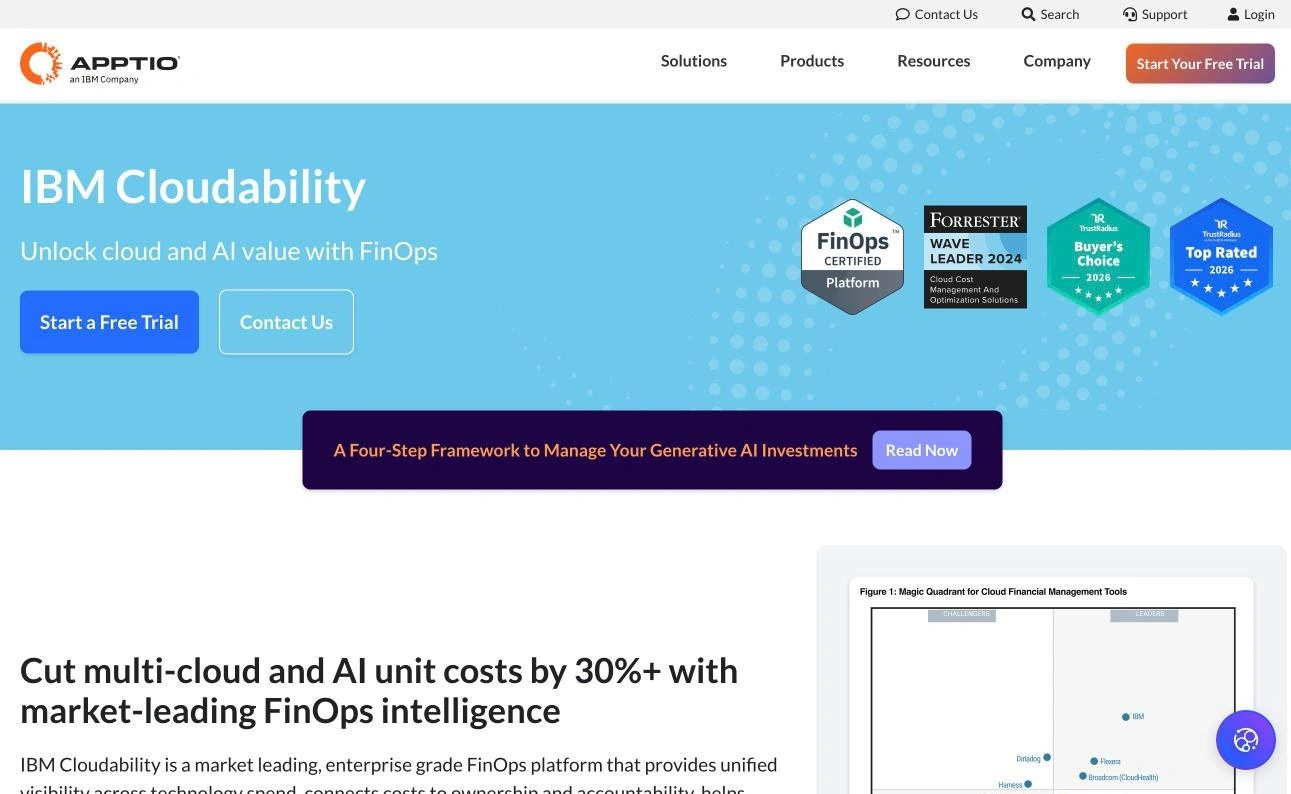
Cloudability is the comparison a procurement team reaches for first: cloud cost reporting inside a bigger vendor’s portfolio. Its AWS Marketplace listing shows $30,000 a year for up to $1 million of annual cloud spend, $76,680 for up to $3 million and $132,480 for up to $6 million.
IBM is aiming at the third question too. Apptio AI Value and ROI became generally available on November 6, 2026, alongside connectors to AI providers, and IBM says it ties technology investment to business outcomes. Ask to see that at the level of one customer and one product. The Cloudability alternatives guide has more.
3. CloudHealth
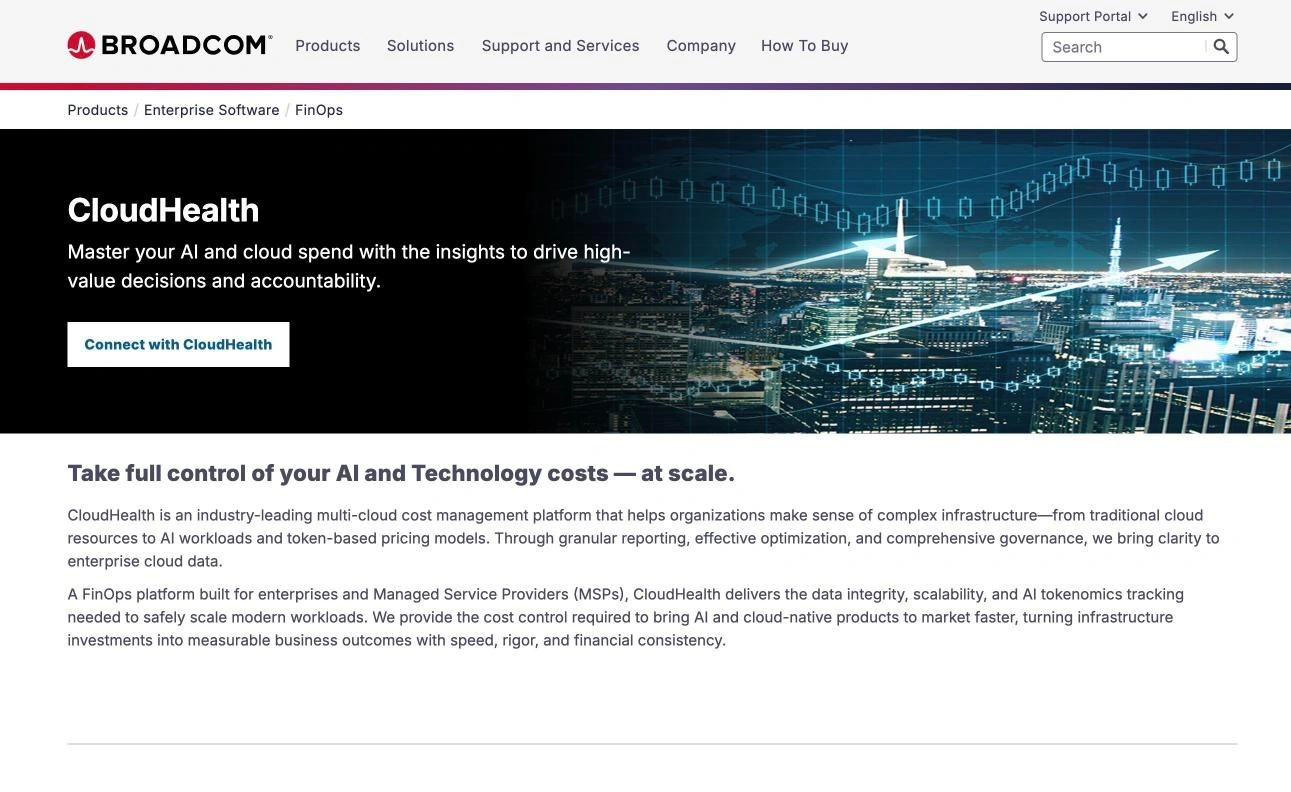
CloudHealth is the governance choice. Broadcom owns it, and Arrow Electronics has been its sole provider for sales and support since May 6, 2024. Its AWS Marketplace listing starts at $45,000 a year for up to $150,000 of monthly AWS spend, then $90,000 for up to $300,000.
Its AI and Tokenomics Dashboard, first shown in June 2026, reports cost per million tokens across model providers and attributes usage to users, teams or projects. That answers how much and who, and gets as far as the project. The CloudHealth alternatives guide has the detail.
4. Finout
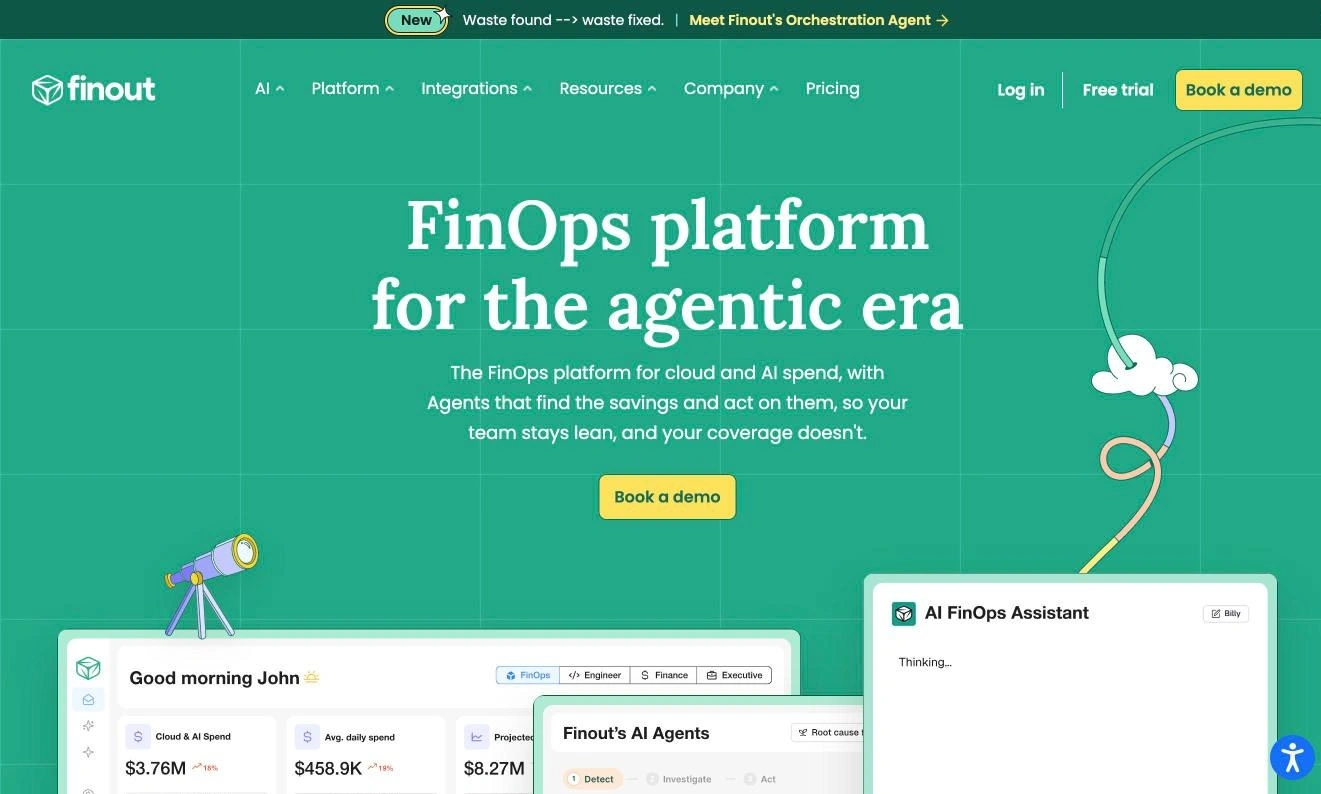
Finout says plainly that its fee is not a percentage of spend and not per seat. It charges a flat annual fee by committed-spend tier, fixed for the term, with Kubernetes adding 25% on the Business and Pro plans. OpenAI, Anthropic and Cursor bills are included on every plan and split by rules you write.
See the Finout alternatives guide.
5. Vantage
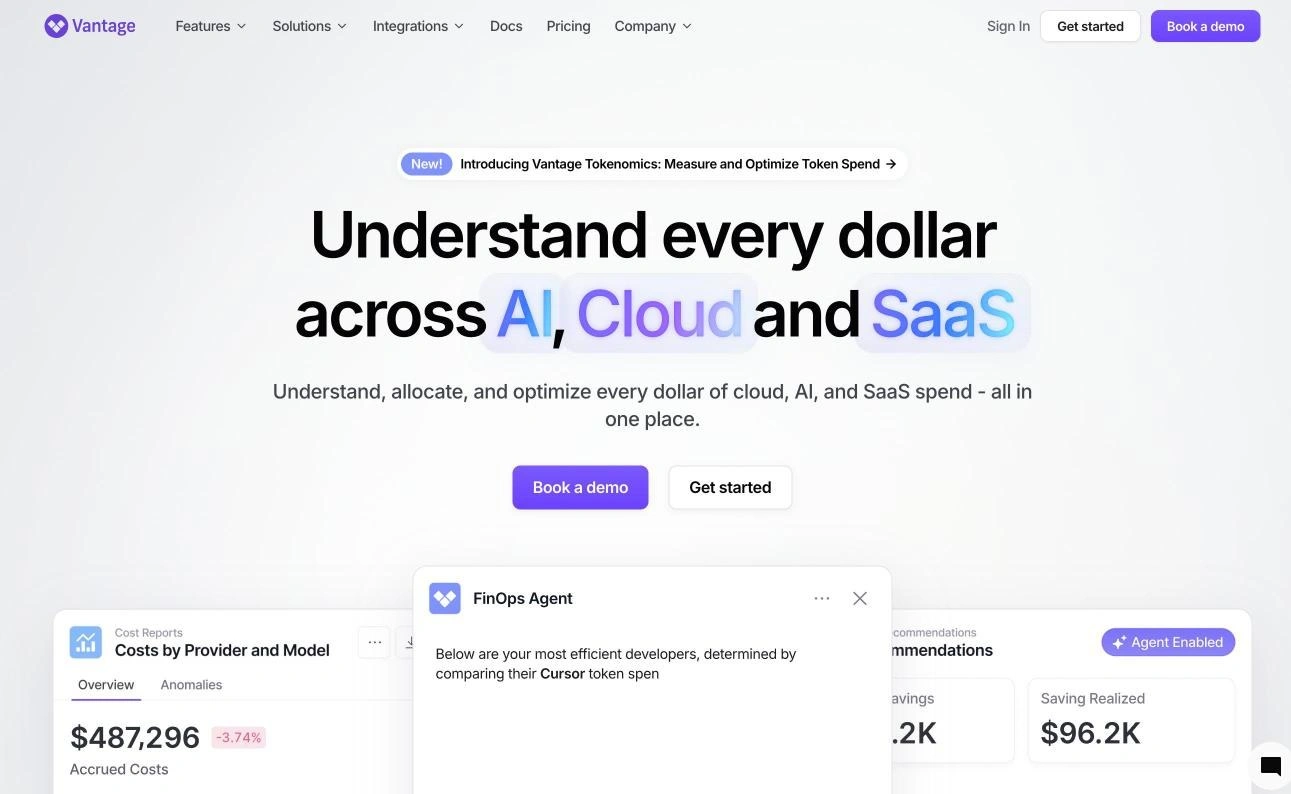
Vantage posts a self-serve rate card: free up to $2,500 of tracked spend a month, $30 up to $7,500 and $200 up to $20,000. Most companies that run Flexera One will be past those tiers and on a quoted plan. Vantage reads Anthropic, OpenAI, Cursor and OpenRouter bills beside cloud, and its paid plans include Autopilot, which buys AWS Savings Plans automatically.
The Vantage alternatives guide goes deeper.
6. Datadog Cloud Cost Management
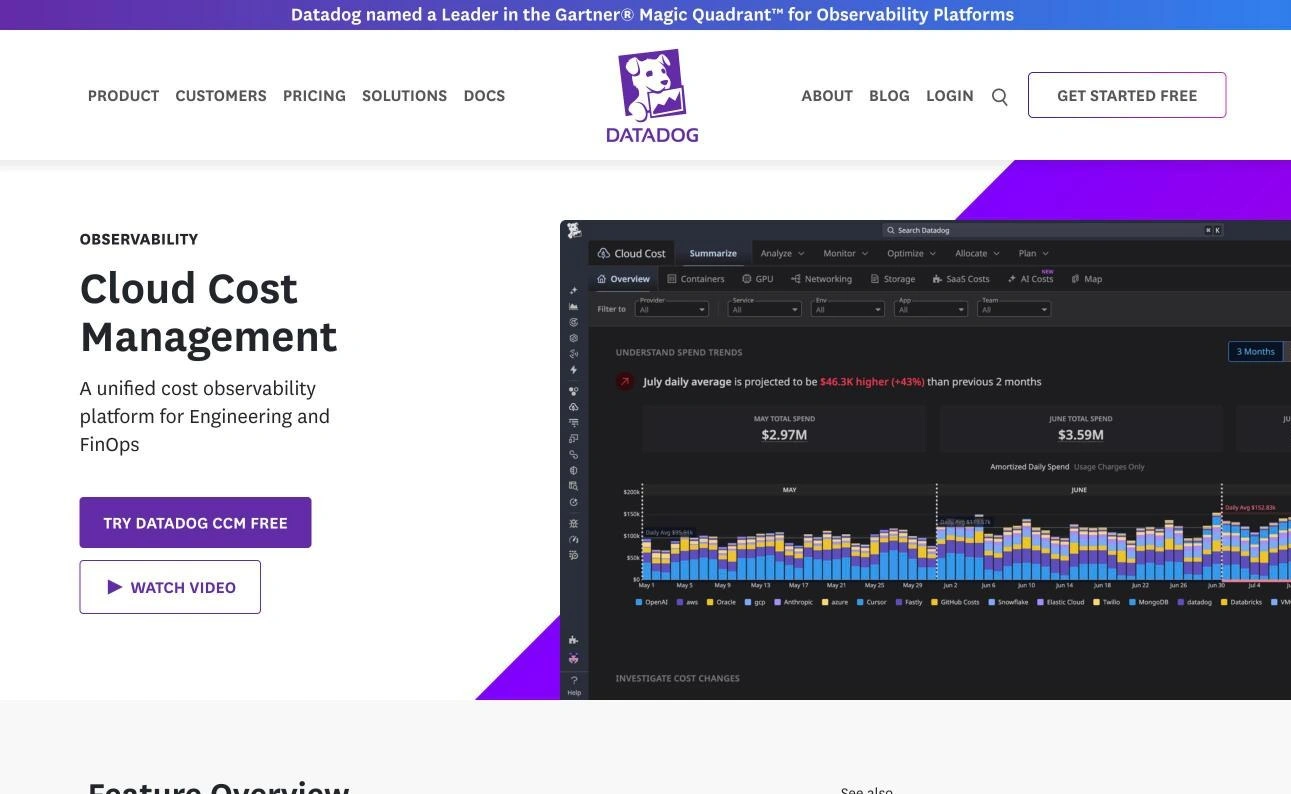
Datadog makes sense when engineers already work in it, because cost sits beside the metrics they read every day. It lists at $5 (Pro) or $10 (Enterprise) per $1,000 of cloud and SaaS spend a month, billed annually. That fee is on top of the observability bill, which is often a line worth allocating in its own right.
Is there an agentic alternative to Flexera’s automation?
Yes. Flexera’s automation came through acquisitions, and independent tools still do the same jobs: buying commitments, running Kubernetes clusters and shutting down idle resources.
7. nOps
nOps is the nearest independent match for what Flexera acquired in ProsperOps. It buys and manages cloud commitments automatically, costs $0 to sign up, and takes a percentage of realized net savings; its separate cost visibility product is a flat fee based on cloud spend. Its FAQ does not state the percentage. The nOps alternatives guide compares the commitment tools.
8. Usage.ai
Usage.ai answers one fear: committing to capacity you will not use. It buys commitments with manual approval or on autopilot and pays cashback on eligible commitments that go underused. It charges a percentage of realized savings.
9. Cast AI
Cast AI replaces Flexera One Container Optimization. It automates Kubernetes nodes and workloads, and on January 12, 2026 it announced OMNI Compute, which finds spare capacity, GPUs included, across cloud providers and regions. It doesn’t publish a rate. Cast AI says its plans follow compute consumption and quotes each one.
The Cast AI alternatives guide covers the cluster tools.
10. Kubex (formerly Densify)
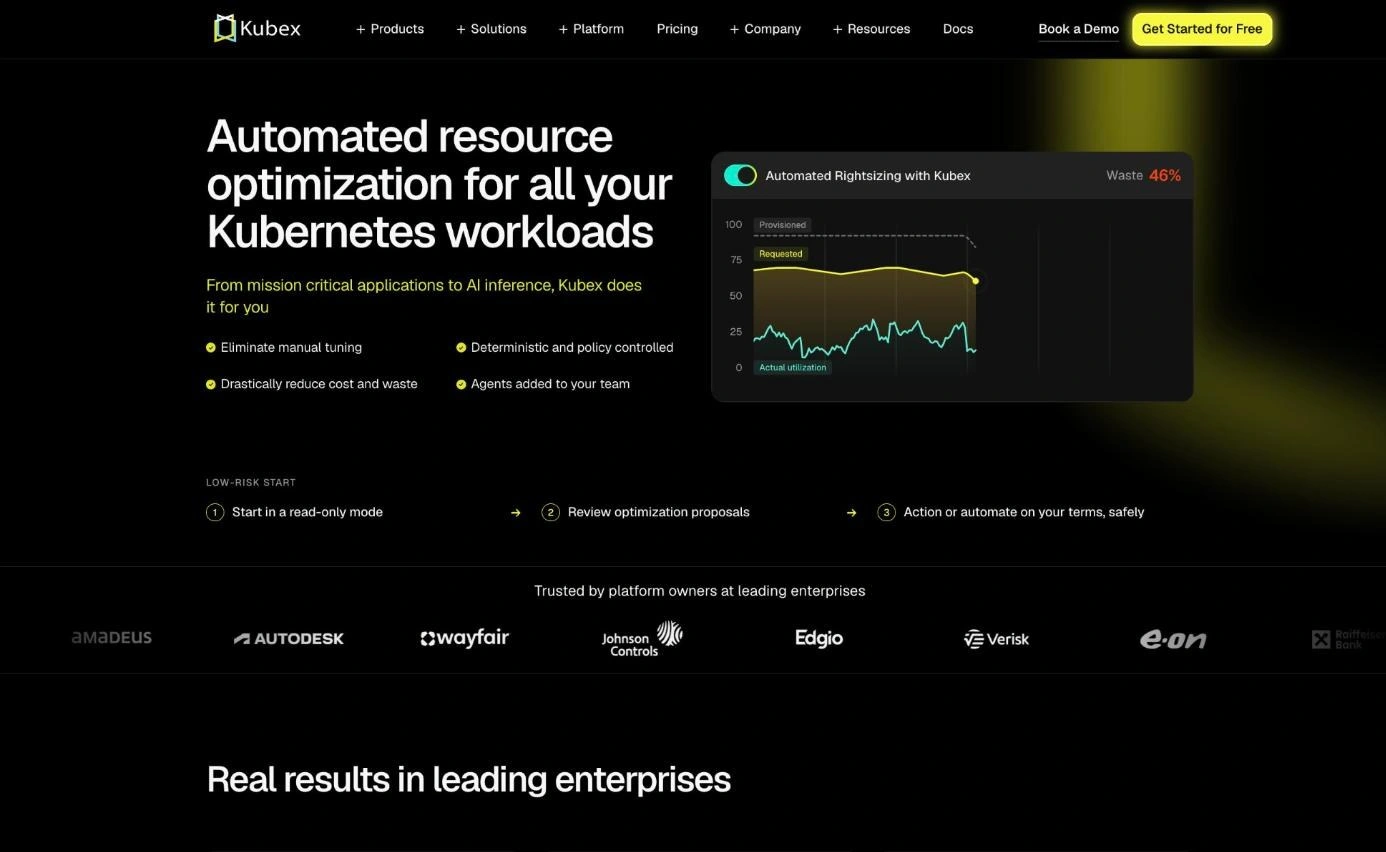
Kubex publishes its price: $1 per vCPU a month for Kubernetes and cloud rightsizing, with 60 days free. GPU optimization sits on its Enterprise plan at a quoted price.
11. Harness
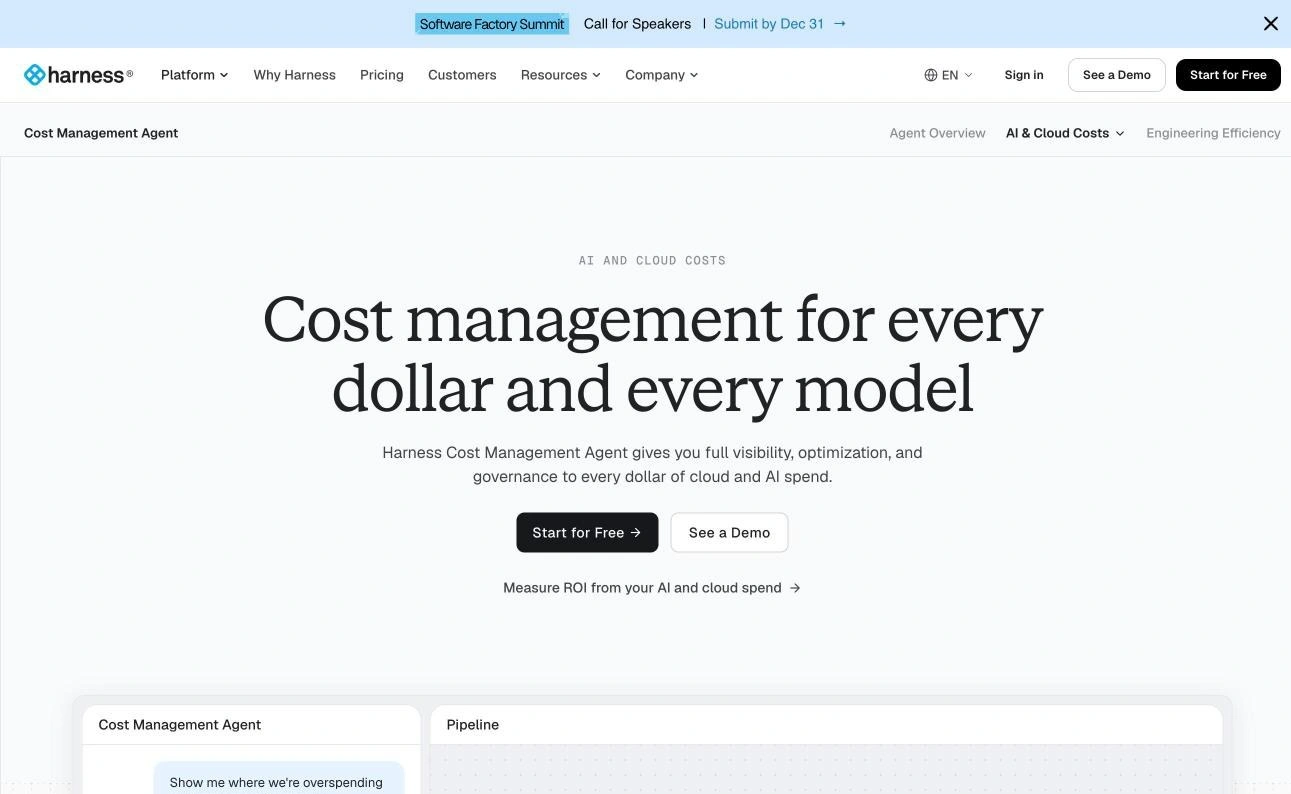
Harness fits teams that already ship software with it. Its AutoStopping feature watches development, test and staging resources and stops them once they have sat idle past a threshold you set. Harness has a free plan, but the cost product sits on its paid tiers, which are quoted.
One warning about automation. It lowers the rate you pay. It cannot tell you whether the workload should exist, which is why finance teams often run one of these tools beside a reporting tool.
What replaces Flexera for software licenses and SaaS management?
Software asset management tools replace Flexera for licenses and SaaS, and CloudZero is not one of them. License compliance, audit defense and seat reclamation are IT asset management, which is Flexera’s original business. ServiceNow, USU, Ivanti, Eracent and Certero all sell software asset management tools that compete with Flexera’s.
Flexera vs. ServiceNow: which should hold your license data?
The choice usually follows the platform. Teams that run ServiceNow for IT service management tend to keep license data there. Teams that need license positions for Oracle, IBM, SAP and Microsoft audits tend to stay with Flexera. Zylo is a common pick when the problem is SaaS renewals alone, in place of Flexera One SaaS Management.
When is Flexera the right choice?
Flexera is the right choice when a software audit is a real financial risk, when you run a large hybrid estate, or when one vendor for licenses, SaaS and cloud matters more than depth in any one. Flexera announced on June 23, 2026 that Gartner had named it a Leader for SaaS management platforms, and Gartner named it a Leader for cloud financial management tools in 2025.
Many of the companies we talk to keep Flexera for licenses and add a layer for the AI and cloud question. That’s a reasonable setup.
What should you bring to a Flexera renewal?
Bring numbers from your own business, not the vendor’s. They show what the renewal will cost and whether it buys the report you need.
| Bring this | Why it matters |
|---|---|
| AI as a share of your cloud bill | At 10% or more you are with 30.1% of our panel. At 25% or more, 9.8%. |
| The bill sources you plan to connect | Each one adds to spend under management |
| Service accounts, bots and AI agents that hold a seat | They count as users on the SaaS product |
| The acquired products on the quote | Ask whether ProsperOps, Spot and CloudCheckr sit on one contract or several |
Frequently asked questions about Flexera alternatives
What’s the next step before you renew or replace Flexera?
Put the Flexera quote next to last quarter’s cloud and AI bills. If you can’t say what that spend produced, a new term buys a fuller count of spend you still can’t explain.
Schedule a CloudZero demo and bring both documents. We’ll work through them with you, starting from the questions your board is asking.
Vendor facts come from each vendor’s own release, terms, documentation or pricing page, from AWS Marketplace listings, and from Thoma Bravo and IBM.