A real workflow showing how Claude + CloudZero MCP turns plain-English questions into actionable cost intelligence — no dashboards, no tickets, no waiting
As Director of Finance and Accounting at a software company, my job can be described simply: Understand what we’re spending, who’s responsible, and whether we can get more efficient. But as anyone who’s had to wrangle AI costs knows, doing so for AI is anything but simple.
Like the 91% of companies now embedding AI in their products (per CloudZero’s FinOps in the AI Era report), CloudZero’s AI spend is growing fast. AI tools are powerful, and we’ve all gotten unambiguous encouragement from leadership to find ways it can make our work more efficient. This means a lot of experimentation, which is great; it also means a lot of disorganized costs, which, especially for me, isn’t.
AI providers are notoriously bad at (or apathetic toward) showing their customers what they’re spending and when. Until recently, all of CloudZero’s AI costs were piling up on our CTO’s credit card, whose statement my colleague Randi had to manually copy over into a spreadsheet to give us anything like AI visibility.
This was especially problematic when I saw that our AI API costs were doubling at an alarming rate in our monthly P&L, and I had no idea why — i.e. how much we were spending on each provider, how service costs varied within providers (e.g., Claude Sonnet 4.5 vs. Claude Opus 4.5), or which of our employees was spending the most. This is the AI cost visibility problem in its purest form.
As is the case anytime a cost category increases, I had two goals:
- Understand why AI costs were rising: where exactly they were increasing, by how much, who was responsible, and what business need was driving it
- Understand if we could save money: if there were savings opportunities available to us that would not slow down innovation
10 Minutes Of Prompting
Conveniently, CloudZero had just released an AI Hub. The Hub includes an MCP server and a Claude Code Plugin; between them, I could sync up all sources of cost, usage, and revenue data, then ask Claude plain-English questions to get the answers I needed. I’m not the world’s most technical person, but it was extremely easy for me to set this up and start prompting.
This entire process, from setup to prompting to getting answers, took about 10 minutes. Here’s how it went:
Question 1: ‘How much have we spent on AI, November through January?’
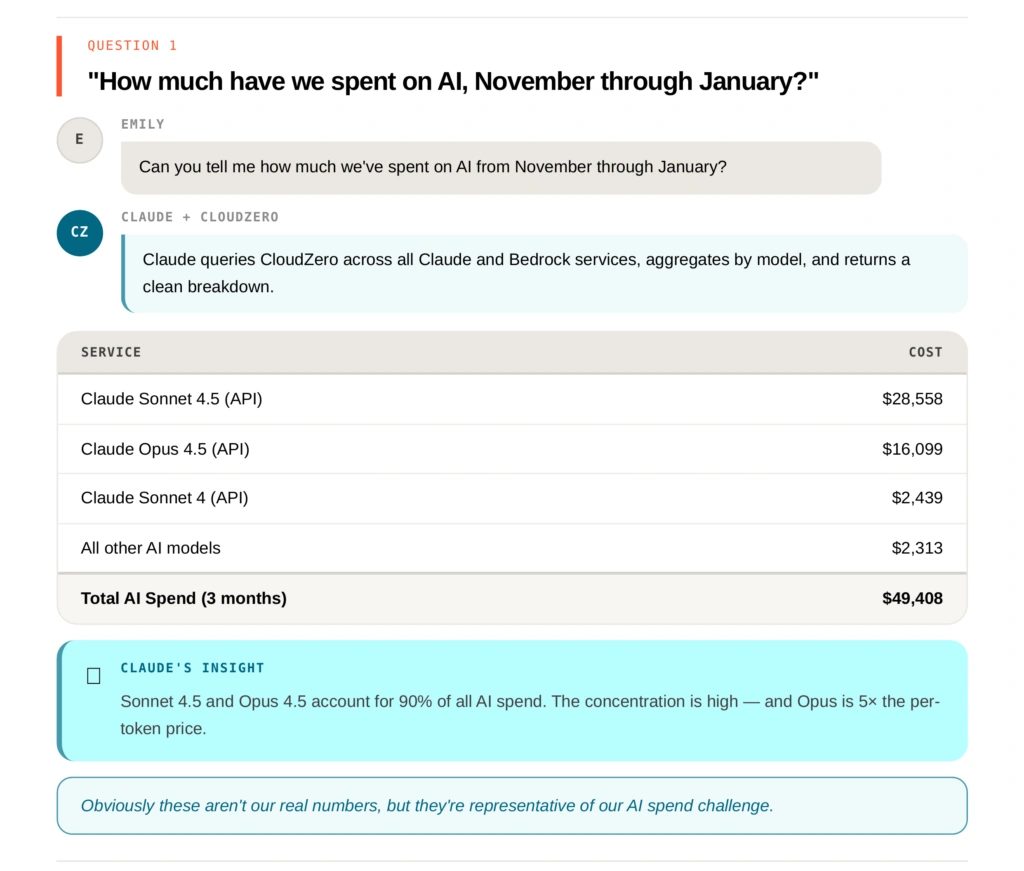
Just like that, a clear breakdown of our costs by our AI providers and their services. Which was great, but which wasn’t yet a great encapsulation of why. Just like in the cloud, knowing that your S3 costs are increasing gives you no insight into what drove the increase — much less what, if anything, you got in return.
So, I went deeper.
Question 2: ‘What in our business is driving these costs?’
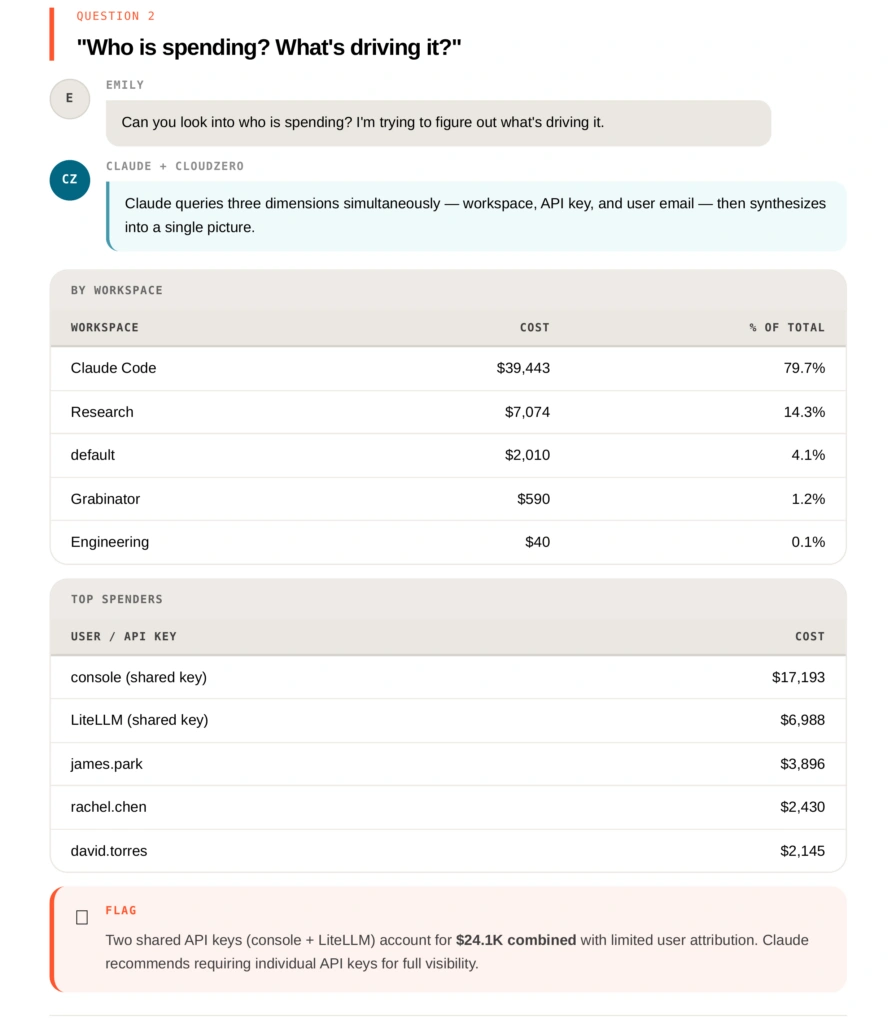
Now we’ve got costs by workspace and by top spender. You’ll notice that shared API keys are more costly than any individual user; Claude noticed that too, and made the astute recommendation to require individual API keys, which would give us full user visibility.
Still, knowing totals isn’t knowing trends. Let’s go another layer deeper.
Question 3: ‘What is growing our AI costs?’
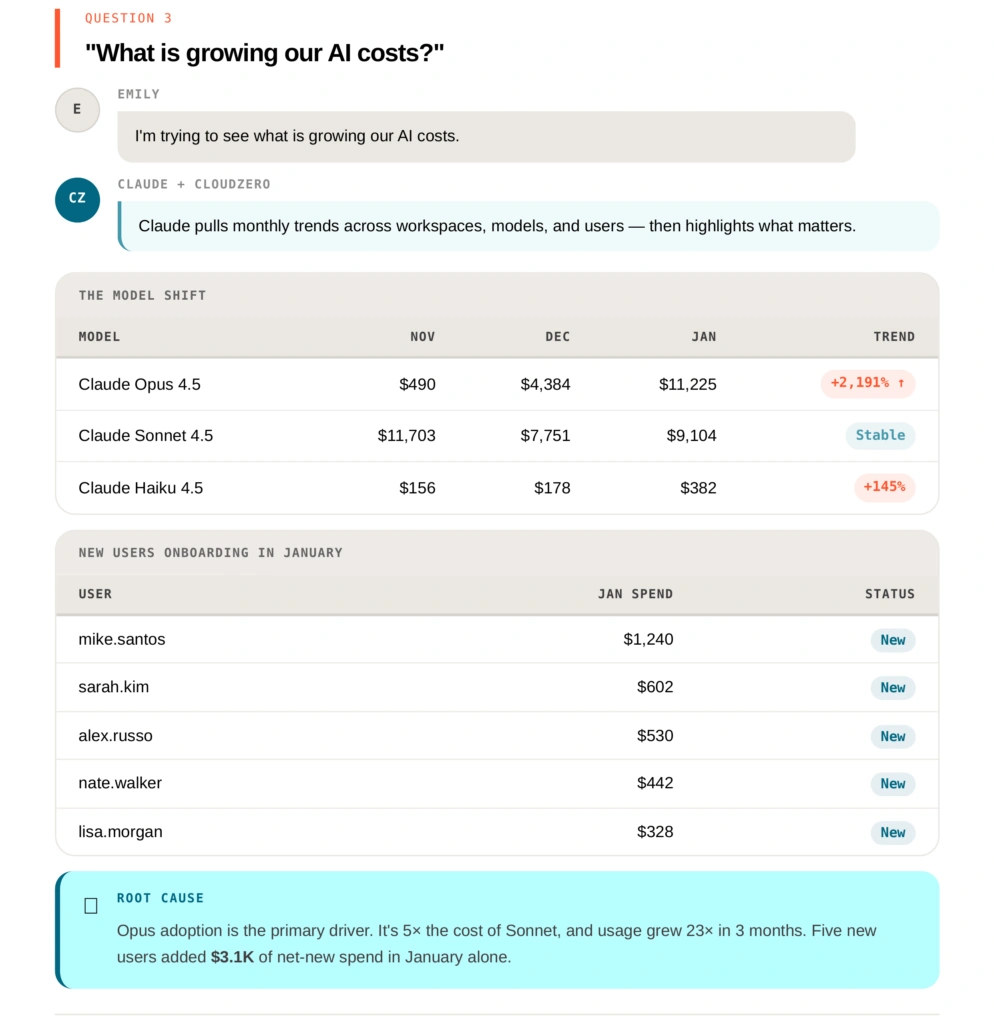
A stark insight here: Opus is up 2,191%, while Sonnet and Haiku are comparatively stable. My first goal was to understand why AI costs were rising. With this, I know exactly where costs are rising, so with just a little more digging, I can get to why.
Question 4: ‘Show me who is using Opus 4.6.’
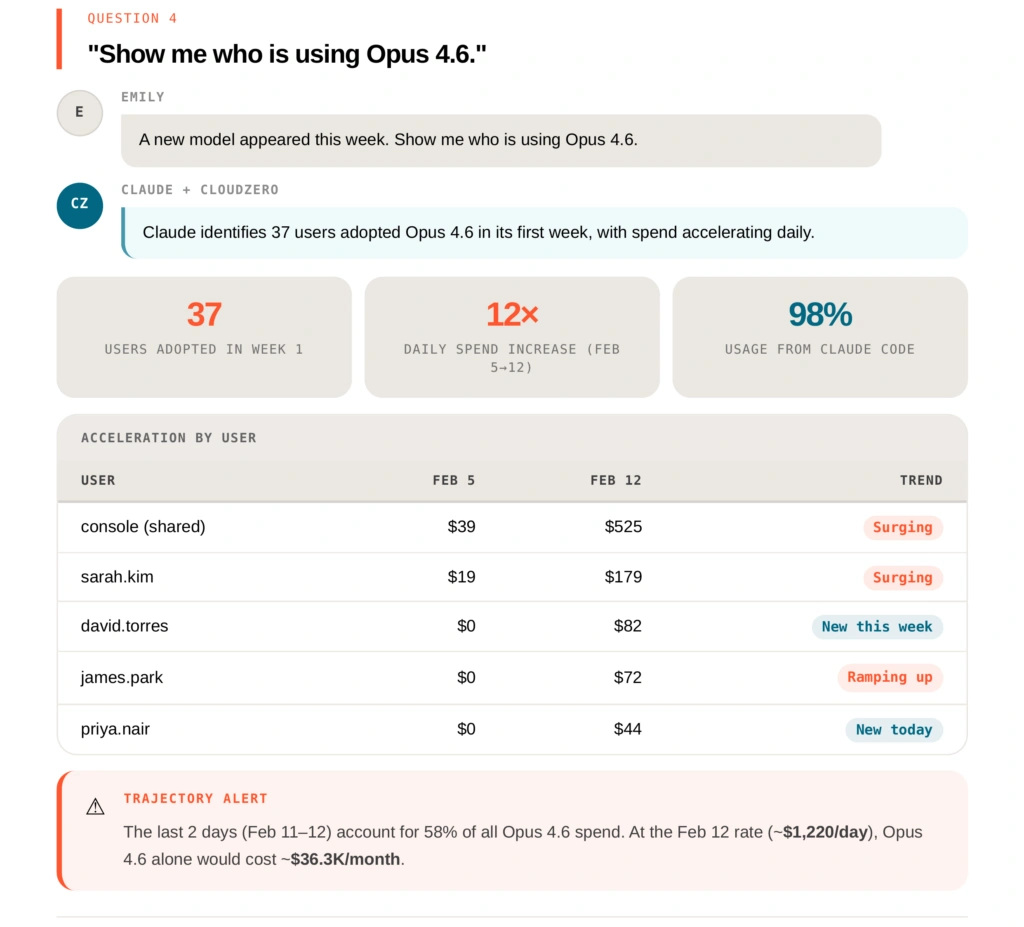
The key insight here is that one person in particular was driving a ton of new Opus spending. I asked this person what she was doing that would drive this much spending. It turned out to be an account development representative (ADR) who was vibe-coding a GTM play to book more meetings — a valiant project, but one that was costing a lot to develop in Opus.
Last question. Did we need to be spending this money? Or could we save without hampering innovation?
Question 5: ‘How much would we save shifting Opus to Sonnet?’
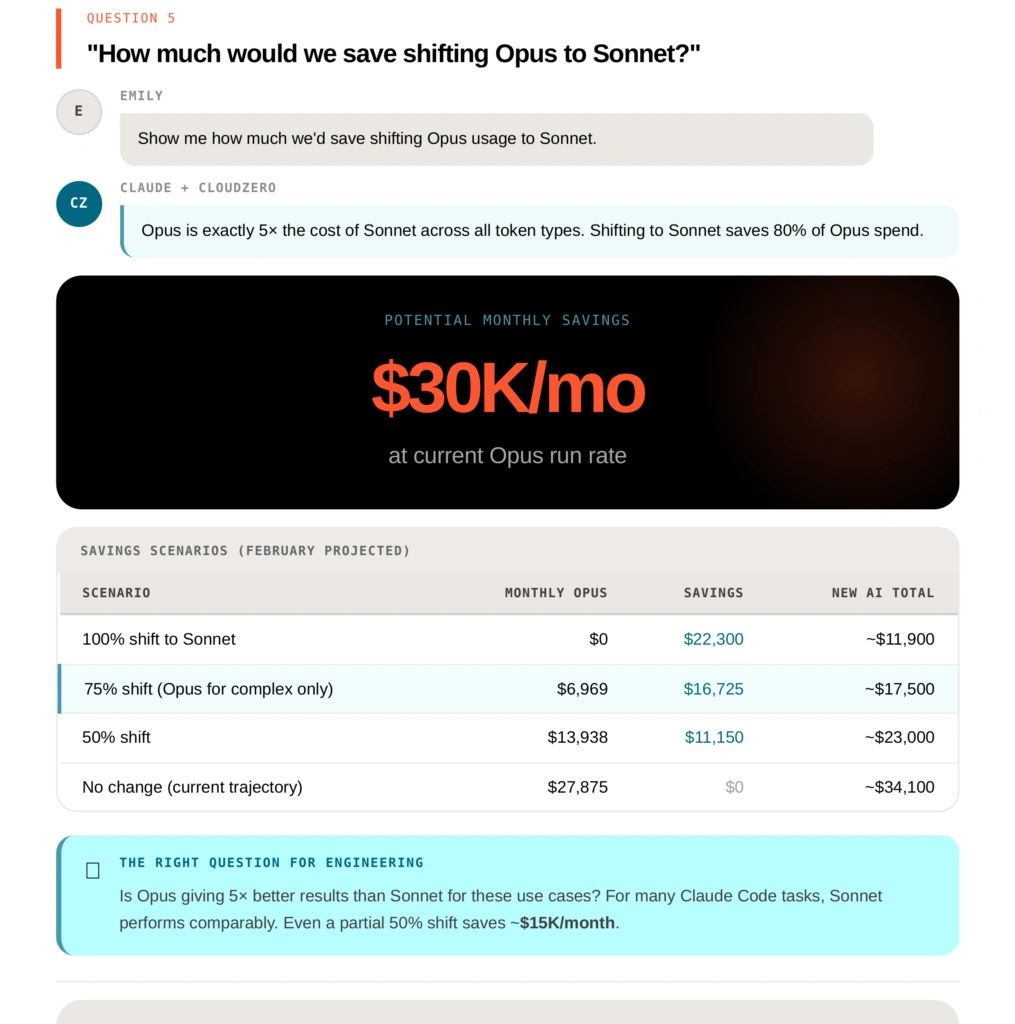
We wanted to support our ADRs innovating, especially in AI. But we didn’t want to spend money recklessly. Opus costs 5x more per token than Sonnet — a cost per token gap that compounds fast at scale. With a few prompts in Claude, I got to the bottom of our cost increases, found an area of inefficiency, and found a concrete, practical solution that was easy to implement.
Report
Finance needs to prove AI’s return: CloudZero report
260 senior finance leaders (more than half CFOs) told us why the speed of seeing AI spend, not the size of it, separates who pulls ahead on AI from who gets burned.
What I Took Into My Meeting With Engineering
In 10 minutes, without ever opening CloudZero, filing a ticket, or waiting for a report, I had everything I needed to get the conversation going with engineering:
- A total AI spend number. The broad strokes, a great place to start. $39.5K total over 3 months, trending toward $27K+ this month alone.
- The root cause. The what. Opus model adoption grew $2,000+ since November. It’s 5x more expensive per token than Sonnet.
- Named individuals and teams. The who — and, after talking to the spenders, the why. 37 Opus 4.6 users identified. Top spenders named. Shared keys flagged for audit.
- Specific savings opportunities. What we can do about it. $13K–$30K/month by shifting some Opus usage to Sonnet, with scenario modeling for potential shifts.
- A clear, action-oriented question for Engineering. “Is Opus giving us 5x better results than Sonnet for these Claude Code tasks?”
Drinking Our Own Champagne
Some people would call this “eating our own dog food” — i.e., using our own product to drive results. But that implies some sense of obligation: We should use our own product because we made it.
This isn’t dog food. It’s champagne. I wanted to use CloudZero’s AI Hub because it was the fastest, clearest way to get answers. I didn’t know CloudZero’s query syntax, and I didn’t need to. I asked questions the way I’d ask them of a talented colleague, and I got answers I could act on in minutes.
The CloudZero MCP integration turns Claude from a chatbot into a finance analyst with real-time access to all our cloud cost management dimensions. A not-super-technical Director of Finance got actionable insights, in 10 minutes, using just plain English.
Cheers to that.
Trust me, you’re not the only finance professional dealing with this. Share this post with your finance network on LinkedIn.
Or email it to a finance colleague or team leader who might be interested in learning how they can curtail rising AI API costs without complicated engineering.