Quick Answer
Grok pricing splits into consumer plans and API token rates. Consumers pay $0 on the free tier, $30 per month for SuperGrok, or $300 per month for SuperGrok Heavy, with Grok also bundled into X Premium subscriptions. The API bills per million tokens: Grok 4.6, the current flagship, costs $2 input and $6 output, Grok 4.3 costs $1.25 and $2.50, and rates double once a prompt reaches 200,000 tokens.
On May 15, 2026, xAI quietly retired the original Grok 4, the reasoning flagship it had launched just ten months earlier. Requests to the old model now silently redirect to Grok 4.3, which costs $1.25 per million input tokens against the original’s $3, and $2.50 per million output tokens against the original’s $15.
Read those numbers again as a budget owner. The output rate fell 83% in ten months. Any annual AI budget built on Grok 4’s launch pricing was fiction within two quarters, and in the generous direction, which is somehow the version finance teams plan for least.
That velocity is the real story of Grok pricing. The models change, the rates change, and the pages ranking for this topic openly contradict each other. Every rate below comes from xAI’s own documentation, checked August 26, 2026, and noted where a figure is an estimate rather than a published price.
We’ll cover the consumer plans, the free tier, the full API rate card including the add-on meters most guides skip, how Grok compares to the other frontier models, and what pricing that moves this fast means for anyone accountable for AI ROI.
How much does Grok cost?
xAI, Elon Musk’s AI company, prices Grok across two separate products that share a brand: the consumer chatbot at grok.com and in the Grok apps, and the developer API.
The consumer side charges flat monthly fees. The API meters every token. Here’s the consumer side first:
| Plan | Price | What it’s for |
|---|---|---|
| Free | $0 | Limited Grok access with usage caps |
| SuperGrok | $30/month | Full model access with a larger weekly usage pool |
| SuperGrok Heavy | $300/month | The highest usage limits, for all-day heavy work |
| X Premium bundles | Varies by X tier | Grok access included inside an X subscription |
The Grok cost question most people are really asking is whether $30 buys enough usage, and xAI changed how that works in June 2026. Paid plans now draw from one shared weekly usage pool spent across Chat, Imagine, Voice, and Build, replacing the old per-two-hour prompt caps.
That change matters because most guides still quote the retired caps. If a page tells you SuperGrok allows a fixed number of prompts every two hours, it’s describing a pricing structure that no longer exists, which is a useful freshness test for everything else that page claims.
One structural note before the tiers: the API requires no consumer subscription at all, and no X account. Developers sign up at x.ai, get a key, and pay per token. The two products meter completely differently, so we’ll take them one at a time, starting with free.
2026 State of AI Spend Report
Why Finance Caps What It Can’t See
Learn how finance leaders are managing AI spend, and how they’re approaching FY2027
Is Grok free?
Yes, with real limits. The free tier includes access to Grok’s core chat with capped usage: enough to evaluate the model honestly, not enough to run daily work on. Free users get a taste of the weekly pool; paid tiers get the meal.
There’s also a Grok free trial path worth knowing: xAI has periodically offered trial access to paid features and promotional API credits for new developer accounts. Availability shifts with xAI’s campaigns, so treat any specific trial offer you read about as expired until the signup flow proves otherwise.
The practical free-tier question is where the ceiling sits, and the honest answer is that xAI tunes it continuously and doesn’t publish granular caps the way infrastructure vendors publish storage limits. Budget planning on the free tier is guesswork by design. The paid tiers are where the numbers firm up.
What do SuperGrok and SuperGrok Heavy include?
SuperGrok at $30 per month is the standard Grok subscription for individuals: full access to current models, image generation, voice, and the larger shared weekly usage pool. For most daily users, this is the tier that removes friction without requiring a conversation with anyone in procurement.
SuperGrok Heavy at $300 per month is the power tier, carrying the highest usage limits in the lineup. It’s priced for people whose work runs through Grok all day, and its 10x premium over SuperGrok is fundamentally a usage calculation, not a features checklist.
Canceling is worth documenting, since thousands of people search for it monthly: like most consumer subscriptions, Grok plans are managed from account settings or through the app store that billed you, with access running through the end of the paid period. Check the current flow in your account, since xAI adjusts its billing surfaces regularly.
For individuals, that’s the whole decision made in one screen. For companies, though, the consumer tiers are rarely where the Grok money actually goes. The API is, and the API is where the pricing gets genuinely interesting, and genuinely easy to misread.
How much does the Grok API cost in 2026?
Here is the current xAI Grok API rate card. All rates are USD per million tokens and apply to prompts under 200,000 tokens:
| Model | Input | Cached input | Output | Context window |
|---|---|---|---|---|
| Grok 4.6 (flagship) | $2.00 | $0.50 | $6.00 | 500K tokens |
| Grok 4.5 | $2.00 | not published | $6.00 | 500K tokens |
| Grok 4.3 | $1.25 | $0.20 | $2.50 | 1M tokens |
| Grok 4.1 Fast | $0.20 | not published | $0.50 | 2M tokens |
| Grok Build 0.1 (coding) | $1.00 | $0.20 | $2.00 | 256K tokens |
Checked August 26, 2026 against xAI’s release notes and pricing docs. Cached rates are shown only where xAI publishes them.
A few rows deserve a second look. Grok 4 Fast’s 2 million token context window is the largest in the lineup, at the lowest price, which makes it the workhorse for high-volume retrieval and long-document work. And Grok Build 0.1 targets the coding-agent market that Claude Code pricing currently anchors.
Grok 4.5, launched July 8, 2026, is the frontier tier, and independent benchmarking by Artificial Analysis put its pricing roughly 60% below comparable Claude and OpenAI flagships for similar benchmark performance at launch. Aggressive pricing is xAI’s visible wedge into enterprise workloads.
And the retired Grok 4 row isn’t in the table because it no longer exists to buy. The history matters anyway: $3/$15 to $1.25/$2.50 in ten months is the trajectory to remember whenever a vendor quote, or an internal forecast, treats today’s rate as permanent.
The list price, though, is only the opening bid. Four add-on meters routinely move a real Grok API bill 20% to 100% away from what the table above predicts, and most pricing guides skip all four.
Here’s the complete set.
What add-on charges change the Grok API bill?
These four billing mechanisms are where the rates xAI quotes and the invoice you receive part ways. None of them are hidden. All of them are easy to forget when someone multiplies tokens by list price in a planning spreadsheet and calls the result a forecast:
| Meter | Rate | When it bites |
|---|---|---|
| Long-context threshold | 2x all token rates | The entire request doubles once a prompt reaches 200K tokens |
| Priority Processing | 2x standard token rates | Opt-in tier for lower latency at double price |
| Batch discount | 20% off, Grok 4.3 and 4.20 only | The flagship 4.5 gets no batch discount |
| Server-side tools | $5/1K calls (web search, X search, code execution), $10/1K (file attachments), $2.50/1K (collections) | Agent workloads that call tools constantly |
The long-context rule is the sharpest edge. A 210,000-token prompt isn’t billed as 200K at standard rates plus 10K at double. The entire request bills at the doubled rate, so a workload that drifts past the threshold doesn’t grow its bill smoothly. It steps it.
Cached input is the lever pointing the other way. At $0.50 per million on Grok 4.6 (a 75% discount) and $0.20 on the 4.3 family (84%), repeated system prompts and shared context become nearly free, which is the single biggest optimization available to high-volume RAG and agent workloads.
Here’s what that math looks like on a deliberately simplified workload. A support assistant handling 100,000 single-turn requests a month, averaging 2,000 input and 500 output tokens each, runs 200 million input and 50 million output tokens. On Grok 4.3, that’s $250 of input plus $125 of output: roughly $375 a month.
Now apply the caching lever. If 70% of that input is a repeated system prompt served from cache at $0.20 per million, the input bill falls to $103 and the total lands near $228, a 39% cut from one configuration choice. Most Grok cost estimates never model that lever at all.
Tool calls deserve special attention from anyone building agents, because agents call tools relentlessly. At $5 per thousand web searches, an agent averaging four searches per task adds two cents to every run, invisible in testing, very visible at a million runs, the exact pattern we’ve traced in AI agent cost analysis.
So the honest Grok API forecast is tokens times list price, times a caching assumption, times a long-context assumption, plus tool calls on top. Which raises the natural next question worth asking: after all of that math, is Grok actually the cheap option?
How does Grok pricing compare to OpenAI, Claude, and Gemini?
At list price, Grok is currently the market’s aggressor. Grok 4.5’s 2/6 undercuts comparable OpenAI and Claude flagship rates significantly, and Grok 4 Fast’s 0.20/0.50 competes directly with the budget tiers in Gemini’s lineup and with DeepSeek’s famous disruption pricing.
Price per token isn’t price per outcome, though. On Artificial Analysis‘s Intelligence Index, Grok 4.6 scores 61, fourth behind Claude Opus 5, and independent evals still put Grok behind Claude on code generation and behind OpenAI on function-calling reliability in multi-turn agent loops. A cheaper token that needs two attempts is an expensive token, a truth every eval-driven team eventually invoices.
Where Grok’s aggression genuinely matters is negotiating power and workload placement. Teams running multi-model stacks, often spanning Perplexity’s API and others, route bulk latency-tolerant work to whichever provider is cheapest that quarter, and Grok’s rate card makes it a serious candidate for that slice. Modeling that routing decision properly is an LLM cost exercise, not a list-price glance.
Our Grok vs. ChatGPT comparison covers the capability trade-offs in depth. The budget-level takeaway is simpler: Grok’s pricing is a moving target by strategy, xAI wants the enterprise slice and is buying it, and that has one big implication worth its own section.
Why does Grok’s pricing churn matter for AI budgets?
Count the pricing events in this article’s timeline. A flagship launched July 2025 at $3/$15. Retired ten months later. Its successor priced 58% to 83% lower. Usage caps restructured in June 2026. A new flagship, Grok 4.5, in July 2026 priced 60% under competitors. Then Grok 4.6 replaced it 35 days later. Six budget-relevant changes in fourteen months, from one vendor, and the last two landed inside a single quarter.
Now hold that against how finance actually plans. In CloudZero’s 2026 survey of 260 finance leaders, 55% said they ran over their AI budget, and 32% overran by more than 20%. Those overruns happened while headline per-token prices, as Grok’s own trajectory shows, were falling.
That’s the paradox worth sitting with: unit prices dropped and budgets still broke, because usage grew faster than rates fell and nobody’s forecast connected the two. Model pricing churn doesn’t just invalidate spreadsheets. It quietly converts every static AI budget into a guess with a signature on it.
The teams handling this well have stopped treating model pricing as an annual planning input and started treating AI spend as a continuously monitored unit cost: cost per feature, per customer, per agent run. When the vendor changes the rate card, their numbers update by themselves. That’s the capability CloudZero was built to provide.
How does CloudZero keep Grok spend measurable?
CloudZero is the AI ROI company, managing more than $15 billion in cloud and AI spend, and vendors like xAI are exactly why the category exists: pricing that changes quarterly, meters that stack, and spend that grows faster than any manual review cycle can track.
Grok spend lands in the same view as everything else. CloudZero’s AnyCost capability ingests AI platform costs, including OpenAI and Anthropic natively and any provider via AnyCost adaptors, alongside AWS, Azure, GCP, Snowflake, and Databricks. Your Grok API charges, your other model bills, and the infrastructure underneath land in a single spend picture, token to server.
Unit cost that survives rate changes. CloudZero maps token spend to products, features, and customers, so the question that matters, “what does this AI feature cost to serve, and is it worth it?”, stays answerable even while the per-token math underneath keeps shifting with every model release.
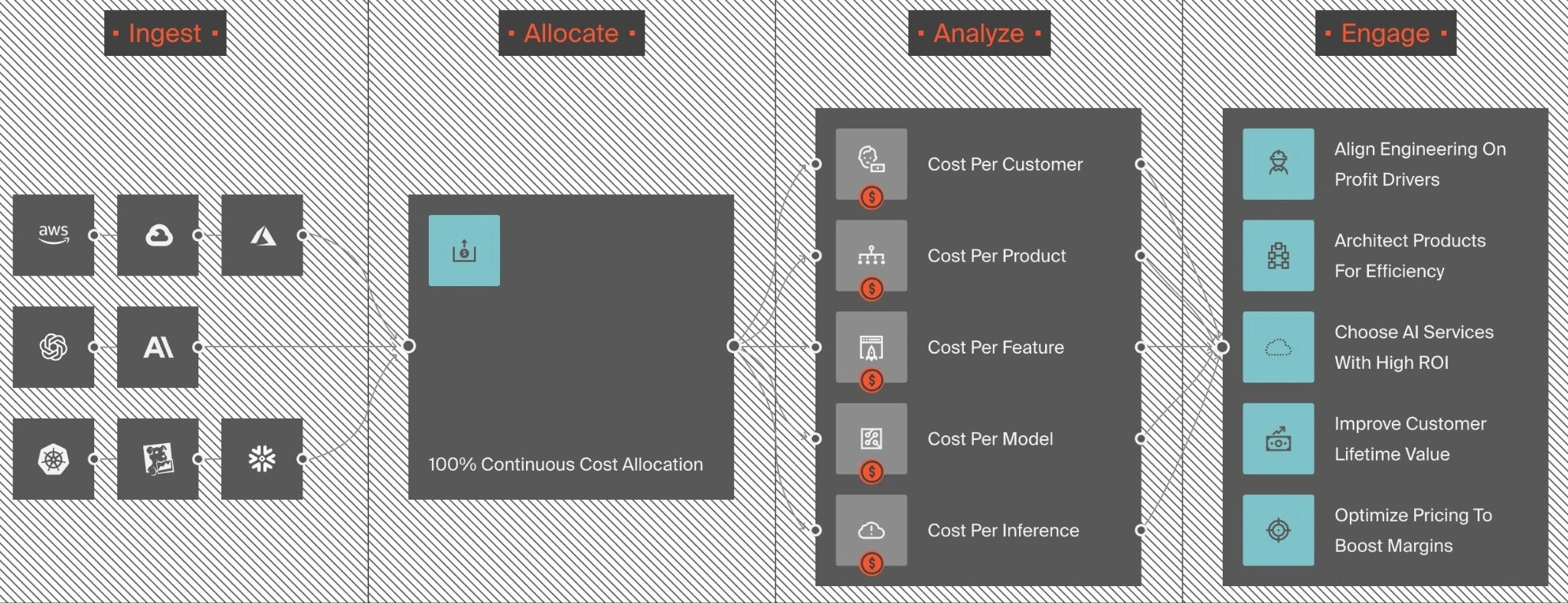
Cost spikes surface the same day. An agent that drifts past the 200K threshold doubles its token bill in one deploy. CloudZero’s anomaly detection flags that step-change when it happens, not on the invoice, a discipline it runs on its own bill: 54 focused hours once banked $1.7 million in annualized savings, and customers average 22% in year one.
Grok’s pricing will change again, probably before this page’s next quarterly refresh. That’s not a reason to avoid the platform. It’s a reason to stop budgeting AI on static spreadsheets and start measuring it like the living unit cost it is.
Request a demo and bring your actual token volumes, and we’ll show you what your AI features really cost to serve across every provider you use. Or start with a free cloud cost assessment for a no-commitment read on where your AI spend visibility ends today.
Frequently asked questions about Grok pricing