Quick Answer
AI infrastructure costs span four buying tiers in 2026: API-only teams spend hundreds to tens of thousands per month on tokens, GPU renters typically pay $2 to $10 per GPU-hour by chip class, committed-capacity buyers sign six-to-eight-figure reservation contracts, and owners spend millions per rack. The stack has six layers, and most budgets underestimate everything below the GPU line.
The four largest hyperscalers opened 2026 with February’s earnings-season tally guiding roughly $630 billion in combined capital spending. By autumn, earnings-call revisions had pushed the tracked total to roughly $730 billion, up about 78% from 2025’s record $410 billion, with Amazon alone raising its guide to roughly $220 billion in July.
That revision pattern is the single most useful fact for anyone budgeting AI at normal-company scale, because it explains the market you’re buying into: the world’s most sophisticated infrastructure buyers keep concluding they under-ordered. As Value Add VC’s capex analysis put it, “being short on compute is the one mistake none of them can afford to make.” Scarcity rolls downhill from there into the prices, reservation terms, and capacity queues the rest of us see.
CloudZero sits on the receiving end of those prices: the first cloud cost platform to integrate directly with Anthropic, built to pull cloud, GPU, and AI spend into one allocated view, and what follows is the map it draws from.
By the end you’ll have three things: the six layers of the stack and what each actually costs, the four buying tiers with real monthly numbers, and the capacity-commitment math that turns infrastructure planning into a finance decision.
What is AI infrastructure?
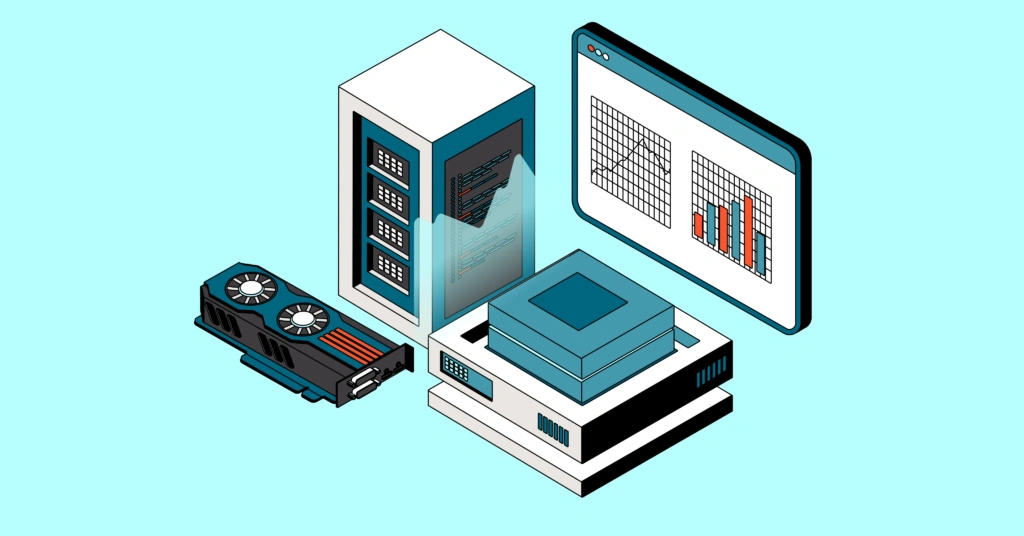
AI infrastructure is the physical and software stack required to train and run artificial intelligence models. Six layers, bottom up: power and data centers, compute (GPUs and custom accelerators), networking that keeps thousands of chips synchronized, data and storage feeding them, orchestration software scheduling the work, and the serving layer where training and inference actually run.
The definition matters because the term carries two other meanings. Investors use the term for the stocks-and-buildout story, and general IT uses cloud infrastructure for ordinary compute and storage. For anyone holding the budget, the practitioner meaning governs: the stack your AI workloads run on and the bill it generates.
2026 State of AI Spend Report
Why Finance Caps What It Can’t See
Learn how finance leaders are managing AI spend, and how they’re approaching FY2027
What are the six layers of the AI infrastructure stack, and what does each cost?
Each layer has its own cost driver, and the expensive surprises live below the line most budgets draw.
| Layer | What it is | What drives cost | Where the prices live |
|---|---|---|---|
| Power and facilities | Data center space, cooling, electricity | A modern GPU rack draws several times a traditional one; power is the binding constraint | Owners and colocation buyers only |
| Compute | GPUs, TPUs, custom silicon | Scarcity pricing; roughly 35% to 40% of 2025 hyperscaler capex flowed to Nvidia by tracker estimates, and below 40% once land, buildings, and power are counted | H100 rates, cloud GPU comparison |
| Networking | Interconnects syncing chips each training step | The slowest link stalls everything, so overprovisioning is standard | Bundled into instance and cluster pricing |
| Data and storage | Feeding GPUs fast enough to keep them busy | GPUs idling on data still bill; utilization is a storage problem that bills as compute | Cloud storage and throughput tiers |
| Orchestration | Schedulers and cluster managers (Kubernetes, Slurm, Ray) | Engineering time plus the waste it does or doesn’t prevent | Kubernetes GPU attribution |
| Training and inference | Where models run; you train once and pay to serve forever | Inference volume compounds; token economics govern the metered path |
The layer table also explains the most common budgeting mistake: pricing the GPU and treating the other five layers as rounding. Utilization data says otherwise, since a GPU waiting on storage or a stalled interconnect bills identically to one doing work.
How much does AI infrastructure cost?
It depends on which of four buying tiers you’re in, and the tiers differ by orders of magnitude.
| Tier | You buy | Average 2026 spend | The trap |
|---|---|---|---|
| API-only | Tokens from model providers | Hundreds to tens of thousands per month | Inference volume compounds quietly |
| GPU rental | On-demand or spot GPU-hours | Typically $2 to $10 per GPU-hour; thousands to hundreds of thousands monthly | Idle time bills like work |
| Committed capacity | Reservations, provisioned throughput | Six to eight figures annually | Paying for peaks you provisioned but don’t hit |
| Ownership | Hardware, colocation, power | Millions per rack before staff | Depreciation meets model churn |
Here’s a worked example: a team renting 16 GPUs at $4 per GPU-hour around the clock spends about $46,700 a month, $560,000 a year, before storage, networking, and the engineers running it. The same team at 40% real utilization is paying $10 per useful GPU-hour inside the $4 sticker.
That gap between paid hours and useful hours is where most AI compute cost overruns live, and it’s invisible on the invoice. Every $1 per GPU-hour of waste on that one cluster compounds to about $140,000 a year.
The same arithmetic decides build versus rent: ownership beats rented rates only when sustained utilization stays high enough to amortize hardware whose economic life model churn keeps compressing.
The hyperscalers’ near-$730 billion year exists precisely because they meter these tiers to everyone else. Their capex is the supply curve behind your rate card.
What is AI capacity planning?
AI capacity planning is deciding how much compute to secure ahead of demand and in what form: on-demand flexibility, reserved commitments, provisioned throughput on managed platforms like Bedrock, or owned hardware, which is data center capacity planning at enterprise scale. In 2026’s scarcity market it’s a finance decision wearing an engineering costume, because every capacity choice is a spend commitment with a term attached.
The core trade is symmetric and unforgiving. Under-commit and you pay on-demand premiums or queue for capacity during exactly the demand spike you built for. Over-commit and you’ve signed for peaks that never arrive; committed-but-idle capacity is the enterprise version of the utilization gap above.
The discipline that works is unglamorous: baseline from measured usage rather than roadmap optimism, commit to the floor you can prove, keep the spike layer on-demand, and revisit quarterly because both your demand and the market’s prices move. The scaling mechanics that execute these decisions are their own topic.
Capacity planning also names a workforce and project discipline, staffing against demand, and most software sold under that name serves the workforce meaning. Same phrase, different budget line. Everything above and below concerns the compute meaning.
Who are the main AI infrastructure providers?
AI infrastructure providers sort into five categories, and knowing which category you’re buying from matters more than any vendor ranking. Hyperscalers (AWS, Google Cloud, Azure) sell every tier from tokens to reserved clusters. Specialized GPU clouds (the CoreWeave class) sell compute with better availability and often better rates.
Model providers (OpenAI, Anthropic, and the broader LLM API market) sell the serving layer as a metered product. Chipmakers sell the scarcity itself. And colocation plus power providers sell the bottom of the stack to owners.
Most real-world AI estates buy from three of these categories at once, which is why the bills never reconcile in one place. Rankings within categories change quarterly and live in dedicated comparisons; the category structure is the durable part.
How do you measure and allocate AI infrastructure costs?
Measurement is where the budget breaks, because the stack bills in incompatible units: GPU-hours here, tokens there, reserved capacity somewhere else, and none of it tagged to the team or product that consumed it. The GPU workload cost problem, per-workload answers from shared clusters, is the canonical example, and it’s solvable.
The platform pulls every layer’s bill into one place through its integrations (native connections plus the AnyCost pipeline for anything with an export), allocates it by team, product, and workload through Dimensions, and turns capacity commitments into tracked Budgets with hourly drift detection. An idle reserved cluster shows up as a flagged variance rather than a year-end confession.
To plan a commitment against your own measured demand, schedule a demo and bring the reservation quote.
Frequently asked questions about AI infrastructure costs