Quick Answer
ClickHouse vs Snowflake comes down to one question a CFO can use: how predictable do you need the bill, and how fast do you need the answer?
Snowflake is a managed cloud data warehouse billed in consumption credits. Easy to run, prone to surprise invoices.
ClickHouse is an open source columnar database built for real-time speed, usually far cheaper at scale but harder to operate.
Most teams run both. The real trick is seeing what each one costs before the invoice lands.
ClickHouse vs. Snowflake at a glance
Here is the whole Snowflake vs. ClickHouse decision on one screen. Every row is a line someone in finance has had to defend to a board.
| ClickHouse | Snowflake | |
| Category | Open source columnar database (OLAP database) | Managed cloud data warehouse |
| Pricing model | Free license plus infrastructure, or ClickHouse Cloud (compute plus storage) | Consumption credits, $2 to $4 each by edition |
| Cost at scale | Often 3 to 5x cheaper for heavy analytics | Higher, and harder to forecast |
| Speed | Sub-second queries on billions of rows | Great for batch and BI, slower on real-time |
| Ops effort | Higher if self-hosted, low on Cloud | Very low, it just runs |
| Ecosystem | Deep for streaming and observability | Enormous, connects to nearly everything |
| Bill predictability | Steadier | Famously spiky |
| Best for | Real-time analytics, dashboards, observability | Governed BI, reporting, mixed workloads |
One line to tape to the budget: ClickHouse vs. Snowflake is not “which is better.” It is “which meter do you want running, and can you read it in time.” There are two meters. Here is why that changed.
Report
Finance needs to prove AI’s return: CloudZero report
260 senior finance leaders (more than half CFOs) told us why the speed of seeing AI spend, not the size of it, separates who pulls ahead on AI from who gets burned.
Why does this comparison land on the CFO’s desk now?
Short version: the data warehouse quietly became an AI platform, and AI is the fastest-growing line on your bill.
For years, Snowflake vs. ClickHouse was an engineering argument about query speed. Then both platforms started running frontier AI directly on your data. Snowflake now hosts Claude and OpenAI’s GPT-5 models inside Cortex. ClickHouse ships Claude-powered agents you drive from Claude Code and Cursor.
So you are no longer paying for storage and queries alone. You are paying for inference on top.
That is two consumption meters stacked together, both usage-based, both able to double in a month because a feature got popular.
Gartner expects worldwide AI spend to hit $2.5 trillion in 2026, and a lot of it hides inside data platform bills. That is why choosing between ClickHouse and Snowflake is now a finance decision, not just a data-team one.
At CloudZero, the AI ROI company, this is the pattern we see daily: teams optimize the warehouse, then get blindsided by the AI meter running beside it. Picking the warehouse is step one. Proving the spend was worth it is the whole game, and we come back to it below.
The company that asked an AI which database to use
The best ClickHouse vs. Snowflake story of the year belongs to Anthropic, the company that builds Claude. It is worth telling start to finish, because it is the entire comparison in miniature.
The setup: Claude 3 launched in March 2024 and people noticed. Claude 3.5 arrived, and, in the words of Anthropic engineer Maruth Goyal, things hit the fan. Usage soared. Telemetry, logs, and metrics exploded with it.
The fire: their old observability database buckled. Goyal’s description translates the engineering problem into finance terms directly. When the data gets too big, the database catches fire, queries time out, and money catches fire. Meanwhile the safety bar rose. Claude Opus 4 in May 2025 triggered AI Safety Level 3 controls, which meant locking down any data leaving their clusters.
The punchline: a three-person team needed something fast, secure, air-gapped, and low-maintenance. Goyal did not have a superintelligence on hand, so he asked the next best thing. He asked Claude what to use. Claude said ClickHouse.
The payoff: after moving to an air-gapped ClickHouse deployment, Goyal summed it up in three parts in ClickHouse’s case study: “The database is green, queries are lightning-fast, and money is not on fire.”
One engineer said he had not noticed the database running in weeks.
Two takeaways for finance. Anthropic did not throw this at a general-purpose cloud data warehouse because real-time, high-volume analytics is exactly where warehouse credits catch fire and a purpose-built OLAP database shines. And the metric that decided it was not benchmark speed. It was whether money was on fire, which is a CFO’s question answered by an engineer.
What is the difference between ClickHouse and Snowflake?
The difference between ClickHouse and Snowflake is architectural, and it drives every cost and speed tradeoff below.
Snowflake is a proprietary cloud data warehouse. It splits storage from compute, keeps data in object storage, and runs queries on virtual warehouses you size up or down. It is built for governed BI, reporting, and mixed workloads, and it is the center of gravity for most data stacks.
ClickHouse is an open source columnar database, an OLAP database tuned for sub-second queries on gigantic tables. It reads only the columns a query needs, compresses hard, and skips data it can ignore. That makes it a monster for observability, event analytics, and user-facing dashboards.
The honest framing: these are different tools. Snowflake is a warehouse and governance ecosystem. ClickHouse is a speed-and-cost engine. They overlap on real-time analytics, and that overlap is where the money gets decided.
How does Snowflake pricing work?
Snowflake pricing runs on credits, which is why the snowflake cost conversation gets tense. You burn credits whenever a virtual warehouse is running, and a few things drain them when you are not looking.
On US AWS on-demand, a credit costs about $2 on Standard, $3 on Enterprise, and $4 on Business Critical. Non-US regions add roughly 30 to 60%. Capacity contracts cut 20 to 40%. Storage is separate, around $23 per compressed TB per month.
The math is simple but sneaky. Warehouse sizes double credit burn per step, from 1 credit an hour at XS up to 512 at 6XL. A Medium warehouse on Enterprise runs $12 an hour just sitting there.
Then the snowflake pricing model ambushes you. Credits also drain from idle warehouses, serverless jobs, and background maintenance. In one ClickHouse benchmark, Snowflake automatic clustering quietly ate 450 credits, about $900, keeping a single table tidy before anyone queried it.
That is the real answer to how much does snowflake cost: it depends on patterns you cannot fully see until the month closes. A snowflake pricing calculator or a snowflake cost per credit estimate gives you a starting number, not the real one.
The 2026 change finance should note: Snowflake’s Cortex AI runs on a separate credit currency, billed per token. The moment you use Claude or GPT-5 inside Snowflake, a second meter starts ticking beside your warehouse credits.
How does ClickHouse pricing work?
ClickHouse pricing comes in two shapes, and both tend to be steadier than Snowflake credits.
Self-managed ClickHouse is free to license. You pay for infrastructure and the engineers who run it. ClickHouse Cloud pricing is managed: you pay for compute and storage, with elastic scaling that shrinks when idle, so you are not funding a warehouse you forgot to turn off.
The finance appeal is predictability. ClickHouse cost tracks workload more cleanly, and elastic scaling means a concurrency spike does not lock you into a permanently oversized cluster.
The tradeoff is real. Self-hosted ClickHouse asks your team to understand MergeTree engines, partitioning, and replication. That engineering time is a genuine line item, even when it never hits a vendor invoice. Ignore it and your cheaper option quietly gets expensive.
Here is how the two pricing models line up for a finance reviewer.
| Cost component | ClickHouse | Snowflake |
| Compute | Compute units (Cloud) or your own servers | Credits: $2 to $4 each, per second, 60-second minimum |
| Storage | Included in Cloud tiers or your infra | ~$23 per compressed TB per month |
| Idle cost | Scales down when idle | Credits burn until auto-suspend triggers |
| Background jobs | Ordering keys cost nothing extra | Clustering and serverless features draw credits |
| AI on top | Agent usage billed separately | Cortex AI on a separate credit currency, per token |
| Operational cost | High if self-hosted, low on Cloud | Effectively zero |
Is ClickHouse cheaper than Snowflake?
Usually yes, for the workloads it is built for. But total cost of ownership is the number that matters, not the sticker price.
For real-time and high-throughput analytics, ClickHouse tends to run 3 to 5x cheaper than Snowflake for equivalent work, and the gap widens on premium Snowflake editions.
Here is what the published benchmarks and analyses actually say, with each source and its bias labeled, because the vendor numbers point in opposite directions.
| Source | Snowflake | ClickHouse | What it measured |
| ClickHouse Inc. benchmark | $202 (2X-Large warehouse) | $41 | Loading one dataset: ClickHouse 2x faster, 5x cheaper, 38% better compression |
| Snowflake engineering rebuttal | ~80% lower ingestion cost (Snowpipe Streaming) | baseline | Says the ClickHouse test left out client-side costs worth 60%+ of the total |
| OneUptime worked example | ~$5,632/mo | ~$600 to $1,200/mo | XL warehouse running always-on (illustrative) |
| Benjamin Wootton, independent TCO | baseline | 50%+ potential savings | Data-dependent, and did not independently verify the compression claim |
The honest read: ClickHouse wins its own real-time benchmark, Snowflake wins its own streaming-ingestion benchmark, and an independent analysis lands in the middle around 50%-plus for always-on workloads. So model it on your own data before you assume a number.
Now the caveat that keeps this honest: cost is not just the invoice. A badly tuned self-hosted ClickHouse cluster can burn engineering hours that dwarf Snowflake’s credits. And Snowflake can be cheaper for sporadic, low-volume querying, because you pay nothing between queries while ClickHouse often runs always-on.
So the 3-to-5x rule holds for heavy real-time work, not for a warehouse someone pokes twice a month. This is also why the snowflake cost optimization market exists. Plenty of teams do not need to migrate. They need to see and control the Snowflake spend they already have, which is a visibility problem, not a platform problem.
Is ClickHouse faster than Snowflake?
For real-time analytics, yes, and it is not close. ClickHouse’s vectorized engine, columnar compression, and sparse index deliver sub-second queries on billions of rows. That is why it dominates observability and user-facing dashboards.
ClickHouse’s own benchmarks put ClickHouse Cloud at over 2x faster than Snowflake with 38% better compression on real-time workloads. As a vendor benchmark, treat the exact figures as directional, but the direction is not controversial.
Snowflake is not slow. It is built for a different job: long-running reports, complex star-schema joins, and ad-hoc exploration across governed data. For those, Snowflake often wins, and the convenience is worth real money. Speed only matters relative to the workload, which is the whole point of a real ClickHouse vs. Snowflake evaluation instead of a headline.
When should you choose ClickHouse vs. Snowflake?
Use this as a finance-friendly decision framework. It also settles the neighboring fights your team will inevitably pick.
Choose ClickHouse when you need real-time analytics, sub-second dashboards, observability at scale, high-concurrency user-facing analytics, or predictable cost on heavy workloads, and you have the engineering muscle.
The same logic decides ClickHouse vs. BigQuery, ClickHouse vs. Redshift, ClickHouse vs. Postgres, ClickHouse vs. Druid, ClickHouse vs. DuckDB, and ClickHouse vs. TimescaleDB: ClickHouse wins on speed and cost for event and time-series data.
Choose Snowflake when you want a fully managed platform, broad workload support, deep governance, and the biggest ecosystem in data, and you would rather your team focus on data than servers. Comparing Snowflake vs. Databricks, Snowflake vs. Redshift, Snowflake vs. BigQuery, or Snowflake vs. Synapse? Snowflake’s edge is governance, data sharing, and ease of operation, not raw price.
Run both when you want batch and BI in Snowflake and real-time in ClickHouse. This is common and sensible. It is also why snowflake alternatives searches rarely end in a clean breakup.
Most teams bolt ClickHouse onto the real-time layer rather than ripping Snowflake out.
Whichever way you lean, the meter most teams fail to plan for is the AI one, covered next.
The line item finance always misses: AI on top of the warehouse
The Clickhouse vs. Snowflake decision no longer ends when you pick a warehouse, because both are now AI platforms, and that is the meter that surprises people.
Snowflake signed a $200-million partnership with Anthropic and a separate $200-million partnership with OpenAI, putting Claude and GPT-5 right inside Cortex AI.
Thousands of Snowflake customers already burn trillions of Claude tokens a month through it. Cortex Code, its Claude-powered coding agent, became the fastest-growing product in Snowflake’s history.
ClickHouse went the same direction, shipping Claude-powered agents and a managed server that customers wire up to Claude Code, Cursor, and their own agents.
Translation for finance: your cloud data warehouse is now an inference platform too. A single AI feature can pull cost from four vendors at once, the warehouse, the model provider, a vector database, and a pipeline, and none of them says “AI feature” on the invoice.
You picked a warehouse to control cost and accidentally adopted a second meter. This is the exact blind spot behind a number from CloudZero’s 2026 AI ROI survey of 260 finance leaders: only 16% see AI spend data in real time, and half wait days, or until the invoice, to learn what they spent. You cannot govern a two-meter bill you can only read after the fact.
How does CloudZero show both meters before the bill lands?
Direct answer: CloudZero ingests the warehouse and the AI on top into one model, attributes every dollar to a team, product, or customer, and alerts the owner before the invoice. Here is the plumbing, by platform, so you can see it is specific and not a slogan.
On Snowflake, every credit gets an owner. CloudZero’s Snowflake integration uses an AI-powered allocation engine to attribute every warehouse query, Cortex call, and storage charge to the team, product, customer, or feature behind it, whether your tagging is perfect or barely there.
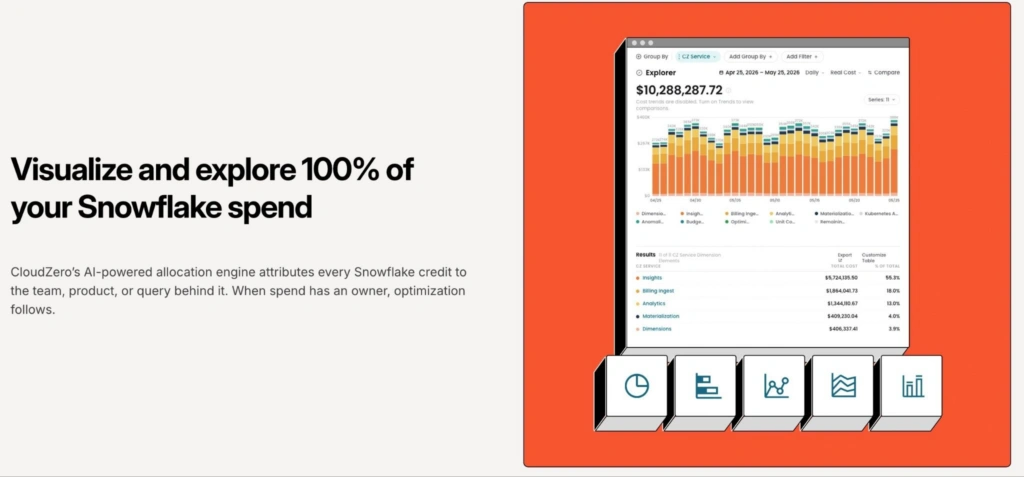
As AI workloads ramp on Cortex, anomaly detection catches spikes in near-real time and routes the alert to the engineer who owns the warehouse, query, or model, not to a finance inbox next month.
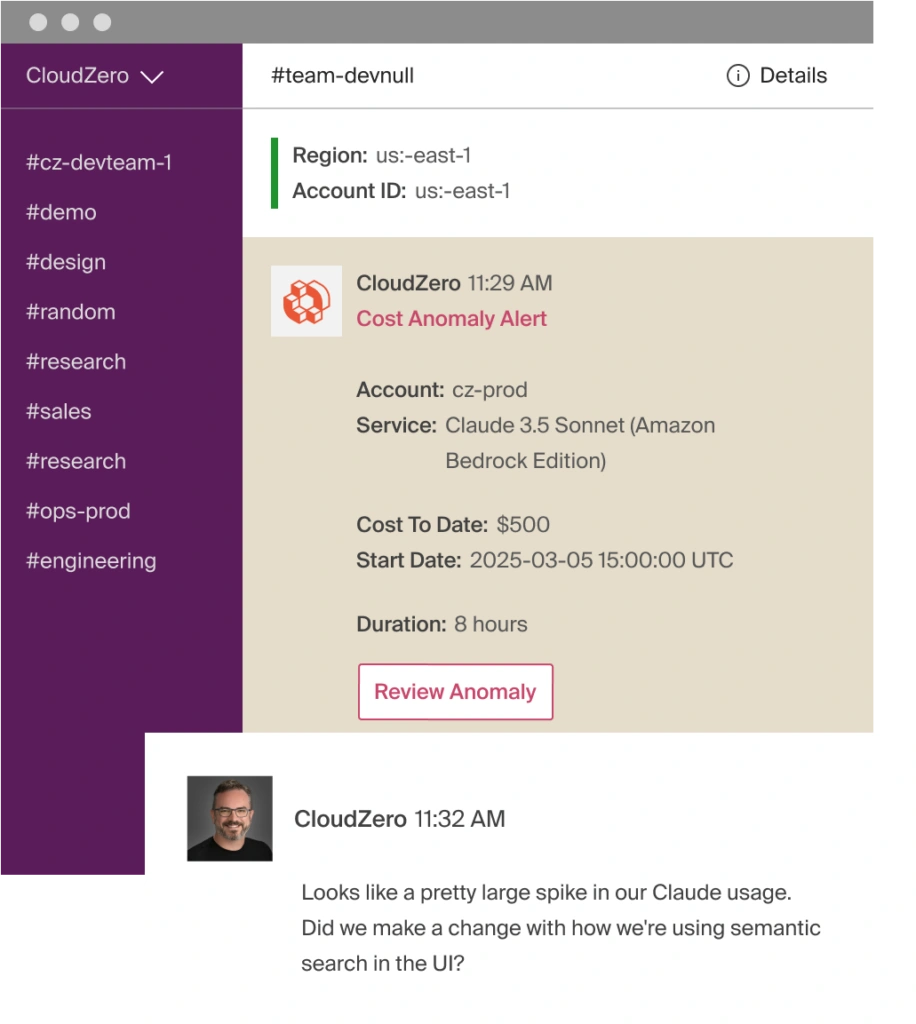
On ClickHouse, the shared cluster finally gets attributed. Most ClickHouse services run many teams against one cluster, so the bill says ClickHouse and nobody owns the spike. Through its AnyCost approach, CloudZero maps every compute hour, storage terabyte, and cross-region transfer to the team, dashboard, or product responsible, and monitors spend against 12 months of baselines with no manual thresholds. A bad partition key or a runaway subquery gets flagged while it is still reversible.
Both feed one number. CloudZero normalizes Snowflake, ClickHouse, Anthropic, OpenAI, Cursor, AWS, GCP, Azure, and Kubernetes into one model.
CloudZero was the first platform to integrate Anthropic’s cost API. Claude tokens sit beside warehouse credits, in the same view, in the same currency you report on.
The payoff is unit economics, which is the whole reason we frame every dollar around AI ROI, not raw AI cost.
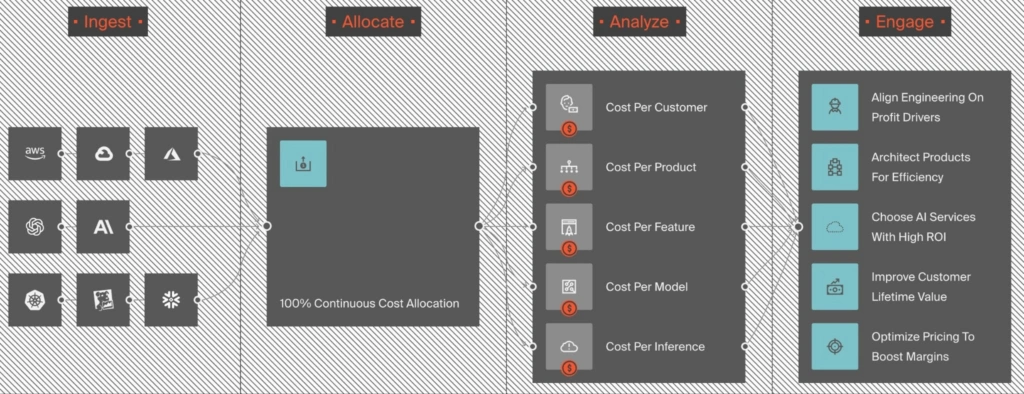
CloudZero’s Dimensions turns Snowflake and ClickHouse spend into cost per customer, cost per product, cost per query, and, for products running vector search or RAG on ClickHouse, cost per inference. “AI costs $200,000 a month” is a number. “The search feature costs $0.003 per query for profitable customers and $0.14 for unprofitable ones” is a decision.
Here is the proof, with names attached. NinjaCat, a marketing analytics company on AWS and Snowflake, turned a monthly bill nobody could explain into cost per customer, then used it to align pricing to what each customer actually cost to serve.
We also drink our own champagne. CloudZero runs its own serverless stack on Snowflake, and used the platform to re-architect how it stores and surfaces resource tags on Snowflake, cutting about $70,000 a year, part of $470,000 in total infrastructure savings.
Skyscanner, also a CloudZero customer, found enough savings within two weeks to pay for a full year of the platform, across more than $15 billion in managed cloud and AI spend.
So pick the platform that fits the workload. ClickHouse for real-time and cost, Snowflake for governance and breadth, both if you are sensible. Just remember what you report to the board is not the platform. It is whether the spend produced a return. That is the AI ROI question, and it is the one worth building around.
Frequently asked questions about ClickHouse vs. Snowflake