Quick Answer
AI cost monitoring is the continuous tracking of AI and LLM spend in real time, broken down by the models, features, teams, and customers generating it. It is not the same as reading the monthly bill - done well, it shows spend as it happens, flags anomalies before they become invoices, and connects every dollar to an outcome so finance can protect AI ROI instead of explaining it after the fact.
The story every finance team knows
It always starts on the third of the month, when the invoices land.
Picture a VP of Finance opening the monthly AI bill. It is triple that of last month. There is no warning, no line item that screams why, just a big number and a board meeting on Thursday.
She pings engineering. Engineering shrugs: they shipped a feature last sprint that calls a bigger model on every request, but they can only see their own provider’s console, not the whole picture, so they cannot say how much it added. Product chimes in that the feature is a hit and usage is way up.
Nobody is lying. And nobody can answer the only question that matters: is this feature making money, or quietly torching the margin on every customer who uses it?
So finance does the one thing it can do without data. It tells everyone to slow down on AI until they understand the spend. Growth stalls, not because the AI was a bad bet, but because nobody could see the bet while it was live.
That scene plays out somewhere every month, and it is entirely preventable. It is also, almost word for word, what CloudZero’s 2026 survey of 260 finance leaders found at scale: teams that cannot see their spend fast enough freeze, while teams that can keep investing with confidence.
AI cost monitoring is what separates the two, and everything below is how it works.
Report
Finance needs to prove AI’s return: CloudZero report
260 senior finance leaders (more than half CFOs) told us why the speed of seeing AI spend, not the size of it, separates who pulls ahead on AI from who gets burned.
Key takeaways
- AI cost monitoring is real-time visibility into AI and LLM spend, tracking cost as it happens rather than reconciling it weeks later from a provider invoice.
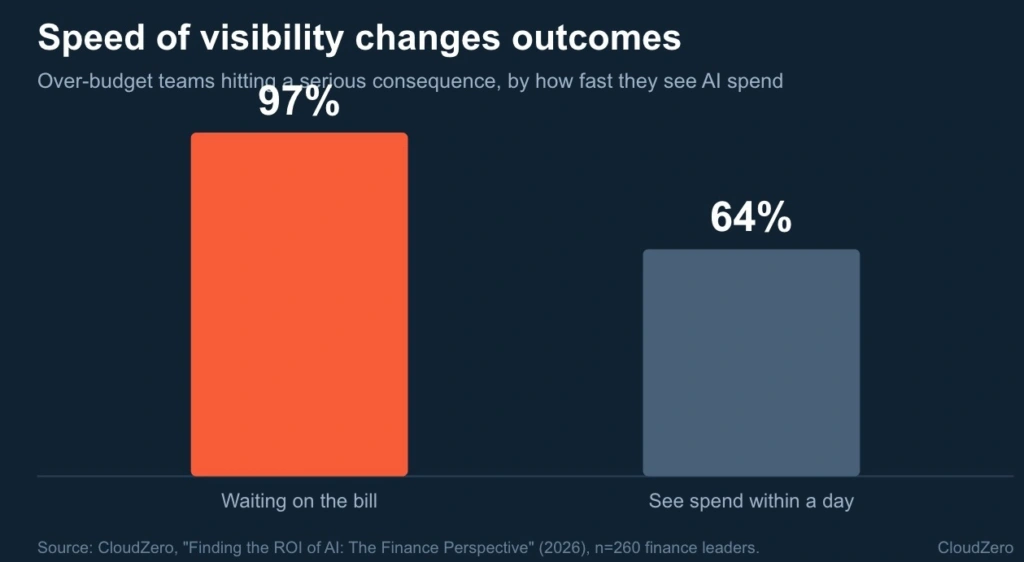
- Speed is the whole point. In CloudZero’s 2026 survey of 260 finance leaders, among teams that went over budget, those who could see spend within a day hit a serious consequence 64% of the time, against 97% for those waiting on the bill.
- Monitoring is not the same as management, optimization, or observability. It is the “what are we spending right now, and on what” layer that the others depend on.
- A good monitor tracks spend per model, per feature, per team, and per customer, not just one total, because that is what ties cost to AI ROI.
- CloudZero delivers this through streaming telemetry, anomaly detection, and outcome attribution, so the people spending on AI and the people answerable for it finally share one live view.
The fix is not a better monthly report. It is monitoring: seeing AI and LLM spend as it happens, in enough detail to act while it still matters. A monthly bill is a bank statement from 1995 wearing an AI badge; monitoring is the live view that would have caught that 3x feature on day one, not on the third of next month.
This guide covers what AI cost monitoring is, how it differs from the terms it gets confused with, what a real monitor tracks, how often to check, and how to tie all of it back to AI ROI, with a real case study at the end.
What is AI cost monitoring?
AI cost monitoring is the continuous tracking of AI and LLM spend in real time, broken down by the models, features, teams, products, and customers that generate it. It answers one question on demand: what are we spending on AI right now, and on what? The goal is visibility fast enough to act on, not a report you read after the money is gone.
That last part matters more than it sounds. The CloudZero survey found that AI is driven outside finance in 74% of companies, but finance owns the bill in 60%. So the people running up AI spend usually are not the people tracking it, and the tracker is working from data that is already stale. Monitoring closes that gap by giving both sides the same live picture.
Real LLM cost monitoring goes deeper than a dollar figure. Because AI cost is driven by tokens, a real monitor watches usage at the level of models, prompts, features, and requests, so a spike is not just visible but explainable. Seeing that spend doubled is alarming. Seeing that it doubled because one feature started calling an expensive model is actionable.
AI cost monitoring vs. management vs. observability vs. optimization
These four terms get used interchangeably, and they should not be. They describe different jobs, and confusing them is how teams end up with a dashboard that answers the wrong question. Here is the clean version.
AI cost monitoring answers “what am I spending right now, and on what.” It is about real-time visibility and alerting.
AI cost management is the broader discipline of owning and governing that spend over time, which we cover in managing AI spend.
AI cost optimization is about spending less.
And AI cost observability is usually an engineering concept about system health (latency, errors, traces), where cost is the one pillar most teams skip, as we argue in AI observability.
| Term | Question it answers | Focus |
| AI cost monitoring | What am I spending right now, and on what? | Real-time visibility, alerting, attribution |
| AI cost management | How do I own and govern AI spend over time? | Process, ownership, accountability |
| AI cost optimization | How do I spend less without losing value? | Efficiency, routing, caching, right-sizing |
| AI cost observability | Why is the system behaving this way? | Engineering health, with cost as a pillar |
Monitoring is the foundation the other three stand on. You cannot manage, optimize, or prove the return on spend you cannot see clearly and quickly. That is why it comes first.
Why real-time AI cost monitoring matters for AI ROI
The case for AI cost visibility is not “dashboards are nice.” It is that speed of visibility measurably changes outcomes. The CloudZero survey devoted an entire section to this, and the numbers are hard to argue with.
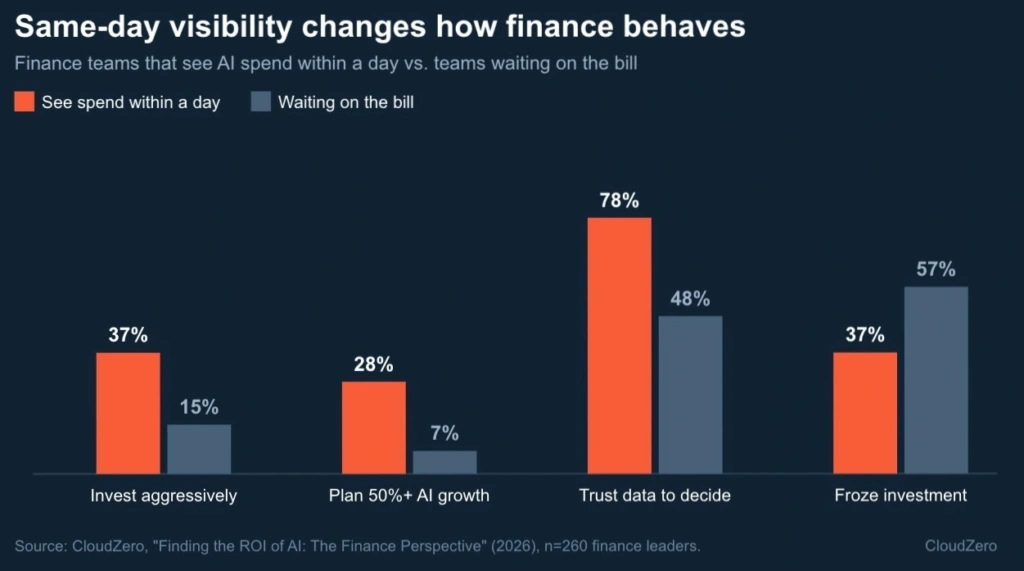
Start with what fast data prevents: freezing. Teams whose AI spend data reaches them within a day were far less likely to hold back AI investment for lack of data, 37% versus 57% for slower teams. Seeing the spend keeps them in the game.
Speed also keeps them out of trouble. Among teams that went over budget, those who could see the spend within a day hit a serious consequence (board pushback, a spend cap, a cancelled initiative) 64% of the time, against 97% for those waiting on the bill. Same overruns.
The only difference was whether finance saw it in time to act.
And it changes posture. The same-day group was more than 2x as likely to hold an “invest aggressively” stance and 4x as likely to plan 50% or more AI spend growth, 28% versus 7%.
They also trusted their numbers: 78% rated their spend data decision-grade, against 48% of slower teams. In the survey’s own words, spend discipline is overrated and speed of visibility is underrated.
This is the heart of what CloudZero calls the AI paradox: the AI era does not punish high spend, it punishes blind spend. Monitoring is how you stop spending blind. It converts AI from a scary line item into a signal you can steer by, which is exactly what protects agentic AI ROI and every other AI bet on the books.
How often should you monitor AI costs?
In real time, or as close to it as you can get. The CloudZero survey pinned down the break point precisely: spend data that reaches finance within a day behaves like a completely different category than data that arrives several days later or with the bill. One day is the line between acting and reacting.
Monthly monitoring, the default for most finance teams, is really just accounting. By the time a monthly report shows a problem, the spend is already gone and the cause is weeks cold. Weekly is better but still leaves room for a runaway agent or a bad deploy to rack up serious money before anyone notices.
The practical target is same-day visibility with real-time alerting on top, so routine spend is reviewed continuously and genuine anomalies page someone the moment they happen. Only about half of finance teams have same-day data today, which is precisely why the half that do are pulling ahead.
| Monitoring cadence | What it lets you do | What it misses |
| Monthly (the invoice) | Reconcile and report after the fact | The spend already happened and the cause is weeks cold |
| Weekly | Spot broad trends | A runaway job or bad deploy can burn serious money in seven days |
| Real-time / same-day | Catch spikes, act, and steer investment with confidence | Requires streaming spend data and real attribution |
What should an AI cost monitoring tool track?
A real AI cost monitoring tool tracks far more than a running total. The total tells you that you are spending. It does not tell you whether the spend is working, and “is it working” is the only question the board actually cares about. The tracker has to connect spend to the things the business runs on.
Here is the checklist. If a tool cannot do most of this, it is a bill viewer, not a monitor.
| What to track | Why it matters |
| Spend in real time, same-day not monthly | Speed is what prevents freezes and blowups |
| Cost per model and per provider | Shows which models and vendors drive the bill |
| Cost per feature, product, team, and customer | Ties spend to outcomes, margin, and AI ROI |
| Tokens and cost per request or task | The true unit of AI cost, especially for agents |
| Anomalies and spikes as they happen | Catch a runaway before it becomes an invoice |
| Budgets and forecasts | Shows where you will land, not just where you are |
Notice how much of this is about attribution, not accounting. Cost per customer and cost per feature are what turn a spend report into a decision: pour more into what pays off, pull back from what does not.
The survey backs this up. Finance did not want one magic number; 48% wanted three or more unit-cost lenses (per dollar of revenue, per customer, per feature, per transaction), because no single metric fits every business.
How to monitor AI and LLM costs: a practical approach
Setting up AI spend monitoring is less about buying a tool and more about answering four questions in order. Get these right and the tooling falls into place.
- First, what are we spending, in real time? Connect every source of AI and LLM spend (model providers, cloud, and the tools built on them) into one live feed instead of a pile of monthly invoices. This is the raw AI cost tracking and LLM cost tracking layer.
- Second, who and what is driving it? Tag and allocate spend to teams, features, products, and customers. A number you cannot attribute is a number you cannot act on. This is where most homegrown dashboards stall.
- Third, what is normal, and what is not? Set budgets and anomaly alerts so a spike pages a human the day it happens, not the day the bill lands. This is the difference between a one-dollar bug and a five-figure one.
- Fourth, is it worth it? Put cost next to the outcome it produced (revenue, usage, tickets resolved) so every dollar can be judged on return. That is the jump from monitoring spend to proving AI ROI.
Plenty of teams try to build this with spreadsheets and provider consoles. It works until it does not, usually the first time a ChatGPT or OpenAI API bill jumps and nobody can say which feature moved it. Monitoring across several providers (Claude, the Claude API, Claude Code, Cursor, and Azure OpenAI) by hand is where the spreadsheet approach quietly falls apart.
How CloudZero delivers real-time AI cost monitoring
Here is the problem every homegrown monitor eventually hits. The people running up AI spend (engineers, calling models and agents all day) are not the people answerable for it (finance, at month end). When the spender and the tracker work from different data, lag is built in, and the survey showed lag is exactly what gets teams burned.
CloudZero was built to close that gap by giving both sides the same live view. It ingests AI, LLM, and cloud spend through streaming telemetry so the picture is current, not a month old, then breaks it down by the dimensions that matter to the business: team, product, feature, and customer.
That turns raw spend into answers finance can use. Instead of “we spent a lot on AI,” you get cost per customer, cost per feature, and margin, the unit metrics the survey said finance wants most. It is real AI cost observability aimed at the pillar most tools skip: cost.
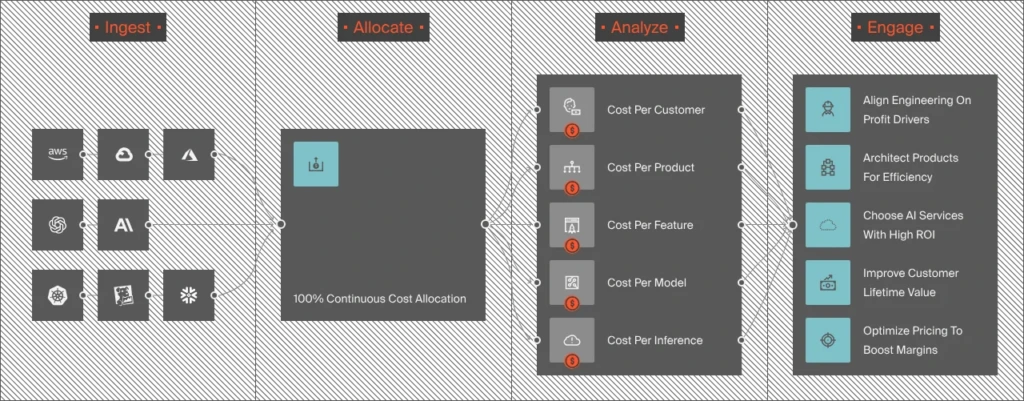
Several capabilities make it a monitor rather than a report:
Anomaly detection flags a spike the day it happens, not the day the invoice lands.
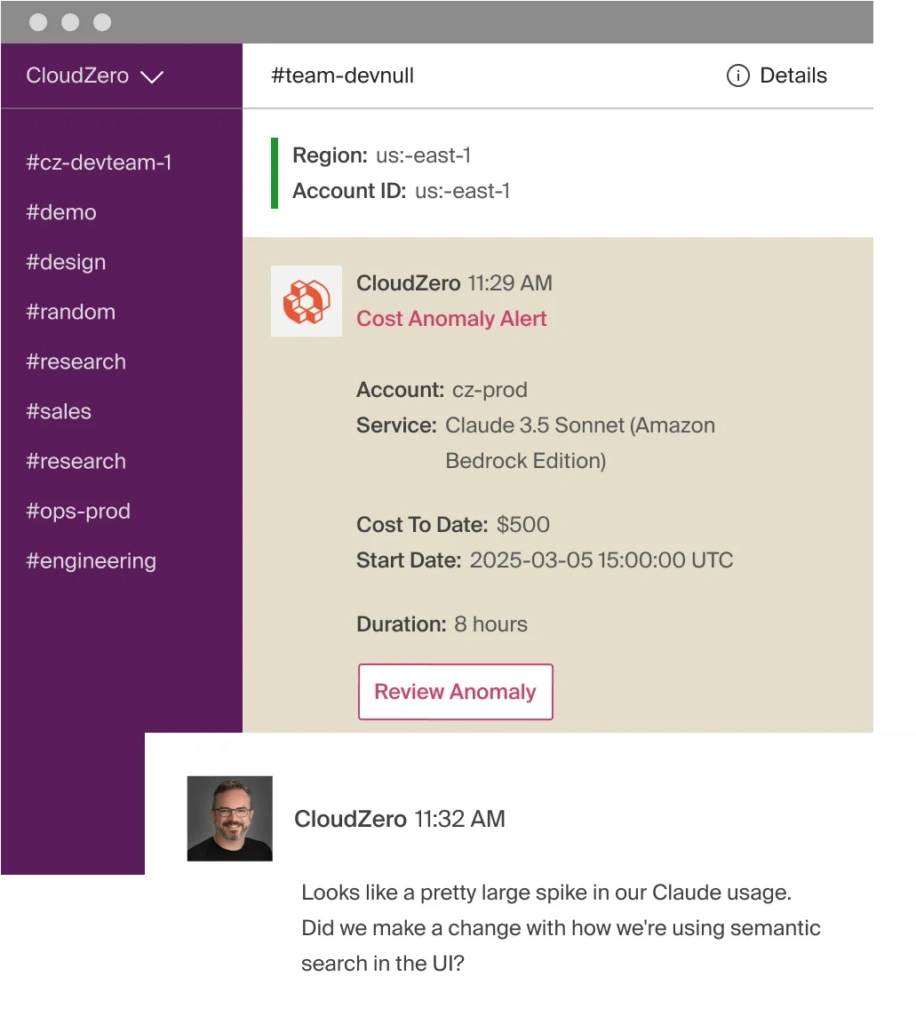
Budgets and forecasting show where spend is heading, not just where it has been.
And AI Hub brings those cost answers into the agentic tools where engineers already work, so the person who can fix a spike sees it in context. For the deeper agent story, see CloudZero’s guide to agentic AI cost.
CloudZero connects to the whole stack the spend flows through: Anthropic, OpenAI, and Cursor for AI, plus the cloud service providers and SaaS tools underneath. The result is what the survey said the winners have: the ability to read AI spend as a live, per-outcome signal, every dollar tied to the value it created. If you want that view of your own AI spend, you can  or take a self-guided product tour with CloudZero.
Case study: monitoring 50+ LLMs across 40 million users
The clearest proof of what real-time AI cost monitoring does is a real one. CloudZero documented a global SaaS platform with more than 40 million users whose engineering organization actively ran over 50 LLMs, spanning multiple GPTs, Claude, Llama, and others, across multiple regions and workloads. (CloudZero anonymized the customer, so the numbers are attributable but the name is not.)
Here is the situation, start to finish.
The problem. As the platform’s AI architecture matured, cost tracking and allocation grew increasingly complex. Spend was scattered across dozens of models, regions, and workloads, with no clean line from a dollar spent to the model, feature, or customer that spent it. This is textbook AI cost sprawl: the bill is real, but nobody can say what any of it bought.
What monitoring gave them. CloudZero ingested the whole multi-model, multi-region stack with no tagging required, then made it legible in real time: token-level cost intelligence down to the individual model and feature, model-aware allocation by model family, region, app, and customer segment, and live visibility into experiments, fine-tuning, and token caching as they happened, not weeks later on an invoice.
The results, in months. The platform could suddenly attribute spend by customer, region, app, operating system (Mac versus Windows), and user tier (free versus premium), and read unit economics like cost per token and cost per user tied directly to model usage and customer value.
That visibility paid off fast. It uncovered more than $1 million in immediate savings by optimizing inference workloads and caching tokens, alongside a 50% or greater reduction in compute spend, and it connected LLM investment to outcomes across all 40 million users.
The lesson is the one this whole guide keeps circling: the win was not a smaller bill, it was seeing the spend in real time, attributed to the models and customers driving it, so the team could act on it. That is the difference between monitoring and accounting.
Other CloudZero customers running large multi-model stacks, including Grammarly (which runs 50+ LLMs), Skyscanner, and Toyota, use the same real-time approach to keep AI spend tied to outcomes.
Frequently asked questions