What do 475 senior leaders across software, financial services, cybersecurity, and other industries all have in common? They have little to no idea whether their AI investments are paying off.
CloudZero just released FinOps in the AI Era: A Critical Recalibration, a report assessing the state of cloud and AI spending. Culled from hundreds of responses from people directly accountable for cloud spending, the report shows that while FinOps maturity is accelerating, cloud efficiency is plummeting.
Formal cloud cost programs now exist at 72% of organizations, nearly double the result from last year’s report (39%). But Cloud Efficiency Rate (CER) has dropped across all segments. CER measures the percentage of revenue that companies send to their cloud providers; a company with a 92% CER sends just 8% of their revenue to cloud providers. Elite CER has dropped from 92% to 85%, median CER has dropped from 80% to 65%, and lowest quartile CER has dropped from 70% all the way to 45%.
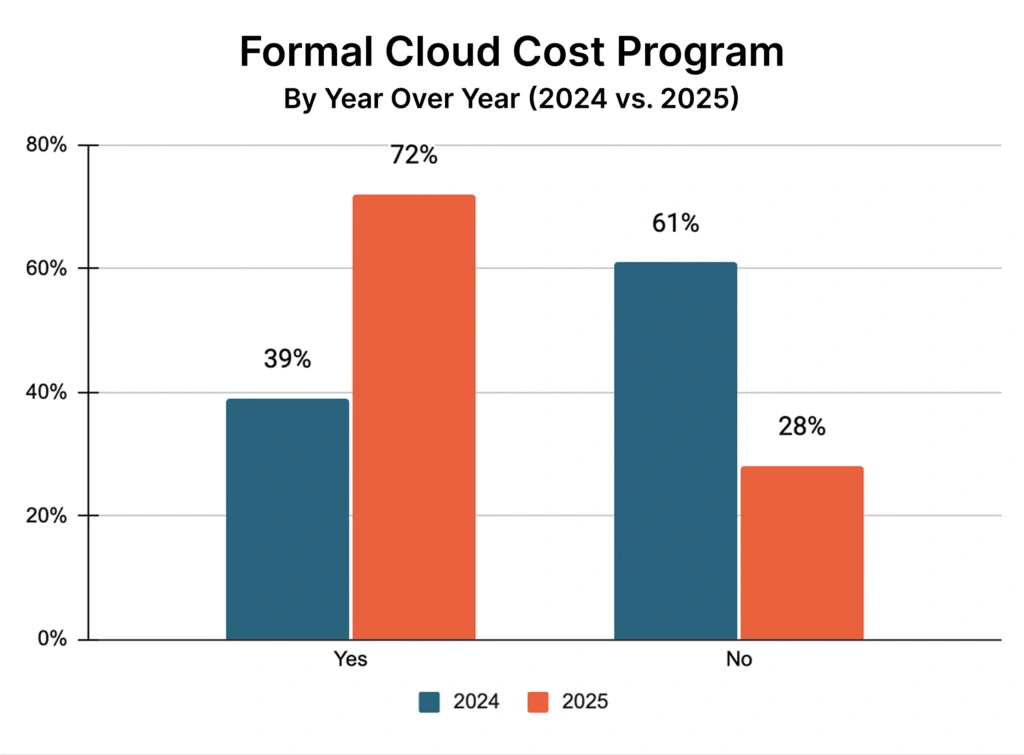
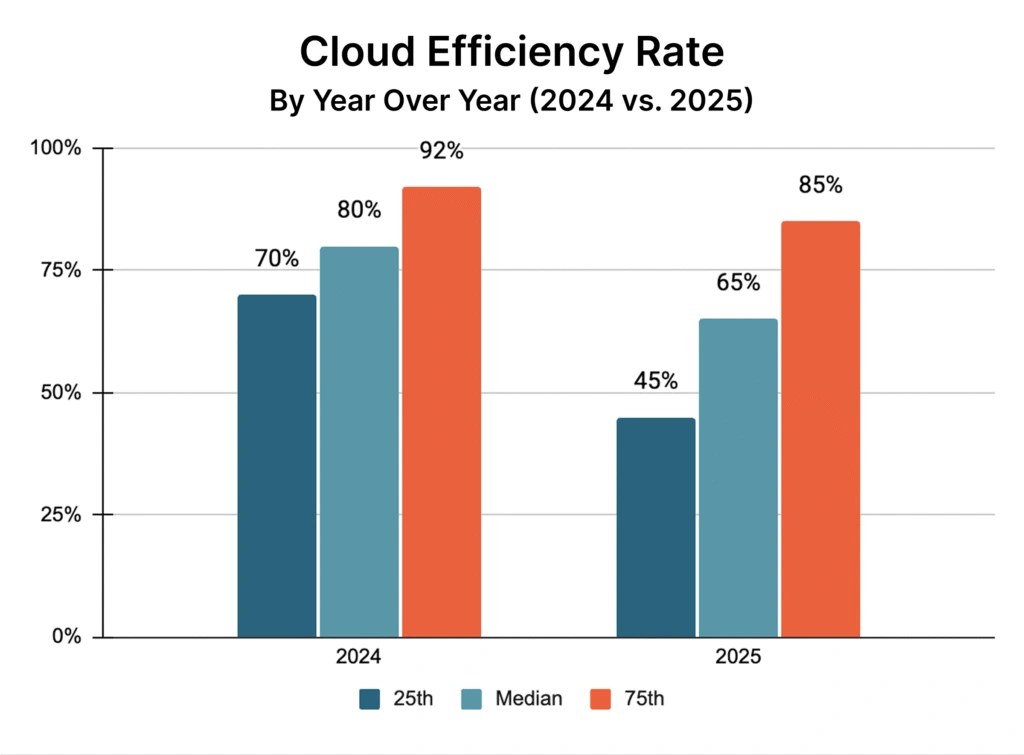
As they become more FinOps-savvy, companies are sending a higher percentage of their revenue to cloud providers.
Why? You guessed it: AI.
The vast majority of companies categorize AI costs as cloud costs. While cost observability has grown considerably in the 13 years since the public cloud first launched, the same cannot be said for AI cost observability — and companies are feeling the pain.
You can access the full report here. In this blog, I cover a subset of key findings around AI cost inefficiency and how companies can adapt.
The True Cost Of AI Cost Obscurity
AI spending is accelerating to breakneck speeds
Part of the reason for these trends is the sheer acceleration of AI spending. After just three years of general access to AI, 40% of companies now spend at least $10M a year on AI. That’s shockingly close to the 47% who spend at least $10M a year on the cloud after 13 years of general access.
Companies are using a fragmented stack of AI providers
AI usage is spread out across the public cloud, private clouds, third-party GPUs, and self-hosted LLM APIs. Most organizations are using more than one. There are multiple providers within each category, and no two providers give customers billing data in the same format at the same time.
Different teams use different providers for different purposes at different stages of the engineering lifecycle. The kicker: A third (34%) don’t discover cost overages until they receive their bills. A full third have no idea how they’re tracking against AI budgets in real time.
AI budget variance is rampant
The combination of accelerating spending and limited visibility has produced an enormous amount of AI budget variance:
- More than half (54%) of companies report ~11%–25% AI budget variance
- One in five companies report ~50% AI budget variance
That means three-quarters of companies are missing the mark by at least 11% — and one-fifth are missing by 50% or more.
Report
Finance needs to prove AI’s return: CloudZero report
260 senior finance leaders (more than half CFOs) told us why the speed of seeing AI spend, not the size of it, separates who pulls ahead on AI from who gets burned.
The Impending Profitability Crisis — And How To Withstand It
Ultimately, the report paints a familiar picture: We’re in the early stages of the AI disruption cycle. Like the cloud, or the internet, or oil, or electricity before it, companies are most concerned with finding the most durable business applications for this new technology, and they’re not terribly concerned with how much it costs.
Because AI users aren’t overly concerned with costs, AI providers aren’t overly concerned with making cost reporting easy. FinOps for cloud costs took 13 years to emerge and mature; FinOps for AI is practically at square one.
But, as happened with cloud costs, AI costs will eventually have to turn profitable. It’s inevitable. As that pressure rises, the companies who most proactively set up AI cost visibility and unit economics will be in the best position to win.
To stay ahead of the AI cost curve, CloudZero recommends:
- Visibility that distinguishes AI costs from cloud costs
- AI cost tracking at the customer and transaction levels
- Investment in engineering efficiency measures like code optimization
- Building cost-to-price relationships to base AI pricing models on real user costs
- Deploying real-time guardrails to keep AI costs in check
We’ve seen this movie before. A new technology disrupts existing processes; companies spend a lot trying to out-innovate each other; and eventually, the profitability chickens come home to roost. Establishing some basic AI cost visibility guardrails now is critical for long-term viability.