Like most SaaS companies, you’re under pressure to ship AI-powered features faster, smarter, and at scale. For many teams, that pressure leads to relying on external AI platforms, managed models, and third-party APIs instead of building everything from scratch in-house.
At first, it feels like a win.
Your team ships an AI-powered feature in weeks instead of months. No GPU clusters to manage. No models to train. No infrastructure to babysit.
You plug into a third-party AI platform and, just like that, your product is smarter, faster, and more competitive.
But months later, what started as a shortcut to innovation quietly becomes a dependency you didn’t plan for (and can’t easily unwind).
This is AI vendor lock-in, and it’s becoming one of the most underestimated risks in modern software development.
In the next few minutes, we’ll unpack why AI is driving a new form of vendor lock-in, how it affects both engineering velocity and SaaS margins, and what you can do to stay in control without halting innovation.
What Is AI Vendor Lock-In (And How Does It Differ From Traditional Lock-In)?
At its core, AI vendor lock-in happens when your product, workflows, or internal operations become dependent on a specific AI provider’s:
- Models and APIs
- Pricing structures and usage limits
- SDKs, tooling, or fine-tuning paths
- Hosting environment and data pipelines
It follows the same pattern, just with higher stakes and fewer exit routes.
Once you’ve built deeply on a specific provider’s services, switching becomes expensive, disruptive, and sometimes unrealistic. Over time, unwinding that dependency can require re-architecting key AI features, retraining models, migrating data, or accepting lower performance.
Report
Finance needs to prove AI’s return: CloudZero report
260 senior finance leaders (more than half CFOs) told us why the speed of seeing AI spend, not the size of it, separates who pulls ahead on AI from who gets burned.
Why AI Lock-In Is Different From Traditional Lock-In
Traditional vendor lock-in usually centers on infrastructure you can see and measure. Think of compute instances, storage volumes, and databases.
AI lock-in, on the other hand, is often API-driven (instead of infrastructure-driven), usage-based (not capacity-based), and embedded inside product features (instead of standalone systems).
That difference makes AI lock-in tricky to detect early, and more expensive once it’s entrenched.
Consider a few common scenarios:
- You don’t own the model powering a core product feature.
- You don’t control where inference runs or how data is processed.
- You’re billed per token, per request, or per output, often outside your primary cloud bill.
On the surface, everything looks fine — the feature works. Customers are happy. Engineering keeps shipping.
But underneath, critical parts of your product are now tightly coupled to a vendor you don’t control.
And unlike traditional lock-in, where costs are typically visible as infrastructure line items, AI lock-in can grow in stealth mode, without clear cost attribution. And when your usage scales with customers, features, and experimentation, that dependency becomes both harder to detect and harder to reverse.
Why AI Is Accelerating Vendor Lock-In Across Modern Tech Stacks
AI vendor lock-in isn’t happening because teams are careless. It’s happening because AI fundamentally changes the economics, architecture, and timelines of software development in ways that naturally push teams toward external providers.
Three forces, in particular, are accelerating lock-in across modern tech stacks.
AI innovation is moving faster than most teams can build internally
New models, modalities, and performance breakthroughs now appear in months instead of years like before.
For most organizations, building comparable AI systems in-house would require:
- Specialized machine learning talent
- Dedicated, often GPU-heavy infrastructure
- Continuous training, tuning, and evaluation
- Ongoing investment just to stay current
That reality pushes many teams toward a buy-instead-of-build approach.
External AI platforms make it possible to ship AI features quickly, experiment without long setup cycles, and compete with larger, better-funded players. But once a feature depends on a third-party model or API, switching later is rarely a simple configuration change. More often, it means a rewrite.
AI workloads often live outside your cloud boundary
Unlike traditional services, many AI workloads don’t run on the infrastructure you provision or control directly.
Instead, inference, embeddings, or model execution happens behind third-party APIs, inside managed AI platforms, and across SaaS services with their own billing and usage logic.
That means AI usage isn’t fully visible in your cloud bill. Costs aren’t tied to familiar constructs like instances or storage. And tagging and account-based allocation break down.
From an engineering perspective, this abstraction simplifies development. But from a finance perspective, it creates cost blind spots.
In turn, AI spend becomes harder to track, harder to forecast, and harder to attribute to specific features or individual customers. And that makes dependency harder to spot until your costs spike.
Helpful Resources:
Proprietary models and ecosystems create structural dependence
Many of today’s most capable AI models are proprietary. You get access to them through vendor-specific APIs, SDKs, and tooling, as well as fine-tuning workflows that aren’t easily portable.
Over time, teams optimize around these constraints. For example:
- Prompts are tailored to a specific model’s behavior
- Feature logic adapts to vendor-specific outputs
- Performance expectations become tied to one provider’s roadmap
The deeper this integration goes, the higher the switching cost becomes. And even when an alternative model comes into existence, migration becomes retraining the assumptions embedded in your product.
Lock-in grows incrementally, then suddenly
Perhaps the most dangerous aspect of AI vendor lock-in is how stealthily it forms.
It starts something like this:
- “Let’s just use this API for now.”
- “We’ll revisit later if it gets expensive.”
- “This feature depends on it, but it’s working.”
Over time, those decisions compound into operational risk.
The Hidden Business Impact Of AI Vendor Lock-In
Consider these.
Unpredictable and volatile AI costs
Unlike traditional infrastructure pricing, AI costs scale with customer behavior, not capacity. And that makes AI spend tricky to forecast and easier to underestimate.
Even a small increase in usage, adoption, or model complexity can drive outsized cost spikes, and often outside your primary cloud bill. And by the time finance investigates, the increase has already hit your P&L.
Incomplete AI unit economics
Healthy SaaS margins depend on understanding and working with your unit economics. But when AI workloads run through external platforms, your:
- Costs aren’t naturally tied to specific features or individual customers
- AI usage is hard to attribute beyond high-level totals, and
- Finance/FinOps lacks visibility into cost drivers.
What follows is uncertainty around which AI features are profitable, which customers are cost-intensive, and where optimization should happen. And that lets margin erosion slide in unnoticed.
Reduced strategic and financial flexibility
As AI becomes embedded into the core of how your product works, dependence on a single vendor tends to limit options.
Pricing changes, contract terms, or roadmap shifts directly affect your cost structure. Negotiating leverage decreases. Switching becomes costly. And strategic decisions increasingly depend on external providers.
For leadership, that turns AI vendor lock-in into both a governance and risk issue.
Takeaway: When AI costs feel unpredictable, organizations tend to respond by slowing experimentation or halting deployments. And that shifts AI from a growth driver to a perceived liability. Yet the root problem isn’t AI itself. It’s the lack of visibility and control that makes innovation feel financially risky.
Why Traditional Cloud Cost Tools Don’t Solve AI Vendor Lock-In
You know this.
Most cloud cost tools are built on the assumption that your workloads, usage, and spend reside within your cloud environment and can be tracked through infrastructure primitives such as instances, storage, and databases.
However, AI pricing models are based on usage rather than on capacity or provisioned resources. Costs scale with product usage, not infrastructure allocation.
At the same time, many AI workloads don’t run in your cloud at all. So, its costs don’t show up cleanly in your cloud cost reports.
Tagging works well for infrastructure you control, but it doesn’t persist through external AI platforms or API calls. So, teams often struggle to answer basic questions about what’s driving their AI costs and whether those costs are expected, efficient, or sustainable.
Moreover, traditional cloud cost reports only show you what was spent, but not why it was spent or how it ties back to your product’s behavior, customer usage, or margins.
The result of all this is a dangerous gap in your AI cost visibility.
Common Approaches Teams Are Using to Reduce AI Vendor Lock-In
Most approaches we are seeing fall into three broad categories.
Some teams are introducing AI middleware between their applications and providers
These layers are standardizing how their AI models are called. That’s allowing the team to route requests across multiple vendors or switch providers without rewriting core application logic.
Middleware can reduce technical coupling and improve flexibility. But it doesn’t eliminate lock-in on its own. So, you’ll still need visibility into how your AI usage, performance, and costs change across providers to make informed decisions.
Others are focusing on open or portable AI infrastructure
This includes using open-source models, deploying self-hosted inference, or choosing GPU infrastructure designed to avoid provider-specific constraints.
These strategies offer greater control and long-term optionality. However, they come with trade-offs.
For example, operating AI infrastructure requires specialized expertise, introduces operational overhead, and shifts responsibility for reliability, scaling, and optimization back to internal teams.
A third group is designing systems for interchangeability by default
Instead of embedding AI logic directly into product features, they isolate it behind adapters or service layers. This makes it easier to swap models or providers later and reduces the cost of experimentation.
That said, interchangeability alone doesn’t solve the visibility problem. Even well-designed architectures can struggle to explain how AI usage translates into real-world costs and margins.
And that’s where most mitigation strategies are falling short.
Let’s change that for you.
Drive Your AI Growth Without Slowing Innovation Down
AI vendor lock-in isn’t something most teams choose deliberately. It’s the byproduct of moving fast in a landscape where speed matters, competition is fierce, and building everything in-house isn’t realistic.
The goal, then, isn’t to avoid AI vendors altogether. It’s to avoid flying blind.
High-performing teams accept that AI workloads will span clouds, APIs, SaaS platforms, and managed services. What’s setting them apart is that they are using reliable AI cost visibility.
They now know which features are driving their AI usage, which customers are influencing costs, and how their AI spend is affecting margins in real time (not weeks later in an end-of-month finance review). They can see who, what, and why their AI costs are changing, so they know exactly what to do next.
That clarity is helping them make informed trade-offs, course-correct early, and keep innovation moving — without breaking the bank.
And CloudZero can help you adopt and automate that, too
CloudZero gives engineering, finance, and leadership teams a shared, accurate view of AI costs across their entire environment. Across cloud providers, third-party AI platforms like OpenAI and Anthropic, external APIs, and multi-account setups.
Instead of guessing your way through layers of multi-platform tags or fragmented cost data, CloudZero grounds your AI costs in real business context.
It then breaks that data down into immediately actionable insights, like your real-time cost per AI service, so you can see exactly where your costs are coming from and what’s driving them.
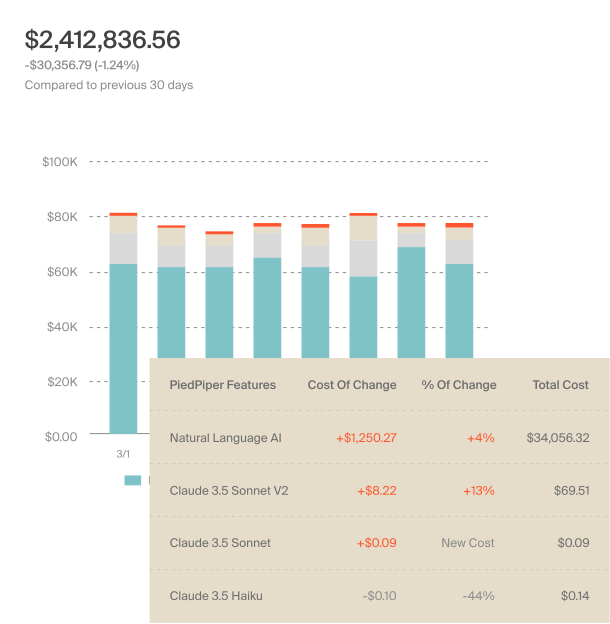
This means you can finally:
- Understand your AI cost per feature, customer, and workflow as it happens
- Take advantage of real-time cost anomaly detection to catch and fix leaks before they erode your bottom line
- Forecast AI spend with confidence even as your usage scales
- Support experimentation without turning AI into a financial risk.
With this level of AI cost intelligence, CloudZero helps your team keep innovation and profitability from competing with each other. Instead, you get to keep and grow both.
If AI is central to your product,  to see how you, too (like the teams at Toyota, Grammarly, Duolingo, and other CloudZero customers) can scale your AI-powered innovation with cost confidence — no matter where you use it.
Frequently Asked Questions about AI Vendor Lock-In