Quick Answer
Chargeback formally bills each department for the cloud resources they consume, moving costs onto their P&L; showback reports those same costs to teams for visibility while leaving them on a centralized IT budget. Chargeback moves money. Showback moves information. Neither model is inherently more mature than the other. The FinOps Foundation is explicit on this point: the right choice depends on your organization's accounting policies, not a maturity checklist.
Why Does Cloud Cost Allocation Matter In 2026?
Here is a number that should make every CFO reach for their coffee: organizations waste an average of 27% of their cloud spend annually, according to the FinOps Foundation’s State of FinOps data.
At Gartner’s projected $723 billion in global public cloud spending for 2025, that translates to roughly $195 billion disappearing into idle resources, orphaned storage volumes, and over-provisioned instances nobody remembers spinning up.
The culprit isn’t usually a lack of good intentions. It’s a lack of cloud cost allocation, the mechanism that connects spend to the teams, products, and decisions that drive it. Without it, cloud bills become a single, opaque line item that everyone assumes someone else owns.
Engineering teams have no signal about the cost impact of their architectural choices. Finance can’t forecast because there is no consumption data tied to business units. And the question every leader should be asking — was it worth it? — becomes unanswerable.
This is exactly where showback vs chargeback enters the picture. Both are methods for assigning cloud costs to internal teams. Both create visibility. But they differ fundamentally in how much financial accountability they impose, and that difference shapes everything from engineering behavior to budget accuracy.
The State of FinOps 2025 report confirms the urgency: full allocation of cloud spending is the #2 current priority for FinOps practitioners, with 30% ranking it in their top priorities, trailing only workload optimization and waste reduction at 50%. Cost allocation isn’t an administrative exercise. It’s the foundation that makes every other FinOps capability possible.
Report
Finance needs to prove AI’s return: CloudZero report
260 senior finance leaders (more than half CFOs) told us why the speed of seeing AI spend, not the size of it, separates who pulls ahead on AI from who gets burned.
What Is Showback In Cloud Computing?
IT showback is a cloud cost management method where each business unit receives a report showing the cloud resources they consumed and the associated costs, but those costs remain on a centralized IT or infrastructure budget. The showback meaning is right there in the name: you show the costs back to the teams that generated them.
Showback reporting gives teams visibility into their consumption patterns without requiring changes to internal accounting or ERP systems. It is a transparency mechanism, not an enforcement mechanism — the cloud bill stays on a centralized IT budget even after the teams see their share of it.
An analogy: Showback is like getting an itemized receipt for a company dinner. You see what everyone ordered, but the corporate card still covers the tab.
When showback works best
Showback tends to be the right starting point when your organization is early in its FinOps journey and teams don’t yet trust the accuracy of allocation data. It also fits when cloud costs are concentrated in a small number of cost centers (making formal chargeback overkill), when you need to build a culture of cost awareness before introducing financial consequences, when tagging coverage is incomplete, or when leadership wants directional visibility but isn’t ready to restructure budgeting processes.
The FinOps Foundation puts it simply: showback is always required in any FinOps practice. It is the non-negotiable foundation. You can run a mature FinOps program on showback alone. You cannot run one without it.
Advantages of showback
Showback delivers value with relatively low organizational friction. It does not require ERP integration, budget restructuring, or approval from the CFO’s office. Teams get educated about their spend without feeling penalized, which matters when you are trying to shift engineering culture toward cost consciousness rather than trigger a turf war.
It also serves as a data quality proving ground. If your allocation logic has gaps, untagged resources, shared infrastructure costs split poorly, discount amortization that doesn’t make sense, you want to find those gaps when the numbers are informational, not when they’re hitting P&L statements and someone in finance is asking why the DevOps team apparently spent $200,000 on a service they’ve never heard of.
Limitations of showback
The fundamental weakness of showback is that visibility without consequence tends to produce awareness without behavior change. If the report shows your team burned $47,000 on a staging environment that nobody used last month, but that number doesn’t affect your budget, the urgency to fix it is… theoretical. Like a gym membership you keep paying for because maybe next month you’ll go.
Research from CloudZero found that 89% of organizations say a lack of cloud cost visibility impacts their ability to carry out their role. Showback addresses the visibility problem. But visibility without accountability is like a dashboard with no steering wheel, you can see where you’re headed, but you can’t change direction.
And that brings us to the other side of the chargeback and showback equation.
What Is Chargeback In Cloud Computing?
A cloud chargeback model takes allocation one step further: actual cloud costs are formally charged to each department, team, or product’s P&L. The expenses move from a centralized IT budget into the budgets of the business units that consumed the resources.
Using the dinner analogy: each person at the table gets their own bill. And suddenly, those espresso martinis look a lot less appealing.
In a chargeback model, the finance team works with FinOps practitioners to define allocation rules, which costs go to which cost centers, how shared infrastructure is divided, how commitment-based discounts are distributed. Those rules feed into the accounting system, and teams are held financially responsible for their consumption.
What is a chargeback model in simple terms? It’s the mechanism that turns “the cloud bill went up” into “Team Alpha’s compute costs increased 22% because they launched a new microservice without rightsizing the instances.”
When chargeback works best
Chargeback becomes the right model when your organization has mature tagging and allocation practices in place (you need to trust the numbers before charging for them), when teams are large enough to manage their own budgets and make cost-informed trade-offs, when cloud spend is a material line item and the CFO needs it broken out by business unit, when you want to drive active optimization behavior, or when the business has committed to a FinOps operating model where engineering and finance share accountability.
Advantages of chargeback
Chargeback creates a direct feedback loop between cloud consumption and financial outcomes.
When a team’s budget absorbs the cost of an over-provisioned database cluster, the conversation about rightsizing happens organically, nobody needs to send a scolding Slack message or passive-aggressive cost report.
This financial accountability also improves forecasting. The State of FinOps 2025 report ranked accurate forecasting as the #3 priority for FinOps teams. Teams operating under a chargeback model are better equipped to forecast because they actively manage their spend as a budget line, not observe it as a dashboard curiosity.
Chargeback also aligns incentives across the organization. Product teams can calculate cost per customer, cost per feature, or cost per transaction, the unit economics that tell you whether growth is profitable or just expensive. Without chargeback, these metrics lack the financial rigor to influence real business decisions.
Limitations of chargeback
Chargeback is harder to implement, and the consequences of getting it wrong are more visible. Inaccurate allocation in a showback report is an annoying data quality issue. Inaccurate allocation in a chargeback model is a budget dispute that escalates to the VP level before lunch.
Common friction points include shared cost allocation (how do you split the cost of a shared Kubernetes cluster, a centralized data platform, or enterprise support charges?), ERP integration (chargeback requires integration with the company’s financial systems, which means working with the accounting team and navigating months of process), discount attribution (if the platform team negotiated a three-year reserved instance that saves 40%, who gets credit?), and cultural resistance (teams that have never been held financially responsible for infrastructure usage may push back, especially if the initial numbers don’t feel accurate).
What’s The Difference Between Chargeback And Showback? (Side-By-Side)
Here’s a quick chargeback vs showback comparison table:
Feature | Showback | Chargeback |
Cost ownership | Centralized IT budget | Individual team/department P&L |
Financial impact | Informational only | Affects team budgets directly |
Behavior change | Encourages awareness | Drives active optimization |
Implementation complexity | Low to moderate | Moderate to high |
ERP integration required | No | Yes |
Tagging maturity needed | Moderate (directional accuracy OK) | High (allocation must be defensible) |
Shared cost handling | Can be estimated or excluded | Must be formally defined and documented |
Best for | Early FinOps adoption, building trust | Mature practices, budget accountability |
Forecasting impact | Improves visibility into trends | Enables team-level budget planning |
Unit economics support | Limited (costs visible but not owned) | Strong (costs tied to P&L drive ROI analysis) |
FinOps Foundation guidance | Always required | Depends on organizational policy |
Should You Start With Showback Or Chargeback? (The Hybrid Approach)
Here’s where most organizations, and most articles on this topic, get it wrong.
They frame IT chargeback vs showback as a progression: start with showback, graduate to chargeback, congratulate yourself on your maturity.
The FinOps Foundation’s framework explicitly pushes back on this narrative: “Neither way should be considered more mature than the other, as which method used is entirely dependent on organizational accounting policy and preference.”
That matters because framing chargeback as the “grown-up” version of showback creates perverse incentives. Teams rush to implement chargeback before their data is trustworthy, which creates budget disputes that set the entire program back. The goal isn’t chargeback. The goal is cost accountability that drives better decisions.
That said, the most successful pattern we see looks like this:
Phase 1: Showback as foundation
Deploy showback reporting to every team consuming cloud resources. The goal: building trust in the data, not driving behavior change. During this phase, you validate allocation logic, clean up tagging gaps, and let teams see their spend without feeling threatened. This usually takes three to six months for organizations with reasonable tagging coverage.
Phase 2: Selective chargeback
Introduce chargeback for the business units where it makes sense, usually the largest consumers and teams that already have budget owners accustomed to managing variable costs. Keep showback running for everyone else. This creates a reference point: teams under chargeback will visibly start optimizing in ways that showback-only teams don’t.
Phase 3: Full allocation with exceptions
Expand chargeback across the organization, but maintain centralized budgets for truly shared infrastructure (security tooling, observability platforms, core networking) where per-team attribution would be arbitrary and counterproductive.
Microsoft’s own FinOps guidance recommends the same sequenced approach: start with showback for visibility, implement cost allocation to align cloud costs with organizational reporting hierarchies, then layer chargeback on top.
How To Implement A Chargeback Model For IT Services
A chargeback model for IT services requires more than just splitting the cloud bill by department and hoping for the best.
Before you move a single dollar onto a team’s P&L, confirm you have these four prerequisites in place:
Prerequisite | Minimum threshold | Why it matters |
Tagging coverage | 80%+ of cloud spend attributable to a team, product, or cost center | Below 80%, shared-cost allocation becomes too large a share of the bill and invites disputes |
Billing export pipeline | AWS CUR, Azure Cost Management Export, and/or GCP Billing Export running daily into a queryable data store | Chargeback requires line-item detail, not monthly summary invoices |
Finance alignment | Named owner in finance who has reviewed and approved the allocation rules | Chargeback touches the ERP; without a finance owner, month-end close will break |
Executive mandate | VP-level sponsorship and budgeted owners for each chargeable team | Without budget owners, there’s no one to charge — and teams will escalate allocation disputes you can’t resolve |
If you’re missing any of these, stay in showback until you close the gap. Running chargeback on weak foundations is how FinOps programs lose trust in their first quarter.
1. Define your allocation taxonomy
Before any money moves, answer the question: what dimensions matter to the business?
Common allocation dimensions include team or department, product or service, environment (production vs. staging vs. development), and customer segment.
This is where collaboration between FinOps, engineering, and finance is essential. Engineering knows the architecture. Finance knows the cost center structure. FinOps bridges the two. Skip the collaboration, and you’ll build an allocation model that’s technically correct but organizationally useless.
2. Establish tagging and metadata standards
Tagging is the technical foundation of chargeback. Every resource needs metadata that maps it to the allocation taxonomy. The FinOps Foundation’s allocation guidance recommends required tags like cost center, environment, and application, with enforcement policies that prevent resource creation without required tags.
Reality check: perfect tagging is a myth. Even mature organizations have 10-20% of spend that resists clean attribution; shared services, untaggable resources, platform-level costs. The question isn’t whether you’ll have untagged spend. It’s whether your allocation approach can handle it without leaving a hole in the data. (Spoiler: spreadsheets can’t. Modern FinOps platforms use code-driven allocation to map even untagged and untaggable resources.)
3. Define shared cost allocation rules
Shared costs are the most contentious part of chargeback, and where most IT chargeback model examples fall apart in practice. Common approaches include proportional allocation (split based on each team’s percentage of total spend), even split (simple but often unfair), usage-based (most accurate, most complex), and fixed allocation (pre-negotiated percentages, predictable but may drift from reality).
Document the rules clearly and get stakeholder buy-in before charging the first dollar. Nothing derails a chargeback program faster than a VP discovering their team absorbed $200,000 in shared Kubernetes costs they never agreed to.
4. Automate the allocation pipeline
Manual chargeback via spreadsheets doesn’t scale. It also doesn’t build trust, if finance has to manually adjust numbers each month, the whole process feels about as rigorous as eyeballing a recipe.
Automation should handle cost ingestion from multiple cloud providers, tagging enrichment for untagged resources, allocation rule application, discount and commitment amortization, and reporting delivery.
Tools like CloudZero automate this pipeline end-to-end, mapping every dollar to products, features, environments, and teams, including untagged and shared spend, using a code-driven approach that works even when tag hygiene is imperfect.
That’s the difference between a tool that reports costs and one that allocates them.
5. Start with a shadow chargeback period
Run the chargeback model in shadow mode for one to two billing cycles. Show teams what their bill would look like under chargeback without actually moving money. This catches allocation errors, surfaces disputes early, and gives teams time to prepare their budgets. Think of it as a dress rehearsal: better to discover the shared cost allocation feels wrong when it’s hypothetical than when it’s hitting someone’s P&L.
How Does AI Spend Change Chargeback And Showback?
Cloud cost allocation was hard enough when the bill was just compute, storage, and networking.
AI infrastructure has added new complexity, and exposed the limits of traditional allocation methods.
The State of FinOps 2026 report found that 98% of organizations now manage AI spend, up from 63% in 2025 and 31% in 2024. That’s the fastest adoption curve the FinOps Foundation has ever recorded. AI moved from an emerging concern to everyday FinOps scope in just two years.
But AI costs behave differently than traditional cloud spend, and that has direct implications for both showback and chargeback:
- API-based pricing (OpenAI, Anthropic) is consumption-based per token, making per-team attribution straightforward but forecasting difficult, token usage can spike 10x in a week when a team ships a new feature.
- GPU compute (training and fine-tuning) creates large, spiky bills that don’t fit neatly into monthly budget cycles. A single training run might cost more than a team’s entire compute budget for the month.
- Embedded AI costs are often hidden inside broader compute and storage line items, making them invisible to standard allocation logic. CloudZero’s billing data analysis found that approximately 2.5% of actual cloud spend goes to AI services, compared to the 30-36% budget intent organizations report in surveys. The gap suggests much of AI cost is embedded and invisible to traditional allocation approaches.
- Shared model infrastructure, a centralized ML platform serving multiple teams — creates the same shared-cost attribution challenges as traditional shared services, but with less established allocation patterns.
For organizations implementing cloud chargeback, AI spend requires its own allocation rules.
The per-token API model makes cloud showback relatively straightforward, you can attribute each API call to a team or application. But charging back GPU training costs for shared models requires the same principled allocation framework that took years to develop for traditional cloud infrastructure.
The organizations getting this right treat AI as a new cost optimization dimension, not an afterthought bolted onto existing allocation. They’re asking the question that ultimately matters: not just “how much did the AI cost?” but “was the AI worth what we spent?”
What Does An IT Chargeback Model Look Like In Practice?
Here is a simplified IT chargeback model example for a mid-size SaaS company with three product teams:
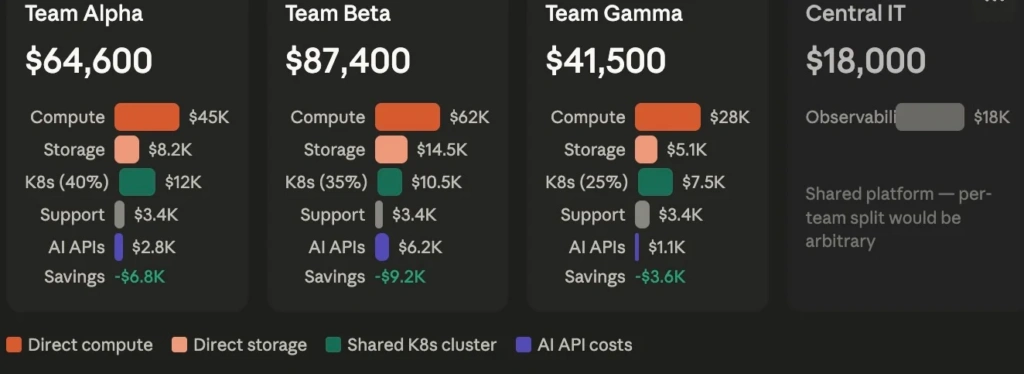
In this model, directly tagged compute and storage are attributed to the owning team. The shared Kubernetes cluster is split by CPU utilization percentage. Enterprise support is split evenly. AI API costs are attributed per-token to the calling application. Commitment-based savings are credited proportionally to consumption. And the observability platform stays on the central IT budget because it serves all teams equally and per-team attribution would be arbitrary.
The real power of this model emerges when you connect it to revenue. If Team Alpha generates $320,000 in monthly revenue from its product, their cloud cost ratio is roughly 20%. If Team Beta generates $1.2 million, theirs is about 7%. That’s unit economics, and it tells you far more about business efficiency than total cloud spend ever could. Only 43% of organizations currently track cloud costs at the unit level. The rest are flying blind on the question that matters most.
What Are The Most Common Chargeback And Showback Mistakes?
Here are the most common mistakes to watch out for:
1. Treating chargeback as “more mature” than showback
Worth repeating because the industry keeps getting this wrong: chargeback is not a promotion from showback. The FinOps Foundation is explicit that some organizations will run on showback permanently, and that’s fine. If your accounting structure doesn’t require departmental P&L allocation of cloud spend, forcing chargeback adds complexity without adding value. The FinOps showback vs chargeback debate has a definitive answer: it depends on your organization.
2. What’s the difference between cost allocation, chargeback, and showback?
Cost allocation is the overall process of attributing cloud spend to the teams, products, or business units that generated it. Chargeback and showback are the two methods for doing that allocation. Showback reports the allocated costs to teams for visibility. Chargeback formally bills those costs to team budgets. Put simply: allocation is the work; showback and chargeback are the output. You can’t do chargeback or showback without first doing cost allocation.
3. Launching chargeback before the data is trustworthy
Nothing destroys a chargeback program faster than inaccurate bills. If a team gets charged $80,000 for resources they know they didn’t use, trust is gone, and rebuilding it takes far longer than doing the data quality work upfront would have taken. Run the shadow period. Validate the allocations. Then go live.
4. Ignoring shared costs
Pretending shared costs don’t exist, or holding them all centrally, skews the chargeback picture. Teams that heavily use shared platforms look artificially cheap. Define shared cost allocation rules explicitly, even if the rules are imperfect. An acknowledged approximation beats a hidden distortion.
5. Over-engineering the model
A chargeback model that requires a PhD in cloud accounting to understand will not drive behavior change. It will drive confusion and Slack messages asking “what does this line item mean?” Start with the 80/20: allocate the major cost categories cleanly, acknowledge the approximations in shared costs, and iterate quarterly.
6. Forgetting the “was it worth it?” question
Both showback and chargeback can tell you what teams are spending. Neither automatically tells you whether that spend created business value. The highest-performing organizations pair their allocation model with unit economics; cost per customer, product, team, or AI, to connect cloud spend to business outcomes. Chargeback answers “who spent what.” Unit economics answers “was it worth it.” You need both.
Frequently Asked Questions about Chargeback vs. Showback
Showing Your Departments Their Costs Requires A Deep Understanding Of Where Those Costs Come From
Monthly bills are lump sums. They don’t tell you who spent what — or why. Acting on that alone is guesswork.
Tags help, but they’re rarely perfect. Some resources are shared or untaggable. Without reliable allocation, showback and chargeback won’t be trusted.
CloudZero makes it finance-grade. It maps every dollar to products, features, environments, and teams — including untagged and shared spend — so reports are clear, auditable, and fair.
With CloudZero Dimensions, you see costs the way the business runs: by product, feature, team, and environment. That’s the foundation for accurate showback now — and confident chargeback later.
Ready to turn visibility into accountability?  to see for yourself.