In the cloud computing industry, we hear the word “scaling” a lot. We talk about scaling up resources to meet demand, scaling our teams, and scaling our platforms. What tends to get lost is whether your costs are scaling in proportion to the value you’re delivering.
If those two metrics don’t move in tandem, it’s likely you’re leaving money on the table.
It’s not enough to simply use the cloud. You have to leverage its greatest feature: the ability to be truly elastic with your costs and resource usage. That means achieving a state where your costs rise and fall tightly alongside demand.
The trick is that cloud cost elasticity doesn’t happen automatically. It must be measured, deliberately built through careful architecture choices, and continuously optimized.
Let me explain how you can do exactly that.
Here’s How Cloud Elasticity Can Save You Money
Most people talk about cloud elasticity as if costs are the lever you should tweak directly. The traditional definition of cloud elasticity is “the degree to which a company’s cloud spend increases or decreases in response to changes in usage, traffic, or infrastructure.”
However, I would push back a little and argue that we need to be worried more about architectural elasticity rather than simply cost elasticity. A well-designed architecture that expands and contracts with demand will naturally be cost efficient; putting costs first in this equation is akin to putting the cart before the horse. You need to build an elastic architecture first, and then elastic costs will follow.
Related read: What Is Cloud Scalability? Benefits And Tips For Every Organization
What’s the top sign your company lacks cloud elasticity?
The biggest red flag we see working with clients is when off-peak costs are the same as peak time costs.
Let’s say you operate a SaaS company that services other businesses. You’re likely to see heavy demand during work hours on Monday through Friday, with a lot less usage overnight and on weekends. If you don’t scale your resources up and down in response to that pattern of demand, one of two things will happen:
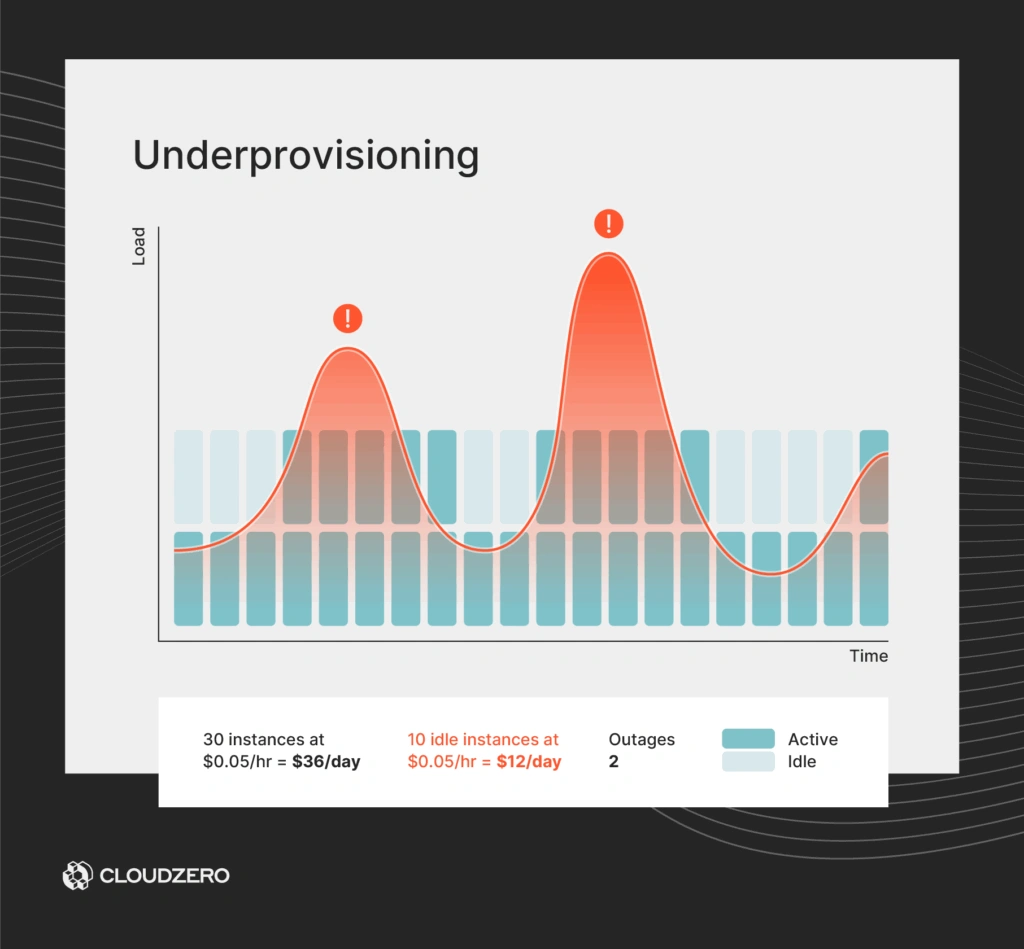
1. You’ll deliver a poor user experience.
Users will have to wait or your services will fail because you don’t have enough resources when traffic surges.
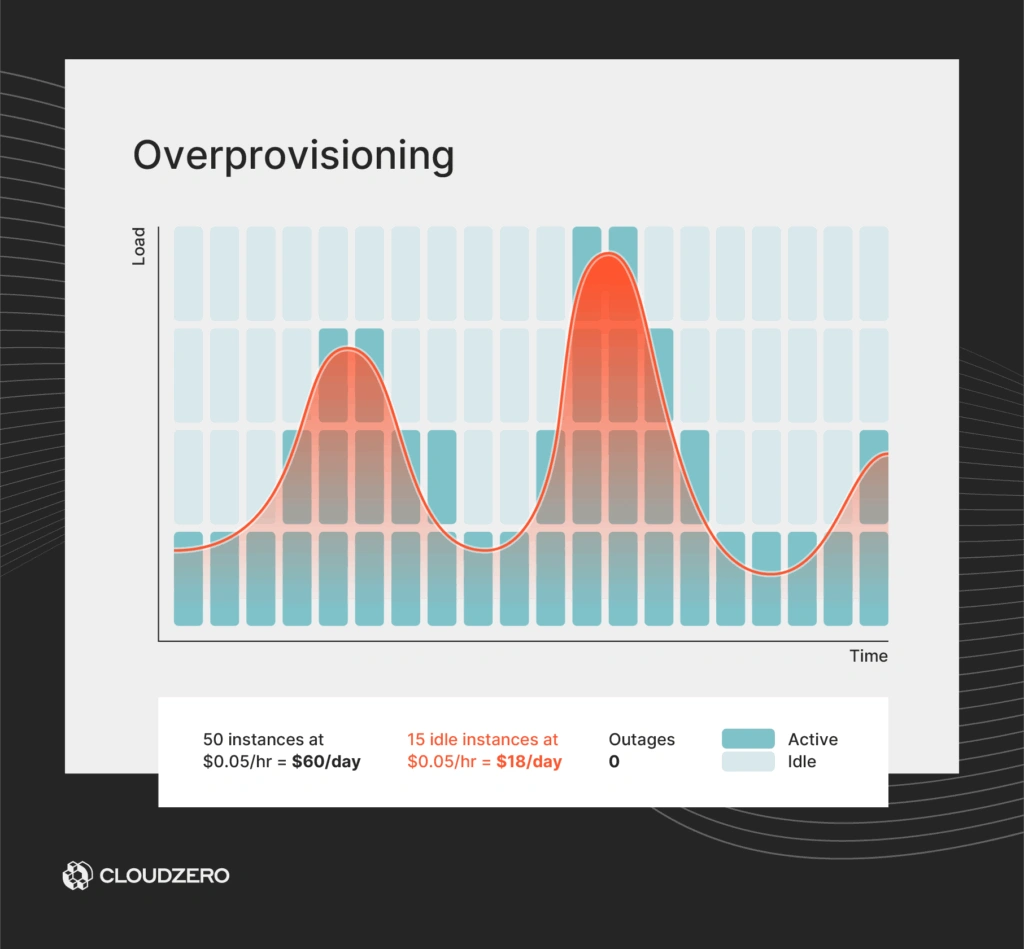
2. You’ll waste a lot of money.
You have too many resources idling during off-peak times, which means you’re spending money you could otherwise be saving without affecting your customers’ experiences.
There are exceptions, of course. Companies like Uber see 24/7 demand simply due to the nature of the services they provide.
But for most companies, a steady 24/7 infrastructure cost is a strong signal that you’re paying for compute even while it’s sitting idle. In fact, this is one of the first things we look for with new CloudZero clients. We want to see whether your costs dip when your usage dips. If not, it’s safe to say you’re wasting money!
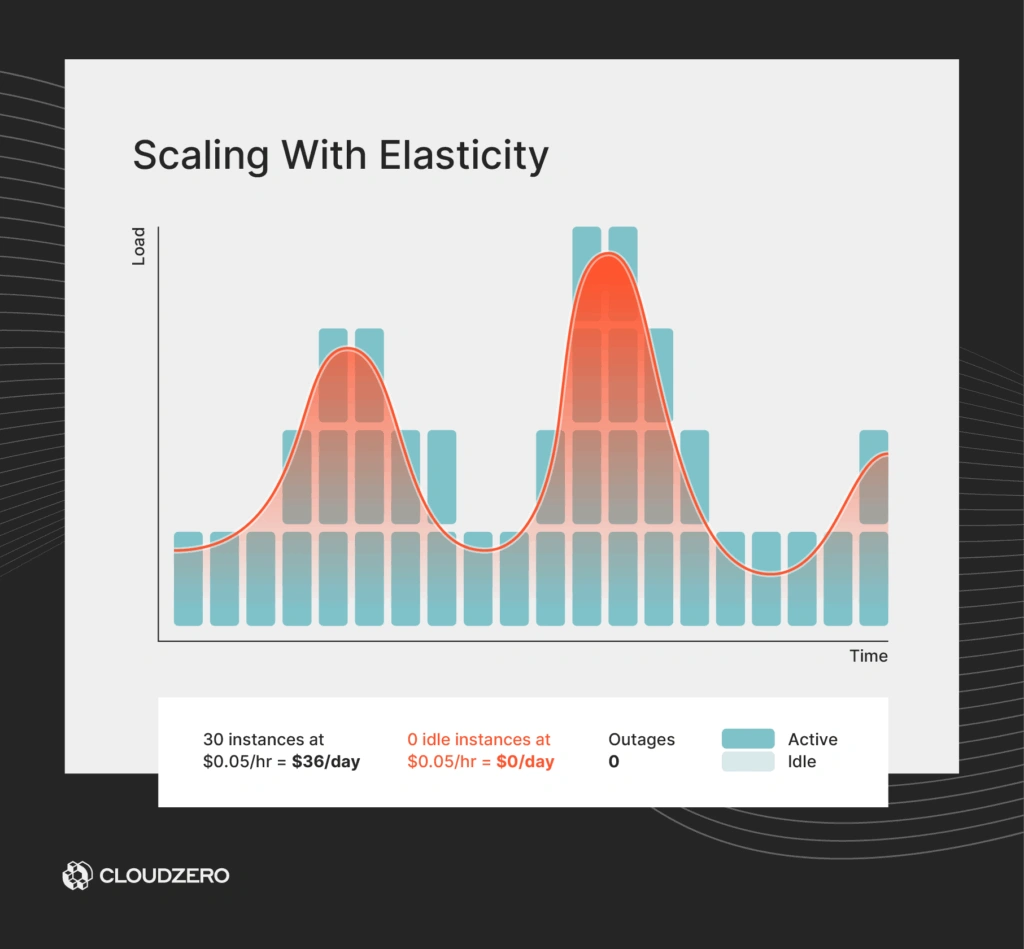
This is why elasticity is so important in a FinOps context. You only want to spin up resources when there’s an actual need for them.
How can you monitor your elasticity more closely?
Once you identify a potential problem with elasticity, it’s important to be able to quantify it. And even if you fix the issue, it’s good to keep track of your elasticity over time. Circumstances change so quickly in the cloud world, it can be all too easy to let a new problem go unnoticed for months.
While comparing your costs to the peak rhythms in your business can give you a general idea of your elasticity, you can’t stop there. To truly understand the health of your spending patterns, you’ll need to tap into one of our favorite concepts here at CloudZero: unit metrics.
There are two powerful ways to measure elasticity in greater detail using unit metrics:
1. Cost versus demand.
Compare a graph of your cloud costs next to a graph of your user demand (think API calls or user logins). If you see demand drop significantly hour-to-hour or day-to-day but your costs don’t drop in proportion, that’s a strong indicator that you’re missing elasticity opportunities that could save your company money.
2. Cost divided by adoption.
If this metric rises on the weekends or during off hours, it suggests you’re spending the same amount of money to deliver less user value. Again, this indicates you’re missing out on an opportunity for elasticity.
The beauty of both of these methods is that they are as customizable as you need them to be.
You can just as easily calculate these figures at the company level as you can drill down to a specific feature or a single business unit. If you’re responsible for part of the platform, for example, you could map your API calls against your costs for that feature and see if the two track together or wildly diverge.
This kind of visibility into costs per X business unit (traffic, features, customer, etc.) is foundational to FInOps maturity. It’s the kind of strategy that will set you apart from your competition as your peers struggle to understand why their bills are so much higher than usage would suggest.
How can you build for better elasticity?
A business that makes FinOps a top priority has an advantage, in that every architecture decision will have cost efficiency as a core consideration. Therefore, if you want to increase your cost efficiency and elasticity, one of the best things you can do is embrace FinOps at a company level.
To fine-tune, you can then look deeper into your build decisions, including:
Understanding your requirements from day one.
Let’s say you need to duplicate data to create backups or to maintain extra active environments for resilience. You know going in that those choices will cost more money. However, you can still work within the parameters of your task to smartly design architecture that spends money only when demand requires it.
By making good choices from day one, you ensure you are leveraging the strengths of the cloud to build a cost efficient and scalable architecture before you run into trouble down the line.
Examining the services you’re already using.
Some services are simply easier to make elastic than others. This is why so many engineers gravitate toward serverless or containerized infrastructure. These options are inherently better suited to scaling up or down as needed.
In fact, if configured correctly, serverless systems often handle scaling more or less automatically. More API traffic spins up more compute. On the other hand, while containerized systems are highly effective, they will require more active management to scale up and down with demand.
Report
Finance needs to prove AI’s return: CloudZero report
260 senior finance leaders (more than half CFOs) told us why the speed of seeing AI spend, not the size of it, separates who pulls ahead on AI from who gets burned.
CloudZero helps achieve cloud elasticity — and avoid the consequences of overspending.
While the most obvious consequence of ignoring elasticity is that you’re simply leaving money on the table, there’s another pitfall you can avoid by prioritizing better infrastructure choices now.
Ignoring elasticity undermines your business case for continued investments in your project.
Everyone wants to be in charge of a project that delivers great user outcomes and makes a profit for the company. The simple truth is that if your product has high margins and good adoption, your company will likely keep investing in it. If you have bad margins, even a great customer experience probably isn’t enough to persuade your execs to keep believing in your cause.
Elasticity — and the unit metrics that help you track and measure it — often makes the difference between a successful project and an unsuccessful one. It offers a way to improve margins without sacrificing aspects of the user experience. It’s also far easier to figure out how not to do work when there is no demand than it is to rearchitect how efficiently you can do that job 24/7, even during times of peak demand.
In other words, focusing on elasticity is the easiest way to make sure you’re building a competitive product that keeps the funds flowing. And the easiest way to achieve elasticity is to analyze your unit metrics with CloudZero and get rid of those inefficiencies you don’t even know are holding you back.
 to see how tracking your unit costs can change the whole way you think about cloud spend.