There’s always been a bit of a communication breakdown between finance and engineering when it comes to cloud costs. Cloud costs are driven by technical factors expressed in esoteric terms, and so speaking the language of finance does not guarantee that you’ll speak the language of cloud cost.
But AI is changing that. Fast.
With the right AI tools, finance leaders can now ask natural-language questions about their cost data and get fast, accurate answers. Depending on how technically minded you are, this could entirely eliminate the step of having to pass these questions through engineering leaders, wait for them to assemble the data, and rely on them to translate it into communicable insights.
In this blog, I explain what these tools are, how they work, and how you can use them to answer questions at different levels of complexity.
Level 1: Why Did Our Cloud Bill Spike Last Month?
It’s the simplest, most nontechnical of cloud cost questions, the question anyone who’s seen (and been accountable for) a rising cloud bill wants to understand. It’s a simple question, but as with all things cloud, its simplicity belies the complexity of its answer.
When you ask why a cloud bill spiked, what you’re really asking is, what drove the increase? The answer could be almost anything: a big new customer, the shipping of a new feature (or several), something in a sandbox environment someone forgot to turn off, etc. In order to figure out which one it was, you need to be able to accurately allocate your costs to the sources driving them.
Allocation is the first step in all of CloudZero’s customer relationships. We allocate costs by customer, product, feature, team, microservice — and/or whatever else is most critical to your business.
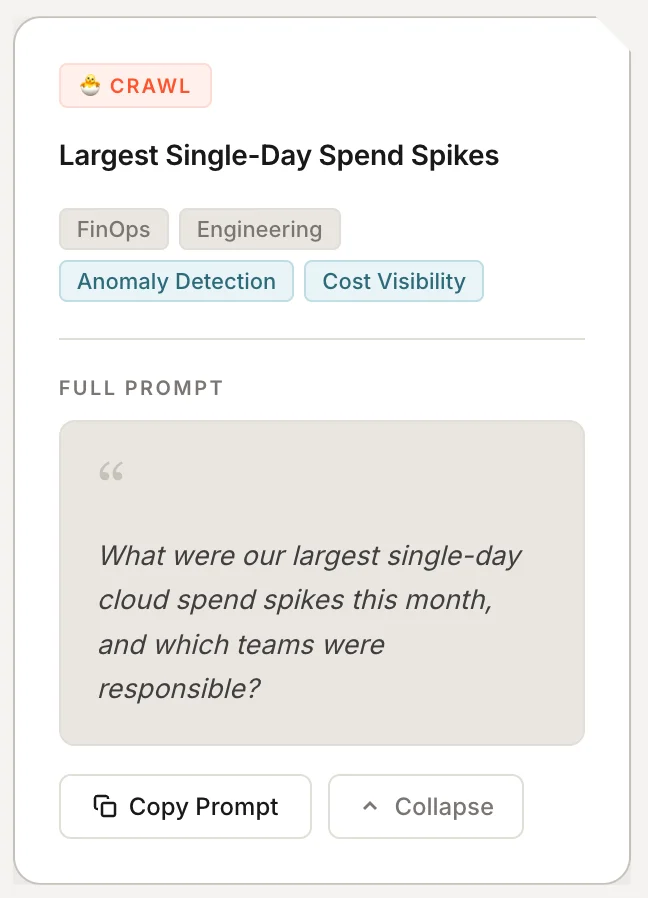
Our Claude Code Plugin sits atop this foundation of allocation. It takes five minutes to set up, and once it’s up and running, you can ask that question as it’s written: “Why did our cloud bill spike last month?” and get a full dimensional breakdown of which costs increased, which products/features/customers/etc. they connect to, and who’s responsible for managing them.
Here’s the exact prompt:
Report
Finance needs to prove AI’s return: CloudZero report
260 senior finance leaders (more than half CFOs) told us why the speed of seeing AI spend, not the size of it, separates who pulls ahead on AI from who gets burned.
Level 2: Quarter Close Cloud Spend Reconciliation
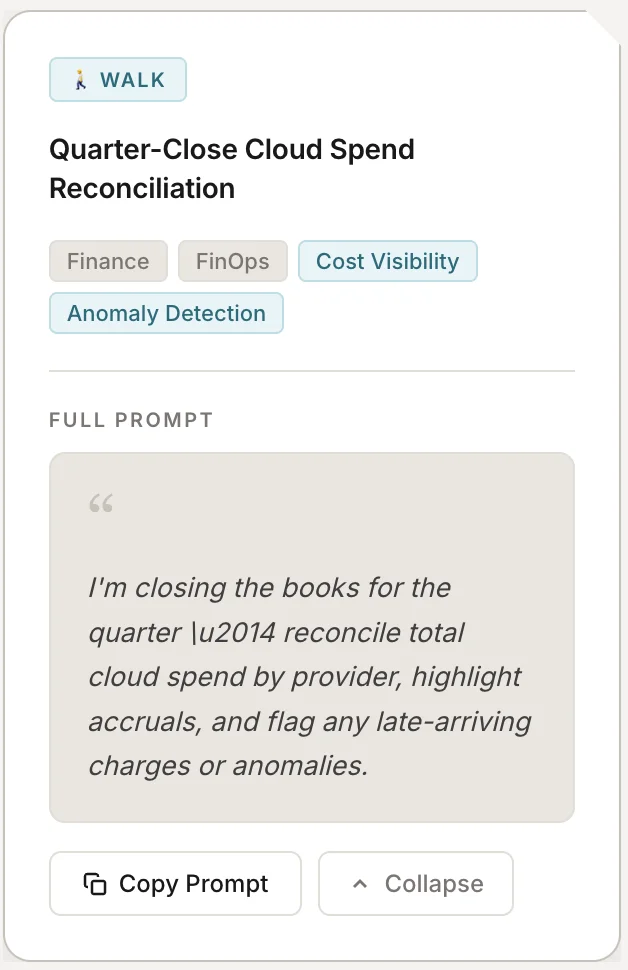
AI is exceptionally good at helping finance leaders close the books. Again, once you’ve got complete, accurate cost allocation, you can use our Claude Code Plugin to ask your most pressing accounting questions as the quarter draws to a close.
Here’s another sample prompt (full library here):
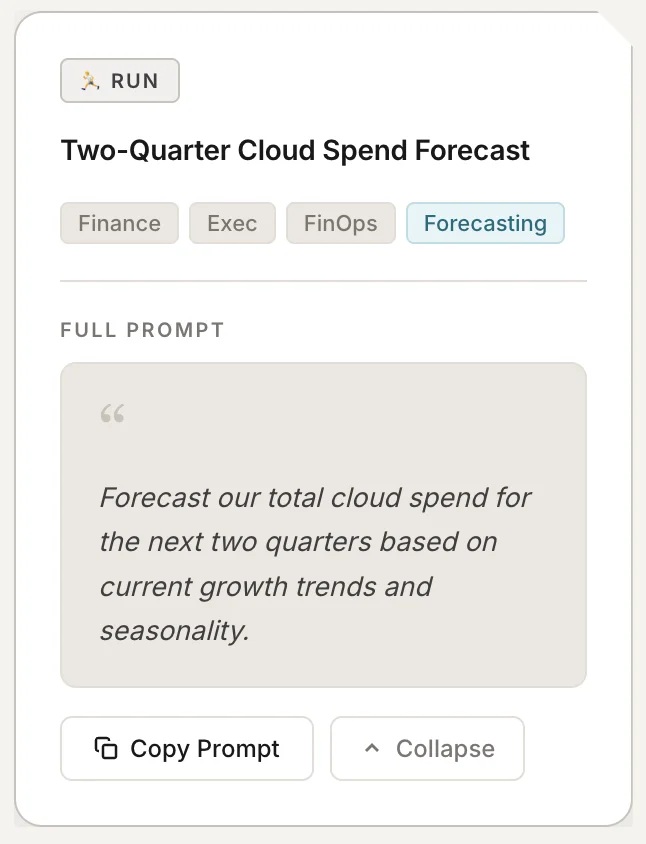
Level 3: Two-Quarter Cloud Spend Forecast
Cloud spend is notoriously difficult to forecast because of its volatility. The best forecasts come from the most comprehensive understanding of your cloud cost trends — not just the broad strokes, but a granular knowledge of how costs tend to fluctuate within all dimensions of your business.
Claude can hold all this information in its prodigious brain, and serve it up to you in straightforward, digestible insights. Here’s a prompt you can use in our Claude Code Plugin:
For the more technical finance leaders out there, you can get even more granular with your AI-augmented forecasts. If your engineering team is rolling out a new product, you can track its costs at different stages of adoption, understanding how readily customers are adopting it, what revenue it’s contributing, and, therefore, whether its costs are justified.
You can ask AI to compare a new product’s costs to your most heavily used product(s) to anticipate what the new product would cost at scale. If Claude flags potential inefficiencies, you and your engineering colleagues can get out in front of them, correcting them before you incur unnecessary costs.
From Question To Insight In Seconds
In the past, getting answers to each of these questions would have entailed at least two more steps: passing the questions through engineering leaders, and requiring them to create a dashboard that surfaces the answers.
With the ability to ask and answer these questions autonomously, finance leaders can get straight to the insight, find opportunities to get more efficient, and drive meaningful conversations with engineering leaders.
Learn more about our Claude Code Plugin here.