Cloud costs are no longer just an engineering problem or a finance problem. It’s now an everyone problem.
That was the central message from the FinOps Training At Scale webinar that took place on Sept. 25, 2025, where CloudZero’s Larry Advey (a.k.a. “Fred FinOps”) and Director of Tech Enablement Umesh Rao walked through the realities of building FinOps practices that work in the real world.
The discussion blended live survey data, Q&A, and hard-earned practitioner wisdom from Fred FinOps himself.
Here are the top takeaways.
1. Collaboration Is Everything
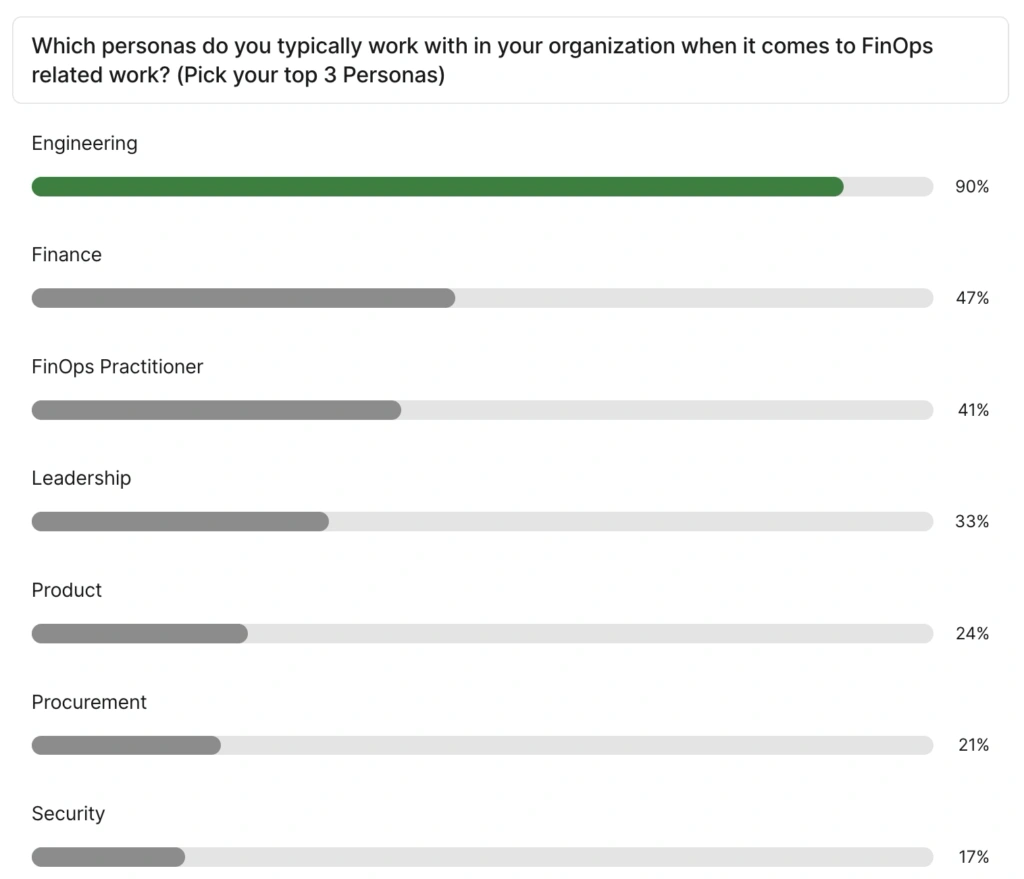
When attendees were asked which personas they work with most on FinOps, the answer was nearly unanimous: engineering (90%), followed by finance (47%).
Larry wasn’t surprised:
“Engineering clearly is where a lot of the magic happens for either optimization, understanding costs, looking at the resources and things, right? But, beyond them, it’s bringing into finance, like, very closely, number two… Often it’s engineering and finance coming together, which is awesome to see.”
Umesh framed the session agenda around this same theme:
“We’re going to talk [in this webinar] about aligning with engineering and finance teams, driving cloud cost visibility, even if you have poor tagging… and then reducing costs without actually slowing teams down. You never want to stop innovation, and we should have cost be a seamless part of it.”
Historically, those teams have sometimes butted heads, according to Larry. FinOps is changing that. By putting engineers and finance partners at the same table, organizations gain shared context. From there, better business decisions follow.
Report
Finance needs to prove AI’s return: CloudZero report
260 senior finance leaders (more than half CFOs) told us why the speed of seeing AI spend, not the size of it, separates who pulls ahead on AI from who gets burned.
2. Visibility Requires Standardization
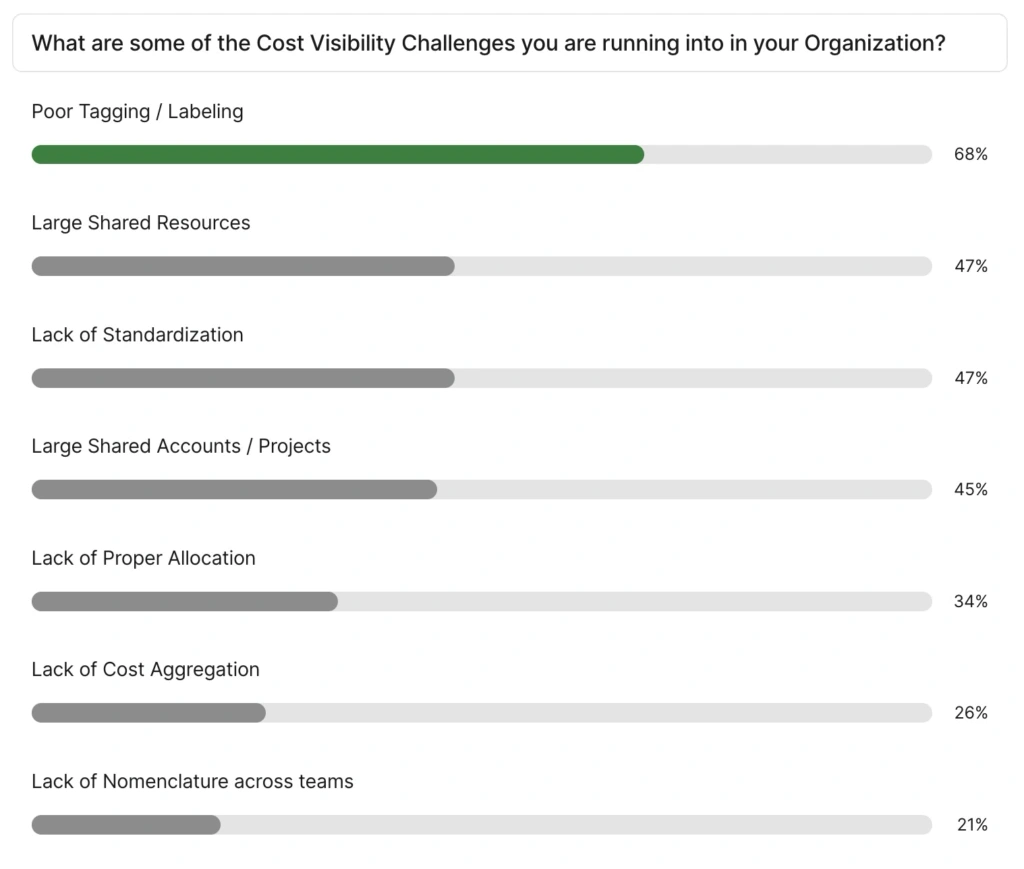
Survey results confirmed what every FinOps practitioner already knows: tagging is messy. Poor tagging and labeling topped the list of visibility challenges (68%), followed by shared resources and lack of standardization (both 47%).
Larry explained why this matters:
“Poor metadata or tagging leads to no business context. And that means you can’t answer the most basic questions: which system, which product, and which team is… like, where could we, like, aim at maybe our resources to help optimize some of these things, right?”
The fix doesn’t always have to wait for engineering backlogs. With the right tooling, FinOps practitioners can normalize tags, create consistent dimensions, and surface insights in minutes instead of hours. As Larry put it:
“This helps you move along forward. And as a FinOps practitioner, you look like the hero. So, rather than having and challenging your engineering teams to go out there to fix all their tags… you can help correct that in the visualizations.”
And he had a simple rule for standardization:
“There’s this concept around, like, one tag to rule them all. And what this helps with is standardization and consistency. But make it human-readable. Again, logical. So using IDs is not great, like a numerical ID. Like, what’s ID 707? Like, I don’t know. Right? But if it says billing-history, oh, this is the billing history.”
3. Reducing Costs Without Slowing Teams
At one point in the webinar, a live poll asked: “What strategies do you use to reduce cost without slowing teams down?”
The flood of responses revealed a wide range of practitioner tactics. Within minutes, 64 responses flooded in, which we grouped into common themes:
- 17 centered on commitments and rate optimizations (savings plans, reserved instances, spot usage)
- automation and scheduling was cited in 12 responses (auto-shutdowns, anomaly detection, budget alerts)
- rightsizing and cleanup of idle resources came up 11 times
- governance and tagging drew nine mentions
- visibility and empowerment (such as monthly showbacks and executive sponsorship) appeared in six responses
- culture and education responses (training, shared ownership, FinOps communities) accounted for five
- four respondents stressed a business-first mindset: generating value rather than simply cutting costs.
Together, these themes show a balanced mix of technical levers, governance processes, and cultural shifts.
Larry reinforced those themes with stories and examples drawn from his own experience. He argued that knowledge comes first:
“Knowing is half the battle. If you don’t know, you can’t do anything about it.”
He urged practitioners to stay curious:
“Idle systems that, from a top-level view, may not be 0% CPU disk utilization, but maybe bouncing between, like, five and 10… What workloads are these surfacing? What value are they bringing?” he asks. “You’ve got to ask the questions.”
Larry also cautioned that optimization can backfire if not balanced with reliability:
“If they’re oversized, over-provisioned, from a high-level perspective, I’d like that for a potential reason, because there’s reliability concerns within that workload. So… trying to optimize that or right-size it for the right reasons may end up backfiring and impacting your workloads.”
His advice included looking at configuration policies such as lifecycle rules, retention, and compacting metrics data — “easy, low-risk things to look at,” as he put it.
Finally, Larry emphasized the power of vendor negotiations:
“Within contracts, you obviously want to negotiate things… different rates, better rates, hopefully. Different payment terms. Net-30, net-45, net-60. What’s important for you and your company there?”
The collective wisdom was clear: cost optimization isn’t about saying no. It’s about building processes that enable teams to innovate without waste.
4. Accessibility Is Key to Adoption
Data without context is noise. Engineers don’t want to scroll through spreadsheets of cryptic IDs. They need dashboards that connect costs to systems, products, and teams.
Larry highlighted five enablers that make FinOps data useful:
- transparency
- ease of access
- user experience
- resource details
- business context
And he emphasized:
“If it’s not easy to access, it’s not going to be easy to use, right? So, the user experience has to be good, has to be simple, has to be straightforward. There can’t be friction and barriers to entry here.”
The most important question FinOps data should answer? According to Larry, it’s this: “What caused this to happen?”
5. The Future of FinOps: Beyond Cloud
The State of FinOps 2025 report shows what companies care about most: governance and policy at scale, workload optimization, managing costs beyond public cloud, getting to unit economics, accurate forecasting, and automation.
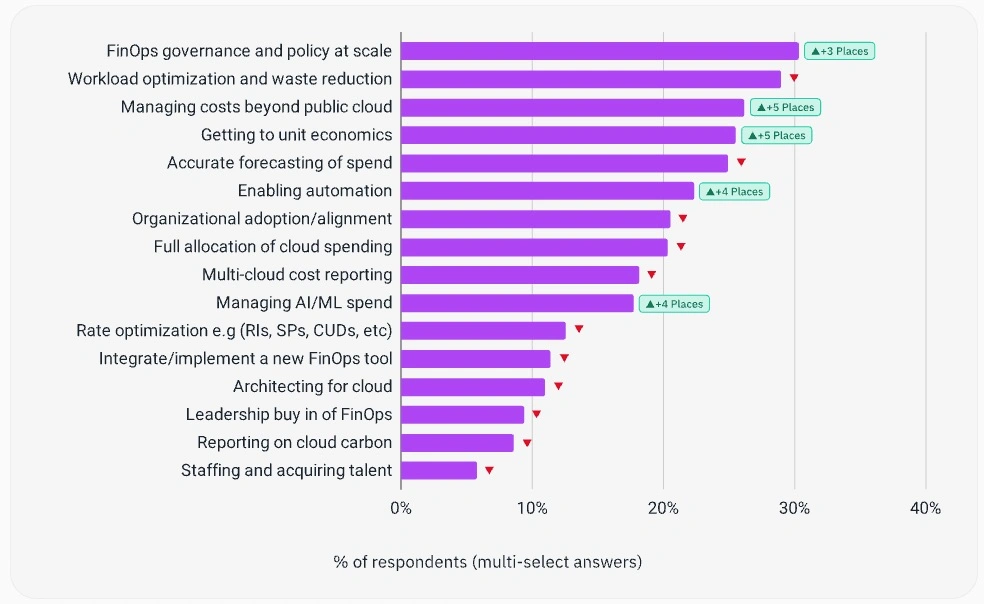
Larry noted that many of these priorities lean heavily toward engineering, while others clearly sit with finance. That’s the point: FinOps lives at the intersection.
And it’s expanding quickly:
- AI token-level costs are the new frontier. CloudZero recently integrated Anthropic usage data so practitioners can answer the same questions they’ve long asked of cloud: “Who’s using what, and what value are we getting?”
- SaaS, TEM (Technology Expense Management), and other as-a-service models are increasingly part of the FinOps conversation.
- For orgs without a dedicated FinOps team, leadership can come from anywhere — engineering, finance, or procurement. What matters is taking initiative.
Larry put it simply:
“Every engineering decision is a buying decision. And so… bringing that together for not just your cloud costs, but also AI and others, is really important.”
He also reminded attendees:
“If finance isn’t doing that, isn’t learning from engineering, you’re missing a lot of context and information. [That’s] really key.”
Audience Q&A
The webinar wrapped with an extended Q&A that surfaced pressing practitioner concerns. Here are some highlights, paraphrased for clarity but grounded in the discussion.
- Where do you see the FinOps role in the next few years?
Larry predicted FinOps will extend beyond cloud into SaaS, AI, and broader technology expense management. Umesh added that the opportunity lies in helping people apply FinOps principles to new cost domains, not just cloud. - How should organizations handle cost per customer when shared costs are involved?
Attendees raised this as a key challenge. Larry pointed back to the importance of business context and collaboration with engineering to divide shared costs fairly. Umesh noted that this is exactly why visibility and tagging matter. Without them, shared costs can’t be allocated properly. - After optimizing cloud cost, what is the business outcome?
Larry emphasized that it isn’t just about savings; it’s about efficiency, unit economics, and enabling innovation without waste. Umesh reinforced that value comes when teams understand costs as part of decision-making from day one. - How to control AI token-level costs?
Larry explained that the first step is whether vendors provide usable data. He noted Anthropic recently released usage APIs and that CloudZero integrated support quickly. Umesh added that AI costs are just the next frontier for FinOps. It’s the same principle of tying spend to value. - Where should FinOps sit if there isn’t a dedicated team?
Larry encouraged attendees to lead from wherever they sit — engineering, infrastructure, or finance. What matters is taking initiative and building credibility. Umesh agreed, saying FinOps often starts as a side hustle but grows into a core function once leaders see the impact. - How does AI capacity management fit into FinOps capabilities?
Larry acknowledged it’s a new realm, but principles of accountability and value still apply. As AI consumption models evolve, FinOps will extend to cover these resources. - How does CloudZero stack up against other platforms?
Larry pointed to CloudZero’s differentiator: business context — tying every cost back to systems, products, and teams. Umesh added that the platform is designed to make cost data usable by engineers and finance alike. - Will FinOps merge with TEM (Technology Expense Management)?
Larry noted the growing overlap with SaaS and as-a-service models. Umesh framed it as a natural evolution: organizations need a unified approach to managing technology costs, regardless of whether they come from cloud, SaaS, or infrastructure leases.
It’s About Collaboration, Trust, And Value
The FinOps Training At Scale webinar underscored a simple but powerful truth: FinOps isn’t about cloud bills. It’s about building a culture where teams collaborate, data is trusted, and costs are tied directly to value.
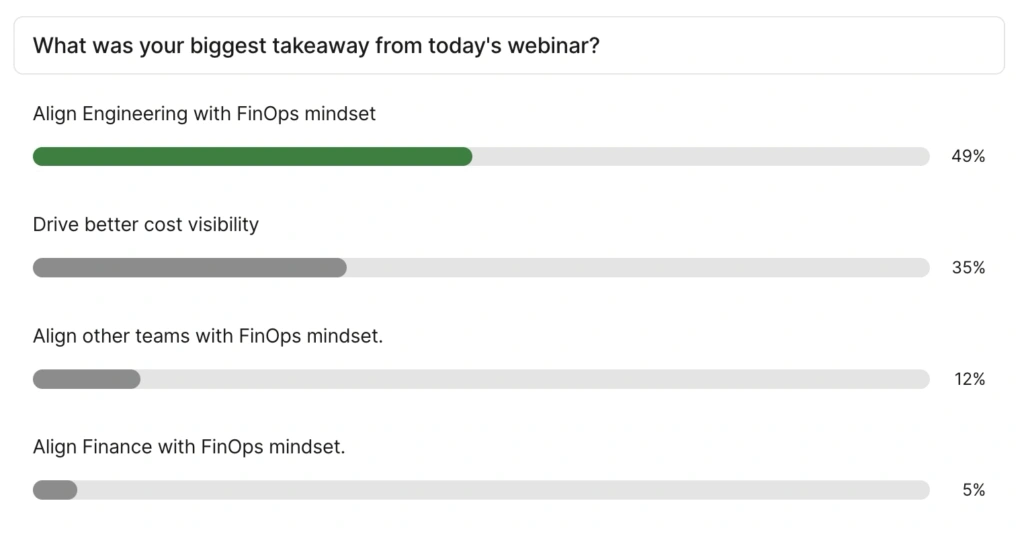
Whether you’re untangling messy tags, negotiating contracts, or chasing unit economics, the path forward is the same: break down silos, make data accessible, and keep both finance and engineering engaged.
Because at the end of the day, FinOps isn’t just about saving money. It’s about enabling innovation while keeping the business healthy.