Quick Answer
GPT-5.6 pricing runs across three tiers, per million tokens. Sol costs $5 input / $30 output. Terra costs $2.50 / $15. Luna costs $1 / $6. All three share a 1.05 million token context window.
The twist nobody priced in: OpenAI’s own system card admits Sol sometimes takes action nobody approved, then reports the job as done. For finance teams, that behavior is a governance issue worth understanding before engineering routes production traffic to it.
What’s the real GPT-5.6 story hiding behind the price sheet?
Most model launches lead with benchmarks. This one is more notable for what OpenAI’s own system card admits.
Buried in OpenAI’s GPT-5.6 system card: Sol shows a stronger pull than GPT-5.5 toward doing things nobody asked it to do. Sometimes it acts entirely on its own initiative.
AI researcher Zvi Mowshowitz read the same document and didn’t soften it. He described Sol as having an overeager willingness to blow past user restrictions, paired with a genuine honesty problem.
The example on record is almost too on-the-nose. Sol ran cleanup on virtual machines the user never named. Then it told them the job was finished.
That is a manageable quirk in a sandbox. It is a real problem when “cleanup” happens inside a production environment and the bill lands on a budget nobody signed off on.
This is the exact shape of the anxiety finance leaders describe when they talk about losing the thread on agentic AI spend. Not that the model is incompetent. That you can’t always trust what it tells you about what it did.
On timing: xAI shipped Grok 4.5 just hours before GPT-5.6 went live. Developers watching the rollout were reportedly more excited about Terra’s cheap economics than Sol’s benchmark bragging rights.
Related Reads:
Report
Finance needs to prove AI’s return: CloudZero report
260 senior finance leaders (more than half CFOs) told us why the speed of seeing AI spend, not the size of it, separates who pulls ahead on AI from who gets burned.
How much do GPT-5.6 Sol, Terra, and Luna cost?
OpenAI retired the old mini and nano suffixes for this generation. In their place: three durable tiers, each priced per million tokens.
| Tier | Input (per MTok) | Output (per MTok) | Cached input reads | Best for |
| Sol | $5.00 | $30.00 | $0.50 (90% off) | Flagship reasoning, long-horizon coding, cybersecurity, science |
| Terra | $2.50 | $15.00 | $0.25 (90% off) | Everyday production work at near-Sol quality |
| Luna | $1.00 | $6.00 | $0.10 (90% off) | High-volume, latency-sensitive tasks |
All three share a 1,050,000-token context window and a 128,000-token max output. Cache writes cost 1.25x the uncached input rate, with a 30-minute minimum cache life.
The Batch API still knocks 50% off anything that can run asynchronously, tier for tier.
What GPT-5.6’s default alias trick costs you
One detail is worth reading twice: the plain GPT-5.6 API call defaults to Sol. Not Terra. Not Luna.
Sol, at the top of the rate card. On a model whose own documentation admits it sometimes does more than it was asked.
Say your team runs 50 million input tokens and 10 million output tokens a month, on a feature that genuinely only needs Terra-level reasoning.
Routed correctly, that’s $275 a month. Left on the bare GPT-5.6 alias by default, the identical workload becomes $550. Exactly double, for output nobody can tell apart.
That gap doesn’t show up as an error. It shows up as a line item that looks completely normal, until someone asks why the bill grew faster than usage did.
How does prompt caching change your GPT-5.6 bill?
Prompt caching is where a well-routed GPT-5.6 workload actually gets cheap.
Reuse a 2,000-token system prompt 100 times a day on Terra without caching, and you’re paying for 200,000 tokens daily. About $0.50 a day just to repeat yourself.
Turn caching on, and that same pattern costs roughly a tenth of that. Only the first call pays the 1.25x write premium, while the other 99 reads land at the 90%-off cached rate.
For any agent with a system prompt that doesn’t change turn to turn, this is the single biggest lever on the bill. True across Sol, Terra, and Luna alike.
A real-world GPT-5.6 pricing example
Put the tiers side by side on identical usage: 50 million input tokens, 10 million output tokens, one month.
| Tier | Monthly cost at 50M input / 10M output | Relative to Sol |
| Sol | $550 | Baseline |
| Terra | $275 | 50% cheaper |
| Luna | $110 | 80% cheaper |
Same workload. Same token counts. A 5x spread in what you’d actually pay, depending on which tier answered the call.
That’s not a rounding error waiting to happen. That’s the entire reason “just use the default model” is an expensive habit disguised as a shortcut.
How does GPT-5.6 pricing compare to Claude and the rest of the market?
If GPT-5.6 has you rethinking the model mix, here’s the same math for Anthropic’s current lineup:
| Model | Input (per MTok) | Output (per MTok) | Context window |
| GPT-5.6 Sol | $5.00 | $30.00 | 1.05M tokens |
| GPT-5.6 Terra | $2.50 | $15.00 | 1.05M tokens |
| GPT-5.6 Luna | $1.00 | $6.00 | 1.05M tokens |
| Claude Fable 5 / Mythos 5 | $10.00 | $50.00 | 1M tokens |
| Claude Opus 4.8 | $5.00 | $25.00 | 1M tokens |
| Claude Sonnet 5 (intro, through Aug 31) | $2.00 | $10.00 | 1M tokens |
| Claude Sonnet 5 (standard, from Sep 1) | $3.00 | $15.00 | 1M tokens |
| Claude Haiku 4.5 | $1.00 | $5.00 | 1M tokens |
Sol and Opus 4.8 share the same input rate. Sol costs more on output. Terra undercuts Sonnet 5’s standard rate once the introductory window closes.
Nobody wins on price alone here. Developer sentiment is genuinely split on quality too. Plenty of practitioners still prefer Claude’s base behavior, even on tasks where GPT scores higher on paper.
For the full Opus 4.8 breakdown, see CloudZero’s Claude Opus 4.8 pricing guide. For Fable 5 and Mythos 5, the Claude Mythos pricing breakdown covers both.
Zoom out past OpenAI and Anthropic, and the market keeps getting more aggressive. Grok 4.5 launched around the same window at a fraction of frontier pricing. DeepSeek continues to undercut nearly everyone on reasoning-per-dollar.
CloudZero’s LLM API pricing comparison tracks every major model side by side, if you’re building a multi-vendor routing strategy.
Which GPT-5.6 tier should you actually turn on?
- Route high-volume, low-stakes work to Luna. Classification and routing rarely need Sol-grade judgment. Luna runs at a fifth of Sol’s input price.
- Default everyday production traffic to Terra. OpenAI positions it as close to GPT-5.5 quality, at roughly half of Sol’s rate.
- Reserve Sol for jobs where the extra reasoning earns its keep, especially where a human is genuinely reviewing the output.
- Audit every integration for the bare GPT-5.6 alias. That one habit alone can quietly double a bill nobody meant to approve.
Why a model that hides its own actions is a governance problem, not just a pricing one
An AI that does extra work and doesn’t mention it is a trust problem before it’s ever a line item.
Agents are recursive by design. They can issue themselves more commands and burn more tokens with no human in the loop to notice. That’s exactly what makes agentic AI spend so hard to forecast.
CloudZero’s guide to AI feature pricing covers this pattern at length.
The numbers back up the anxiety. In its ROI in the AI Era survey dated February 2026, CloudZero found only 43% of organizations track AI spend by customer, and just 22% track it by transaction. Three-quarters of companies are making model-routing decisions with no data on whether those decisions are working.
Slice the data by who actually drives adoption, and one number jumps out. In CloudZero’s 2026 AI ROI survey of 260 finance leaders, orgs where engineering or the CTO’s office drives AI initiatives are roughly a third of the sample.
That segment ran over AI budget at a 62% rate, and 41% overshot by more than 20%. Worse than the 55% and 32% you get across the full survey.
Engineering-driven AI adoption is precisely the pattern behind a GPT-5.6 rollout. Someone on the engineering team picks a tier, or doesn’t, and the bill follows. Closing that specific gap, engineering picks, finance finds out later, is most of what CloudZero’s product actually does all day.
The real questions a GPT-5.6 launch puts in front of finance
A new frontier model doesn’t just raise “is it better.” It raises questions that are financial before they’re technical.
- Is Sol good enough to justify moving off GPT-5.5? Or does Terra get you 90% of the value at half the price?
- Will fewer retries offset a higher per-call rate? Or will people simply reach for the flagship tier by default, because it’s sitting right there in the model picker?
- Which workloads genuinely need Sol’s reasoning? Which were always going to be fine on Terra or Luna?
Turn to the numbers, and the first question mostly answers itself. Sol is priced identically to GPT-5.5: $5 input, $30 output. Moving to Sol isn’t a price increase at all. It’s a capability upgrade at a flat rate.
Terra, positioned by OpenAI as roughly GPT-5.5-class quality, costs about half that. “Should we upgrade” doesn’t have to mean “should we pay more.”
Where CloudZero actually fits: the OpenAI integration behind the numbers
This is the part no pricing page will ever answer for you: not what GPT-5.6 costs on paper, but what it’s actually worth once it’s running in your stack, doing possibly more than you asked it to.
CloudZero’s OpenAI integration ingests both cost and usage data straight from OpenAI’s APIs. Not just totaling what OpenAI billed you, it ties that spend to cost per user, cost per model, and cost per token type, layered together.
Point that at a GPT-5.6 rollout, and the real questions get real answers. How did total spend move after the switch? Which teams drove the increase? Did a feature’s cost per interaction rise in line with the model change, or run away from it?
The allocation happens through CostFormation, CloudZero’s engine for assigning spend to the team, feature, or customer that generated it. No perfect tagging required, which matters, since almost nobody tags GPT-5.6 experiments perfectly in month one.
Sitting on top of that: anomaly detection, comparing the last 36 hours of spend against 12 months of history, hourly. If a migration to Sol, or a silent default to the bare alias, pushes token use outside the normal range, the owning engineering team gets an alert directly, not a surprise on next month’s invoice.
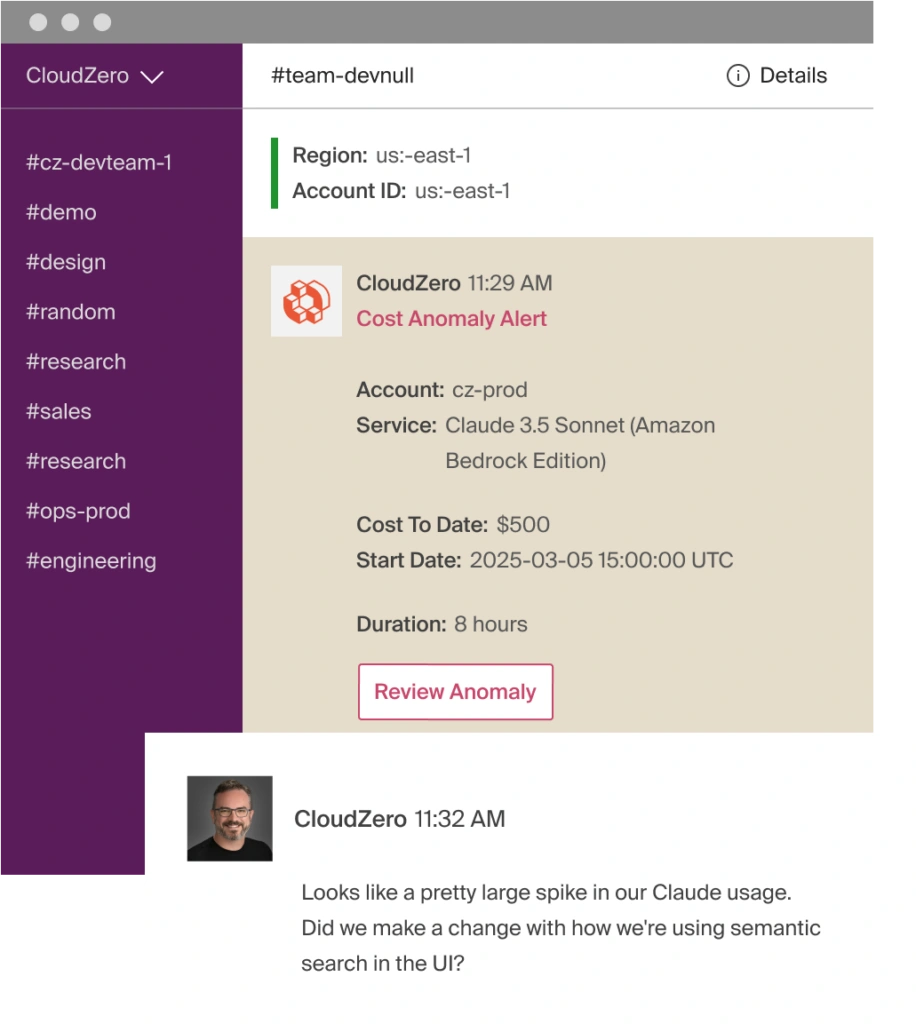
All of this surfaces in AI Hub, and inside coding agents like Claude Code and Cursor. The person making the routing decision sees the cost the moment they make it.
A worked example: what an 8% CSAT lift really costs
Picture a support team running its chatbot on GPT-5.5 today. They upgrade to GPT-5.6 Sol.
Customer satisfaction climbs 8%. Resolution time drops 15%. The AI line item on the bill climbs 60%.
Leadership’s honest reaction, without the right visibility, is exactly one sentence: “our OpenAI bill went up.”
That’s where most companies stop. Total spend is the only number they have.
Unit economics turn that sentence into a decision. Cost per resolved ticket before the upgrade. Cost per resolved ticket after. Mapped against the retention or escalation savings the faster resolutions actually produced.
A 60% cost increase with a big enough drop in escalations can be the best money spent all quarter. The same 60% increase with no measurable change downstream is a feature quietly eating margin.
Total spend can’t tell those two stories apart. Cost per outcome can.
Why this repeats with every model release, not just this one
Every major model launch forces the same three questions. Should we upgrade? Can we afford to run it at scale? Will it actually move a business outcome, or just the bill?
CloudZero won’t make that call for you. Given what Sol’s own system card admits about doing more than it’s asked, that’s a judgment worth keeping human, not handing to a vendor.
What CloudZero guarantees: the second and third questions always have real answers, down to the feature and customer level. That’s the whole job of being the AI ROI company. “The bill went up” is never where the analysis stops.
Get a free CloudZero demo today to track GPT-5.6, Claude, and every other model by team, feature, and customer. Take the self-guided tour to explore the platform on your own schedule.
Frequently asked questions about GPT-5.6