AI is the new frontier for FinOps maturity. It introduces fresh spend patterns and new opportunities for value.
As GPUs, inference, and retraining reshape costs, FinOps maturity grows through visibility, forecasting, and shared mindset about how these workloads drive business impact.
In this 2025 post, I gave my guidelines for implementing AI tagging to give business context and clarity to vague AI invoices. Now, I’m sharing the next level up: how to drive FinOps in AI with AI.
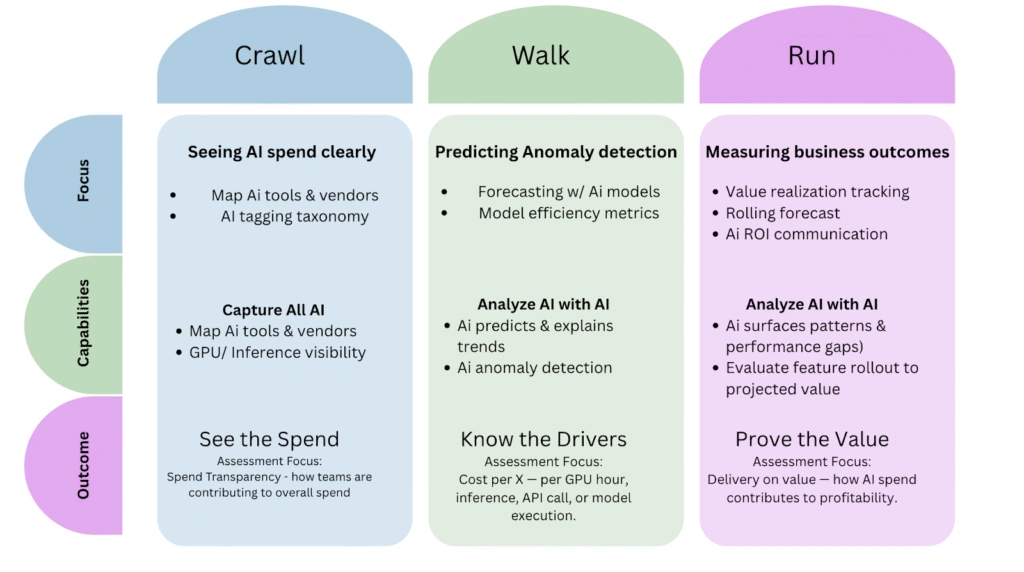
Crawl: Gain Visibility Into AI Workloads
The first step is clarity.
What this looks like:
- Mapping all AI platforms, vendors, and billing sources
- Tracking GPU utilization, model run cost, inference vs training
- Tagging features and models to show how teams influence the invoice
- Using proxies like API calls, tokens, or executions to allocate shared services
- Integrating AI-driven insights to predict spend and detect anomalies
When visibility strengthens, teams finally understand what’s spending the profits.
Outcome: Teams respond faster to cost changes because they can finally see them.
Report
Finance needs to prove AI’s return: CloudZero report
260 senior finance leaders (more than half CFOs) told us why the speed of seeing AI spend, not the size of it, separates who pulls ahead on AI from who gets burned.
Walk: Manage Uncertainty & Improve Predictability
AI workloads fluctuate. Seasonality, adoption surges, retraining cadence, and experimentation all introduce volatility.
The Walk stage equips teams to navigate this uncertainty.
What this looks like:
- Measuring spend efficiency across models and features
- Tracking expected spikes for planned activity
- Comparing estimated usage to actual usage for iterative planning
- Automating alerts and anomaly detection
- Using natural-language to ask questions like: “Why did inference costs increase last week?”
This stage uncovers inefficiencies that were previously invisible.
Assessment Focus: Cost per X — per GPU hour, inference, API call, or model execution.
Outcome: Teams see not just what costs increased but why — and what to do next.
Run: Align AI Spend to Business Value
At this stage, FinOps align AI investments to measurable outcomes.
Key capabilities: Evaluating whether feature rollouts achieved projected value
- Comparing real-world performance to planned budgets
- Making rolling forecasts across engineering, product, and finance
- Reviewing whether the AI tech stack aligns with business outcomes
- Using AI-driven pattern detection to surface areas of underperformance
In the Run stage, teams communicate insights in business terms, not spend terms.
Assessment Focus: Delivery on value — how AI spend contributes to profitability.
Outcome: Leadership sees value, not volatility.
A Practical Example: Moving From Crawl to Walk
A team conducts an internal FinOps maturity assessment and discovers that AI forecasting is still at the Crawl stage. Cloud costs are well understood, but GPU usage, model retraining spikes, and inference growth are not.
The team shares findings with their AI decision-makers, who approve:
- Integrating deep GPU visibility
- Expanding tagging for AI features
- Testing AI-assisted forecasting models
These investments that push the team toward Walk maturity and unlock more predictable AI financial planning. The assessment becomes a catalyst for alignment and operational clarity.
Closing Thought: Influence Through Insight
FinOps for AI can enable adaptability. As teams mature, they evolve from describing ‘what happened’ to predicting what ‘will happen’ to shaping outcomes that deliver business value.
The practitioner becomes the interpretive layer that connects spend to decision-making.
Visibility fuels maturity, which fuels influence. In turn, influence fuels value.
And in the world of AI, value is the ultimate metric.