When building or scaling a SaaS product, few architectural decisions carry as much long-term weight as tenancy model selection. Single-tenant and multi-tenant cloud environments each come with distinct trade-offs around security, cost, operational complexity, and customer experience — and the right choice depends on where your product sits in its growth curve, who your buyers are, and how much infrastructure overhead your team can absorb.
This guide breaks down how each model works, when each makes sense, and how to maintain cost visibility regardless of which path you take.
Table Of Contents
- What Is Single-Tenant Cloud Architecture?
- What Is Multi-Tenant Cloud Architecture?
- What Is A Mixed Tenancy Model?
- Single-Tenant Vs. Multi-Tenant Architecture
- Single-Tenant Benefits And Drawbacks
- Multi-Tenant Benefits And Drawbacks
- When To Use Each
- Understanding Cost Per Customer In Multi-Tenant Architecture
- Frequently Asked Questions About Single-tenancy Vs. Multi-tenancy Architectures
What Is Single-Tenant Cloud Architecture?
In SaaS, a single-tenant architecture is where a single instance of the software application, and its supporting infrastructure, serves a single customer (tenant).
The single instance of the software runs on a dedicated cloud server for just this one customer. So there is no sharing it with any other customer of the SaaS provider.
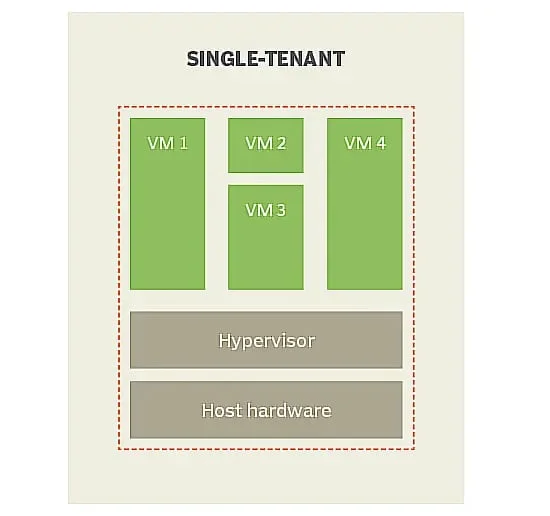
Credit: TechTarget – In a single tenancy model, all the VMs are dedicated to a single customer’s usage. The SaaS provider manages the infrastructure (hypervisor and host hardware).
Single tenancy in cloud computing also means:
- The hosting vendor manages some aspects of the dedicated infrastructure and the software instance.
- The customer retains most of the control over how to customize the software and infrastructure.
- Because the infrastructure and software instance is not shared, single tenancy often provides greater confidentiality, security, backup, and performance than shared infrastructure.
- Each tenant has their own isolated environment, giving them greater flexibility than shared infrastructure models.
- The dedicated service costs more than a shared architecture
Research Report
FinOps In The AI Era: A Critical Recalibration
What 475 executives told us about AI and cloud efficiency.
What Is Multi-Tenant Cloud Architecture?
A multi-tenant architecture is where a single software instance and its supporting infrastructure are shared among two or more customers (tenants) at the same time.
While each tenant’s data is isolated from the other tenants’, each customer shares a single database, software application, and SaaS server with the others.
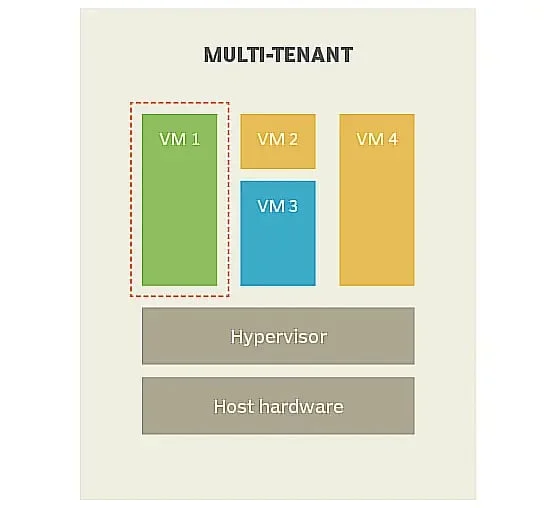
Credit: TechTarget – In a multi-tenancy model, a customer uses just one instance out of several. The SaaS provider controls the underlying infrastructure.
Multi-tenancy in cloud computing means that:
- All customers are physically integrated but logically separated.
- All tenants share the same codebase and database.
- A single instance of the SaaS application runs on a single server and serves multiple customers at the same time.
- Each tenant can customize their database schemas, UI colors, and application rules to some extent. But the hosting provider yields the most control over the SaaS infrastructure.
- Multi-tenancy leverages economies of scale to lower operational costs compared to a dedicated environment.
- Scalability is emphasized here, providing virtually limitless computing capacity.
The trade-off of shared infrastructure is that one tenant’s heavy resource usage can occasionally affect neighbors — a phenomenon known as the “noisy neighbor” problem, where one tenant’s compute or I/O spikes degrade performance for others on the same infrastructure.
What Is A Mixed Tenancy Model?
Mixed (or hybrid) tenancy combines elements of both approaches. Portions of the application stack run as dedicated resources for individual customers, while other components remain shared across all tenants.
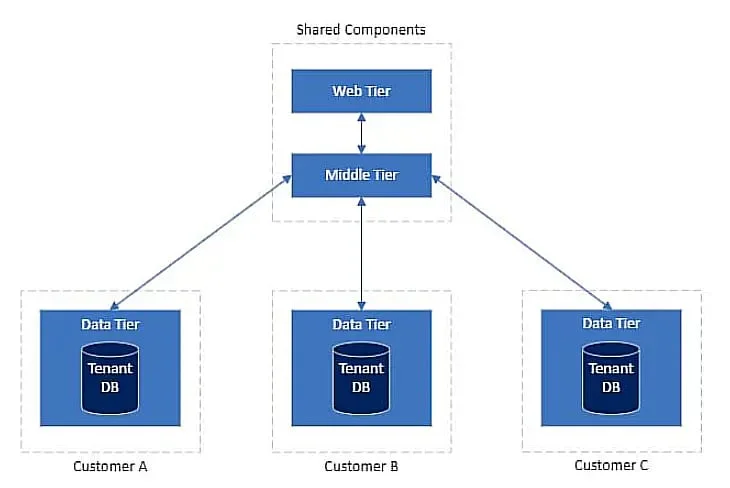
Credit: Microsoft – Mixed tenancy provides some dedicated and some shared components at the same time.
This model has become increasingly common in mature SaaS products. A typical pattern: free and standard-tier customers run on shared, multi-tenant infrastructure to keep unit costs low, while enterprise customers with compliance requirements or heavy workloads get isolated compute, dedicated database schemas, or even separate clusters. The shared application layer handles authentication, the UI, and common business logic, while the data and processing layers vary by tier.
Mixed tenancy is particularly useful when your customer base spans regulated and unregulated industries, or when you need to offer performance guarantees (SLAs) to high-value accounts without the operational cost of running fully single-tenant infrastructure for every customer.
Multi-Tenant Vs. Single-Tenant Cloud Architecture
| Factor | Single-Tenant | Multi-Tenant |
| Infrastructure | Dedicated per customer | Shared across customers |
| Data isolation | Physical separation | Logical separation |
| Cost per customer | Higher (dedicated resources) | Lower (shared resources) |
| Customization | Extensive (full environment control) | Limited (within application boundaries) |
| Maintenance | Per-instance updates and patching | Centralized, single deployment |
| Scalability | Scale each instance independently | Pool resources dynamically |
| Performance risk | Isolated (no neighbor effects) | Noisy neighbor potential |
| Compliance posture | Stronger default isolation | Requires careful architecture |
The real estate analogy is often used to explain single-tenant vs. multi-tenant cloud architecture.
In a single-tenant cloud architecture, each customer lives alone in a single apartment building which has its own security system and facilities and is completely isolated from neighboring buildings.
In multi-tenant cloud architecture, tenants live in different apartments inside a single apartment building. They share the same security system and communal facilities.
But each tenant has a key to their respective apartments so their privacy is guaranteed within their apartment. However, the activities of fellow tenants are more likely to have an impact on their comfort in the building.
Most startups opt for a multi-tenant setup, which means having one big database that houses all the customer data.
With the right security systems in place, customer data stays private. While customers cannot see each other’s data, they do live in the same database, and the same computer processes all of the data; so, it’s not segmented in any way.
Benefits And Drawbacks Of Single-Tenant Cloud Architecture
The benefits associated with single-tenant cloud architecture include:
- Data security – Each customer’s data is isolated, minimizing the risk of a data breach that affects multiple customers.
- Customization – More customization options are available in a single-tenant system compared to a multi-tenant system because each customer has dedicated software and hardware.
- Portability – It can also be easier to migrate data from a single-tenant architecture. The most obvious reason is that there is simply less data to handle compared to a multi-tenant setup.
- Noisy neighbor risk: When tenants share compute and I/O resources, one customer’s resource-intensive operations — large data exports, batch processing jobs, or traffic spikes — can degrade performance for others. Mitigation strategies like rate limiting, resource quotas, and tenant-aware autoscaling help, but they add architectural complexity.
Also, since the data store contains only data for a single customer, the team has less worry about complicated migration scripts and mixing customer data on migration. Lastly, most single-tenant architecture replicate the same infrastructure for each customer; therefore, migrating data is often similar to setting up a new customer.
Some disadvantages of single-tenant cloud architecture are:
- Complex setup and management – You have to deploy an instance and set up a database for each customer. As the clientele grows, it becomes more difficult to manage multiple applications. Single-tenant architecture is particularly unsuitable for small startup teams.
- High costs – Running a single-tenant set-up is more expensive than using shared resources. If every customer had their own database and compute, you would need a lot of resources to manage it.
- Inefficient resource usage – Resources are also likely to be underutilized, leading to inefficiencies. Since customers do not have the same usage patterns, allocating the same amount of physical resources to each customer will result in some customers using all (or even needing more) of their allocated resources while others use little or none of their resources.
Benefits And Drawbacks Of Multi-Tenant Cloud Architecture
Some of the benefits associated with multi-tenant cloud architecture are:
- Easy deployability – Consider a team of two people building a new startup. It would be too much work for a team of two to serve multiple clients using a single-tenant approach. While it is doable, it will require a lot of effort. If they adopt a multi-tenant system, however, they can reach for tools provided by the cloud services provider, such as AWS, and build their application faster.
Multi-tenancy is at the heart of effective SaaS operations because it makes it easy to build and deploy applications faster and to scale those applications quickly.
- Efficient resource usage – Unlike the single-tenant model where resources are likely to be underutilized, available resources in a multi-tenant environment are used maximally because they are shared by multiple users.
- Reduced costs – Multiple customers share the cost of the environment in multi-tenancy, so the application is cheaper to build and maintain. Maintenance and management costs are shared by all customers. For example, a single DynamoDB Table can easily hold all application data for millions of customers (as is the case with Amazon itself).
While multi-tenant cloud architecture is usually the best approach for most consumer-facing applications, it is not without its disadvantages, which include:
- Greater security risk – In a multi-tenant system, the risks are higher because resources are shared by multiple customers. If one customer’s data is compromised, it is more likely that it will affect other customers, unlike in a single-tenant cloud where security incidents are isolated to a single client.
- Lack of cost visibility – In comparison to a single-tenant system where each customer has their own database, it is much harder to separate costs in the multi-tenant system.
When To Choose Single-Tenant vs. Multi-Tenant Architecture
The decision ultimately comes down to four factors: your customers’ compliance requirements, the sensitivity of the data you handle, your team’s operational capacity, and your unit economics targets.
Single-tenant tends to make sense when:
- Customers operate in heavily regulated industries (healthcare under HIPAA, financial services under SOX/PCI-DSS, government under FedRAMP) where physical data isolation is a compliance requirement — not just a preference
- Customers need dedicated performance guarantees with contractual SLAs that can’t tolerate noisy neighbor effects
- Your business model supports higher per-customer pricing that offsets the infrastructure overhead
- Customers require deep customization or on-premises deployment options
Multi-tenant is the stronger default when:
- You’re serving a high volume of customers where per-customer infrastructure costs need to stay low
- Your application handles data that can be securely isolated at the logical level
- Your engineering team is small and needs to centralize operations rather than manage per-customer infrastructure
- Speed to market matters — multi-tenant deployments are faster to build, ship, and iterate on
Consider mixed tenancy when:
- Your customer base spans both regulated enterprise buyers and self-serve SMB or mid-market users
- You want to offer tiered service levels where enterprise customers get isolated resources without rebuilding your entire stack
- You need performance isolation for a subset of high-value accounts without abandoning the cost efficiency of multi-tenancy for everyone else
Most consumer-facing SaaS applications run multi-tenant. Most enterprise-grade products serving regulated industries start single-tenant or move toward mixed tenancy as they scale.
Understanding Cost Per Tenant in Multi-Tenant Architecture
The biggest operational trade-off of multi-tenancy is cost visibility. When all your customers share the same databases, compute clusters, and application instances, figuring out what each individual customer costs to serve requires purpose-built tooling — traditional cloud billing won’t get you there.
Without per-tenant cost visibility, you can’t answer foundational business questions: Which customers are profitable? Which pricing tiers are margin-positive? Where should engineering focus optimization efforts for the biggest business impact?
So, how do you tease apart your multi-tenant architecture to understand your costs per tenant? This is where CloudZero comes in.
CloudZero’s cost intelligence platform solves this by automatically allocating shared infrastructure costs to individual tenants, features, and teams — without requiring perfect resource tagging. The platform ingests cost and usage data from 50+ cloud, data, and AI providers, then uses CostFormation to map 100% of spend (including shared resources, Kubernetes clusters, and SaaS tools) to the business dimensions that matter: cost per customer, cost per feature, cost per deployment.
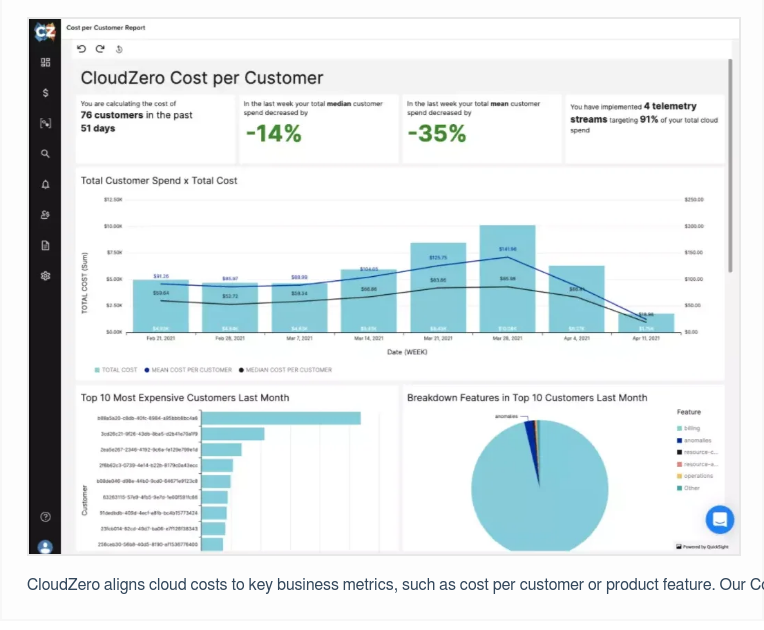
This gives SaaS companies the cost granularity of single-tenant visibility while maintaining the operational and economic advantages of multi-tenant architecture. Engineering teams get self-serve access to explore cost data, AI-powered anomaly detection flags unexpected spend changes in real time, and finance teams can build accurate unit economics models that inform pricing, packaging, and growth strategy.
Companies like Drift have used CloudZero to cut $2.4 million from their annual AWS bill by identifying which product features were margin-negative, while Symphony Talent reduced their AWS costs by 48% through engineering-led optimizations powered by granular cost visibility.
 to see how CloudZero helps you break down costs in a multi-tenant architecture, giving you the insight you need to run a profitable business in the cloud.


FinOps In The AI Era: A Critical Recalibration
What 475 executives told us about AI and cloud efficiency.