Women leaders from CloudZero, Campfire, and Preql AI sat down to talk about what it actually takes to modernize finance in 2026 — AI spend, smarter tooling, and the skills that matter now for finance practitioners and executives looking to manage cloud and AI spend in a rapidly changing and unpredictable financial environment.
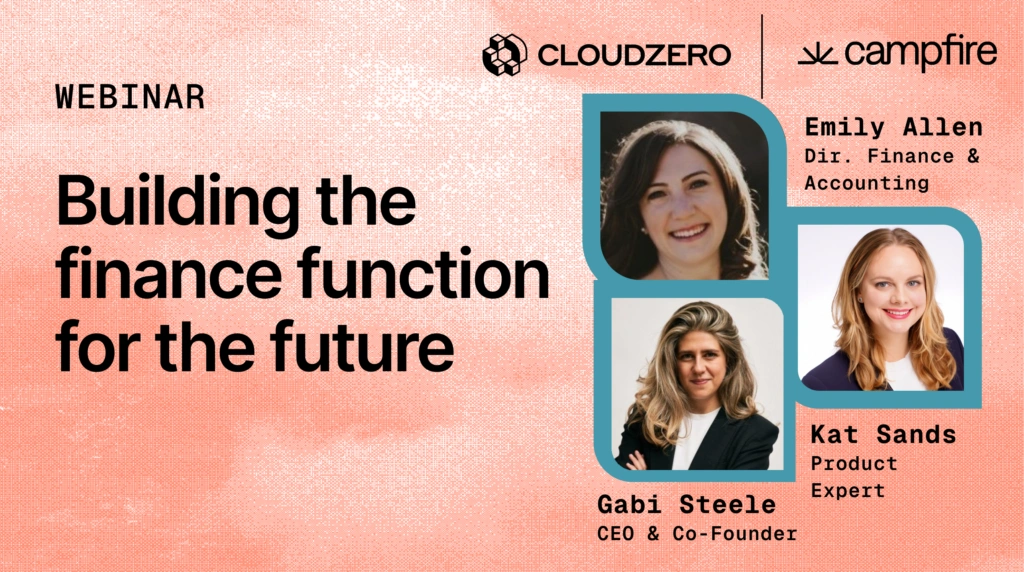
On March 19, 2026, CloudZero and Campfire co-hosted a virtual panel in honor of International Women’s Month, called Building the Finance Function for the Future. The conversation brought together three leading experts on the topic:
- Emily Allen, Director of Finance and Accounting at CloudZero
- Kat Sands, solutions consultant at Campfire
- Gabi Steele, CEO at Preql AI, who moderated.
What followed was a candid, practical discussion about how AI is reshaping the day-to-day of finance — not in theory, but right now, in the tools finance leaders are actually running.
The session covered two major themes: what’s working today in modernizing finance, and what it takes to build the finance team of tomorrow.
Both turned out to be the same conversation.

Watch the video
Enter your email for instant access
Here are the top takeaways.
1. Finance is moving from scorekeeping to strategy — and fast
Six months ago, Emily was in the middle of an ERP evaluation. CloudZero had been running on QuickBooks, and leadership needed convincing that newer, AI-native platforms were worth a look. Today, she does customer references for Campfire once or twice a week.
That shift from “you’re taking a chance” to “you need to be doing this or you’re yesterday’s news” happened in less than a year.
Emily put it plainly: if you’re not using AI daily to rethink your processes, your to-do lists, your workflows, you’re already behind.
Kat saw the same inflection. At an AI event last October, the question was still “how do I get my team to use AI?” The answer was democratization — get it in everyone’s hands and see where the wins emerge.
Now Campfire’s challenge isn’t adoption. It’s helping customers share what’s working with each other.
Report
Finance needs to prove AI’s return: CloudZero report
260 senior finance leaders (more than half CFOs) told us why the speed of seeing AI spend, not the size of it, separates who pulls ahead on AI from who gets burned.
2. The modern finance stack isn’t a single tool — it’s a philosophy
When Gabi asked Emily to describe the modern finance stack in 2026, Emily didn’t name a list of vendors. She named a principle: what unlocks my team to do the work we actually want to do?
For her, that means Campfire for the close process, CloudZero for cloud and AI spend visibility, and Ramp for vendor management. Those are all tools that handle the repetitive stuff and trust each other’s data, and then get out of the way. The goal isn’t consolidation for its own sake. It’s eliminating the mundane work that was never really meant for humans.
AI has complicated that calculus. Every person at a company with access to an AI tool is now making spending decisions whether they know it or not.
“Every time you run a prompt,” said Emily, “everyone in the company is spending money.”
That framing meant AI spend is a distributed cost center, and not just an IT line item. That’s changing what finance leaders need to see. Emily uses CloudZero internally to track which models teams are running, who’s toggling between providers, and what the cost impact is when someone runs Opus instead of Sonnet for a task that doesn’t need it.
Kat added that Campfire’s integration philosophy is built for exactly that reality. When AI spend is distributed across every team and every tool, no single platform can own the full picture, and Campfire isn’t trying to. The bet is that being the connective tissue in a strong, curated stack is more durable than trying to replace it.
3. AI earns trust when the data underneath it already does
This was the sharpest point of the session, and all three panelists converged on it independently.
Kat described Campfire’s approach to automation as rooted in an auditor’s mindset: foot it, tie it back to source, select and trace. If you can’t verify the output, you can’t trust it — and if you can’t trust it, you can’t tell a board where the number came from.
Gabi added the corollary: AI scales good data fast, but it scales bad data faster. The organizations seeing the most value from AI in finance are the ones who started with clean, trusted inputs. The ones struggling are trying to automate their way out of a data quality problem.
“AI earns trust when it’s working with data that people already trust.”
Emily made that concrete. She’d connected CloudZero’s data, which is SOC-certified and auditable, to an MCP server and asked it directly: who’s spending what on AI, and which models are they using? Because the underlying data was trustworthy, the AI could actually answer the question. She got a clear picture of model usage across the org without touching her engineering team. That ultimately establishes the workflow finance leaders need: visibility without dependency.
4. AI spend is becoming finance’s problem to own
One of the most underrated parts of the conversation was Emily’s description of a new category of finance headache: AI token spend that cuts across every department and is nearly impossible to forecast.
For example, someone in sales burns through the company’s daily Claude budget doing outreach optimization. An agent running overnight on Opus racks up costs no one anticipated. A new model drops and it’s 30% more expensive than the one your team built its workflow around.
“You sort of don’t really know when you’re running on Opus,” Emily said. “And it’s spanning multiple departments.”
Emily also raised a question that hasn’t been settled anywhere yet: if agents are replacing engineer hours on capitalized software projects, how does that affect the balance sheet?
Human time has always been capitalized, through salaries, benefits, and contractor fees logged against a project. Agent time hasn’t been defined (yet). These aren’t hypothetical conversations — they’re happening in board meetings right now.
The finance leaders who are already building the visibility to answer these questions will be in a much stronger position than those waiting for the accounting standards to catch up.
5. The skills that matter now aren’t the ones you’d expect
Emily’s answer to “what do you look for when hiring?” was a moment of humility more than anything. The willingness to say “I don’t know what the difference between Claude in my browser and Claude Desktop is, but I’m going to figure it out” — that, she said, matters more than years of journal entry experience.
The point: AI is absorbing the mechanical work. What remains is communication, judgment, and the ability to help non-finance people actually understand what the numbers mean.
Kat came at it from a different angle. She was laid off last summer, pivoted to a solutions consultant role at Campfire, and credits her ability to learn AI tools in real time without a formal background in them as what got her there.
Kat’s advice: share your prompts, share what’s working, and ask people how they’re using the tools. “There’s really no help in gatekeeping your prompts.”
Both points add up to the same thing: the finance function is becoming more collaborative, more cross-functional, and more reliant on the skills that AI can’t replicate — curiosity, communication, and a willingness to say yes to work you haven’t done before.
6. Treat AI like a junior teammate, not an oracle
The most practical frame of the session came from how all three panelists described their actual workflows. Kat walked through a detailed example: a CFO with a broken VBA spreadsheet, investment transaction codes no one could decode anymore, and no clear path to a journal entry. She used AI to understand the code structure, had it write a prompt, fed that prompt plus the spreadsheet into Campfire, and got a fully categorized journal entry that the CFO confirmed was exactly what they wanted.
The process wasn’t “give it to AI and see what happens.” It was: use AI to build the scaffolding, apply accounting judgment to verify the structure, and let the automation run once you trust the output.
That’s the pattern across the session: AI as first pass, human as final review. Not because AI can’t get it right, but because the finance function lives and dies on being able to answer “how did you get that number?”
From The Q&A
What’s been the biggest surprise for you working with AI in your role?
Emily: That she’s operating in terminal. A CPA with a background in FP&A and investor relations, she’s now querying AI spend data and building API calls that automatically route journal entries from CloudZero directly to her Campfire review queue without her touching them.
The vocabulary alone — terminal, API calls, token-based usage — wasn’t anywhere in her professional experience a decade ago.
“It’s just very surprising in general, but that to me is just how kind of more engineer-adjacent finance is becoming.”
Kat: That the parts of the job she was always weakest at — SQL queries, API calls, programming logic — are exactly where AI is strongest. She’d always had to rely on an engineer to build an API call, explain the data structure, and then wait on their timeline.
Now those tools are accessible to her directly.
“The knowledge I have and my contributions and how I’m looking at things — with the combination of that, it helps me do more and get more traction.”
What’s the first thing finance teams are surprised AI can handle — the aha moment?
Kat pointed to Campfire’s flux analysis: a report that used to take real time to build and was frequently inaccurate now generates automatically, with inline editing, anomaly flagging, and a daily Slack summary of high-value or duplicate transactions.
The aha isn’t just that it produces a number — it’s that it produces the story behind the number, and you can drill into exactly where it came from.
The bottom line
The finance function is changing faster than most finance professionals expected — and the pressure isn’t coming from a single direction. Boards want AI ROI answers finance teams don’t have yet. New cost categories like AI token spend are appearing faster than accounting standards can define them. And the tools themselves are evolving week to week.
What’s working for the teams ahead of this curve isn’t a particular stack. It’s a posture: start with data you trust, automate what’s verifiable, keep humans accountable for the final number, and stay curious enough to learn the new vocabulary as it arrives.
The job isn’t going away. Only the worst parts of it are.
Want to get visibility into your AI and cloud spend before your board asks? See how CloudZero works
Ready to get visibility into your AI and cloud spend? Schedule a demo