The wrong people got the most attention from Jensen Huang’s comments last week.
Huang told the All-In Podcast that he’d be “deeply alarmed” if a $500,000 engineer consumed less than $250,000 in AI tokens annually. Within 48 hours, the discourse collapsed into a compensation debate. Theory Ventures’ Tomasz Tunguz had already been framing tokens as a potential “fourth component” of total comp alongside salary, bonus, and equity; Huang’s comments gave the idea escape velocity.
That framing is wrong, and it describes something genuinely troubling: a world where companies meter out the tools necessary to do the job and call it a benefit. Nobody talks about giving engineers a “keyboard budget” as a recruiting differentiator. (Though at this rate, give it six months.) The compute you need to do your work is infrastructure, not a perk.
What Huang was actually saying is more important. He made the analogy himself: “This is no different than one of our chip designers who says, ‘Guess what? I’m just going to use paper and pencil.'”
Consider what the history of developer tooling actually looks like. Punch cards gave way to terminals. Terminals gave way to IDEs. Version control went from manual file copies to Git. Each transition didn’t make developers optional; it raised the floor on what a developer was expected to produce. A developer in 2010 who refused to use version control wouldn’t have lasted long regardless of raw talent, because the craft had changed underneath them.
AI tools are that transition. Not a productivity boost for early adopters, but a permanent shift in how software gets designed, written, reviewed, tested, and shipped. Huang was explicit about this at GTC 2026:
“100% of NVIDIA is using a combination of Claude Code, Codex, and Cursor. There’s not one software engineer today who is not assisted by one or many AI agents helping them code.”
That’s not a vision statement. That’s NVIDIA telling you what the floor looks like right now.
Token consumption is a proxy for something real: whether you’ve actually changed how you work, or whether you’re building the same way you were three years ago with access to a better search engine.
That’s the question Huang was asking. It has nothing to do with compensation.
The consequences are already here
Anthropic published research earlier this month tracking which jobs are most exposed to AI disruption. Most people read it as a job replacement chart. That’s the wrong take.
What it actually shows is which jobs are changing the fastest, and therefore which developers face the sharpest reckoning soonest. Computer programmers came in first; AI now covers 74.5% of the tasks that define the profession. Customer service representatives ranked second at 70.1%.
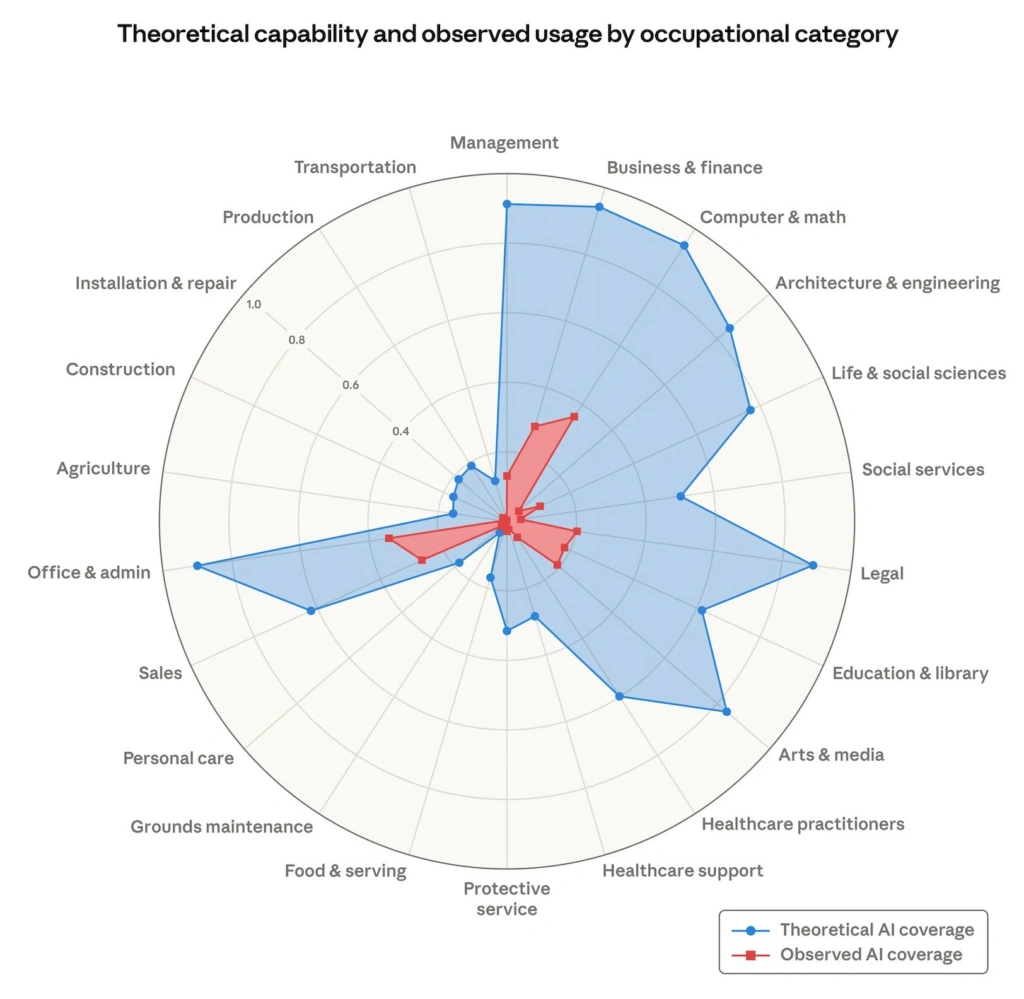
Read that number again. Three-quarters of what you do as a software engineer can now be done, assisted, or accelerated by AI. The Anthropic research isn’t predicting that developers disappear. It’s predicting the sequence: which roles transform first, and who gets sorted in the process. If you’ve adapted, you’re still in the conversation. If you haven’t, you’re the Block story.
In February 2026, Jack Dorsey cut 40% of Block’s workforce (more than 4,000 people) and was explicit about why: “intelligence tools.” He then told shareholders he expected most companies to make similar cuts within the next twelve months.
This wasn’t someone burying a restructuring in a press release. He put the causation directly in the letter. The craft changed. The people who hadn’t changed with it were the 4,000.
Worth noting what Dorsey didn’t say: that AI made those people more productive and Block reaped the upside. He said AI made them replaceable and Block cut the cost. That distinction matters, because right now, most of the AI ROI story is a headcount story.
That’s a real outcome, but it’s a thin one. The harder question, the one almost nobody can answer yet, is whether AI spend is producing value beyond the cuts.
Report
Finance needs to prove AI’s return: CloudZero report
260 senior finance leaders (more than half CFOs) told us why the speed of seeing AI spend, not the size of it, separates who pulls ahead on AI from who gets burned.
So how would you know?
How would you know which of your engineers have made the shift? How would you know whether your AI investment is producing value or just generating invoices?
Most organizations can’t answer either question, because they can’t see the spend. The inference costs are there; they’re just invisible. We call this the AI attribution gap: the distance between what organizations think they’re spending on AI and what they can actually measure, trace, and tie to outcomes.
CloudZero’s Cloud Economics Pulse puts numbers on it. Enterprises report allocating 30-36% of cloud budgets toward AI workloads. Actual measurable AI spend on cloud bills sits closer to 2.5%.
That’s not a rounding error. It’s a structural blind spot. Billing data tells you how much was spent. It never tells you why, because the context that matters (which team, which feature, which customer, which model) lives in telemetry, not on an invoice.
The rest is buried in compute and storage line items that were never designed to surface it, scattered across vendors with incompatible billing schemas.
AI inference spend is variable, shared, and hard to allocate. If that sounds familiar, it should; it’s the same structural problem that made cloud costs hard a decade ago.
The difference is that AI costs are unpredictable along two axes instead of one (what the model is asked to do and how users behave with the feature), and they’re scaling at a pace that makes last decade’s cloud growth look gentle.
If you can’t attribute the spend, you can’t have the performance conversation Huang described. You can’t distinguish the engineers who’ve transformed how they work from the ones running up a tab.
And you definitely can’t answer the question that comes after attribution: is this spend producing the right outcomes, or are we just paying more to do the same things?
That’s the question every organization will face. Knowing what you spent is table stakes. Knowing what it produced is the one that separates the companies that lead this transition from the ones that fund it.
(We went deeper on the cost management side of Jensen’s GTC remarks here.)
Jensen Huang issued a warning, not a pep talk. If you didn’t hear it, you’re already behind.