Right now, 48% of organizations say they’re being asked to measure or report on AI-related costs. The problem is that they’re still figuring out how to do it.
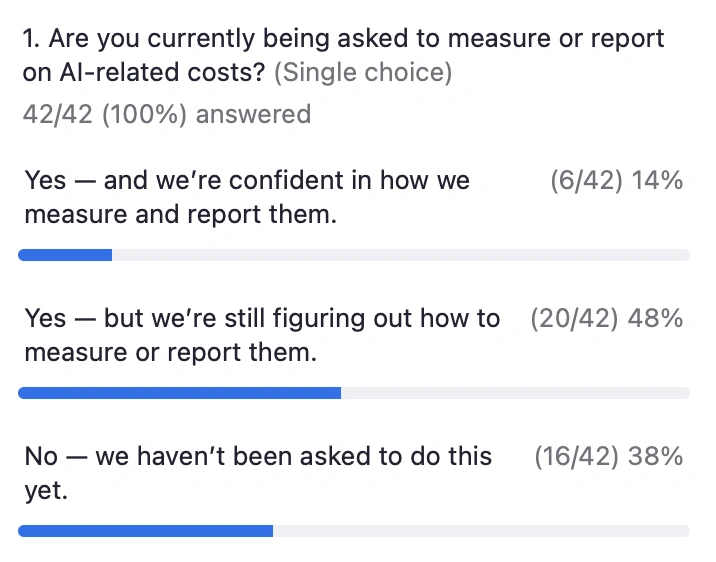
That was a very telling stat from a recent CloudZero webinar on AI and profitability, and speaks loudly to the reality that many organizations are still struggling to get a grasp on AI spend which our data shows to be rising sharply as a part of total spend in recent months.
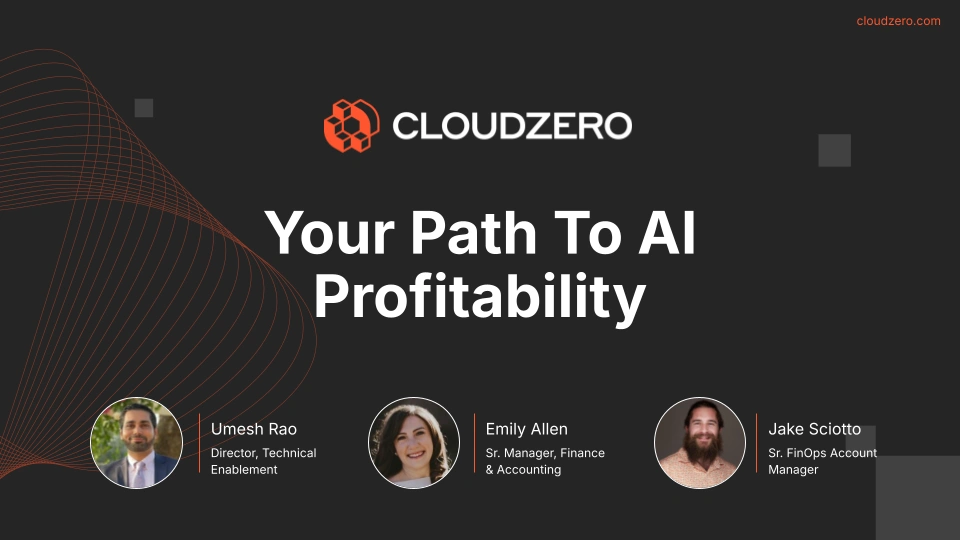
The session, led by Emily Allen (Senior Manager, Finance & Accounting) and Jake Sciotto (Senior FinOps Account Manager) and hosted by Umesh Rao (Tech Enablement Director), brought much-needed clarity to the AI spend table. It delved into why AI spend breaks traditional cloud cost models and what teams can do to get ahead of that curve.

Let’s look at the top six takeaways:
1. AI Spend Doesn’t Play Nice With Budgets
Emily opened by walking through a typical finance planning and budgeting cycle: review historicals, forecast based on hiring and initiatives, and build a model to guide the next 12 months.
But that cycle, she emphasized, simply doesn’t accommodate AI’s volatile nature: “AI costs in this planning cycle do not get along.”
Unlike traditional software or infrastructure costs, which are generally fixed, predictable, and tied to long-term contracts, AI-related expenses can spike without warning. They vary not just by usage, but by behavior, team, or even unstructured experimentation that resists traditional forecasting models.
AI workloads often originate outside engineering, can be charged per token, request, or inference, and scale exponentially with usage. These variables make planning incredibly difficult for finance teams.
Emily shared an example of how this can occur. For instance, a salesperson can use up all of the ChatGPT credits normally allocated to engineering and dev work, just because they’re trying to re-engineer how to reach out to potential customers.
Traditionally, finance teams can forecast things like headcount and software spend with reasonable accuracy. But AI often veers far off that script.
“If you’re really looking at your forecast models,” Emily says, “AI does not fit into this cookie cutter process that we’ve established and done for years.”
Her advice? Finance teams need faster feedback loops and more accurate visibility to deal with AI’s unpredictability. The old-school planning assumptions may work for traditional cloud, but they just don’t hold up in the new stress test that AI costs bring.
Report
Finance needs to prove AI’s return: CloudZero report
260 senior finance leaders (more than half CFOs) told us why the speed of seeing AI spend, not the size of it, separates who pulls ahead on AI from who gets burned.
2. AI Is No Longer Just Engineering’s Problem
Emily also took issue with the long-held idea that engineering teams are the sole drivers of cloud spend. While CloudZero CTO Erik Peterson’s oft-quoted “Every engineering decision is a buying decision” still holds true even in today’s landscape, it’s no longer the only mindset that organizations can adopt.
In short: it’s not just an engineering decision. AI tools, by their democratic nature, are used throughout organizations and therefore the spend can originate anywhere; for instance, in sales, marketing, customer support, everywhere. Because of that, Emily calls on engineers and product teams to partner with finance early.
“To be honest, if I had an engineering partner come up to me and say, ‘Hey. I want to be intentional about how we’re using our AI’,” Emily said, “I would be screaming at the top of my lungs with joy.”
Finance teams like things to be predictable. That means as few surprises as possible. This kind of collaborative transparency makes life easier for those managing budgets.
“I’m not the budget police,” said Emily. “But how do we make sure that spend is what makes sense for our P&L and for our profitability metrics?”
3. Think In Layers: Reframing AI Spend
Meanwhle, Jake Sciotto walked the audience through a sweeping historical perspective, tracing AI’s evolution from the 1950s Turing machine through the rise of LLMs. He highlighted key milestones along the way, from symbolic programming in the 1980s, to the rise of neural networks and early machine learning in the 2000s, to the 2017 breakthrough Transformer architecture that made today’s large language models possible.
This history lesson was all by design – and Jake’s point is to think about AI as a continually developing phenomenon with multiple chapters to it.
“We’ve got to reframe about how we think about AI spend, right?” said Jake. “AI is not new. And I would encourage us to think about it in layers.”
He defined those layers as:
- Generative AI and agentic systems (e.g., ChatGPT, Claude)
- Machine learning and simulation environments
- Infrastructure layers (compute, GPUs)
- Platform services (storage, networking)
Each layer adds its own complexity and cost signature. Some are bundled into hyperscaler invoices. Others live in vendor APIs or credit-card receipts. And many are opaque.
That’s why, Jake said, “AI spend is not cloud spend. We can’t treat it the same way.”
In other words, you can usually model usage in traditional cloud via instance hours, storage GBs, egress fees, etc. But, Jake stresses: “A lot of AI spend is driven off of human behavior and unpredictability.”
Think of it like this: understanding the architecture of AI is just the beginning. To truly manage AI spend, you also have to anticipate how humans will interact with it across teams, tools, and use cases.
4. First Step: Find It And Own It
Jake also added that the first challenge most teams face isn’t optimization itself. Optimizing means you need visibility and identification, knowing where AI spend is happening.
Even that is in itself a struggle, Jake says. “The first challenge is: where is it? Who’s using it?”
That isn’t limited to the big three cloud providers of AWS, GCP, and Azure. There are many niche AI vendors including those specializing in video or image generation, and they provide little cost transparency. Even when they do, it’s not standardized across vendors or even month to month from the same service.
“Most of this AI cost issue right now in terms of a reactive phase is not caused by waste,” said Jake. “It’s caused by unclear ownership.”
In other words? It’s about ownership, not just of budget, but cost accountability as well. That’s the key first domino. Without it, nothing else can fall into place.
Ultimately, managing AI spend isn’t just about finding one owner. Rather, it’s about building shared responsibility across finance, engineering, and product teams.
5. Next Step: Get To Real Unit Economics
OK, ownership is sorted. What’s next? Teams now can start making sense of AI costs. But don’t resort to generic metrics, Jake warns.
“Cost per token… doesn’t really move the needle for a lot of folks.”
Plus, tokens are hard to tie to specific use cases. They’re often abstract and decoupled from real business outcomes which makes it difficult to attribute costs to specific customers, teams, or product features. Without context, metrics like token count may offer visibility at first glance, but don’t support strategic decision-making or profitability analysis which is what decision makers need.
Instead, organizations should look for meaningful, domain-specific metrics:
“If you’re in video-gen or image-gen, [use] cost per image generated, cost per image downloaded,” Jake said. “Stuff that matters when you show it back to the people that are making decisions on it.”
This is exactly what the FinOps framework encourages: move beyond visibility to business alignment. When unit costs are tied to outcomes, teams can stop managing spend in isolation and start informing strategy.
That same thinking applies across industries and AI use cases. In customer support, it could be cost per resolved ticket using AI chatbots. In fraud detection, it might be cost per transaction analyzed. For SaaS companies, you might look at cost per model inference per user.
What matters most is that these metrics map directly to business impact. This helps teams connect spend with value, prioritize investments, and ultimately drive more strategic conversations around profitability.
This level of granularity isn’t easy, of course, Jake warned. He made it clear that this is a long game: “That is not something that happens in a quarter. It doesn’t happen very rapidly. There are a lot of moving parts.”
6. The End Goal: Predictability And Leverage
Ultimately, visibility and unit economics pave the way for smarter, faster decisions, and stronger negotiating power.
“Frankly, now the customer has power over the AI vendor,” Jake said. “I know what they can give me in their API. They’re giving me a better price than you are.”
Imagine a SaaS platform that relied on usage estimates from a GenAI vendor for billing purposes. After implementing detailed cost tracking and aligned AI spend with specific customer activity, this platform might discover that vendor pricing doesn’t align with actual consumption patterns whether due to bundling, opaque billing, or inflexible SKUs.
Once that platform has this data, the team could negotiate for a custom pricing tier tied to actual inference volume, potentially reducing their monthly bill and creating new headroom for growth. Again, a hypothetical scenario, but that’s the benefit of understanding the cost dynamics of AI.
Another, very real benefit is that when you can see the costs, you can better forecast your spend; which is a major struggle for many organizations.
“Imagine a world where you’ve got your fixed costs and your AI spend, and you can predict a new product,” Jake offered. “Then we can forecast and look into the future.”
But achieving this level of maturity demands more from FinOps itself.
“It’s going to require a lot more FinOps practitioners to have full end-to-end data pipeline knowledge.”
In other words: AI cost accountability isn’t just a technical challenge. Think of it as an evolution of the FinOps discipline.
Want to explore how CloudZero helps teams measure, manage, and improve AI unit economics? Schedule a demo.