Quick Answer
Quick Answer: AI ROI (AI return on investment) measures the financial and operational value an organization realizes from its AI investments relative to the total cost of those investments, including infrastructure, model costs, data preparation, talent, and ongoing operational expenses. According to Deloitte's 2025 survey of 1,854 executives, 85% increased AI investment in the past 12 months, yet typical payback takes 2-4 years and only 6% see returns under one year.
Every quarter, the same scene plays out in boardrooms across the Fortune 500. The CEO asks: “What is the return on everything the company is spending on AI?” The CTO talks about productivity gains and developer velocity. The CFO points at a cloud bill that doubled but cannot isolate which line items are AI. The board nods politely and tables the discussion until next quarter, when the same question will produce the same non-answer. (If this sounds familiar, you are not alone. Keep reading.)
IBM’s Think Circle puts a number on this discomfort: only about 29% of executives say they can measure AI ROI confidently. Less than one in three. The money keeps moving. The measurement does not.
CloudZero, The AI ROI Company, built the platform that closes this gap. CloudZero gives finance and engineering teams a shared, real-time view of AI costs by model, team, feature, and token, then integrates that spend to the business outcomes that justify it.
On May 28, 2026, CloudZero launched the Financial Control Plane for AI with customer validation from Shutterstock, Coinbase, and Klaviyo. This guide explains the framework behind that launch.
Before getting to the “how,” a quick definition for anyone who just Googled “AI ROI” and landed here.
What is AI ROI?
AI ROI measures the financial value an organization receives from its AI investments relative to the total cost of those investments. The calculation includes both the investment side (GPU compute, model training, inference API costs, data preparation, third-party model licensing, engineering talent, and platform infrastructure) and the return side (revenue generated, costs avoided, margin improved, and time saved).
For finance leaders, AI return on investment matters because AI spend behaves differently from every other technology budget line.
Traditional enterprise software has predictable per-seat licensing.
AI costs are consumption-based and variable: driven by inference volume, model selection, token usage, and compute intensity. A feature that handles 1,000 conversations a month produces a very different P&L at 100,000 conversations. That variability makes standard investment analysis models unreliable unless the cost data is granular enough to calculate unit economics: what does each AI capability cost per unit of value delivered?
Distinguish hard ROI (direct cost savings, revenue attribution, margin improvement) from soft ROI (decision quality, employee productivity, time-to-market acceleration). Both matter. Hard ROI gets board approval. Soft ROI keeps it. The organizations that prove both are the ones that scale AI investment confidently instead of cutting budgets across the board because nobody can show which initiatives are working.
CloudZero’s State of AI Costs report found that only 51% of organizations can confidently evaluate the ROI of AI. The other 49% are investing without a measurement framework. That is not a confidence problem. It is a data problem. And it is fixable.
For a breakdown of what AI actually costs at the model and infrastructure level, see CloudZero’s AI pricing guide.
So if the concept is straightforward, why do so few organizations actually measure it? Four reasons, all of which have expiration dates.
2026 State of AI Spend Report
Why Finance Caps What It Can’t See
Learn how finance leaders are managing AI spend, and how they’re approaching FY2027
Why has AI ROI been so hard to measure?
AI ROI measurement has been elusive for four specific reasons. Each was a genuine blocker to measuring AI ROI. Each now has an operational solution.
Barrier 1: AI costs are distributed and multi-dimensional
A single AI-powered feature might generate costs from an LLM API (per token), a GPU cluster (per hour), a vector database (per query), and a data pipeline (per GB). Four vendors, four billing models, none of them labeled by business purpose on the invoice. The investment side of the ROI equation was unknowable.
What changed: Platforms like CloudZero automatically discover, categorize, and allocate AI spend by team, product, feature, and customer across all providers. CloudZero’s AI Era report found organizations budget 30-36% of cloud spend for AI, but only 2.5% shows up as AI-specific line items. CloudZero finds the other 97.5%. For the full approach to making AI spend visible, see CloudZero’s guide to AI cost management.
Barrier 2: Benefits are indirect and hard to quantify
Better decisions, faster insights, improved customer experience. These outcomes resist dollar quantification in quarterly reviews.
What changed: Pair unit cost metrics (cost per inference, cost per AI-powered interaction) with outcome data from existing business systems. When finance can see both the cost and the outcome at the same unit level, ROI becomes arithmetic, not estimation. That pairing is what CloudZero’s cost per customer model enables.
Barrier 3: AI is entangled with broader transformation
AI rollouts coincide with process redesign, data quality work, and organizational change. Isolating AI’s contribution is like measuring the impact of a new engine while simultaneously redesigning the entire car.
What changed: By tagging AI costs at the workload level (by specific model, specific use case, specific deployment), organizations can isolate the AI contribution from the surrounding transformation. CloudZero’s dimensions engine maps costs to business dimensions regardless of how the underlying infrastructure is organized.
Barrier 4: Payback timelines are longer than traditional tech
Deloitte found standard AI payback runs 2-4 years, three to four times longer than the 7-12 months expected for standard technology investments.
What changed: Some of that longer timeline is real (AI compounds over time as models improve and adoption grows). Some of it is an artifact of poor measurement. Organizations with strong cost visibility identify winning initiatives faster and stop funding losing ones sooner. Shorter effective payback, because the portfolio is optimized in real time instead of reviewed quarterly.
Those four barriers kept AI ROI unmeasurable for years. They do not anymore. Here is the operational path from opaque AI spend to a number the board can evaluate. CloudZero calls it the AI ROI Path.
How do you measure AI ROI in 4 steps?
This is the operational answer that Deloitte, IBM, and PwC do not provide. They tell you AI ROI matters. They do not tell you how to calculate it. The CloudZero AI ROI framework maps a clear progression: visibility, allocation, unit economics, outcome connection. Each step builds on the one before it.
Step 1: See every AI cost
Total visibility across every model call, GPU hour, token, and API charge, automatically discovered and categorized. Most organizations can tell the board their total cloud bill but cannot isolate what the AI-powered recommendation engine costs to run. This step ends that.
CloudZero provides this visibility across Anthropic, OpenAI, AWS, GCP, Azure, and 30+ other providers.
Here’s a practical example from a CloudZero customer : a retail company discovers that 40% of its inference costs come from a single internal tool that only 12% of employees use. That is $180,000/year in AI spend serving an audience one-eighth the size of the total workforce. Visibility made that decision obvious. Without it, the spend would have continued indefinitely.
Step 2: Allocate costs to business dimensions
Raw cost data becomes useful when it is organized by what the business cares about: teams, products, features, customers, deployment stages. Think of it as a chart of accounts for AI spend.
Map workloads by model (GPT-4o vs. Claude vs. fine-tuned), by team (product, support, marketing), by task (summarization, code generation, customer-facing recommendations), and by volume.
Now the CFO can see: the product team spends $85,000/month on AI across three models. Support spends $22,000/month on a single summarization model. Marketing spends $8,000/month on content generation.
Step 3: Establish unit economics
AI ROI (%) = (Value of the outcome − Fully allocated AI cost of that outcome) / Fully allocated AI cost of that outcome × 100
The formula is not the hard part. The hard part is the cost number you put into it.
Most organizations can estimate the value side: tickets deflected, revenue generated, labor saved. What they cannot do is produce the fully allocated cost of the AI that delivered that outcome. Not the total AI line item on the cloud bill. The cost of that specific outcome: every model call, every GPU cycle, every data pipeline dollar traced to the thing it actually paid for.
That is what makes the denominator an infrastructure problem, not a finance problem. Cost per inference, cost per model, cost per feature, cost per customer served: these are the denominators that transform AI from “a cost center” into “an investment with measurable returns.” Without them, AI ROI analysis is guesswork. With them, it is math a board can evaluate.
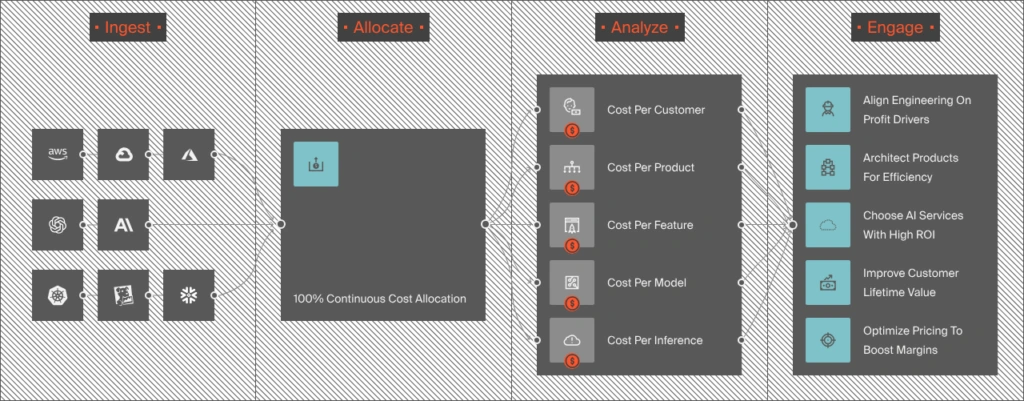
Using CloudZero’s unit economics model, the calculation looks like this: the AI-powered pricing engine costs $0.004 per recommendation and generates an average of $0.18 in incremental margin per recommendation. ($0.18 − $0.004) / $0.004 = 4,400% ROI. No strategy deck needed. The number speaks for itself.
Or: an AI agent resolves support tickets worth $500,000 in saved labor and costs $100,000 fully allocated, which means ($500K − $100K) / $100K = 400% ROI.
Two different use cases, same formula, same requirement: you need the fully allocated cost number to fill it in.
For more math behind these calculations, see CloudZero’s guide to inference economics.
Step 4: Connect cost to outcomes
Pair unit costs with business outcomes from existing systems: revenue per feature, support tickets deflected, conversion rate changes, time saved. This is where AI ROI stops being a hypothesis and becomes a board-ready number
Example: the AI chatbot costs $32,000/month in inference and deflects 18,000 support tickets that cost $9.50 each to handle manually. Net monthly savings: $139,000. That is a 4.3:1 return with a 2-month payback. Not “AI is probably helping.” A number.
CloudZero enables this by surfacing unit cost data alongside the business KPIs that finance already tracks. For how AI cost optimization strategies improve the cost side of the equation, see CloudZero’s guide.
What metrics does a CFO need for AI ROI?
| Category | Metric | What it tells you |
| Cost (the investment) | Cost per inference / cost per API call | The unit cost of running AI |
| Cost per model | Compare economics across providers and model versions | |
| Cost per team / cost per product | Who is spending what, and on which AI capability | |
| Cost per feature | What each AI-powered capability costs to operate | |
| Total AI spend as % of revenue | The portfolio-level view. PwC: AI leaders invest 2.5x as much as peers but spend it nimbly | |
| Value (the return) | Revenue attributable to AI features | Top-line impact |
| Cost avoidance | Tickets deflected, errors prevented, manual processes eliminated | |
| Margin improvement | AI-driven pricing, recommendations, or operational savings | |
| Time-to-value acceleration | Faster product development, faster decisions | |
| Customer retention / NPS changes | Experience impact from AI-powered capabilities | |
| The ratio | Cost per unit of value delivered | This is the number. When finance can say “this model costs $X per inference and generates $Y per outcome,” that is investment analysis, not guesswork. |
The bottom row of that table is what separates organizations that can prove AI ROI from organizations that cannot. It is also what CloudZero’s Financial Control Plane provides.
That framework works cleanly for generative AI: a chatbot, a search feature, a recommendation engine. Each has a cost and an outcome.
But a new category of AI investment is complicating the math.
How is agentic AI ROI different from generative AI ROI?
Agentic AI involves autonomous, multi-step processes where an AI agent plans, executes, uses tools, retries on failure, and orchestrates across systems. The cost structure is fundamentally different from single-inference generative AI.
Deloitte found only 10% of organizations see measurable agentic AI ROI today. Half expect returns in 1-3 years. A third expect 3-5 years.
For a CFO evaluating an agentic deployment, the AI cost benefit analysis must account for four factors that do not apply to a chatbot: agent chain costs (a single task might involve dozens of model calls), tool invocation costs (external API fees per step), retry and error-handling costs (failed branches still cost money), and human oversight costs (review loops for high-stakes decisions). The right unit of measurement is not “cost per API call” but “cost per completed process” compared against the manual process it replaces.
CloudZero tracks agentic AI costs at the workflow level, showing the full cost of an agent chain instead of individual API calls. That is the cost infrastructure a CFO needs to calculate agentic AI ROI at the process level, not the token level.
Generative or agentic, the organizations that prove AI ROI share a set of financial disciplines. And they are not the ones the consulting firms talk about.
What do companies with strong AI ROI do differently?
PwC’s study of 1,217 executives found that the top 20% of organizations capture 74% of AI-driven value. Here is what that top 20% does on the financial discipline side that the consulting reports miss.
- They treat AI spend like a business unit P&L, not a budget line. AI-forward organizations do not manage AI as a line item inside the cloud budget. They build a chart of accounts for AI: revenue attributable, costs allocated, margin calculated. CloudZero’s dimensions engine enables this by mapping AI costs to the same business dimensions finance uses for every other investment.
- They invest in measurement infrastructure before scaling. The organizations that prove AI ROI fastest are not the ones that deploy fastest. They are the ones that instrument AI costs at deployment, the same way a new business unit gets a P&L on day one. Erik Peterson, CloudZero’s founder and CTO, said at the company’s AWS AI Competency announcement: “AI infrastructure is becoming one of the largest line items in cloud budgets, but most companies have no idea which AI workloads are worth the investment. CloudZero solves this problem.”
- They use different ROI models for different AI types. PwC: 86% of AI leaders use different frameworks for generative AI ROI vs. agentic AI ROI. Generative AI delivers productivity and efficiency gains with shorter payback. Agentic AI delivers process redesign and cost structure changes with longer payback but higher ceiling. A single ROI model applied to both will always understate some returns and overstate others.
- They run “scale or stop” portfolio reviews monthly. Not annual. Monthly. Only initiatives with demonstrated AI business value get continued investment. The ones without it get 60 days to show progress or lose funding. That discipline sounds harsh until you consider the alternative: funding every AI experiment indefinitely because nobody can prove which ones deliver gen AI ROI and which ones do not.
- For more, see CloudZero’s guides on how to evaluate AI cost management tools that enable this discipline, and on the cloud infrastructure that underlies AI costs.
Organizations like Toyota, Duolingo, Coinbase, Shutterstock, Klaviyo, and Upstart use CloudZero to connect AI spend to business outcomes at this level of rigor. Upstart applied CloudZero’s cost intelligence to identify which workloads justified their spend and which did not, resulting in $16 million in total savings. Drift followed a similar path and saved $2.4 million annually.
CloudZero also tracks 50+ LLMs with direct integrations to Anthropic and OpenAI (including per-ChatGPT model granularity), normalizes costs across cloud service providers and multi-cloud environments, and integrates with the application monitoring tools and cloud management software that are themselves growing cost line items. Schedule a demo to see AI cost intelligence mapped to business dimensions.