Cloudability is a multi-cloud financial management platform, now part of IBM following its $4.6 billion acquisition of Apptio in 2023.
The platform — officially branded IBM Cloudability — helps enterprises analyze cloud costs across Amazon Web Services (AWS), Microsoft Azure, and Google Cloud Platform (GCP).
IBM Cloudability provides FinOps capabilities as Software-as-a-Service (SaaS), so customers do not need to download, install, or maintain it. Features are available on a flexible pay-as-you-go basis, though actual contracts are structured as annual commitments tied to managed cloud spend.
In this guide, we’ll cover IBM Cloudability’s pricing in detail, what the current tiers cost, where overage fees can add up, and other solutions that may fit your needs.
Software and pricing information last verified April 2026. Features, pricing, and availability may have changed. Please verify current details with vendors before making decisions.
Table Of Contents
Cloudability Features: What Does Cloudability Do?
Cloudability offers several cloud cost management tools integrated into one platform, allowing enterprise customers to gain insight into their cloud spending across clouds.
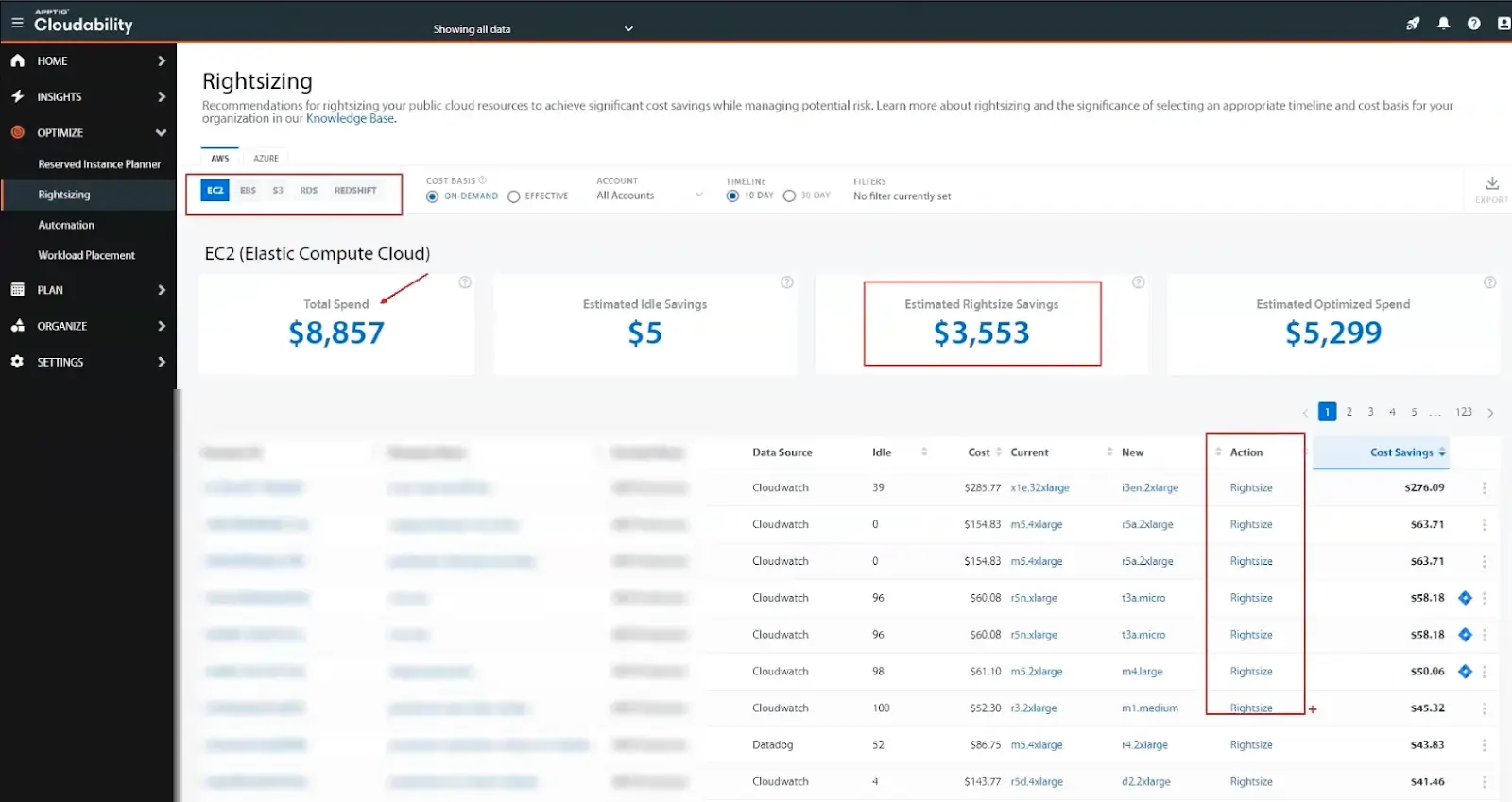
Credit: Cloudability rightsizing feature via AWS
The tool helps organizations adopt cloud financial management, a technique for enhancing financial accountability in the scalable, dynamic, and decentralized cloud environment.
Cloudability’s most popular features include:
- Cloud financial management automation – Enables DevOps, finance, and management teams to actively collect, analyze, and visualize cloud costs relevant to their organization.
- Cloudability TotalCost – Captures and allocates costs across an entire cloud program, including support charges, enabling cloud spend chargeback in full. Allocation and chargeback allow users to monitor cloud usage and spending by specific business users, teams, or departments.
- Dashboards and reports – Provides teams with an overview of their cost of goods sold (COGS) data so they can see how their cloud investments relate to business value.
- Budget and forecasting – Manages cloud budgets, monitors resource consumption, and analyzes costs over time, translating historical cost data into forecasting intelligence.
- Cloud resource rightsizing and recommendations – Helps determine which resources are over-or underutilized based on your specific use case to lower costs while improving performance. Also, receive custom resource rightsizing recommendations by service, team, or project.
- Reserved instance planning – Automatically analyzes cloud usage patterns and dynamic requirements to help buy and utilize suitable Reserved Instances, saving costs and maximizing ROI. It also offers recommendations on how to optimize AWS Savings Plans.
- Container/Kubernetes cost allocation – Enables teams to practice cloud cost accountability by correlating container/Kubernetes spend to business value.
- Professional services – Provides training to customers on how to use its cloud cost management platform.
- Cost anomaly detection – Detects and reports abnormal or unexpected costs to prevent unexpected cloud costs.
It’s worth noting that IBM Cloudability’s optimization recommendations generally require manual implementation. Automated commitment management (Savings Automation) is available as a separate, additional product — not part of the core platform.
So, how much does Cloudability charge for these cloud cost management capabilities?
Research Report
FinOps In The AI Era: A Critical Recalibration
What 475 executives told us about AI and cloud efficiency.
How Much Does IBM Cloudability Cost?
IBM Cloudability uses custom, quote-based pricing tied to annual contracts. The platform does not publish a public pricing page, but the AWS Marketplace listing and third-party sources provide a clear picture of what to expect.
Base Pricing (12-Month Contract)
Based on the current AWS Marketplace listing, IBM Cloudability’s annual contract tiers are:
| Managed Cloud Spend (Annual) | Annual Cost | Effective Rate |
|---|---|---|
| Up to $1M | $30,000 | ~3.0% |
| Up to $3M | $76,680 | ~2.6% |
| Up to $6M | $132,480 | ~2.2% |
For larger organizations, costs scale proportionally. Direct-sales contracts may differ from marketplace rates, but these figures offer a solid baseline for budgeting.
Overage Fees
If your cloud spend exceeds the contracted threshold, additional per-unit fees apply based on your plan tier:
| Plan Tier | Overage Cost Per Unit |
|---|---|
| Financial Planning | $1,650 |
| Essentials | $1,930 |
| Standard | $2,760 |
| Premium | $4,410 |
These overages can accumulate quickly at fast-growing companies. A 20% spend increase beyond your contract mid-year could mean tens of thousands in unplanned Cloudability fees.
Additional Cost Considerations
Beyond the platform fee, keep in mind the total cost of ownership: implementation and onboarding require meaningful setup (connecting accounts, configuring allocation rules, building dashboards), and ongoing training is needed given the platform’s steep learning curve. Multiple reviewers on G2 and PeerSpot flag navigation complexity and adoption challenges.
The platform’s free trial is available through AWS Marketplace, but there is no permanent free plan.
Is Cloudability Pricing Worth It?
Cloudability fits the bill for measuring high-level metrics, such as cost center costs, as other traditional cloud cost management platforms do.
In addition, Cloudability is suitable for large enterprises with substantial cloud budgets to manage, multi-cloud operations, and dedicated cloud management staff.
Cloudability also uses tags for cloud cost allocation, which can be challenging to create and maintain for many organizations.
But it lacks detailed insights, such as cost per customer, cost per feature, or cost per deployment. Yet, these are the granular, actionable insights you need to guide cloud investment decisions, such as:
- Using data to tell how to price your SaaS products to improve profitability.
- Analyzing the costs of supporting individual customers, products, teams, projects, and environments to protect your margins.
- Viewing your cloud bill at different granular levels to compare costs, such as average cost per customer vs. cost per customer or tenant — and how costs have changed over time.
- Accurately mapping cost metrics to the people, processes, and products responsible for identifying improvement opportunities.
- Increasing savings and system performance by automatically applying rightsizing recommendations
IBM Cloudability users also report that the platform has a steep learning curve and a sometimes-overwhelming interface. Finding the data needed to make informed, actionable, and timely decisions without expert guidance remains a common challenge.
What’s The Alternative To Cloudability?
Here is a list of the top Cloudability alternatives. However, if you’re just looking for a straightforward recommendation to consider on your own, consider CloudZero.
CloudZero is a modern cloud cost intelligence platform that delivers continuous, granular cloud cost insight.
CloudZero enables to you:
- Avoid percentage-of-spend pricing models like Cloudability’s. Instead, CloudZero pricing is custom to your environment. This makes CloudZero cost-effective. See how customers like Drift, TripAdvisor, and MalwareBytes use CloudZero successfully here.
- Collect, analyze, and understand cloud costs by the customer, tenant, feature, environment, project, team, etc. You’ll know precisely who, what, and why your costs are changing, so you can determine what tradeoffs to make to optimize costs without compromising engineering velocity or customer satisfaction.
- Accurately allocate costs for tagged, untagged, and untaggable resources in your environment to eliminate cost blindspots — even if you have messy tags.
- Allocate costs of shared resources in multi-tenant environments to see how different tenants consume resources and how to price your services accordingly.
- Present AWS costs alongside Snowflake costs for a complete cloud cost analysis.
- Gain Kubernetes cost intelligence to help you make sense and optimize costs of both containerized and non-containerized spend – down to the hour and pod.
- Align DevOps and finance teams to collaborate on cloud financial management and optimization.
- Nurture a cost-aware engineering culture to help engineers improve costs at the architectural level.
- Detect cost anomalies and automatically receive alerts via email and Slack to prevent overspending
- Measure AI ROI with visibility into spending across providers like OpenAI and Anthropic.
CloudZero also offers budget and forecasting, an optimization dashboard for AWS Savings Plans/Reserve Instance management/Spot Instance orchestration, a cloud migration acceleration dashboard, and more.
Schedule a demo today to see CloudZero in action for yourself!
Cloudability Pricing FAQs
Who is IBM Cloudability best for?
IBM Cloudability is best suited to medium to large enterprises with substantial cloud spend across two or more clouds and dedicated FinOps staff to implement its recommendations.
Does IBM Cloudability support Azure?
IBM Cloudability supports the major cloud service providers, including AWS, Azure, and GCP, with multi-cloud cost visibility being one of its core strengths.
What support options does Cloudability provide?
Expect professional support services, including onboarding, training, setup, and ongoing support. Documentation and webinar-based support are also available.
What are IBM Cloudability’s pricing tiers?
IBM Cloudability offers Essentials, Standard, Premium, and Financial Planning tiers. Each tier comes with different feature sets and overage rates. The Premium tier includes the most advanced governance and optimization capabilities but carries the highest overage charges ($4,410 per unit).
Is there a free trial for IBM Cloudability?
A free trial is available through the AWS Marketplace. There is no permanent free plan.


FinOps In The AI Era: A Critical Recalibration
What 475 executives told us about AI and cloud efficiency.