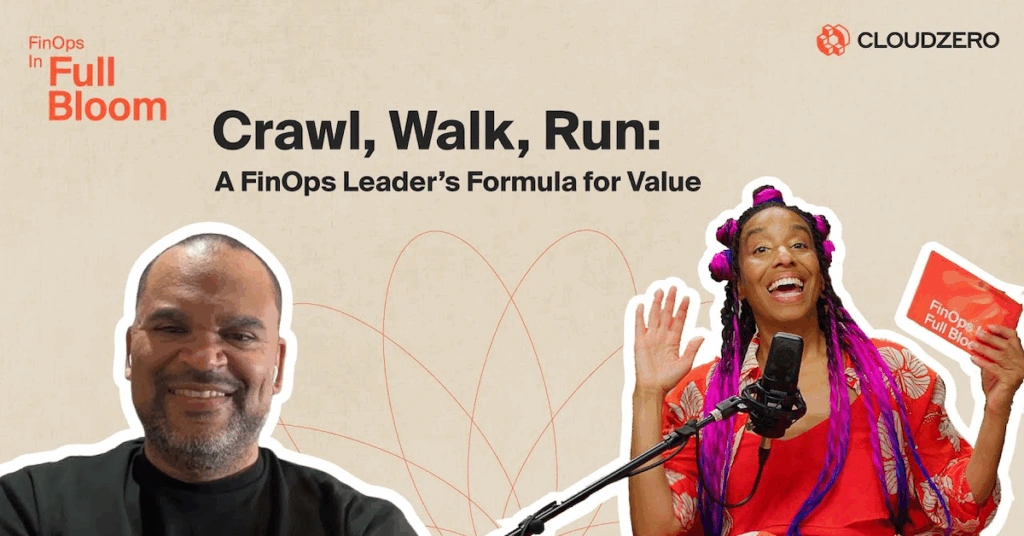
On a recent episode of FinOps In Full Bloom, host Thalia Elie sat down with Anderson Oliveira, a Senior FinOps Account Manager at CloudZero. With more than two decades in IT and deep FinOps expertise, Anderson brought clarity, humor, and a refreshingly human perspective to the conversation.
Their chat covered everything from visibility and budgets to cultural friction and how to shift teams from resistance to results. Here are 13 insights and takeaways every FinOps-minded leader should hear:
1. FinOps As Therapy: Discovering Value Together
Anderson compares uncovering business value in the cloud to a therapy session — namely, asking questions to get to the root of the problem.
“You speak and you ask, and then you, together with them, discover the value,” he explains.
In other words, value isn’t dictated — it’s revealed through inquiry, collaboration, and curiosity. Especially in post-CapEx environments, most organizations haven’t formalized how cloud services tie back to business outcomes.
Anderson’s metaphor of FinOps as a diagnostic conversation is powerful and aligns with CloudZero’s emphasis on bringing financial accountability to the variable spend model of the cloud, where cost discussions become business conversations, not just technical reviews.
This is especially crucial when mapping cloud spend to outcomes like feature delivery or customer growth.
Report
Finance needs to prove AI’s return: CloudZero report
260 senior finance leaders (more than half CFOs) told us why the speed of seeing AI spend, not the size of it, separates who pulls ahead on AI from who gets burned.
2. Engineers ‘Write Checks’ With Every Decision
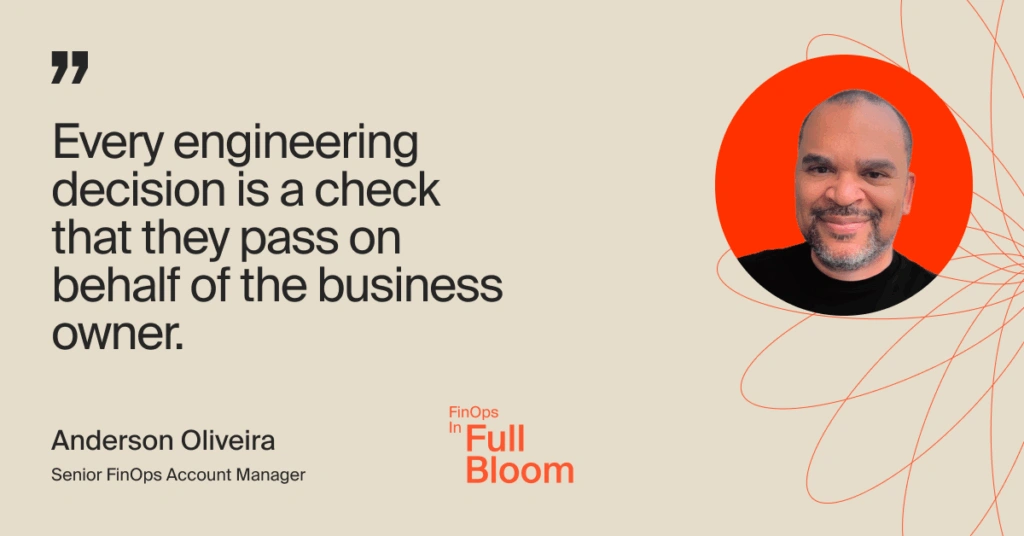
“Every engineering decision is a check that they pass on behalf of the business owner,” Anderson says.
This framing is crucial. When engineers launch a service, scale an instance, or push a feature, they’re authorizing spend.
Making this connection visible helps create the accountability FinOps depends on.
This means engineers need granular, real-time visibility into how architecture decisions affect cloud cost so they don’t feel like spend is out of their control. Not only is this cost awareness, it also directly ties actionable numbers to their work.
3. Even Internal Teams Should Measure Value
Even cloud services that don’t touch customers directly still create value — but that must be framed appropriately.
Anderson offers HR as an example: “Is it cost per employee? Per hire?”
In short: instead of asking whether a service generates revenue, ask what output it enables. Then measure your efficiency against that. FinOps metrics aren’t just about external cost and revenue. It’s also about internal cost per output which enables cross-team alignment and accountability.
Related read: Metrics That Matter In FinOps: Co-Create Value With Engineering And Finance Collaborations
4. Crawl, Walk, Run: A Clear, Actionable Framework
When asked how he guides organizations through maturity, Anderson is quick to the ball:
- Crawl = Visibility: Start by showing total cloud cost. Then break it down — by team, unit, and eventually feature. No accountability without visibility.
- Walk = Budgets: Next, engage finance, procurement, and product leads to define budgets per team. This phase aligns cloud cost expectations with business planning.
- Run = Unit Economics: Finally, optimize around per-unit metrics like cost per user, cost per API call, or cost per gigabyte stored. This is where value-based decisions emerge.
Anderson’s Crawl/Walk/Run map is a core part of FinOps maturity and totally consistent with the FinOps lifecycle that emphasizes visibility first, then budgeting & forecasting, and finally continuous optimization through metrics that drive decision‑making.
[crawl-walk-run image]
5. Optimization Doesn’t Mean Cutting
In a rapid-fire segment, Anderson busts a big myth: “Optimization starts with cutting? Myth.” He jokes, “Why don’t we shut down everything then? You’re going to save millions!”
In other words, the goal isn’t cuts — it’s smarter usage.
This sparks a critical CloudZero theme: FinOps isn’t waste reduction alone. The FinOps Foundation’s State of FinOps research found that while waste reduction is often the top priority, today’s real leaders focus on predictive forecasting, allocation, and ROI transparency — not just cuts.
Another layer of this is CTO Erik Peterson’s emphasis on the value that spend brings when it comes to AI: “The key question is no longer, ‘How much did we spend?’ It’s now: ‘Was it worth it?’”
6. Efficiency Is The On-Ramp To Value Conversations
Not every team is ready to talk about cost. When talking with those teams, Anderson recommends leading with efficiency. Ask, “How efficiently are you using resources?”
From there, it’s easier to introduce value metrics like cost per outcome or return per unit spent.
Anderson’s recommendation to use efficiency as the gateway to value mirrors CloudZero’s whole approach: cloud cost metrics should be tied to business outcomes, not just dollar totals. This helps teams shift from “cost blame” to cost learning.
7. Tailor Your Message To Each Persona
Thalia and Anderson both stress the power of understanding your audience. One of Thalia’s go-to questions is, “How do you measure success?”
If someone can’t answer, that’s the gap. And if they can, you have a hook for how FinOps can support their goals.
The importance of communication in context cannot be understated. Dashboards and reports should speak in the language of each stakeholder. Finance wants forecasts, engineers want cost per workload, product wants cost vs feature value — and a FinOps lead can bridge those languages.
8. Budgeting Is A Culture Shift
Anderson’s description of the walk phase — “budget” — isn’t just about numbers. It’s about relationships. Teams must:
- Define business units
- Align with finance and procurement
- Establish spending thresholds that engineering teams own
It’s less about policing spend, more about building cross-functional agreement.
Related read: Cultural ROI In FinOps: People Drive Pivots
9. Unit Economics Make FinOps Strategic
“To me, run is unit economics,” Anderson says. That’s when FinOps becomes a tool for strategic growth. Teams can monitor metrics like cost per user or margin per API call—then set goals not just for spend, but for improving those ratios over time.
In other words, granular allocation and accurate unit costs are the new key driver of profitability and cloud decision‑making — particularly as companies scale and need to tie cost to revenue, customer acquisition, or usage outcomes.
10. Mindset Shifts Take Time
One of Anderson’s red flags? “When I identify that there is a general understanding that FinOps equals cost savings, I immediately know there’s a lot I need to cover slowly.”
That misunderstanding is still rampant.
The fix? Reframe FinOps as a path to efficiency, value, and growth — not just savings.
That’s a cultural hurdle. Many teams struggle with FinOps because they treat it as a cost-cutting exercise than a value-creation piece.
11. Don’t Assume Everyone Sees The Bill
Visibility sounds simple, but Anderson emphasizes that many teams still don’t see cloud costs day-to-day.
That’s why crawl is foundational. Without cost in their line of sight, engineers can’t act on it.
Also, true cost visibility is fine-grained and hourly, giving engineering teams context beyond what native cloud tools provide. Without that real-time cost awareness, teams can’t act with confidence.
12. Cloud Is Variable by Nature — And That’s the Point
Anderson reminds us, “The nature of cloud is variable cost.” Spend goes up when usage goes up.
Instead of asking, “Why are we spending more?” the better question is, “Did usage go up for the right reasons?”
This reframing helps shift conversations from blame to investigation.
It’s also a defining trait of cloud economics, beyond nuanced perspectives. Teams must embrace variable cost structures with forecasting and allocation rather than fighting them with rigid budgeting.
13. The Most Powerful Word in FinOps: Why?
Anderson closes with a reminder: FinOps isn’t about tools or reports. It’s about asking better questions.
“Are we being more efficient? Are we getting more value?” Those questions open up space for meaningful conversations.
This emphasis on better questions aligns with a key theme: metrics are stories that enable real business decisions. When you evolve from “how much?” to “what impact?”, you’re opening up real cross-team alignment.
Bonus: What’s on Anderson’s Get-It-Done Playlist?
Anderson likes country music and CCM (Contemporary Christian Music). “I’m a musician myself,” he shared. “I love that simple harmony.”
For Thalia, it’s salsa and Buena Vista Social Club all day. That shared love of rhythm and adaptability feels fitting for a FinOps conversation rooted in balance, flow, and listening.
Whether you’re helping teams crawl toward visibility or running toward unit economics, Anderson’s takeaways offer a refreshingly grounded path forward.