Quick answer: IT financial management (ITFM) is the discipline of tracking, allocating, reporting on, and optimizing an organization’s technology spend. It covers cloud infrastructure, SaaS, software licenses, and on-premise systems. The goal isn’t minimizing IT spend, it’s ensuring every dollar is justified by a measurable business outcome. Most ITFM programs operate across four domains: budgeting, cost allocation, showback/chargeback, and optimization.
IT financial management (ITFM) is how organizations make sense of their technology spend, not just what they’re paying, but what they’re getting for it.
Worldwide IT spending is projected to reach $6.15 trillion in 2026, up 10.8% from 2025, according to Gartner. A growing share of that spend runs through cloud infrastructure, AI workloads, and SaaS contracts that don’t map onto a traditional IT budget. Finance leaders who once managed a predictable stack of on-premise costs now own a dynamic, usage-driven model that changes monthly, and often can’t explain the variance when leadership asks.
IT financial management is the governance discipline that closes that gap. This guide covers what ITFM is, how it differs from IT cost optimization and FinOps, how the governance cycle works, and what to look for in ITFM software.
What Is IT Financial Management (ITFM)?
IT financial management (ITFM) is the practice of tracking, allocating, analyzing, and optimizing an organization’s technology spend — giving finance and IT leaders shared visibility into what technology costs, who owns it, and whether it’s worth it.
ITFM meaning in practice: most programs operate across four core domains: budgeting and planning, cost allocation, showback and chargeback, and reporting and optimization. The goal is cost transparency that enables smarter decisions: where to invest, where to cut, and how to connect technology spend to business outcomes.
ITFM is broader in scope than FinOps (which focuses specifically on cloud) and more governance-oriented than IT cost optimization (which focuses on reducing waste). All three disciplines are related, but they’re not interchangeable.
The section below clarifies the distinctions.
playbook
The AI Cost Optimization Playbook
Traditional cloud cost management is broken. Here’s why — and how to make the switch to cloud cost intelligence.
How Does ITFM Differ From FinOps And IT Cost Optimization?
ITFM, FinOps, and IT cost optimization are often used interchangeably — but each has a distinct scope, audience, and purpose. ITFM is the governance umbrella; FinOps is the cloud-specific operational layer within it; IT cost optimization is the tactical execution that produces savings.
ITFM | FinOps | IT cost optimization | |
Scope | All technology spend (cloud, SaaS, on-premise, hardware, licenses) | Cloud spend only | Cloud, SaaS, and infrastructure |
Primary audience | CFO, finance leaders, IT leadership | Engineering, finance, FinOps practitioners | IT leaders, CTOs, FinOps teams |
Core question | Is our technology spend governed and accountable? | Are we getting value from our cloud investment? | Where are we wasting money and how do we cut it? |
Origin | Finance and IT management discipline | Cultural and operational framework (FinOps Foundation) | Cost management practice |
Relationship | Umbrella discipline | Feeds cloud cost data into ITFM | Tactical execution within ITFM |
Key outputs | IT budget, cost center reports, showback/chargeback | Cloud cost dashboards, unit economics, commitment optimization | Rightsizing recommendations, waste reduction, SaaS audits |
In practice: FinOps is the operational layer that ITFM relies on for cloud cost data. IT cost optimization is the set of tactics that produce savings. ITFM is the governance structure that makes both sustainable and legible to leadership.
For a deeper look at IT cost optimization strategies specifically, see CloudZero’s IT cost optimization framework guide. For targeted waste reduction tactics, see the IT cost reduction strategies guide.
Why Does ITFM Matter Now?
IT spend used to be largely predictable — organizations negotiated multi-year contracts, bought hardware on a capital budget, and paid licensing fees on a known schedule. Cloud changed that model entirely.
That model has broken down. Cloud services bill by the second. SaaS contracts proliferate across departments without central oversight. GenAI features are now ubiquitous across software already owned and operated by enterprises, and those features cost more money, according to Gartner. The result is a spend environment that moves faster than most finance teams can track using spreadsheets and end-of-month reconciliation.
Without a structured IT financial management program, organizations hit the same failure modes: budget overruns discovered after the fact, costs that can’t be attributed to specific teams or products, and no defensible answer when the board asks whether technology investments are generating returns. ITFM is how finance leaders build that answer.
How Does ITFM Work? The Governance Cycle
Effective IT financial management is a continuous governance cycle — not a one-time exercise — that progresses through five stages: visibility, cost allocation, showback and chargeback, forecasting and budgeting, and optimization and governance.
Each stage builds on the one before it, and unlike an optimization framework, the goal at every stage is accountability and governance, not just cost reduction.
Stage 1: How do you establish IT cost visibility?
You can’t govern what you can’t see. The first stage is consolidating cost data across cloud providers, SaaS vendors, on-premise infrastructure, and internal cost centers into a single, real-time view.
For cloud environments, raw billing data from AWS, Azure, or GCP is structured by how providers charge: by service, region, and resource, not by how the business is organized.
Turning that data into something finance leaders can govern demands tools that maps provider billing to business structure. CloudZero’s cost of cloud computing guide covers what drives cloud cost.
Stage 2: How do you allocate IT costs?
Once you have visibility into total spend, the next step is attribution: connecting costs to the teams, products, features, or customers that generated them. IT cost allocation is the foundation of any functional ITFM program.
Without clean allocation, finance leaders manage totals and averages, not the granular data needed for real accountability. Effective allocation requires a tagging strategy, clear ownership rules, and tooling that handles untaggable spend and distributes shared infrastructure costs proportionally. For cloud environments specifically, see CloudZero’s guide to cloud cost allocation.
Stage 3: What is the role of showback and chargeback in ITFM?
Showback surfaces cost data to the teams who own it, giving engineering leads, product managers, or business unit heads visibility into what their workloads cost. Chargeback goes further, creating financial accountability by billing those costs back to internal departments.
Most organizations start with showback. Visibility alone changes behavior, teams that had no window into their cloud costs start asking different questions once the number lands in their inbox each month.
For a detailed breakdown of when to use each model, see CloudZero’s showback vs. chargeback guide.
Stage 4: How does ITFM improve IT budget forecasting?
With historical allocation data in place, finance teams can build accurate forecasts. This means moving from static annual budgets toward rolling forecasts that account for usage trends, planned growth, and workload changes.
In cloud environments, effective IT budget forecasting calls for unit economics, understanding not just total spend, but spend per customer, product, transaction or feature. That ratio connects cost to business output and makes forecasts actionable. It’s also the metric that answers the question leadership always eventually asks: was this worth it?
Stage 5: How does governance lock in ITFM gains?
The final stage is closing the loop: using cost and allocation data to identify waste, rightsize resources, rationalize vendor contracts, and make reinvestment decisions. Governance means these processes are embedded in how the organization operates, tagging policies enforced at deployment, automated anomaly alerts, regular cost reviews shared between finance and engineering, and clear cost ownership at the team or product level.
This is where IT financial management earns its place at the strategy table. A mature ITFM program doesn’t just report on spend, it integrates cost data to business outcomes and gives leadership a defensible view of technology ROI.
What Are The IT Financial Management Best Practices?
- Start with allocation before optimization. Most organizations reach for cost reduction when IT spend becomes a concern. The more durable move is building clean cost allocation first. Once you know what costs what and who owns it, optimization follows naturally, and you can measure whether it worked.
- Sequence showback before chargeback. Rolling out financial accountability before teams understand their costs creates friction without insight. Give teams visibility first. Let them engage with the data. Introduce chargeback once there’s alignment around cost ownership. The sequencing matters more than most organizations realize.
- Define your unit economics early. The most useful ITFM question isn’t “how much did we spend?” — it’s “how much per customer, transaction, model, team, or feature?” That ratio integrates IT spend to business value. CloudZero’s cloud unit economics guide covers how to build this visibility in practice.
- Enforce tagging at deployment, not retroactively. Retroactive tagging campaigns are expensive and never fully successful. Tag policies enforced before resource provision prevent the attribution gaps that make cost allocation unreliable downstream.
- Connect ITFM reporting to metrics leadership already tracks. The most mature programs tie cost data to Rule of 40, gross margin, and revenue per employee, not just IT budget variance. When finance leaders can show that cost efficiency maps to business performance, IT financial management earns influence over strategic investment decisions, not just the cost reduction conversation.
What Should You Look For In ITFM Software?
The ITFM software market spans enterprise platforms covering all technology spend and specialized tools focused on cloud cost or SaaS optimization. When evaluating ITFM tools, these are the capabilities that separate effective programs from ones that stall at the reporting stage.
Capability | What to look for | Why it matters |
| Allocation flexibility | Handles shared infrastructure, Kubernetes, untagged spend | Rigid rule-based systems break at scale |
| Integration depth | Connects cloud billing APIs, financial systems, procurement | Gaps in integration create gaps in visibility |
| Cost granularity | Drill from total spend to team, product, or feature | Aggregate dashboards don’t drive accountability |
| Dual-audience reporting | Finance view (cost centers) and engineering view (services) | Without a shared language, ITFM data doesn’t reach decision-makers |
| Unit economics | Cost per customer, product, feature, team, cloud, AI | Connects spend to business outcomes |
| Anomaly detection | Near real-time alerts tied to specific services and teams | Monthly reporting is too slow for cloud spend patterns |
For a roundup of cloud-specific tools that provide the data layer ITFM programs depend on, see CloudZero’s cloud cost management tools guide.
Frequently Asked Questions About IT Financial Management
It All Comes Down To Visibility
Every component of IT financial management, from allocation, forecasting, showback, optimization to governance, depends on one thing: knowing what your technology spend actually is, at a level of granularity that makes it actionable.
That’s harder than it sounds in modern environments. Cloud billing data is structured by provider, not by business. Shared infrastructure resists clean attribution. Multi-cloud environments, spanning AWS, Azure, GCP, and Kubernetes, multiply the complexity. Most organizations end up with meaningful portions of spend sitting in unallocated buckets that finance can’t explain and engineering can’t act on.
CloudZero is built to solve that problem. It connects cloud billing data to business context, allocating spend by team, product, feature, environment, or customer, without needing exhaustive manual tagging.
- Finance leaders get the cost center and budget reporting they need.
- Engineering teams get granular, service-level visibility.
- Leadership gets the unit economics that connect technology spend to business outcomes.
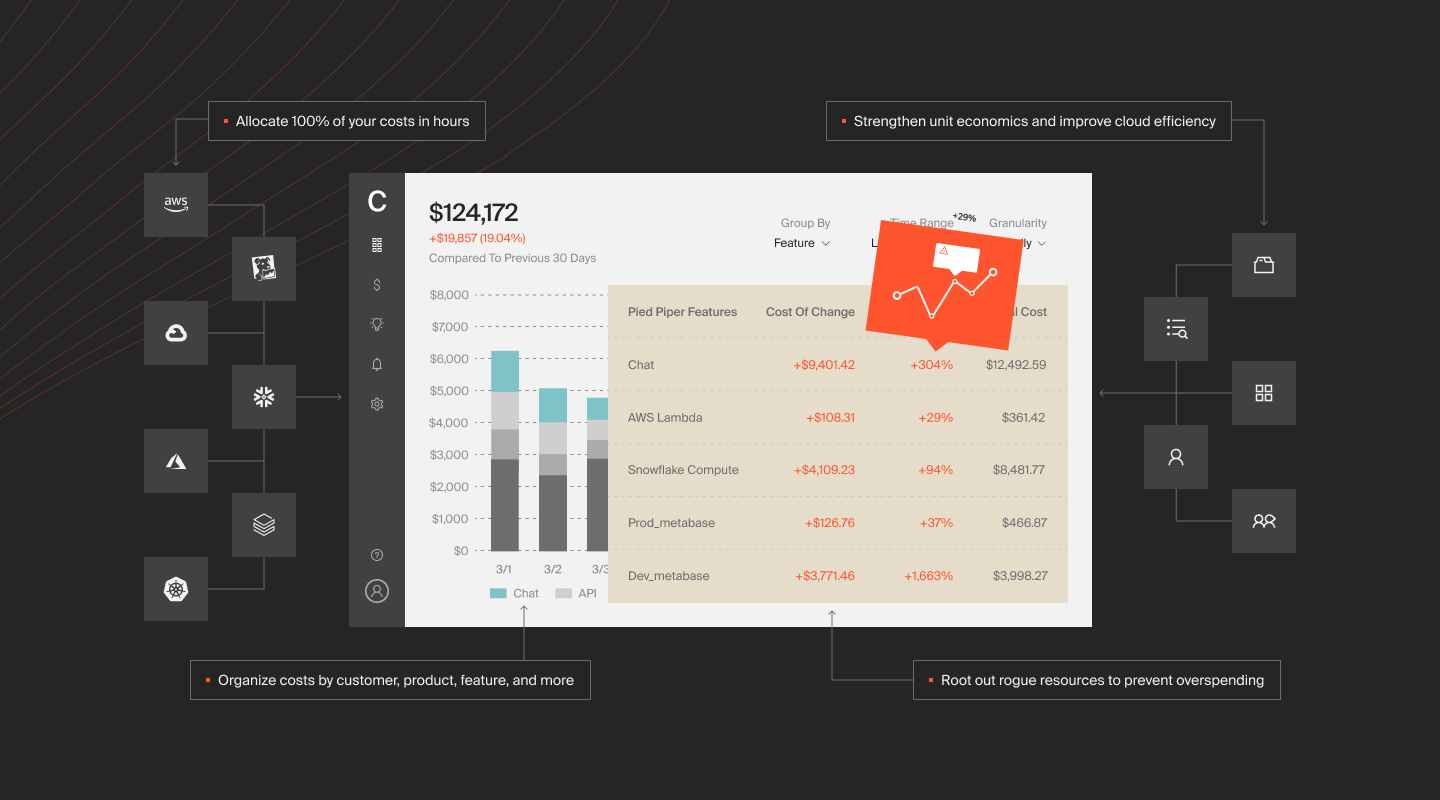
That’s the foundation a mature ITFM program is built on, and it’s what turns cloud billing data from a source of confusion into a source of competitive intelligence.
Ready to build that foundation?  to see how CloudZero works, or start with a free cloud cost assessment to find out where your current visibility gaps are.