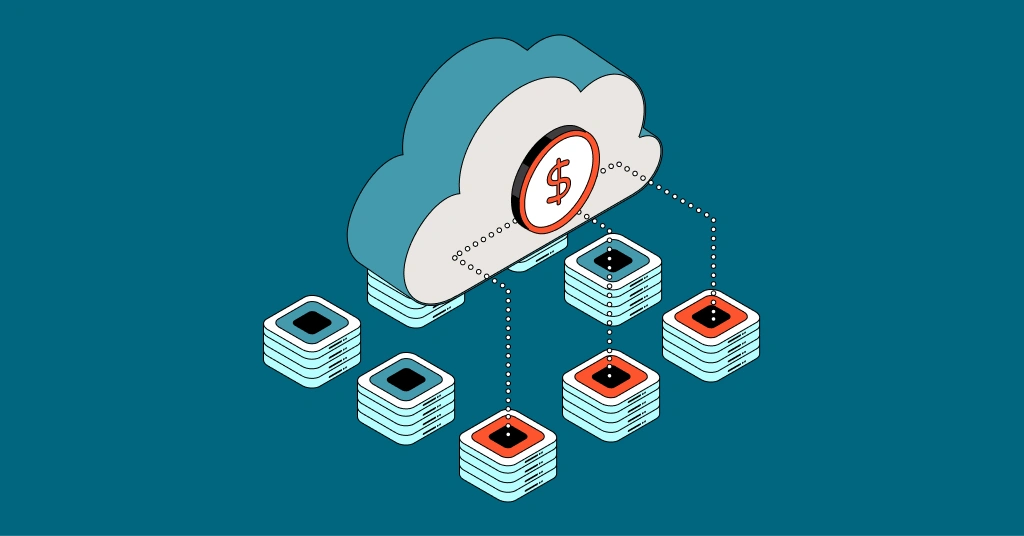
VPC peering can be simple and cost-effective in smaller setups. For growing multi-account platforms, Transit Gateway can offer predictable structure and centralized governance. But that’s not all.
AWS VPC peering connects two VPCs directly with no hourly fee — simple and cost-effective at small scale, but it creates an unmanageable mesh as your VPC count grows.
AWS Transit Gateway routes traffic through a central hub, charging $0.05/hour per attachment plus $0.02/GB in processing fees, but delivering centralized governance and linear scalability.
Use VPC peering for small, stable environments with fewer than five VPCs. Use Transit Gateway when you’re managing multiple accounts, shared services, or hybrid connectivity.
When comparing AWS VPC peering vs. Transit Gateway, most discussions focus on topology — point-to-point versus hub-and-spoke.
AWS VPC peering provides direct, private connectivity between VPCs. AWS Transit Gateway centralizes routing across multiple VPCs, accounts, and hybrid connections.
What’s often overlooked is how these architectures behave as they scale, and how rapidly today’s “simple” design can become tomorrow’s cost and complexity bottleneck.
So, which way do you go, and why?
In this guide, we’ll compare AWS Transit Gateway vs. AWS VPC peering across architecture, scalability, and cost behavior. Use it to help your engineers, FinOps, and finance teams make decisions grounded in both technical and economic realities.
What Does AWS VPC Peering Do?
AWS VPC peering enables two Virtual Private Clouds (VPCs) to communicate privately using AWS’s internal backbone. Once a peering connection is established, resources in each VPC can exchange traffic using private IP addresses (without traversing the public internet).
VPC peering is a direct, point-to-point relationship between two networks. You explicitly create the connection, update the route tables on both sides, and define which CIDR blocks can communicate.
It’s simple and effective in contained environments.
You can also configure the peering within the same region, across regions, or even across separate AWS accounts. That flexibility makes it attractive for teams isolating environments or connecting tightly scoped services that need controlled communication.
How AWS VPC peering works at the architectural level
VPC peering follows a mesh-style connectivity model. Each connection is independent. There is no central routing hub and no transitive routing.
If VPC A is peered with VPC B, and VPC B is peered with VPC C, traffic from A cannot automatically reach C. Every relationship must be explicitly defined.
In small environments, this is manageable. A handful of VPCs means a handful of connections and route tables to update.
As your platform grows, the number of required connections increases. What started as a clean point-to-point design can evolve into a dense web of connections.
Then there’s the cost question.
The cost behavior of AWS VPC peering
On paper, VPC peering looks inexpensive. There’s no hourly infrastructure fee for the connection itself, compared to services that introduce attachment costs.
You still pay for data transfer.
Traffic flowing between peered VPCs is subject to standard AWS data transfer pricing. That includes:
- Cross-AZ traffic: $0.01/GB each direction between Availability Zones in the same region
- Inter-region traffic: $0.02/GB or more depending on regions, billed in both directions
- Same-AZ traffic: Free — but only if both endpoints are in the same AZ
For microservices architectures where services span multiple AZs (which is most of them, for high availability), every service-to-service call that crosses an AZ boundary is a billable event. In high-throughput SaaS environments, this routinely reaches thousands of dollars per month before anyone notices.
The connection isn’t expensive, but the traffic it enables can be.
In a mesh-style environment, tracing unexpected transfer costs can take time, and still leave you guessing.
That may not matter in an early-stage system, but at scale, it does. In a mesh-style environment, tracing unexpected transfer costs can take time, and still leave you guessing.
That may not matter in an early-stage system, but at scale, it does.
Report
Finance needs to prove AI’s return: CloudZero report
260 senior finance leaders (more than half CFOs) told us why the speed of seeing AI spend, not the size of it, separates who pulls ahead on AI from who gets burned.
What Does AWS Transit Gateway Do?
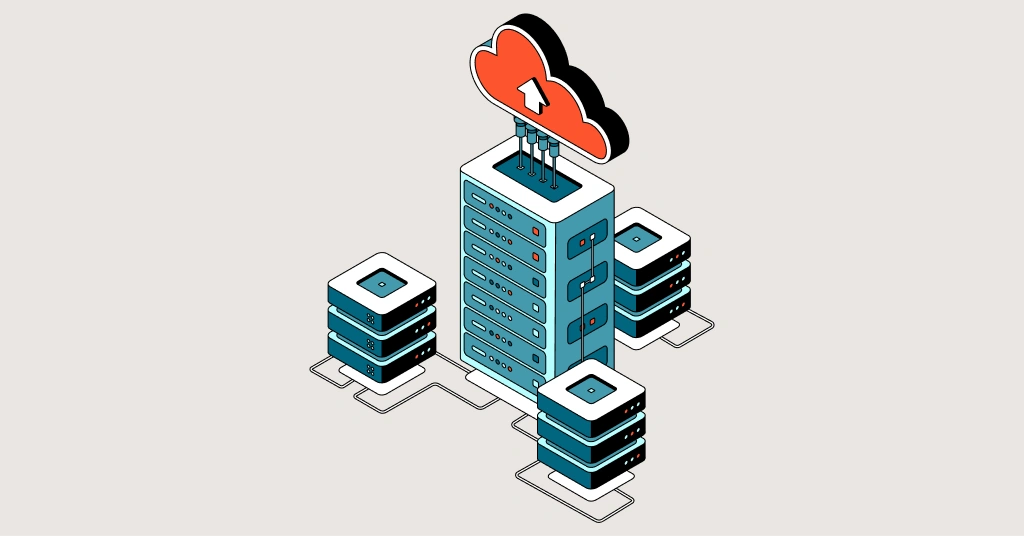
AWS Transit Gateway is a fully managed networking service that acts as a central hub for connecting VPCs, on-premises networks, and even other AWS regions.
Instead of building a web of point-to-point relationships, Transit Gateway introduces a hub-and-spoke model. Each VPC attaches to the central gateway. Routing decisions are managed in one place. And traffic can flow transitively across connected networks without requiring direct peering relationships between every pair.
That means, Transit Gateway shifts networking from a distributed mesh to a centralized control plane.
How AWS Transit Gateway works at the architectural level
With VPC peering, every relationship is independent. But with Transit Gateway, connectivity is coordinated from a single control plane. You don’t create dozens of direct connections. Instead, you attach once and manage routing centrally.
That distinction becomes meaningful as your environment grows.
Want to add a new VPC? Just attach it to the gateway and update routing rules. You don’t need to build multiple new peer relationships or manually reconcile route tables across accounts.
For multi-account SaaS architectures, shared service models, or hybrid connectivity strategies, this structure can help you reduce network sprawl and simplify governance.
Transit Gateway is designed for environments where network growth is expected, not incidental.
How AWS Transit Gateway costs behave
Instead of appearing “free” at the infrastructure layer, the service charges:
- Attachment fee: $0.05/hour per VPC attachment — approximately $36/month per attached VPC, billed regardless of traffic volume
- Data processing fee: $0.02/GB for all traffic routed through the gateway
- Inter-region peering: $0.02/GB (varies by region) for traffic crossing AWS regions via Transit Gateway peering
- Cross-AZ traffic: Standard $0.01/GB each direction still applies on top of the processing fee
For a platform with 10 attached VPCs and 5 TB/month of cross-VPC traffic, that’s roughly $360/month in attachment fees plus $100 in data processing — before any cross-AZ transfer costs. Compared to the $50 a simple peered mesh might generate in transfer-only fees, the difference is real. But at 30+ VPCs, the operational complexity of the peered mesh typically costs more in engineering time than Transit Gateway’s infrastructure fees.
(See current AWS Transit Gateway pricing.)
At small scale, that can look more expensive than VPC peering. And sometimes it is. Once you factor in growth, that picture changes.
In a peered mesh, the absence of attachment fees can mask rising data transfer costs and operational complexity. Transit Gateway, by contrast, makes your infrastructure costs visible upfront.
That visibility can support better cost forecasting.
Because attachments are centralized, you can attribute networking spend by VPC, account, or environment more consistently. You wouldn’t just be looking at aggregate data transfer, but also analyzing traffic through a defined hub.
Transit Gateway doesn’t eliminate data transfer fees. Traffic volume still matters. But it can make network behavior easier to govern, observe, and plan for, especially as your SaaS platform matures and expands.
And at scale, that predictability often matters more than minimizing early-stage infrastructure costs.
What’s The Key Difference Between AWS VPC Peering Vs. Transit Gateway?
Think of AWS VPC peering vs. Transit Gateway like city infrastructure.
VPC peering is like building private roads directly between neighborhoods. If two areas need to connect, you build a road between them.
Transit Gateway is more like a central highway interchange. Every neighborhood connects to the interchange, and traffic flows through a structured hub instead of a growing web of direct roads.
Both move traffic. The difference is how they scale, and how manageable they remain as your city (networking) expands.
Here is where that distinction matters.
| AWS VPC peering | AWS Transit Gateway | |
| Topology | Point-to-point mesh — each relationship defined individually | Hub-and-spoke — each VPC attaches once to a central gateway |
| Transitive routing | Not supported | Supported by design |
| Scalability | Exponential — n×(n−1)/2 connections as VPCs grow | Near-linear — attach and route centrally |
| Infrastructure cost | No hourly fee | $0.05/hour per VPC attachment (~$36/month) |
| Data processing | None (standard transfer rates apply) | $0.02/GB through the gateway |
| Best for | ≤5 VPCs, stable topology, single account | Multi-account, shared services, hybrid connectivity |
1. Topology
VPC peering creates a mesh. Each VPC relationship is defined individually. As VPC count increases, so do the connections and route table updates required to maintain them. Using Transit Gateway centralizes connectivity. Each VPC attaches once, and routing is controlled from a single point.
2. Transitive routing
With VPC peering, there is no transitive routing — if VPC A peers with VPC B, and VPC B peers with VPC C, A cannot reach C without a direct peering relationship. Transit Gateway eliminates this constraint entirely. Traffic flows transitively across all attached networks from a single routing control plane, without requiring you to define every pairwise relationship explicitly.
3. Scalability
In a peering environment, the connection count scales exponentially as VPCs are added. Route tables multiply, and coordination across teams increases.
With Transit Gateway, scaling is closer to linear. New VPCs attach to the hub, and routing updates remain centralized.
4. Cost structure
VPC peering does not charge an hourly infrastructure fee. You primarily pay for AWS data transfer pricing, including across Availability Zones (cross-AZ) and inter-region traffic.
Transit Gateway introduces attachment fees and per-GB processing charges, making infrastructure costs visible upfront.
5. Governance and visibility
Peering distributes network relationships across route tables and accounts. Governance also depends on coordination between teams.
Transit Gateway centralizes routing and policy enforcement, which can help you reduce operational entropy.
Takeaway: The difference lies in how much architectural complexity you’re willing to manage, and how that complexity compounds as your SaaS platform grows.
When To Use AWS VPC Peering
AWS VPC peering works best when your environment is small, predictable, and unlikely to grow quickly.
If cross-VPC traffic is modest, you don’t need transitive routing, and governance is lightweight, often within a single account or a tightly coordinated multi-account setup, peering keeps the architecture simple. You connect what needs to communicate and avoid introducing additional networking infrastructure.
In short, it minimizes overhead while preserving private connectivity.
When To Use AWS Transit Gateway
Transit Gateway becomes the better fit once your architecture starts scaling beyond a few tightly scoped environments.
If your SaaS platform spans multiple AWS accounts, relies on shared services, supports hybrid connectivity, or expects steady VPC growth, a centralized model provides a clearer structure.
The hub-and-spoke design works especially well for multi-account organizations, platform-managed networking, microservices with frequent cross-VPC communication, and customer-isolated environments. Instead of maintaining an expanding web of peer relationships, you manage connectivity from a single control point.
The Hidden Cost Drivers Many Teams Miss
Even if you choose intentionally between AWS VPC peering and Transit Gateway, certain costs tend to surface later.
Cross-AZ traffic is one of them. Services running in different Availability Zones communicate constantly in distributed architectures. At $0.01/GB each direction, a platform processing 10 TB/month of cross-AZ traffic pays $100/month in transfer fees alone — before any Transit Gateway processing charges on top.
Inter-region replication is another. Inter-region transfer costs range from $0.02 to $0.09/GB depending on the regions involved, billed in both directions. For a platform replicating 50 TB/month across regions for disaster recovery, that’s $1,000–$4,500/month in transfer costs — and it scales directly with data volume.
Then there’s connection growth. In a peered mesh, every new VPC increases relationship complexity. Even if your infrastructure costs stay low, operational complexity rises. And complexity often turns into inefficiency.
The real issue isn’t traffic.
It’s visibility.
AWS billing reports show you data transfer charges. They don’t tell you:
- Which feature triggered them
- Which customer drove them
- Whether the spike reflects growth or an anomaly from misconfiguration
- How your networking is affecting your cloud COGS
Without that context, you’re left guessing. And guessing doesn’t scale.
With CloudZero, you can connect the missing layers with clarity.
CloudZero, a cloud cost intelligence platform that allocates AWS spend to customers, features, and environments, ingests your networking costs including Transit Gateway attachments, VPC data transfer, and cross-region traffic, and ties them directly to the business dimensions that matter.
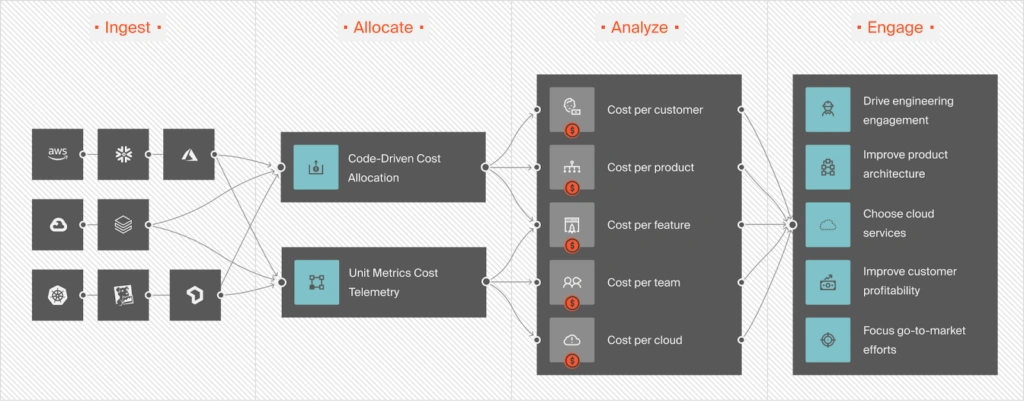
When you have that clarity, your advantage isn’t simply choosing the “right” topology. It’s also being able to see exactly what to adjust, when, and how, to protect your bottom line.
Leading teams at Moody’s, Toyota, and Skyscanner use CloudZero to bring that visibility into their cloud decisions.
If your architecture is growing and you want to see how networking behavior is shaping your margins, grab your free CloudZero demo here to see how it works in your own environment.
Because at scale, reliable cost visibility is what turns infrastructure into strategy.
Frequently Asked Questions about VPC Peering vs. Transit Gateway