FinOps thrives on clarity, and clarity is built on metrics. Metrics give engineering and finance a shared language to understand costs, evaluate trade-offs, and guide innovation.
The most impactful metrics go beyond “how much are we spending?” and help us answer:
- Which features deliver the most business value?
- How effective are cross-team collaborations?
- How efficiently are we using our infrastructure?
When we measure these things, we stretch beyond tracking progress to fueling it.
Beyond Spend: Measuring What Drives Value
Traditional cost metrics, like cost per project or cost per customer, are essential. They provide a baseline of visibility.
Pro Tip: As organizations scale, it’s just as important to measure what creates value as it is to measure what consumes budget.
Here are three places I’ve seen FinOps drive deeper insights and alignment:
- Collaboration-driven features: Assessing the impact of features created through cross-team brainstorms, hackathons, or collaboration sprints.
- Feature adoption: Comparing usage of newly released features with legacy ones, alongside maintenance ticket volume, to evaluate efficiency.
- Implementation pace: Tracking delivery speed for team-sourced initiatives versus top-down directives to understand where innovation flows fastest.
With these metrics in place, FinOps shifts from simply describing spend to driving business value.
Related read: How Much Did OpenAI’s 30,000 CPU Core Optimization Save Them?
2026 State of AI Spend Report
Why Finance Caps What It Can’t See
Learn how finance leaders are managing AI spend, and how they’re approaching FY2027
Storytime: Shutterstock’s Journey To Kubernetes Clarity
This story illustrates the power of metrics that matter, powering meaningful and collaborative action.
At Shutterstock, engineers spent years struggling to trust Kubernetes cost data. After onboarding with CloudZero, they achieved 98% cost accuracy — a milestone that changed everything.
With accurate data, engineers quickly identified unused ephemeral services, saving $2,000/month. Another team corrected a misconfiguration that unlocked $5,000/month in savings.
The real shift lies beyond savings; it’s in culture change. Now, engineers could act with confidence because the metrics were trustworthy – and there was a bonus win because finance gained forecasting precision.
Together, teams aligned around decisions that balanced efficiency with growth.
I wanted to share this story to give you a real world representation of how metrics become catalysts for innovation, profitability, and alignment.
Related read: How CloudZero Supported Shutterstock In Optimizing Costs And Meeting Savings Goals
Expanding the Metric Set: From Collaboration To Infrastructure
I’vd outlined several FinOps-aligned measurements that you can put into practice today.
Metrics like these open the door for broader alignment across leadership, product, engineering, and finance:
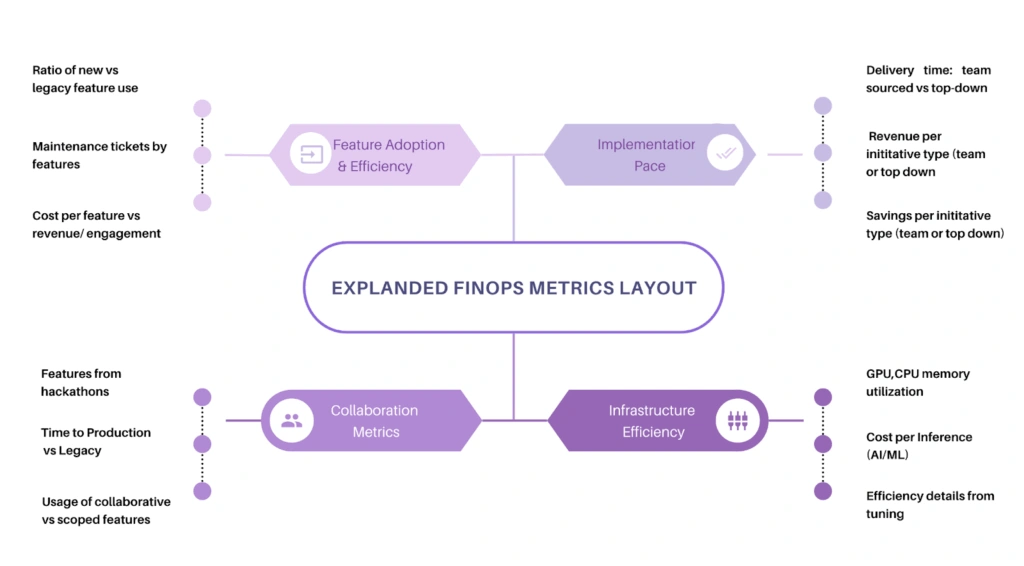
- Cross-team collaboration metrics
- Features launched from hackathons or sprints
- Time-to-production compared with legacy processes
- Usage of collaborative features vs. individually scoped ones
- Feature adoption + efficiency metrics
- Ratio of new feature use to legacy feature use
- Maintenance ticket volume by feature type
- Cost per feature vs. revenue or engagement generated
- Infrastructure efficiency metrics
- Granular GPU, memory, and CPU utilization for workloads
- Cost per inference (AI/ML)
- Efficiency gains from infrastructure tuning over time
- Implementation pace metrics
- Average delivery time for team-sourced initiatives vs. top-down initiatives
- Savings or revenue contribution per initiative type
Together, these measurements create a well-rounded view of cost, value, and momentum.
And for our visual learners, I’ve included a chart below for the expanded FinOps metric layout:
Related read: 30+ Essential Cloud Metrics For SaaS And FinOps Teams
Final Thought: Metrics As Catalysts For Innovation
We know that metrics can describe the past.
Here’s another pro tip: When used effectively, metrics also shape the future.
By expanding beyond cost tracking into collaboration, adoption, efficiency, and pace, FinOps teams empower engineers and finance to co-create value.
With a focus on value drivers, every new measurement is an opportunity to see more clearly and act with confidence.
That’s FinOps in action — clarity turned into momentum.