CloudZero’s Umesh Rao and Larry Advey showed what it actually looks like to connect AI to real cloud cost data, and the results are hard to unsee.
On April 9, 2026, CloudZero hosted a live webinar, Cost Intelligence for the AI Era, featuring Umesh Rao, Director of Enablement, and Larry “Fred FinOps” Advey, Director of Cloud Platform & FinOps. The session was equal parts context-setting and live demo: Umesh walked through the CloudZero platform, then Larry took over to show what happens when you connect CloudZero’s cost data to an AI agent and start asking hard questions.
What came out of it was a pretty clear picture of where AI cost intelligence is heading — and how close it already is.
Here are the top takeaways.
1. AI adoption is different from cloud adoption, and that changes everything about cost visibility
The shift from on-prem to cloud was controlled by R&D and infrastructure teams. The shift to AI is not. Umesh made this distinction right at the top: “With AI, anybody can go to Anthropic, OpenAI or any of the many different providers that are out there and start running it and using it within minutes, right? And you’re actually getting value out of it within minutes as well.”
That accessibility is the point, as well as the problem. The poll the team ran at the start of the session showed a fairly even distribution across the audience: some people using AI for less than 25% of their work, others using it for more than half. A real bell curve. But regardless of where people fell on that spectrum, the underlying cost visibility challenge is the same: when anyone can spin up AI workloads without going through IT, the spending happens faster than the accounting can follow.
Umesh put the stakes plainly: engineers are now 40 to 50% more productive on code. But not all AI usage is productive. Knowing which is which requires cost data that most teams don’t have.
Research Report
FinOps In The AI Era: A Critical Recalibration
What 475 executives told us about AI and cloud efficiency.
2. Finance and engineering are still rowing in opposite directions — AI is just amplifying the noise
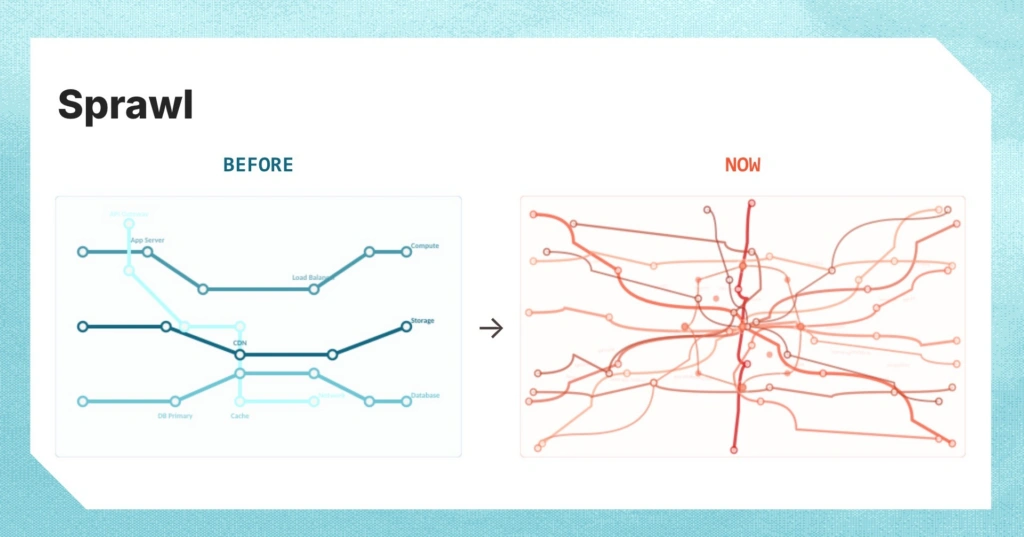
This is the structural tension that kicked off the whole conversation. Umesh described a scenario that resonated hard in the room: CloudZero’s head of sales got a call from a director of engineering who received two calls in the same week. One was the CFO who told him he needs to cut costs by 20%. The other was from the CEO who asked for 10 new AI-enabled features to keep up with competition.
Same company. Same budget. Opposite instructions.
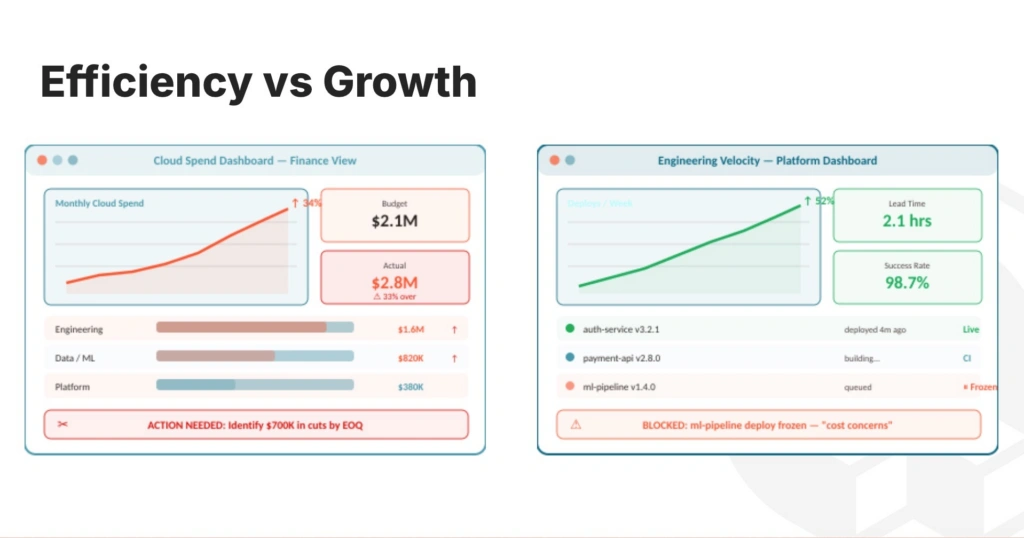
Larry connected the root cause: “Engineering doesn’t understand the impacts that they have to the business metrics that matter that leadership [is] looking at.” Cost-per-transaction, cost-per-user, cost-per-feature — these metrics either don’t exist in most organizations, or they land as a flat number with no context for why it matters or what’s driving it.
The insight Larry kept coming back to was that context helps humans for the same reason it helps AI.
“Just like AI context helps a heck of a lot, right? It’s context amongst us humans too and sharing that amongst ourselves with our peers and leaders.”
3. Trusted AI analysis starts with trusted underlying data
This was a thread both speakers returned to throughout the session, and it’s the part that matters most for anyone thinking about layering AI on top of their cost data: AI is only as trustworthy as the data underneath it.
CloudZero is SOC 1 Type II certified, which means finance-grade accuracy and audit-ready reporting. The platform ingests cost data from AWS, Azure, GCP, Kubernetes, SaaS tools, and AI providers without requiring perfect tagging. CostFormation allocates 100% of spend, including shared and untagged costs. Every dollar has a home.
Larry was direct about why this matters so much in the AI context:
“If you can trust that the root data is accurate with CloudZero, SOC 1 Type 2, SOC 2 Type 2, then you can really trust the information and align it with not only yourselves but those in engineering, product, finance, IT, the business, etc.”
He also made a pointed observation about what happens when AI doesn’t have that foundation: it gets “eager.” Hallucinated figures, hyperbolic conclusions, recommendations that sound reasonable but aren’t grounded in reality.
“You have to force it to come back to reality,” Larry said. “Be the skeptic in the room.”
4. The demo: finding a needle in a haystack — a 16x infrastructure spike, caught in minutes
Larry’s live demo was the centerpiece of the session. Starting with a single question, “tell me about my weekly feature costs for the past 6 weeks,” he showed how CloudZero AI Hub and Claude pull together billing dimensions, telemetry data, and cost data into a curated analysis, all in plain language.
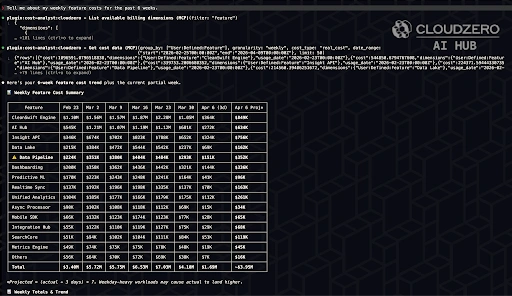
The output builds into a scrollable report: cost per transaction by feature, margin analysis, weekly trend lines. The AI immediately flagged an outlier: Data Pipeline had grown 116% over five weeks, from $224K to $484K, outpacing the rest of the portfolio.
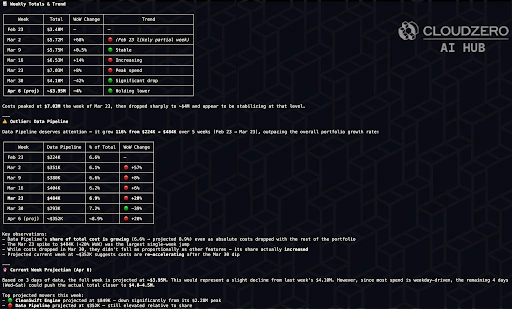
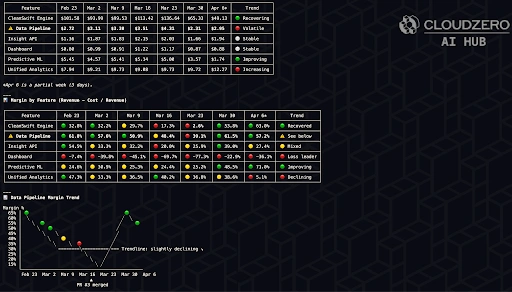
But the real payoff came when Larry pushed further and asked the AI to add cost per transaction, margin, and identify any notable GitHub pull requests from the same period.
What his prompt surfaced was a data pipeline PR from March 23rd that triggered a 16x increase in the number of workers. It was a configuration made ahead of a customer event that never actually happened. Revenue didn’t change. Transactions didn’t change. But infrastructure costs went up sharply.
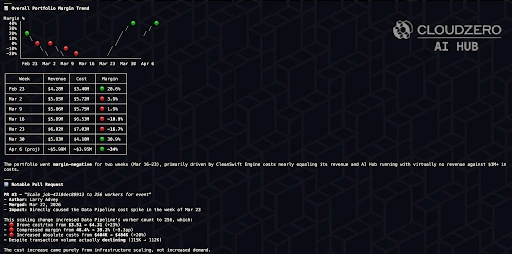
The result was a 20% cost increase, a 23% cost-per-transaction increase, and a 9% margin decrease, all traced back to a single PR. The portfolio had gone margin-negative for two consecutive weeks without anyone noticing until the AI connected the dots.
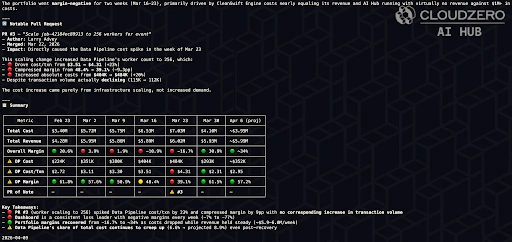
Umesh’s reaction was unscripted and honest: “I would have completely missed it if I was just looking at reports on a weekly basis.”
Larry drove the point home: “You may want to jump into [the top cost item] because it’s the number one cost one, right? That makes sense. But there are outliers down here like the needles in the haystack… that you would likely miss but are easy opportunities.”
And those weren’t the only outliers the session surfaced. Larry’s investigation also flagged a dashboard running as a consistent loss leader with negative margins every week (-7% to -77%). And an AI Hub dimension with virtually no revenue against $1M+ in costs.
5. You don’t need to be an engineer to do FinOps-grade analysis anymore
Until recently, connecting cost data to GitHub, Jira, AWS, and GCP required knowing the exact repos, the exact API structures, and how to query each one. Larry described it plainly: “You had to be very technically minded to program against those to pull the information out… Darn near like an engineer.”
That’s changed. With CloudZero AI Hub connected to Claude (or Gemini, ChatGPT, or any client that supports MCP servers), a FinOps practitioner can ask a question in plain English and get a synthesized cross-source answer. Cost trends, PR attribution, margin analysis by feature, cost per transaction all without writing a single line of code.
The output Larry showed was exportable as an HTML report or PDF, shareable across teams, and drillable on demand. This is the kind of analysis that previously required a data engineer and several days. And this is what AI for FinOps actually looks like in practice.
6. Cost intelligence can, and should, shift left into engineering workflows
The question that got the most airtime in the Q&A came from Theresa Marie Toole: can you go more in depth about Shift Left, and how does this actually fit into an engineer’s day-to-day workflow?
Larry’s answer covered four distinct integration points, each more powerful than the last.
First, PR-level cost benchmarking. Before a merge, an agent can look at the code, pull CloudZero cost data, and provide a real cost estimate for what that change is likely to do. Not a guess. Actual benchmarking against existing workloads.
Second, epic and story-level estimation. Before development even starts, an agent can take the story description, look at existing code and cloud patterns, and give architecture-level cost guidance.
Third, post-deploy alerts. CI/CD integration that fires to Slack a day or two after a merge saying, “here’s what this change did to your cost and margin.”
And fourth, a manager-level view. Surfacing which engineers and which PRs are actively driving cost efficiency, so those wins can be celebrated and shared across the team.
CloudZero is actively building skills for all of these. The pattern is already working for customers who’ve started using it.
Webinar Q&A
Q: Will CloudZero support automated Jira ticket generation?
A: This one got a “+1” from multiple attendees during the session. Umesh answered: automated ticket creation is in progress, and bulk ticket creation is already available in the UI, which lets you create tickets for multiple issues at the same time and track them against cost savings over time.
Q: If a company only uses AWS, wouldn’t Cost Explorer serve the same purpose?
A: A fair challenge from Jay Parekh. Greg Coletti, who was active in the Q&A chat, put it well: “I’d say start measuring now before the problem gets away from you.” Cost Explorer covers AWS billing, but it doesn’t allocate across shared resources, doesn’t handle multi-cloud or SaaS, doesn’t surface unit economics, and doesn’t connect to GitHub or Jira to answer why a cost changed. The gap grows fast.
Q: Does the tool detect cost anomalies in real time?
A: Not yet. CloudZero, like the rest of the industry, is currently gated by how frequently cloud providers surface billing data. But Larry was pointed about this: “Stay tuned. We have a direct answer to that to make it very near real-time.”
Q: Can you create custom calculations based on the data you’re ingesting?
A: Yes. Umesh confirmed: “Our analytics module is both flexible and advanced so that you can input your calculations.” Reports, dashboards, and custom metrics are all configurable within the platform.
The bottom line
The era of manually hunting through cost reports to find the thing that went wrong is ending. AI can surface a March 23rd PR that caused a 16x infrastructure spike, but only if the underlying cost data is accurate, fully allocated, and structured. CloudZero AI Hub, connected to GitHub, Jira, and your own dimension model, is what closes the loop between infrastructure decisions and business outcomes. The question isn’t whether to use AI for cost intelligence. It’s whether your data is clean enough to trust what comes back.
Want to go deeper on connecting AI to your cloud cost data? Book time with Larry — office hours April 15 at 11 AM ET: cloudzero.com/demo


FinOps In The AI Era: A Critical Recalibration
What 475 executives told us about AI and cloud efficiency.