Quick Answer
Claude Opus 5 launched July 24, 2026 at $5 per million input tokens and $25 per million output tokens, identical to Opus 4.8. It delivers near Claude Fable 5 performance at half Fable's price and is now the default model on Claude Max. New effort settings let teams trade capability for token savings, which means two teams on identical pricing can now run up very different bills. Finance teams, that last part is your problem.
Anthropic has shipped a model that costs exactly what the old one cost. Not a dollar more, not a token cheaper. Same rate card, same decimal points.
That should be the most boring sentence in AI pricing. It’s actually the sneakiest one, and if you own an AI budget, it’s about to make your next board meeting more interesting than you’d like.
Here’s the thing: Claude Opus 5 pricing didn’t change. What changed is everything around the price. Anthropic moved the real cost controls inside the model, and the invoice you get in August will depend far more on how your teams use Opus 5 than on what Anthropic charges for it.
Let’s unpack what actually happened, what the numbers say, and why your rate card just became the least useful document in your AI budget folder.
What is Claude Opus 5?
Claude Opus 5 is Anthropic’s newest model. The Claude Opus 5 release date was July 24, 2026, and Anthropic pitches it as coming close to the frontier intelligence of Claude Fable 5, its top model, at half Fable’s price. Anthropic says Opus 5 is “designed to be used every day,” which is corporate for: this is the one they expect on your invoice.
The launch pace alone deserves a raised eyebrow. This is Anthropic’s fourth model in under two months, following Mythos 5, Fable 5, and Sonnet 5 in June. If your AI budget assumed a stable model lineup for the fiscal year, that assumption aged like milk.
Opus 5 is now the default model on Claude Max and the strongest model available on Claude Pro. On the API, developers call it with the model string claude-opus-5. If you’re still budgeting around Opus 4.8, note that it just became the fallback model, not the flagship.
One more wrinkle worth knowing: Anthropic says Opus 5 is its most aligned model to date, but deliberately not state of the art on risky dual-use work like offensive cybersecurity. Requests flagged by safety classifiers fall back to Opus 4.8 automatically in Claude, Claude Code, and Claude Cowork. File that away. It matters for your bill later.
Report
Finance needs to prove AI’s return: CloudZero report
260 senior finance leaders (more than half CFOs) told us why the speed of seeing AI spend, not the size of it, separates who pulls ahead on AI from who gets burned.
How much does Claude Opus 5 cost?
Opus 5 API pricing sits exactly where Opus 4.8 left it:
| Model | Input (per MTok) | Output (per MTok) | Cache write | Cache read |
| Claude Fable 5 | $10 | $50 | $12.50 | $1.00 |
| Claude Opus 5 | $5 | $25 | $6.25 | $0.50 |
| Claude Opus 4.8 (legacy) | $5 | $25 | $6.25 | $0.50 |
| Claude Sonnet 5 | $2 ($3 after Aug. 31) | $10 ($15 after Aug. 31) | $0.375 | $0.20 |
| Claude Haiku 4.5 | $1 | $5 | $1.25 | $0.10 |
Note: Sonnet 5 runs introductory pricing of $2 input and $10 output through August 31, 2026, then moves to $3 and $15. If you’re modeling Sonnet workloads past September, use the higher number.
A few pricing details the launch coverage mostly skipped:
- Fast mode costs double. Opus 5 offers a Fast mode running around 2.5 times default speed at twice the base price, so $10 per MTok input and $50 per MTok output. Speed is now a line item.
- Batch processing still cuts 50%. Asynchronous workloads that can wait get Opus 5 at effectively $2.50 and $12.50 per MTok. For overnight jobs, that’s the real price.
- US-only inference runs 1.1x. Data residency has a surcharge. Your compliance team and your budget owner should probably talk.
- And the fun one: Anthropic’s own legacy price list still shows Opus 4.1 at $15 input and $75 output. In roughly a year, Opus-tier pricing fell 3x, and Opus 5 more than doubles even Opus 4.8’s Frontier-Bench score on top of that. We covered this deflation pattern in our LLM API pricing comparison, and Opus 5 just extended the trend line.
For subscriptions: Claude Pro runs $17 per month billed annually or $20 monthly, and Claude Max starts at $100 per month with 5x or 20x Pro usage. Opus 5 is included in both, which makes Max quietly one of the better deals in AI right now. Full plan breakdowns live in our Claude pricing guide.
Why does the same price produce a different bill?
Here’s where Claude Opus 5 pricing gets genuinely weird, and where finance leaders should lean in.
Every previous model launch worked like a menu. New model, new price, update the forecast, done. Opus 5 breaks that model in three ways.
The effort setting is a spend dial
Opus 5 ships with adjustable effort levels, from low up through max. Higher effort means more reasoning tokens, better answers, bigger bills. Lower effort means faster, cheaper, usually still good. Anthropic’s own launch benchmarks chart performance per effort level for exactly this reason.
Read that again from a budget owner’s chair. Anthropic set the price. Your engineers now set the cost. A developer flipping a configuration flag from medium to max effort just changed your unit economics, and no invoice will ever say so.
Efficiency gains rewrote the math mid-flight
The early customer numbers are startling, and they cut in the cheap direction.
Harvey, the legal AI company, reported Opus 5 matching Opus 4.8’s maximum-reasoning performance while generating 26% fewer tokens on average.
Fundamental Research Lab measured nine percentage points higher accuracy on hard financial-modeling tasks with a third fewer turns and tool calls and 60% less time. One trading firm’s data engineering head, Matt Nassr, reported top results using roughly a seventh of the reasoning tokens of Opus 4.8.
Same rate card. Radically different cost per outcome. Which means comparing models by price per MTok is now like comparing cars by price per liter of paint.
Fallbacks and routing blur the invoice
Two API updates shipped alongside the model. Developers can now change tools mid-conversation without invalidating the prompt cache, a genuine cost saver since cache reads run $0.50 versus $5 for fresh input. And automatic fallbacks can route safety-flagged requests to another model rather than blocking them.
Convenient? Very. But it also means the model on your invoice isn’t always the model your team specced. Traffic quietly routing between Opus 5 and Opus 4.8 won’t change your rate, since both cost the same, but it will scramble any per-model performance accounting you were attempting.
What does Opus 5 cost in practice? Three scenarios
Numbers make this concrete. Take one illustrative workload: 50 million input tokens and 10 million output tokens per month. Same tokens, same model, three configurations:
| Configuration | Input spend | Output spend | Monthly total |
| Batch processing (50% off) | $125 | $125 | $250 |
| Standard Opus 5 | $250 | $250 | $500 |
| Fast mode (2x pricing) | $500 | $500 | $1,000 |
That’s a 4x spread before anyone touches the effort dial, and effort changes the token counts themselves, not just the rate. Crank effort up and the same task simply generates more reasoning tokens. Prompt caching pulls in the other direction, dropping repeated input from $5 to $0.50 per MTok.
Multiply this across an engineering org where every team configures independently, and “what does Opus 5 cost” stops having a single answer. It has a distribution. Which is a very fun word to say in a budget review.
How does Opus 5 compare with Fable 5 and Sonnet 5?
The Fable 5 vs Opus 5 question, and its sibling Sonnet 5 vs Opus 5, will dominate model selection debates for the next quarter. The intra-Anthropic decision now looks like this:
| Sonnet 5 | Opus 5 | Fable 5 | |
| Price (in/out per MTok) | $2/$10 intro, $3/$15 after Aug 31 | $5/$25 | $10/$50 |
| Best for | High-volume production work | Daily agentic coding and knowledge work | Frontier-difficulty problems |
The Claude Opus 5 benchmarks make Fable’s position awkward: on CursorBench 3.2 at max effort, Opus 5 lands within 0.5% of Fable 5’s peak score at half the cost per task. On OSWorld 2.0, a computer-use benchmark, Opus 5 beats Fable 5’s best result at just over a third of the cost. On ARC-AGI 3, Opus 5 scores three times the next-best model. And on Zapier’s AutomationBench, Opus 5 hit a 100% pass rate on an end-to-end churn-prevention workflow without spending more tokens than prior Claude models, per Zapier CEO Wade Foster.
So when does Fable 5 still earn its 2x premium? Genuinely novel, frontier-hard problems, and workloads where the last percentage point of capability pays for itself. For nearly everything else, Opus 5 is the value play, which is presumably why Anthropic made it the everyday default.
If you’re weighing the top tier anyway, our Claude Mythos pricing breakdown covers the restricted-access end of the lineup, and our Claude API pricing guide has the full family math.
Agentic coding teams should also note that Opus 5 slots straight into Claude Code, where subscription and usage pricing has its own quirks, and where multi-agent workflows can multiply token burn faster than any rate change ever could. Running on AWS? Opus 5 landed on Bedrock day one, and our guide to Claude on AWS Bedrock explains how that changes the billing picture.
Should you switch from Opus 4.8 to Opus 5?
For most teams, yes, and unusually for a model upgrade, the finance case is stronger than the engineering one. Same rate, measurably more output per dollar. Box measured Opus 5 outperforming Opus 4.8 by 8% overall, with an 11% gain on data analysis and 17% on due diligence workflows. Lovable clocked a 22% improvement on its hardest agentic coding tasks over Opus 4.7, with less run-to-run variance.
Three caveats before you flip the switch:
- Rebaseline your unit costs first. If Opus 5 completes tasks in fewer tokens, your cost per task should drop. If it doesn’t, something in your configuration is eating the efficiency gain, and you want to see that within days, not at month end.
- Set an effort policy before rollout, not after. Decide which workloads justify high effort and which run at low, and write it down. Teams pulling Opus 5 through Cursor, Claude Code, or any of the Claude Code alternatives will otherwise each pick their own defaults, and the spread lands on your invoice.
- Mind the fallback behavior. Flagged requests route to Opus 4.8 automatically. Same price, different model, so tag your telemetry by actual serving model if you’re measuring quality per dollar.
What does Opus 5 actually mean for your AI spend?
- Zoom out and the pattern is bigger than one launch. Unit prices for intelligence keep falling. Opus-tier work cost $15/$75 a year ago; it costs $5/$25 today, with benchmarks up and token efficiency improving on top. Cheaper units, though, have never once meant smaller bills, as anyone who has read our OpenAI pricing analysis or watched a “cheap” ChatGPT deployment scale will tell you. Consumption expands to fill the budget available, then keeps going.
- What Opus 5 adds is variance. The effort dial, Fast mode, batch discounts, cache economics, and fallback routing mean the same workload can legitimately cost 4x more or less depending on configuration choices made three levels below the CFO. Your forecast isn’t wrong because the prices moved. It’s wrong because the prices stopped being the variable.
- And most finance teams will find out late. CloudZero’s 2026 AI ROI survey of 260 finance leaders found that half wait days, or until the bill arrives, to see AI spend data, and only 16% see it in real time. Against a model whose cost profile can change with a config flag on a Tuesday afternoon, a month-end surprise isn’t a risk. It’s the default setting.
The uncomfortable question Opus 5 poses to every budget owner: if the same model at the same price can produce wildly different bills, what exactly are you forecasting? The honest answer is that you’re no longer forecasting a price. You’re forecasting behavior. And behavior needs instrumentation, not a rate card.
Our breakdown of how much AI really costs goes deeper on why the sticker price is always the smallest number in the story.
How teams keep Opus 5 spend tied to outcomes
This is the part where visibility stops being a nice-to-have. A few concrete mechanics that matter in an Opus 5 world:
See spend at the moment it happens, not at month end. CloudZero’s AI Hub pulls usage from Claude Code, Cursor, Codex, and Gemini CLI into one view, so an effort-setting change shows up in hours, not on an invoice 30 days later.
Allocate to the engineer and the work. Per-engineer allocation shows which teams run high effort and which run lean, and commit-level and Jira tracing connect a Tuesday cost spike to the actual feature branch that caused it. When the bill jumps 40%, “who and why” takes minutes instead of a forensic sprint.
Catch drift before finance does. Anomaly detection flags when a workload’s cost per task moves, which is exactly the signal that someone flipped Fast mode on or cranked effort to max. Budgets set against unit cost, not raw token totals, keep the “cheaper model, bigger bill” paradox visible.
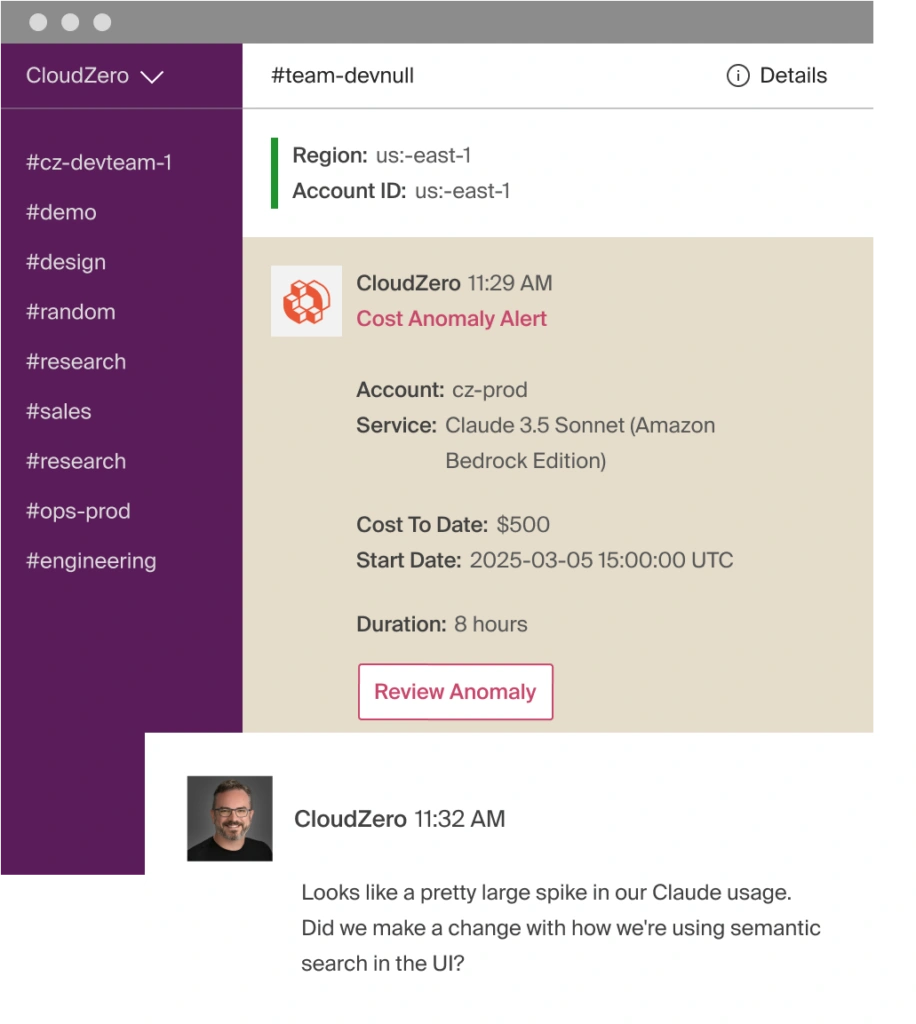
That’s the operating model teams like Duolingo, Coinbase, and Superhuman use to keep AI spend accountable while shipping fast. The rate card tells you what Anthropic charges. Instrumentation tells you what your organization actually does with it. Only one of those explains your bill. Get a free CloudZero demo today.
Frequently asked questions about Claude Opus 5 pricing