Quick Answer
Claude Code agents are Anthropic's system for running parallel AI coding sessions. Agent view (claude agents) is a terminal dashboard that dispatches and monitors background sessions from one screen. Subagents are reusable agent configurations with custom prompts and tools defined in YAML. Agent teams coordinate multiple sessions that message each other.
The cost impact is linear: running 10 parallel agents consumes your Pro, Max, or Enterprise token quota 10x faster. At Anthropic’s reported average of $13 per developer per active day, five concurrent agents could push daily spend to $50–$65. DORA’s 2025 State of AI-assisted Software Development report found that 90% of technology professionals now use AI at work — up 14% from 2024 — with developers spending a median of two hours per day working with AI tools.
As agent-based workflows push that usage from hours to continuous background sessions, the cost math changes category. There is no separate agent billing, all sessions draw from the same plan. Claude Code agent view requires Claude Code v2.1.139+ and is currently a research preview.
What Are Claude Code Agents And Why Do They Exist?
Claude Code has always been one developer, one terminal, one conversation. Powerful, but sequential. Claude Code agents break that constraint by letting developers run multiple autonomous sessions simultaneously, each working on a different task, each consuming tokens independently.
Anthropic ships three agent capabilities, each solving a different orchestration problem:
- Agent view is the control center. Run claude agents and a full-screen dashboard appears showing every background session: what’s working, what needs input, what’s done. Dispatch new sessions by typing a prompt. Peek at progress without interrupting. Attach when you need the full conversation. Sessions survive terminal closure, a supervisor process runs them independently, so you can shut your laptop and the agents keep coding.
- Claude sub agents (also called Claude Code sub agents) Subagents are reusable configurations. Define a YAML file in .claude/agents/ with a custom system prompt, model selection, and tool permissions — a “code-reviewer” subagent that always uses Sonnet 4.6, checks your style guide, and opens a PR comment. Define it once, invoke by name forever. Subagents run within a parent session and report results back, making them the most token-efficient agent type.
- Claude Code agent teams take coordination further. An orchestrator dispatches worker agents that message each other, share results, and converge on a solution. One agent refactors the data layer, another updates tests, a third reviews the PR. The orchestrator manages sequencing. Agent teams are the most capable orchestration mode — and the most expensive — since every inter-agent message is a round trip through the model.
For setup details, see Anthropic’s docs on agent view, subagents, and agent teams. What those docs skip is the cost story, which is where this article earns its keep.
Report
Finance needs to prove AI’s return: CloudZero report
260 senior finance leaders (more than half CFOs) told us why the speed of seeing AI spend, not the size of it, separates who pulls ahead on AI from who gets burned.
How Much Do Claude Code Agents Actually Cost?
Here is the sentence Anthropic buries in the docs that every developer should read before dispatching their first fleet: “rate limits apply: background sessions draw down your subscription usage the same as interactive sessions, so running ten agents in parallel uses quota ten times faster.”
No separate billing. No agent discount. No volume pricing. Every Claude Code agent session eats from the same plan; Pro, Max, Team, or Enterprise, at the exact same rate as interactive work.
Here is what that math looks like, based on Anthropic’s enterprise averages:
|
Scenario |
Sessions |
Est. daily cost |
Monthly (20 days) |
Plan needed |
|
Solo dev, normal workflow |
1 |
~$13 |
~$260 |
Pro ($20/mo) |
|
Dev with 3 parallel agents |
3 |
~$30–$40 |
~$600–$800 |
Max 5x ($100/mo) |
|
Dev running 5–10 agents |
5–10 |
~$50–$130 |
~$1,000–$2,600 |
Max 20x ($200/mo) |
|
10-dev team, 3 agents each (API) |
30 |
~$300–$400 |
~$6,000–$8,000 |
Enterprise |
|
10-dev team, 5 agents each (API) |
50 |
~$500–$650 |
~$10,000–$13,000 |
Enterprise |
The Pro plan’s 5-hour rolling window was designed for one human typing at human speed. Five parallel agents are not typing at human speed. They’ll drain that window in under an hour, especially during peak hours with the community-reported 1.3–1.5x multiplier. Running agents on Pro is technically possible but practically painful, as the five-hour window drains in under an hour.
Model selection is the biggest cost lever. An agent team with one Opus 4.7 orchestrator ($5/$25 per MTok) and four Sonnet 4.6 workers ($3/$15 per MTok) costs roughly 40% less than five Opus agents. Factor in the Opus 4.7 tokenizer generating ~35% more tokens for identical text, and the gap widens further. Defaulting every agent to Opus is like chartering a helicopter for every pizza delivery.
Now multiply that variance across 50 engineers making independent model choices, and “Claude Code pricing” graduates from a purchasing question to a FinOps for Claude problem.
Subagents Vs. Agent Teams: When To Use Which (And What Each Costs)
Picking the wrong orchestration mode wastes both time and tokens. Here’s the decision framework.
|
Feature |
Agent View |
Subagents |
Agent Teams |
|
What it does |
Dashboard for background sessions |
Reusable configs with custom prompts |
Sessions that message each other |
|
Launch method |
Claude agents |
.claude/agents/ YAML |
Orchestrator dispatches workers |
|
Token model |
Each session = independent stream |
Runs within parent session |
Each session = independent + inter-agent messages |
|
Best for |
Independent parallel tasks |
Repeatable workflows |
Dependent multi-step projects |
|
Relative cost |
Medium (per-session) |
Lowest (shared context) |
Highest (per-session + message overhead) |
- Independent tasks → agent view. Fix a bug in service A, review a PR in service B, investigate logs in service C. Three jobs, no dependencies. Dispatch all three and check results when done.
- Repeatable workflows → subagents. Code review with your team’s style guide, test generation against your framework, documentation updates following your template. Define the subagent YAML once with a locked model and system prompt. Every invocation is consistent and cost-predictable.
- Dependent tasks → agent teams. A frontend refactor requiring API changes first, test updates second, and a consolidated PR third. The orchestrator sequences work and passes context between workers. Powerful, but every message between agents is a billable round trip. Use sparingly and deliberately.
The Claude Code multi agent pattern, running several agents regardless of type, works best when you match the orchestration mode to the task instead of defaulting to the heaviest option. Agent teams are the premium feature; not every job needs premium.
5 Ways To Cut Agent Costs Without Cutting Capability
Here are five practical tips that help teams reduce token usage:
- Tier agents by model. Opus for the orchestrator. Sonnet for workers. Haiku for formatting. One team with tiered models costs ~40% less than all-Opus, with minimal capability loss on worker tasks. See our full Claude API pricing breakdown for rates.
- Stop agents when tasks complete. Idle sessions with live processes aren’t free. /stop in a session or Ctrl+X in agent view. Don’t let agents loiter; an idle Opus session is still consuming your token quota.
- Codify model limits in subagent YAML. Committing subagent configs to your repo prevents developers from defaulting every agent to the most expensive model. Code review on Sonnet, linting on Haiku, enforced by configuration, not willpower.
- Clear context between dispatches. Long-running agents accumulate stale conversation history that gets resent on every turn. /clear between tasks cuts per-message token cost by 30–50%.
- Track per-agent spend with CloudZero. Individual tactics help. Organizational visibility prevents surprises. The FinOps Foundation’s 2026 State of FinOps report found that 98% of respondents now manage AI-related cloud costs — up from 31% in 2024 — but AI cost visibility remains the top challenge across the 1,192 organizations surveyed. When 50 developers each manage their own agent fleets, the question “which team, which project, which agent pattern is driving spend?” is the one most organizations cannot yet answer. When 50 developers each manage their own agent fleets, only a platform purpose-built for AI cost management can answer “which team, which project, which agent pattern is driving spend?”
How CloudZero Manages Claude Code Agent Costs At Scale
Every tutorial explains how to launch agents. None explain how to manage the cost across teams. That’s CloudZero’s lane.
First-mover Anthropic integration
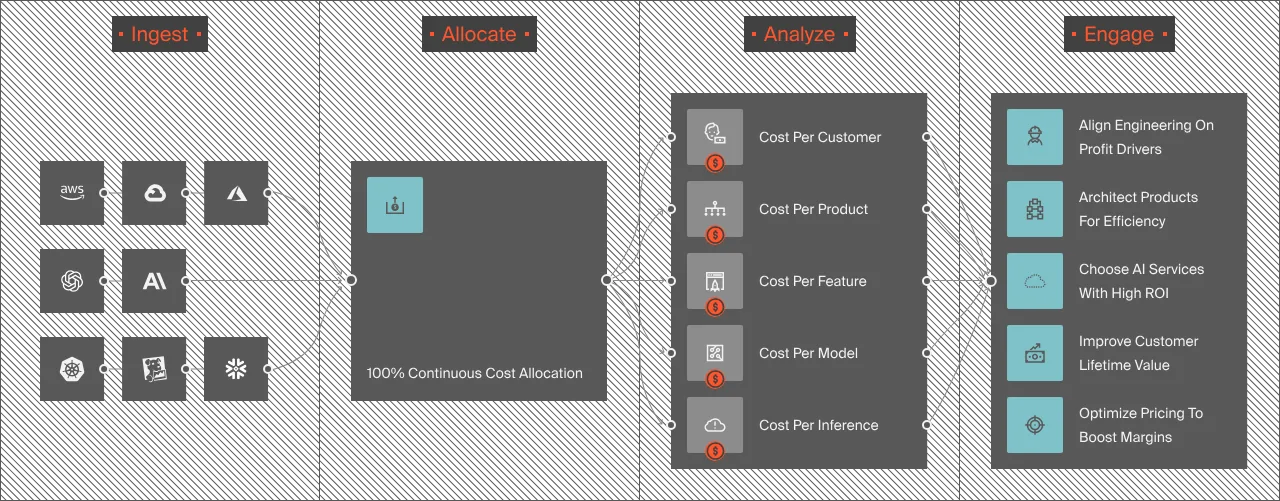
CloudZero is the first cloud cost platform to integrate directly with Anthropic’s Usage and Cost Admin API, pulling token consumption by model, workspace, and API key alongside AWS, Azure, GCP, OpenAI, Snowflake, Databricks, and any source through the AnyCost API. Every AI dollar, every cloud dollar, one dashboard.
Agent cost attribution
CloudZero’s patented CostFormation allocates 100% of Claude costs, even untagged workloads, to business dimensions: cost per developer, per team, per project, per feature. When your VP asks “what does our agent usage cost per sprint?” you have a real-time number.
Anomaly detection for token spikes
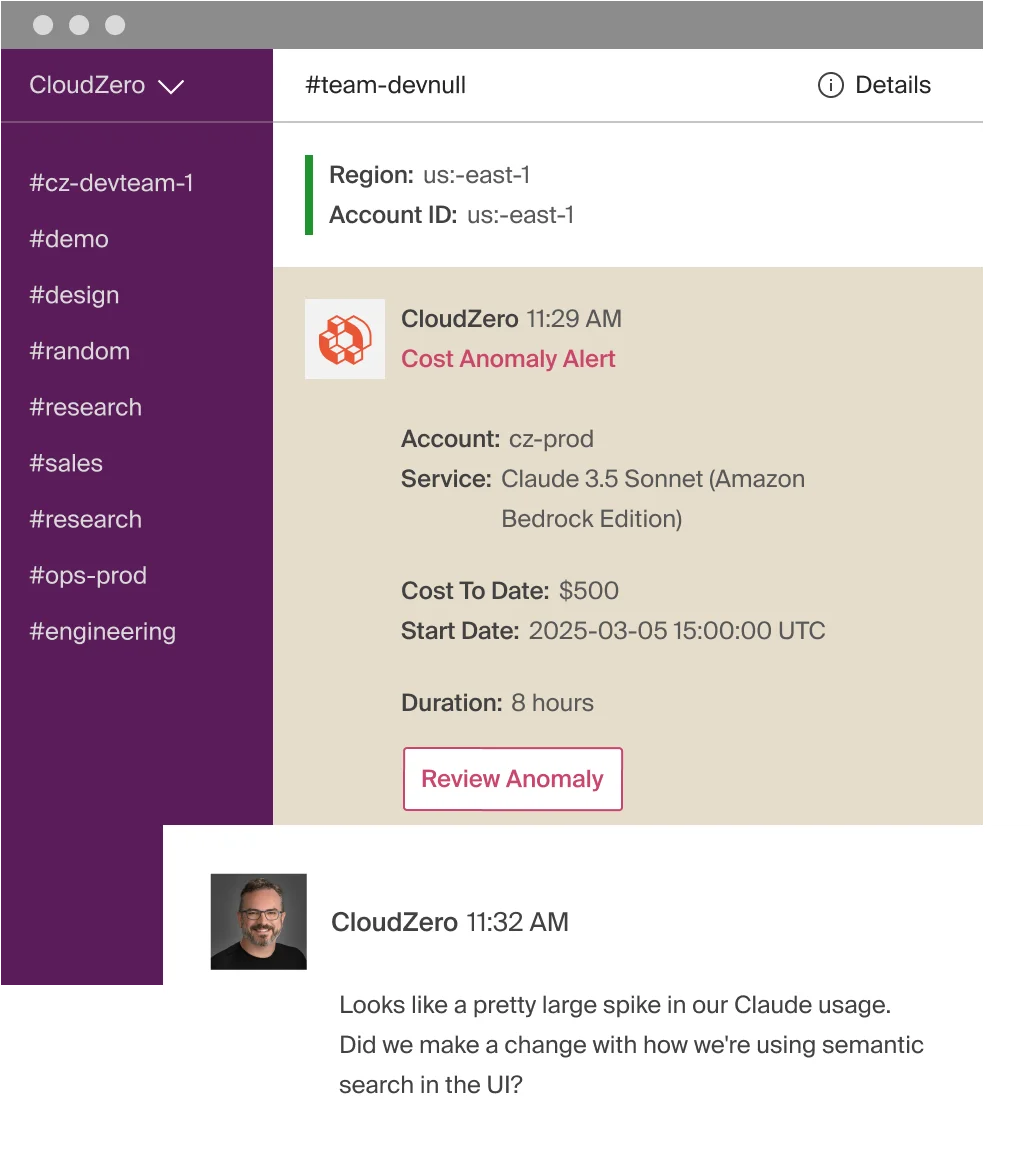
A developer who normally runs one session dispatches ten Opus agents for a migration. CloudZero’s AI-powered detection compares hourly spend against 12 months of patterns and alerts the owning team in Slack before the cost becomes a month-end surprise. One customer running 50+ LLMs saved over $1 million by catching these patterns early.
Cost data inside Claude Code
CloudZero’s MCP Server lets engineers query cost data directly from their terminal. “What did my team spend on agents this week?”, answered without leaving the workflow. Cost visibility where spending happens, not in a dashboard nobody checks.
If you want to know how much your Claude Code agents, from a single background session to a 50-developer fleet, are actually consuming,  to see how CloudZero can help. If you’re an Anthropic user more broadly and want visibility into your Claude costs, connecting to CloudZero only takes minutes. You can also take a free cloud cost assessment to see where your cloud and AI spend currently stand. You’ll be in good company, too, CloudZero manages over $15 billion in cloud and AI costs across ambitious brands like Toyota, Skyscanner, PicPay, Duolingo, Grammarly, and other leading organizations.
Frequently Asked Questions About Claude Code Agents