Cloud cost management is one of the most critical disciplines in modern cloud computing — and one of the most misunderstood. Organizations are spending more on cloud than ever, yet most still cannot accurately answer a basic question: is the spend worth it?
Global public cloud spending is projected to surpass $1 trillion in 2026, according to a Forrester forecast.
Despite that scale, approximately one-third of organizations report an accurate understanding of where their cloud budget is going, according to CloudZero’s State of Cloud Cost Intelligence Report. The rest are flying blind, approving invoices without knowing which teams, products, or features are driving them.
This guide covers what cloud cost management actually means, how it differs from cloud cost optimization, the main components and strategies that make it work, and how CloudZero approaches the problem differently from traditional cost tools.
What Is Cloud Cost Management?
Cloud cost management is the practice of tracking, allocating, and optimizing cloud expenditures so that every dollar of infrastructure spend can be tied to a business outcome.
At CloudZero, we define cloud cost management as the foundation of a working FinOps practice — the capability that makes it possible to answer not just what you’re spending, but who is spending it, why it’s changing, and whether it was worth it. Without that foundation, cloud cost optimization is guesswork.
Cloud cost management encompasses cost visibility, allocation, forecasting, anomaly detection, and unit economics. It applies across all cloud providers — AWS, Azure, GCP, and beyond — and extends into the AI and Kubernetes workloads that increasingly dominate cloud bills.
2026 State of AI Spend Report
Why Finance Caps What It Can’t See
Learn how finance leaders are managing AI spend, and how they’re approaching FY2027
Cloud Cost Management Vs Cloud Cost Optimization
These terms are often used interchangeably. They shouldn’t be.
Cloud cost management is the visibility and governance layer. It tells you what you’re spending and where it’s going.
Cloud cost optimization is the action layer — what you do with that information to reduce waste, rightsize resources, and improve efficiency.
The distinction matters because many teams skip directly to optimization tactics without the management foundation in place. They rightsize instances they can’t fully attribute. They set budgets against costs they can’t explain. Then they’re surprised when the bill keeps climbing.
CloudZero’s framework treats management and optimization as sequential, not interchangeable: you cannot meaningfully optimize what you cannot accurately see.
Learn more about the relationship between the two in our guide to cloud cost optimization strategies.
Why Cloud Cost Management Is Harder Than It Looks
Cloud billing was already complex before AI workloads, multi-cloud architectures, and Kubernetes entered the picture. Now it’s an order of magnitude harder.
A few things that make managing cloud costs genuinely difficult in 2026:
- Fragmented spend across providers and services. Most mid-market and enterprise teams operate across at least two cloud providers. Each has its own billing logic, pricing model, and data format. Without a unified cost layer, you’re comparing apples to invoices.
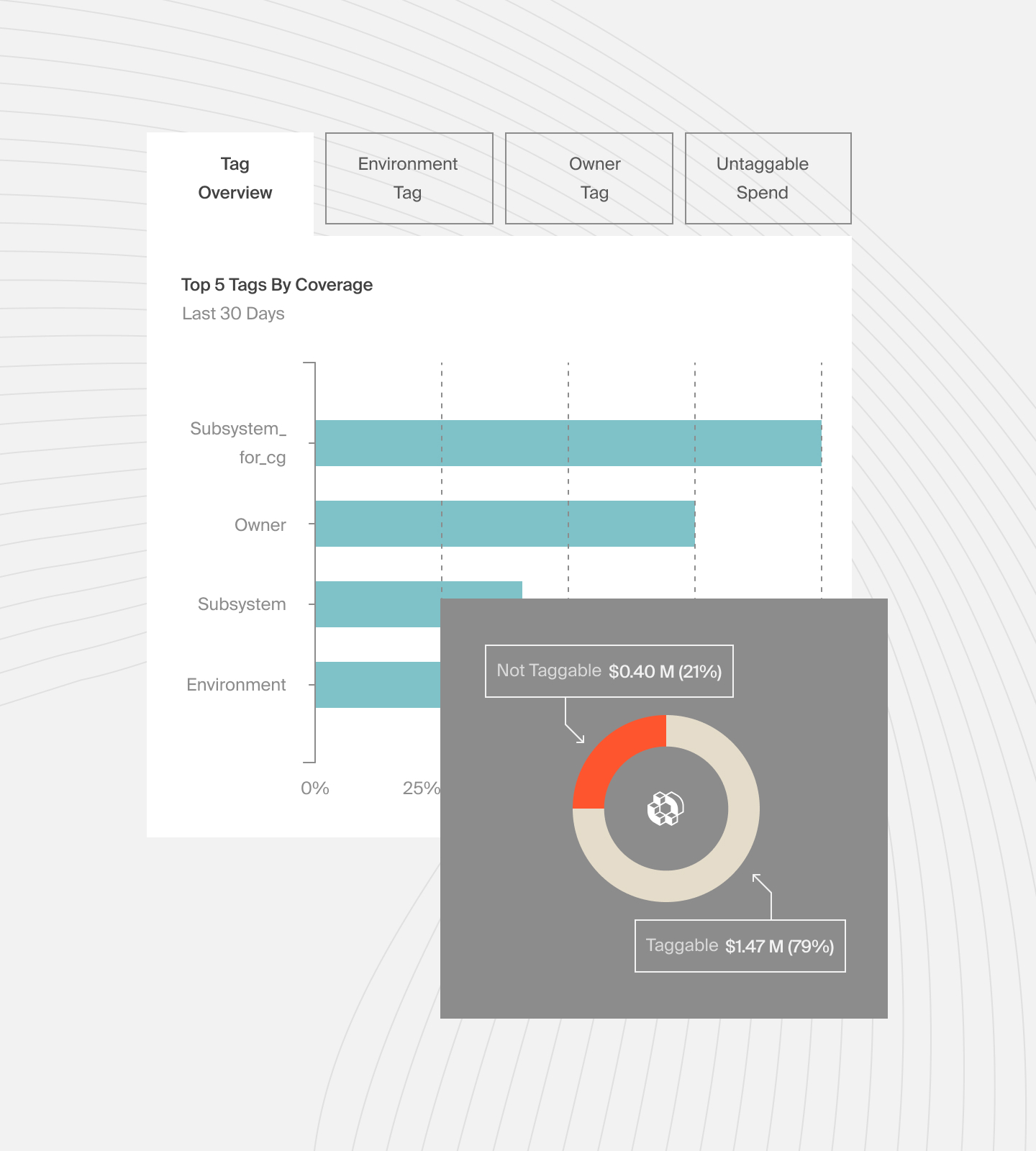
- Tagging gaps and untaggable resources. Tagging is the conventional approach to cost attribution, but it breaks down fast. Kubernetes workloads, shared services, and data transfer fees often cannot be tagged at all. CloudZero analysis shows that the average engineering team has a significant percentage of untaggable spend that conventional tools simply ignore or lump into an “other” bucket.
- AI spend embedded in compute. CloudZero’s Cloud Economics Pulse puts explicitly attributed AI/ML line items at 2.67% of total cloud bills — a figure the report itself describes as a floor, noting that the majority of AI spend remains embedded in compute, storage, and database costs and is not captured in this metric. Meanwhile, CloudZero’s FinOps in the AI Era: A Critical Recalibration report found that 40% of surveyed companies now spend more than $10 million a year on AI. That gap is not because AI is cheap. It is because most AI spend hides inside compute, storage, and database line items that standard tools never connect back to AI workloads.
- The visibility-accountability gap. According to the FinOps Foundation’s State of FinOps 2025, 50% of practitioners rank waste reduction as their top priority, the same position it held the year before. Yet, CloudZero’s FinOps report found that formal cloud cost programs nearly doubled year over year, from 39% to 72% of organizations, while the mean Cloud Efficiency Rate (CER) dropped 15 points, from 80% to 65%. More programs, less efficiency. The culprit is a growing gap between having cost data and making it actionable.
This is the problem CloudZero is built to solve. See how CloudZero approaches FinOps.
Core Components Of Cloud Cost Management
Effective cloud cost management is not a single tool or dashboard. It is a set of interconnected capabilities. Here is how CloudZero defines the core components:
Cost visibility
You cannot manage what you cannot see. Cost visibility means having a real-time, unified view of cloud spend across all providers, services, accounts, and teams, broken down in a way that is meaningful to your business, not just a mirror of your cloud bill.
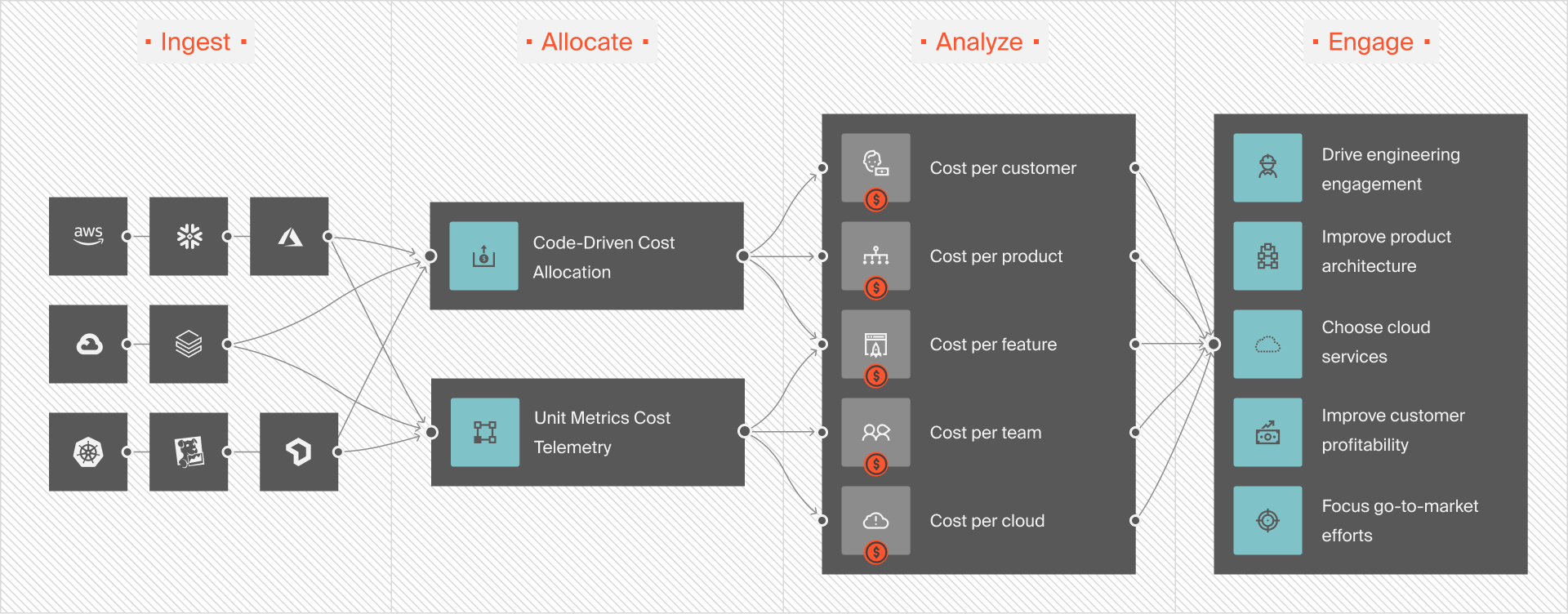
CloudZero delivers this by mapping raw billing data to business dimensions: cost per customer, per product, per feature, per team. Not just “EC2” and “S3,” but which product that EC2 is powering and which customer it is serving.
Cost allocation
Cost allocation is the process of assigning cloud spend to the teams, products, or business units responsible for it. Done well, it makes every team accountable for their own infrastructure costs and gives finance leaders a view of cloud spend they can act on.
There are two primary approaches: tagging and account separation. Both have limitations. CloudZero’s approach to cost allocation goes beyond both, using business mapping to attribute costs without requiring perfect tags, including spend from Kubernetes, shared infrastructure, and AI workloads that traditional methods miss.
Forecasting and budgeting
Accurate forecasting demands more than extrapolating last month’s bill. You need to know why costs moved, which teams are growing, which workloads are scaling, which AI experiments are on the meter. Aggregate spend data tells you what happened. Unit costs tell you why, and what comes next.
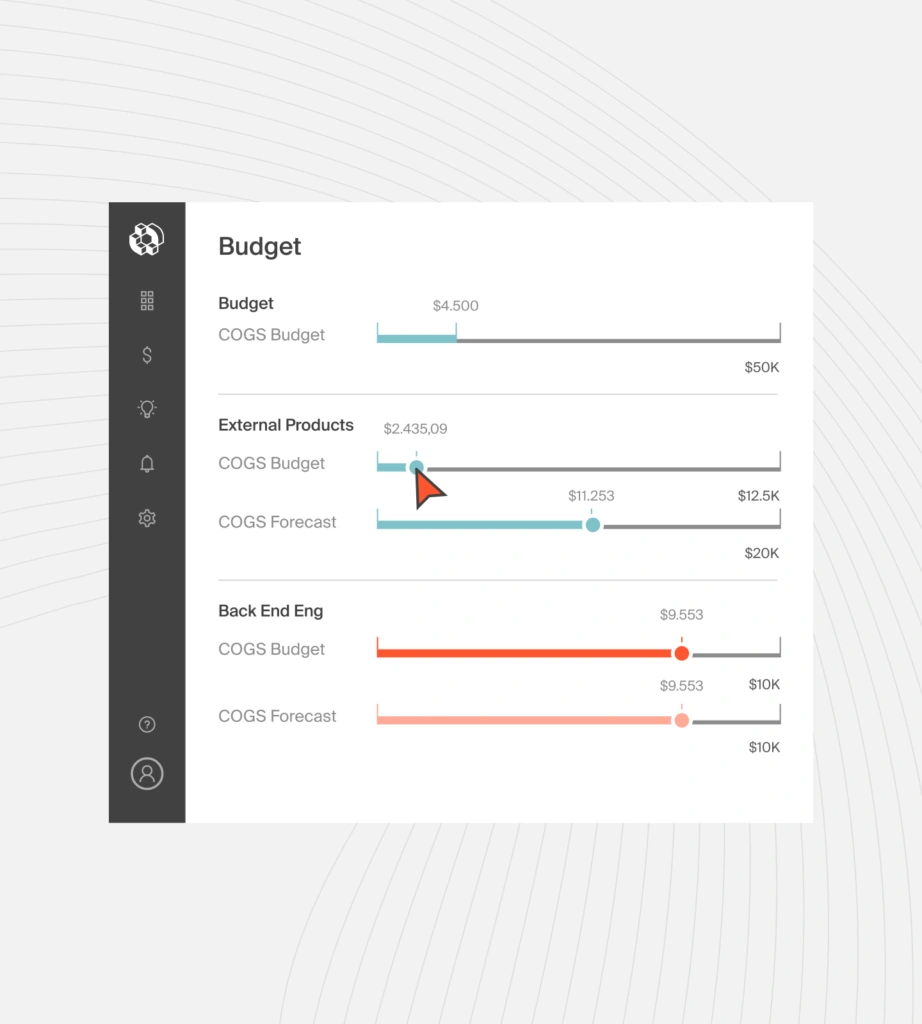
CloudZero Budgets
Anomaly detection
Cloud costs change fast. A misconfigured deployment, an unexpected traffic spike, or a new AI experiment running in the wrong environment can drive thousands of dollars in unexpected spend within hours. By the time it shows up on a monthly invoice, the damage is done.
Effective anomaly detection surfaces cost spikes in real time and, more importantly, explains them.
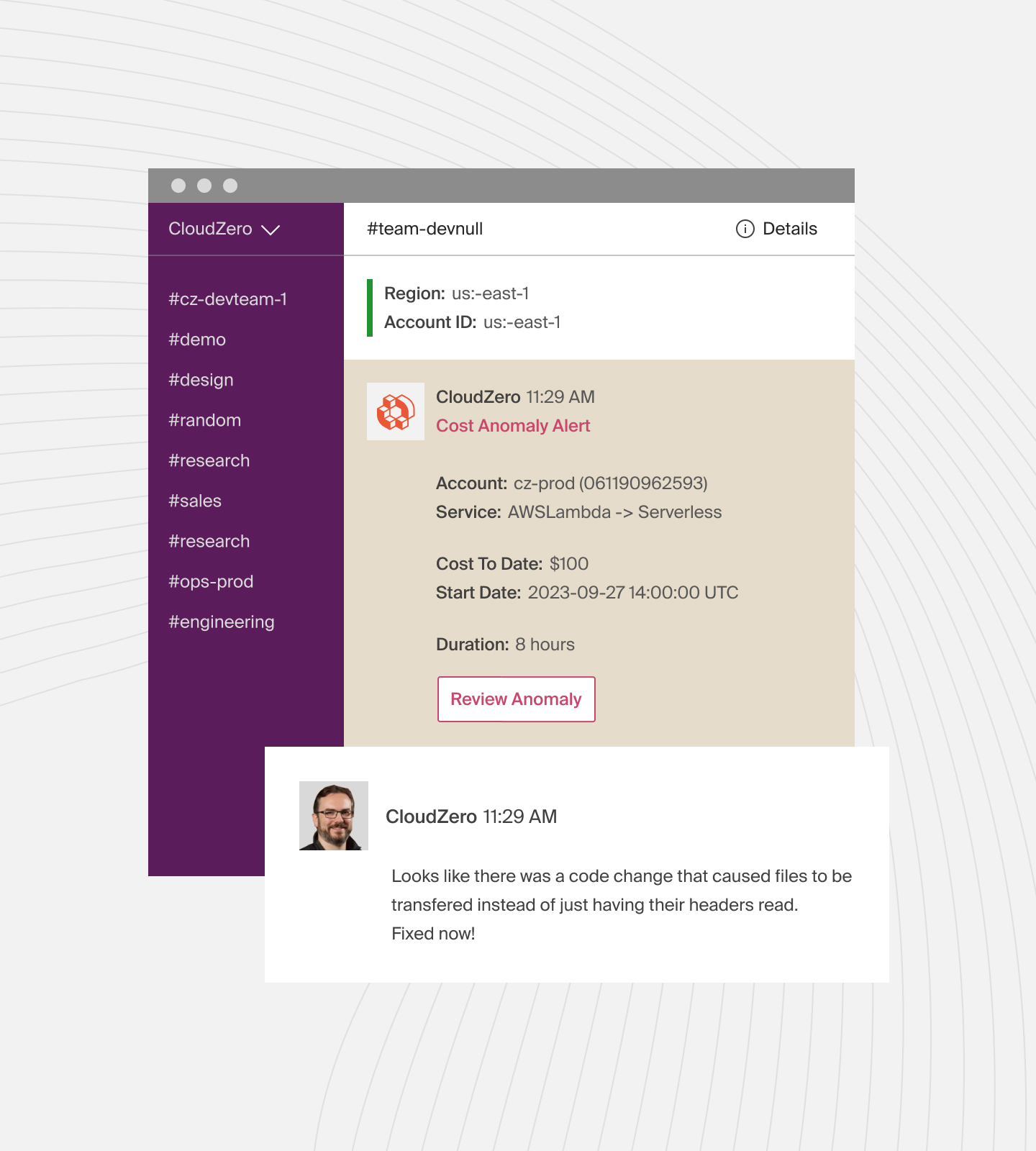
CloudZero anomaly detection has internally identified more than $20 billion in anomalous spend across its customer base including Grammarly, Moody’s, Coinbase and more.
Unit economics
Unit economics is how CloudZero defines the most advanced layer of cloud cost management: connecting infrastructure spend to business value. Cost per customer. Cost per transaction. Cost per API call. Cost per inference.
CloudZero defines unit economics as the answer to the question every CFO and VP of Engineering eventually asks: Was it worth it?
You can’t answer that question with a cloud bill. You can answer it with a cost per unit tied to revenue. See how unit economics works.
Cloud Cost Management Strategies And Best Practices
Managing cloud costs well comes down to six things done consistently. These are the strategies and practices that separate teams with mature cloud cost management from teams that are perpetually surprised by their bills.
1. Unify your cost data before doing anything else
Today’s cloud environments generate cost data across infrastructure, AI APIs, SaaS platforms, data pipelines, and observability tools — each with its own billing format and attribution logic.
When those streams stay siloed, every strategy downstream breaks down.
CloudZero recommends normalizing cost data across providers and services as the first move, before rightsizing, before forecasting, before optimization. This is the foundation. Without it, you’re optimizing against an incomplete picture.
2. Define cost ownership at the workload level
Every workload should have an owner, a team, a product, or a cost center, responsible for its spend. Without clear ownership, accountability diffuses and waste accumulates silently.
The fastest path to ownership is showback: showing teams what they spent without billing them. It creates cost awareness without organizational friction. Chargeback, actually transferring costs to team budgets, comes later, once teams have visibility and can act on it. Jumping straight to chargeback without showback first tends to create defensiveness rather than accountability.
More on showback vs. chargeback.
3. Manage to unit costs, not just totals
Aggregate cloud spend is a lagging indicator. Unit costs are leading indicators that connect infrastructure decisions to business outcomes.
CloudZero defines this as the difference between managing cloud costs and understanding them. A team that knows their cost per customer grew 12% last quarter while revenue per customer grew 8% has a specific, actionable problem. A team staring at a $400K monthly bill does not know where to start. Tag early and establish a consistent taxonomy, but know that tagging alone will not get you to unit economics.
CloudZero’s business mapping layer attributes costs to business dimensions even where tags are missing, inconsistent, or impossible (e.g., Kubernetes shared infrastructure).
See how to calculate cost per customer.
4. Put cost data where engineers actually work
Cost awareness that lives only in a FinOps dashboard engineers never open does not change behavior. It has to surface where engineering decisions are made, deployment pipelines, Slack alerts, sprint reviews.
CloudZero’s Engineering-Led Optimization (ELO) model puts real-time cost data in engineers’ hands in their own language: cost per deployment, cost per service, cost per environment.
When engineers can see the cost impact of their decisions as they make them, waste goes down without a centralized team hunting for it. CloudZero reports that teams with engineering-accessible cost data reduce idle spend faster and with less central oversight than teams relying on finance-side reviews alone.
5. Apply FinOps specifically to AI spend
AI workloads do not behave like traditional cloud infrastructure and standard cost management approaches do not fit them. Training costs are episodic. Inference costs scale with usage in ways that are hard to forecast. Most AI spend is buried in general compute and storage line items, invisible to standard attribution.
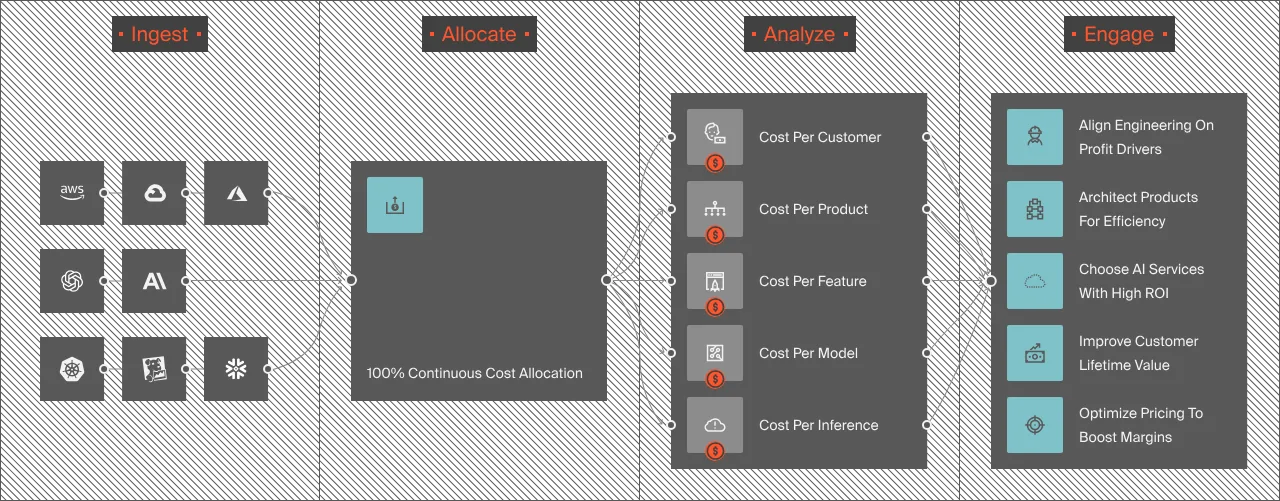
CloudZero’s approach to FinOps for AI applies the same unit economics model to AI infrastructure, tracking cost per inference, cost per model version, and cost per AI feature, making AI spend visible and attributable before it becomes unmanageable.
Useful resources: 32 Best FinOps Tools For 2026: Features And Comparison
6. Automate governance, not just monitoring
Monitoring costs is table stakes. Governing them automatically is what scales. Auto-shutdown policies for non-production environments, tagging enforcement at resource creation, and anomaly-triggered alerts routed directly to the responsible team, these turn cloud cost management from a reactive cleanup exercise into a continuous, embedded practice.
CloudZero’s real-time anomaly detection surfaces unexpected cloud spend before it hits your bill, not by flagging that costs went up, but by explaining exactly which team, service, or workload caused it.
See FinOps best practices for governance in practice.
How To Build A Cloud Cost Management Framework
A cloud cost management framework is the operating model that connects cost data to business decisions on an ongoing basis. Most teams try to skip to the end, optimizing costs before they’ve built the infrastructure to do it reliably. CloudZero’s framework is deliberately sequential for that reason.
Step 1: Establish a single cost data layer. Before anything else, normalize spend data across all cloud providers, services, and accounts into one place. This is your cost spine. It doesn’t have to be perfect on day one, but it has to exist before any downstream work is reliable.
Step 2: Map costs to business dimensions. Raw billing data is not useful to engineers or finance leaders. Map it to the units that matter: teams, products, features, customers, environments. This is where CloudZero’s business mapping layer does what tagging alone cannot, attributing costs to business context even across Kubernetes, shared services, and AI workloads that cannot be tagged.
Step 3: Assign ownership and build accountability loops. Once costs are visible and attributed, assign owners. Start with showback, give teams visibility without billing them. Build the habit of cost review into engineering workflows before introducing chargeback.
Accountability without visibility creates friction; visibility without accountability creates dashboards nobody acts on.
Step 4: Run continuous optimization. With the first three steps in place, optimization becomes tractable. Rightsizing, commitment management, anomaly response, and unit economics review all work against a clean, attributed cost picture rather than a best-guess approximation.
This maps directly to the FinOps lifecycle — Inform, Optimize, Operate — as defined by the FinOps Foundation.
The difference is that CloudZero compresses the time between each phase by making cost data more granular, more real-time, and more tied to business context than native cloud billing tools allow. See how FinOps and CloudZero work together.
Related read: Best cloud cost management tools in 2026
How CloudZero Approaches Cloud Cost Management
CloudZero is built on a simple premise: the cloud bill is not the problem. Not knowing what’s behind it is. That’s why our platform is designed around business context first, not resource-level data that only makes sense to the person who built the infrastructure.
And here is something interesting: The companies that win on cloud cost management are not the ones that spend the least. They are the ones that understand their spend well enough to make confident decisions about pricing, about which features to invest in, and about which customers are actually profitable to serve. That understanding does not come from a dashboard. It comes from integrating cloud costs to the business metrics that drive them.
One example of that shift:
Symphony Talent had a cost management tool, a growing AWS bill, and no clear answer for why costs were climbing. After moving to CloudZero, they gained cost-per-client visibility for the first time and discovered they had been losing money on one client for years without knowing it.
That insight changed their next contract negotiation entirely. The company went on to cut AWS costs by 48%.
The cloud bill was not the problem. Not knowing what was behind it was.
That’s what CloudZero does: it connects your cloud spend to the business decisions that actually matter, which customers are expensive to serve, which features are not earning their infrastructure cost, and where your next dollar of cloud investment will generate the most return.
CloudZero manages more than $15 billion in cloud spend across leading global organizations, including Toyota, Duolingo, Skyscanner, PicPay, Wise, and more. If you’re ready to turn your cloud bill into a business advantage, take a free tour of CloudZero or  to get started. You can also start with a free cloud cost assessment to get a clear picture of where your spend is going and what it’s worth.
Cloud Cost Management FAQs