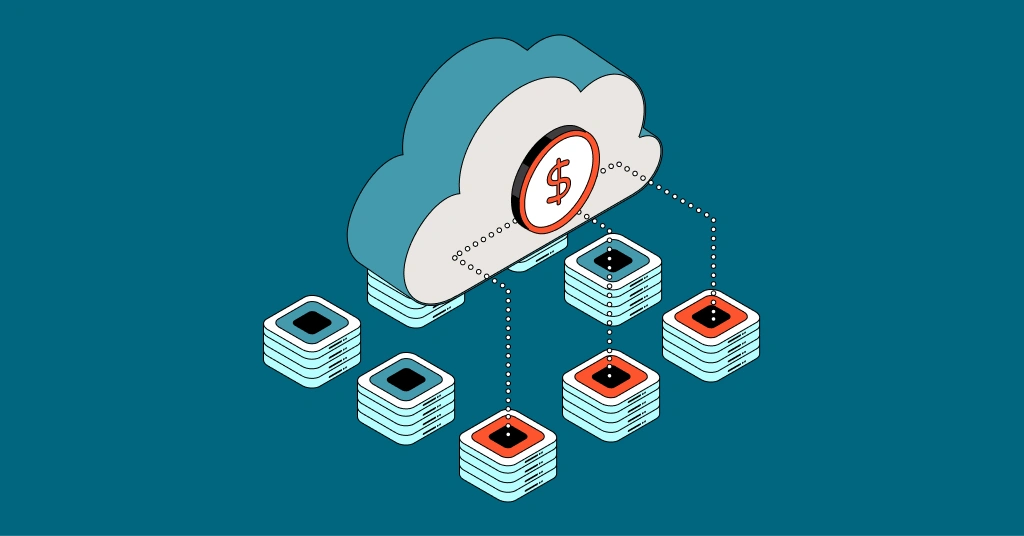

Cloud cost visibility is the ability to see, attribute, and understand cloud spending in real time — knowing not just what your cloud provider charges, but which team, product, feature, or customer drove that cost and why it changed. It is the foundation of FinOps: without it, cost allocation breaks down, governance is reactive, and optimization is guesswork.
Most organizations have basic visibility — a dashboard showing total spend by service or account. Complete visibility is harder to achieve, and far more valuable: 100% of spend attributed to a business owner, updated hourly, normalized across cloud providers and SaaS platforms into one model.
The global cloud market is projected to reach $1.19 trillion in 2026, according to Grand View Research. The organizations that will spend that money efficiently are the ones that solved visibility first.
What Is Cloud Cost Visibility?
Cloud cost visibility is the ability to see, attribute, and understand cloud spending in real time, at the granularity that drives business decisions.
Basic visibility means knowing what your cloud provider charges you. Complete visibility means knowing which team, product, feature, customer, or workload drove that cost, and why it changed.
Most cloud cost problems aren’t billing surprises. They’re attribution gaps. When costs rise and no one can explain who owns the change or what caused it, visibility has failed, even if a dashboard is showing numbers.
The FinOps Foundation defines cost visibility as foundational to FinOps maturity, the first phase of its Inform – Optimize – Operate lifecycle. Without it, nothing else in the practice works.
Maturity level | What you can see | Key gap |
Baseline | Total spend by service and account | No business attribution |
Partial | Cost by team or tag (~75% coverage) | Shared resources, Kubernetes, SaaS costs unattributed |
Advanced | Cost by product, environment, deployment | Data lags 24 hours; multi-cloud not unified |
Complete | 100% allocated, real-time, multi-source | Cost per customer, feature, and AI inference |
Free Guide
The Cloud Cost Playbook
From first visibility to optimized unit economics, step by step.
Why Cloud Cost Visibility Is Harder Than It Looks
Cloud billing data is abundant. Understanding it is not.
A single AWS Cost and Usage Report can contain thousands of line items across dozens of services, regions, accounts, and resource types. Without structured attribution and cloud cost allocation, this data is noise, not insight.
Several structural challenges compound the problem:
- Shared resources. Kubernetes clusters, data platforms, networking, and storage buckets are often shared across teams, products, and customers. Native billing tools allocate shared costs at the account or service level, not at the business-unit level where ownership lives.
- Tag gaps. According to CloudZero’s analysis, 87% of organizations use tagging as their primary allocation method — and on average allocate just 75% of cloud costs. Shared resources like S3 buckets and Kubernetes clusters can’t be tagged, creating persistent blind spots.
- Multi-cloud and SaaS fragmentation. Most organizations run costs across multiple cloud providers plus SaaS platforms such as Snowflake, Datadog, and MongoDB. Each has its own billing format, attribution logic, and update cadence. Without a unified data model, visibility is partial by design.
- Delayed data. Native cloud tools typically update daily. AWS Cost Explorer processes data once every 24 hours or more. A cost anomaly that begins at deployment may not be visible until the following day.
What Is Cloud Cost Allocation And How Does It Work?
Cloud cost allocation is the process of attributing every dollar of cloud spend to a specific owner — a team, product, feature, or customer — so raw billing data becomes actionable cost intelligence.
Without cloud cost allocation, visibility is limited to account-level or service-level totals. You can see total EC2 spend. You can’t see which product is driving it, which customer consumes the most infrastructure, or which deployment caused a spike.
Allocation operates on two levels:
- Direct allocation assigns costs based on resource-level data — instance IDs, service names, account structures, or tags. This works for dedicated resources. It breaks down for shared or untagged infrastructure.
- Proportional allocation distributes shared costs across owners based on usage ratios or telemetry data. This requires a cost intelligence layer beyond native billing tools.
The most mature allocation approaches, like CloudZero’s CostFormation, use a code-based model that defines cost organization the way Infrastructure as Code defines infrastructure.
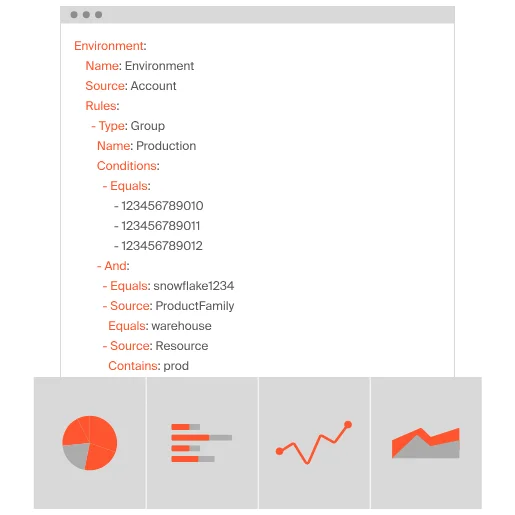
CloudZero’s code-driven cost allocation
This enables 100% cost allocation regardless of tag quality, including shared resources, multi-tenant architecture, and Kubernetes workloads.
What Is Cloud Cost Reporting?
Cloud cost reporting is how visibility becomes actionable for different stakeholders. Engineering, finance, and product teams need different views of the same cost data, structured around the questions each team needs to answer.
- For engineering teams: cost by service, deployment, feature, environment, and Kubernetes workload. Engineers need cost data in their language, tied to the infrastructure they own and the changes they make. See how Kubernetes cost management requires this kind of engineering-native reporting.
- For finance teams: cost by business unit, product line, customer segment, and COGS. Finance needs cloud costs mapped to budgeting, forecasting, and financial reporting categories. Showback and chargeback models depend on accurate, consistently structured reporting.
- For product and executive teams: cost per customer, cost per feature, gross margin by product. These are unit economics, the metrics that connect cloud spend to business outcomes.
Effective cloud cost reporting is real-time, attributed to business owners, not just services and accounts, and consistent across cloud providers and SaaS platforms.
What Is Cloud Cost Governance?
Cloud cost governance is the set of policies, processes, and controls that prevent cost problems before they appear, rather than reacting after the bill arrives.
Governance without visibility is impossible. You cannot enforce budgets you can’t track, alert on anomalies you can’t see, or hold teams accountable for costs they can’t attribute.
With visibility in place, governance operates at three levels:
- Budgets and alerts. Setting cost thresholds by team, product, or environment, and alerting owners when spend approaches or exceeds them. Effective alerts include business context: not just “EC2 costs spiked” but “EC2 costs in the payments service increased 34% since Tuesday’s deployment.”
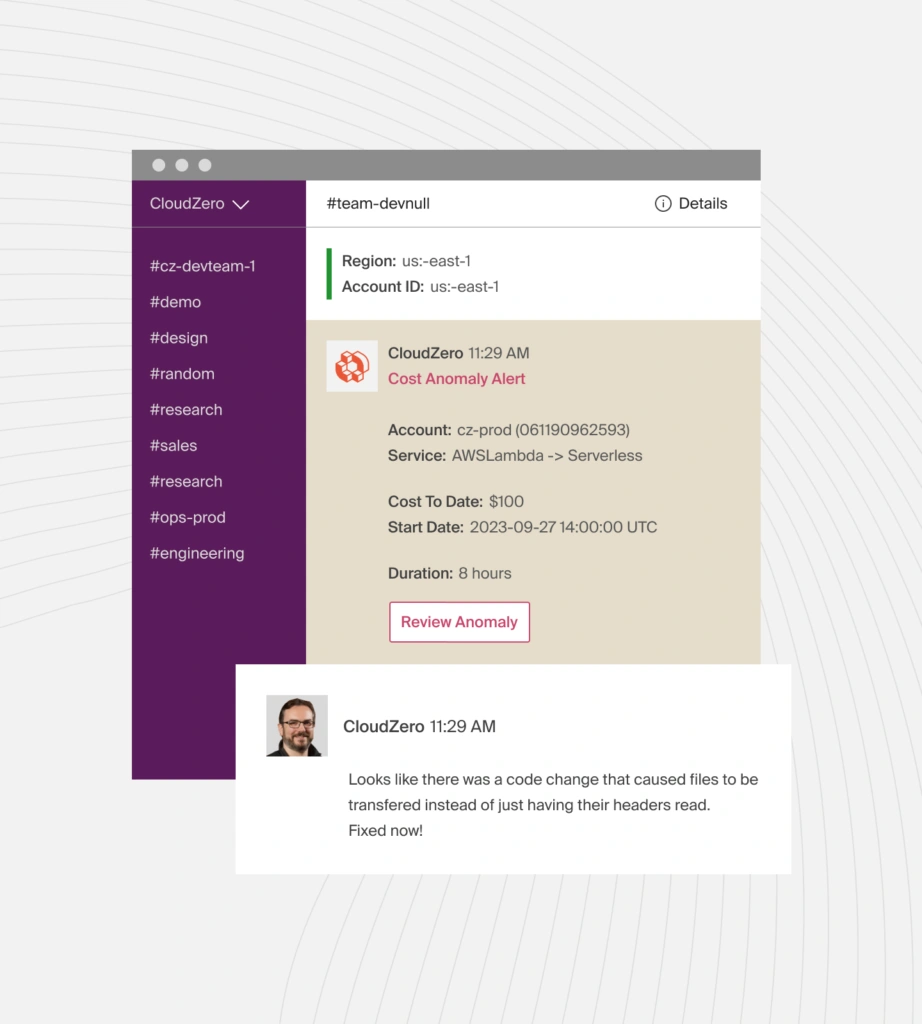
- Anomaly detection. Automated detection of unusual cost patterns, surfaced in real time with ownership routing. CloudZero’s AI-powered anomaly detection compares hourly spend against 12 months of historical data, setting normalcy thresholds without manual tuning and routing alerts to the engineers who own the affected resources.
- Showback and chargeback. Showback gives teams visibility into their cost burden without direct financial accountability. Chargeback takes it further, formally allocating costs back to business units and creating incentives for cost-conscious decisions.
How Does Cloud Cost Visibility Connect To Unit Economics?
Cloud cost visibility is the foundation. Unit economics is where it pays off.
Unit economics applies visibility and allocation to demand data, integrating cloud cost to business value. Cost per customer, feature, team, model or inference. These metrics answer not just what you’re spending, but whether you’re spending efficiently.
The cloud efficiency rate (CER) measures how much revenue a company retains after cloud costs — a CER of 92% or above is considered elite. CloudZero’s analysis of publicly traded customers shows a median CER of 95%, meaning the top-performing companies retain 95 cents of every revenue dollar after cloud spend.
Reaching it demands allocation accurate enough to attribute costs to individual customers and products. It also requires reporting structured for both engineers and finance, and governance in place to catch inefficiencies before they compound.
To learn more on how AI workloads change the visibility problem, especially for token-level spend attribution, see CloudZero’s guide to FinOps for AI.
How To Improve Cloud Cost Visibility: Where To Start
Start with these four steps:
- Audit your current allocation coverage. What percentage of your cloud spend is currently attributed to a business owner? Below 80% is the first priority. See FinOps best practices for a structured starting framework.
- Map your shared cost problem. Identify which resources are shared across teams or customers. This is where most allocation models break, and where the most significant visibility gaps live.
- Standardize your reporting structure. Define the cost dimensions that matter to your business: by team, product, environment, customer. Build your allocation model around those dimensions, not your tag structure.
- Move to real-time data. Daily cost data is insufficient for engineering accountability. If your team makes deployment decisions without knowing their cost impact until the next day, optimization is reactive by design.
- Integrate cost to business metrics. Once allocation is reliable, layer in demand data. Calculate cost per customer, transaction, product or feature. This transforms visibility from a finance exercise into a strategic capability, the foundation for everything in CloudZero’s cloud cost optimization strategies guide.
What Complete Cloud Cost Visibility Looks Like
Complete visibility has four defining characteristics:
- It is real-time, cost data updates hourly, not daily, so a spike is visible within the hour it begins. It is 100% allocated, every dollar is attributed to an owner, with no unallocated bucket.
- It is business-contextualized — costs appear in the language of each stakeholder, whether by team, product, or customer.
- It is multi-source — IaaS, PaaS, SaaS, and AI spend are normalized into one data model, with no separate dashboards to reconcile.
CloudZero’s AnyCost ingests spend across AWS, GCP, Azure, Snowflake, Datadog, OpenAI, and more into a single normalized model.
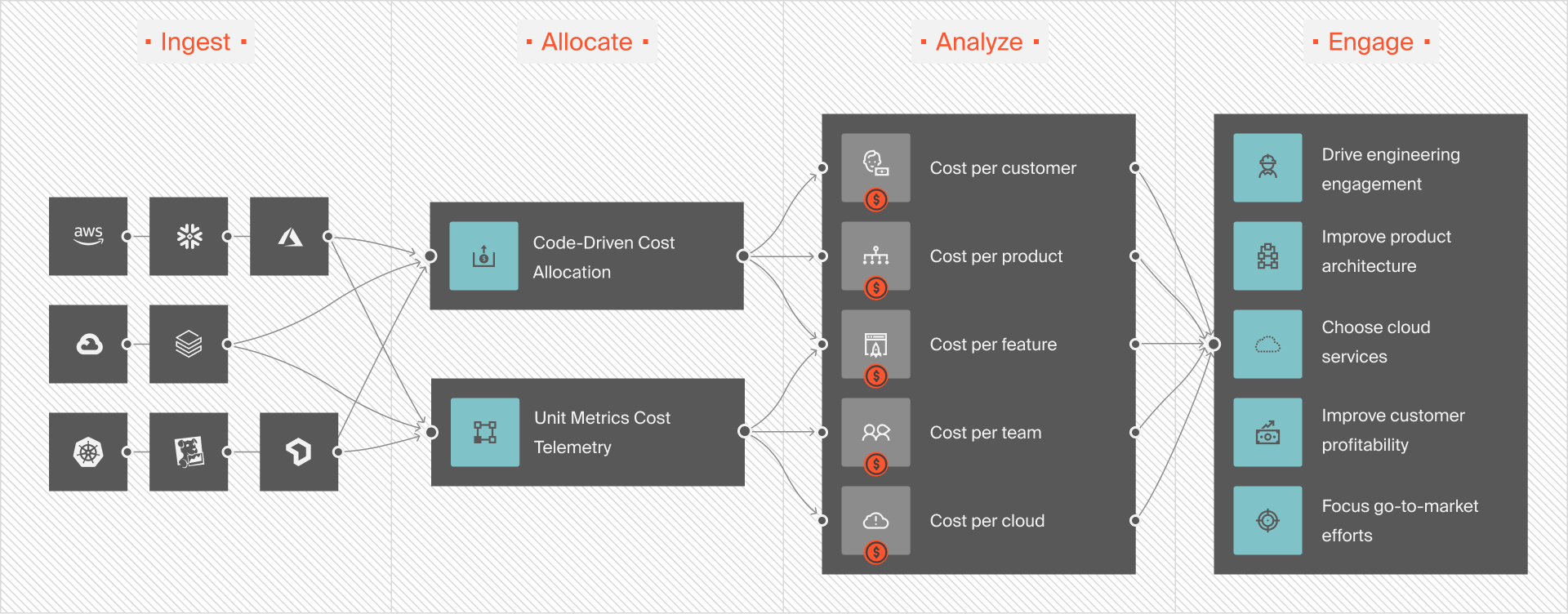
Combined with CostFormation’s code-based allocation, engineering and finance teams share the same trusted cost data, without requiring perfect tags or manual reconciliation.
If your organization is still asking “why did costs go up?” instead of knowing the answer before the question is asked, get a free cloud cost assessment. CloudZero’s FinOps experts will map your current visibility gaps and show you exactly where attribution is breaking down. When you’re ready to see the platform in action,  .
.
Cloud Cost Visibility FAQs
Free Guide
The Cloud Cost Playbook
From first visibility to optimized unit economics, step by step.

The Cloud Cost Playbook
The step-by-step guide to cost maturity