
Quick answer: Multi-cloud cost optimization is the practice of gaining unified visibility into — and actively managing — cloud spend across two or more providers. It requires normalizing billing data across AWS, Azure, and GCP; building a consistent tagging strategy; managing commitment programs independently per provider; rightsizing workloads using provider-specific context; and connecting spend to business outcomes through unit cost metrics.
Multi-cloud cost optimization is harder than single-cloud, and the gap widens faster than most organizations expect.
At CloudZero, we define multi-cloud cost optimization as the practice of gaining unified visibility into, and actively managing, cloud spend across two or more providers, so that every dollar is attributable, every commitment is intentional, and every optimization decision is grounded in business context rather than raw billing data.
Most organizations today operate across multiple cloud providers. According to CloudZero’s 2026 FinOps in the AI Era report, 93% of organizations use a public cloud provider — with AWS at 76%, Azure at 62%, and GCP at 60%, numbers that only add up if many are running more than one. Each one bills differently, names things differently, and structures discounts differently.
The result is a cost management problem that provider-native tooling can’t solve on its own, and one that compounds as your footprint grows.
This guide lays out practical cloud cost optimization strategies and best practices for managing and optimizing cloud spend across AWS, Azure, and GCP, without losing visibility between providers.
Why Is Multi-Cloud Cost Management Harder Than Single-Cloud?
Multi-cloud cost management is structurally harder than single-cloud because each provider uses different billing formats, pricing models, and discount structures.
Each provider publishes billing data in different formats, with distinct pricing units, discount structures, and metadata, making it difficult to compare workloads or create a single source of truth.
AWS calls it a Cost and Usage Report (CUR). Azure exports to Cost Management. GCP uses billing export to BigQuery. None of them speak the same language by default.
That normalization problem isn’t just a technical inconvenience, it has direct financial consequences.
AWS | Azure | GCP | |
Billing export format | Cost & Usage Report (CUR) | Cost Management export | BigQuery billing export |
Discount program | Reserved Instances / Savings Plans | Azure Reservations | Committed Use Discounts (CUDs) |
Discount scope | Account / org level | Subscription level | Project level |
Native rightsizing tool | Compute Optimizer | Azure Advisor | GCP Recommender |
Tagging enforcement | AWS Config / Tag Policies | Azure Policy | Organization Policy / Labels |
According to CloudZero’s 2025 State of Cloud Cost Intelligence report, only 30% of organizations know exactly where their cloud budget is going. The rest are working from an incomplete picture, which means optimization efforts are incomplete too.
Data egress compounds this further. Moving data between providers, or between regions within the same provider, generates costs that are easy to overlook and hard to attribute. According to Gartner’s September 2023 report on data egress, egress fees can account for 10–15% of total cloud costs, and more for data-heavy workloads.
Understanding why it’s structurally harder is step one. Building the foundation that makes it manageable — unified visibility — is step two.
How do you achieve unified visibility across cloud providers?
Unified visibility — a single normalized view of spend across all providers — is the prerequisite for every other multi-cloud cost optimization tactic.
Before any optimization tactic, you need a normalized view of spend across all providers in one place. That means pulling AWS CUR data, Azure Cost Management exports, and GCP billing exports into a single cost layer, and mapping them to consistent dimensions: team, product, environment, service.
The FinOps Foundation’s FOCUS specification exists specifically to address this. FOCUS’s primary goal is to help standardize how providers format billing data, so organizations can compare costs across multiple platforms without building custom integrations for each one.
It’s the closest thing to a shared billing language for multi-cloud environments, and adoption is accelerating. Without it, every downstream initiative — rightsizing, commitment management, anomaly detection — operates on partial data. You end up optimizing slices instead of the whole.
Once you have a unified cost view, the next challenge is making that data meaningful. That’s where tagging comes in.
How do you build a cross-provider tagging strategy?
A cross-provider tagging strategy — one that enforces consistent dimensions like team, product, environment, and cost center across AWS, Azure, and GCP — is the foundation of multi-cloud cost attribution.
A cross-provider tagging strategy needs to define which tags are mandatory, who owns enforcement, and how untagged resources are handled. Common dimensions to standardize across all providers include team or squad, product or service, environment (prod/staging/dev), and cost center.
Tagging and ownership frameworks improve cost traceability by an average of 45%. That’s the difference between a bill you can explain and one you can only guess at.
Automation matters here, manual tagging doesn’t scale. Set policies that auto-tag resources at provisioning, and treat untagged spend as a governance failure, not a rounding error. If you’re running Kubernetes across providers, container-level cost allocation requires additional tooling, since Kubernetes abstracts away the underlying cloud resources entirely.
One important caveat: even a robust tagging strategy has limits. Tags can’t capture costs for untaggable resources, shared infrastructure, or containerized workloads running across namespaces. That’s where code-driven cost allocation, which uses infrastructure and application metadata rather than relying solely on tag coverage, picks up where tagging leaves off.
With allocation sorted, the next lever for reducing your effective spend rate is commitment management, and in a multi-cloud environment, that means treating each provider’s discount programs as separate workstreams.
How should you manage reserved instances and savings plans across multiple cloud providers?
In a multi-cloud environment, Reserved Instances (RIs), Savings Plans, and Committed Use Discounts (CUDs) must be managed independently per provider — they don’t interoperate. AWS Savings Plans are flexible across instance families but require baseline utilization commitments. Azure Reservations are scoped by subscription. GCP CUDs apply at the project level.
AWS savings plans are flexible across instance families but require baseline utilization commitments. Azure reservations are scoped by subscription. GCP CUDs apply at the project level. Buying commitments in one provider does nothing for spend in another.
The practical implication: track utilization rates per provider separately, set coverage targets per provider, and review commitment portfolios at minimum quarterly. Letting RI coverage drift in one provider while another is over-committed is a common, and entirely recoverable, source of waste.
Commitment management controls your rate. Rightsizing controls your consumption. Both are necessary, and in multi-cloud environments, rightsizing calls for provider-specific context to get right.
How do you rightsize workloads across AWS, Azure, and GCP?
Rightsizing means matching resource allocation to actual usage, but the right approach differs by provider. AWS cloud cost optimization tools like Compute Optimizer, Azure Advisor, and GCP Recommender all offer native rightsizing recommendations, and all three have improved significantly in recent years. Use them as a starting point, not a finish line.
The limitation of native tools is scope: they optimize within their own environment. They can’t tell you whether a workload belongs on a given provider at all, or whether it would run more cost-efficiently elsewhere. That demands cross-provider visibility these tools weren’t designed to deliver.
In multi-cloud environments, waste in one provider is often invisible to teams primarily working in another. Build rightsizing reviews into regular engineering cycles, not just when the bill spikes.
Rightsizing and commitment management reduce waste and lower your rate. But neither answers the more strategic question: is the spend delivering value? That requires integrating costs to business outcomes, which means unit economics.
How do you connect multi-cloud spend to business outcomes?
Cost allocation to teams is table stakes. What separates mature cost management from basic hygiene is connecting spend to business outcomes — product lines, features, customers, models, transactions.
CloudZero frames this as cost-per-everything: translating raw cloud spend into unit cost metrics — cost per customer, cost per API call, cost per order processed — that give engineering and finance teams a shared language for making decisions. Instead of asking “why did the bill go up?”, the question becomes “did the spend deliver value proportional to its cost?”
Only 43% of organizations track cloud costs at the unit level, meaning most still can’t translate their cloud bill into a number that means anything to a product manager or a CFO.
In a multi-cloud environment, unit cost calculations are harder because a single business transaction may touch infrastructure across multiple providers. That’s where showback and chargeback models become essential, but only if the underlying cost data is clean, normalized, and mapped to real business dimensions rather than just cloud accounts.
Unit economics give you the insight. Governance gives you the enforcement. Without a governance layer, even the best visibility and allocation work tends to drift.
What governance policies should you apply across cloud providers?
Visibility and allocation only drive optimization if there’s a governance layer that holds teams accountable. In multi-cloud environments, governance needs to be centralized even when infrastructure is distributed.
Centralized governance means a single set of policies, tagging requirements, commitment thresholds, rightsizing triggers, budget alerts — enforced consistently across providers rather than managed separately per cloud.
The FinOps Framework recommends enabling FinOps centrally while allowing engineering teams to own their optimization within guardrails. That model works in multi-cloud environments: a central function sets cross-cloud standards and tracks shared KPIs, while individual teams own execution in their provider environments. The result is cloud resource management that scales with your organization instead of lagging behind it.
Getting governance right is the operational layer. The platform layer, the tooling that makes governance enforceable and visibility actionable across providers, is where CloudZero comes in.
Research Report
FinOps In The AI Era: A Critical Recalibration
What 475 executives told us about AI and cloud efficiency.
Frequently Asked Questions About Multi-Cloud Cost Optimization
How does CloudZero approach multi-cloud cost management?
Most multi-cloud cost management tools are built for single-provider visibility, or they aggregate multi-cloud data at a surface level without integrating it to business context. That’s the gap CloudZero is built to close.
CloudZero aggregates cost data across AWS, Azure, GCP, Kubernetes, Snowflake, Datadog, and more into a single platform, without requiring a perfect tagging strategy to get there. Its code-driven allocation approach captures costs for tagged, untagged, and untaggable resources alike, mapping spend to the dimensions that matter most: cost per customer, product, feature, team, cloud or per AI inference.
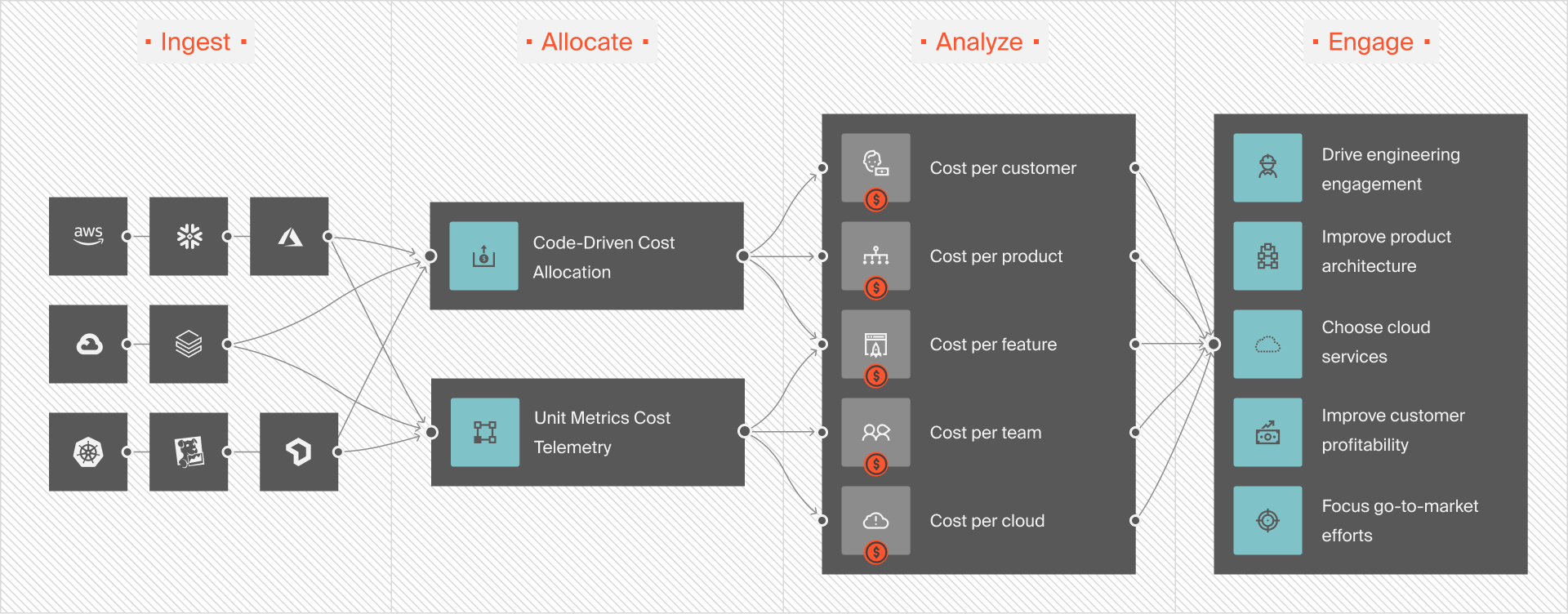
For engineering and finance teams operating across providers, that means a single source of truth. For FinOps practitioners, it means unit cost metrics that make optimization decisions defensible, not just directionally correct.
Remitly increased cloud cost allocation by more than 50% using CloudZero, without additional manual tagging. Malwarebytes saves 6–10 hours per week on cost allocation. Drift reduced cloud costs by over $2.4 million — the result of having accurate, business-contextualized cost data across a complex, multi-provider environment.
The core question in multi-cloud cost management isn’t just “where is the spend?” It’s “was it worth it?” CloudZero is built to answer both.
Your multi-cloud bill is growing. The providers aren’t going to make it easier to understand, but CloudZero will.  and see exactly where your spend is going across multiple cloud providers, Kubernetes, Snowflake, Datadog, Databricks, and more. Not ready for a demo? Start with a free assessmentor take a self-guided product tour first.


FinOps In The AI Era: A Critical Recalibration
What 475 executives told us about AI and cloud efficiency.