In 2025, Oracle shocked the market.
Its cloud growth was so aggressive that Oracle’s stock surged, briefly making founder Larry Ellison the world’s richest person.
That didn’t happen by accident.
Oracle closed fiscal 2025 with $57.4 billion in revenue, mainly driven by cloud services.
Oracle Cloud Infrastructure (OCI) grew roughly 50% year over year, driven by enterprise databases, AI workloads, and network-intensive applications migrating from more expensive platforms.
Despite holding a smaller share of the cloud market than AWS and Azure, Oracle is now one of the fastest-growing hyperscale cloud providers. Enterprises aren’t adopting OCI for brand loyalty. They’re adopting it because its pricing model is different.
And that difference matters.
Oracle Cloud doesn’t price the way AWS or Azure does. Compute scales differently. Network egress follows different rules. Database costs are structured around licenses, not just usage.
For some workloads, OCI delivers major cost advantages.
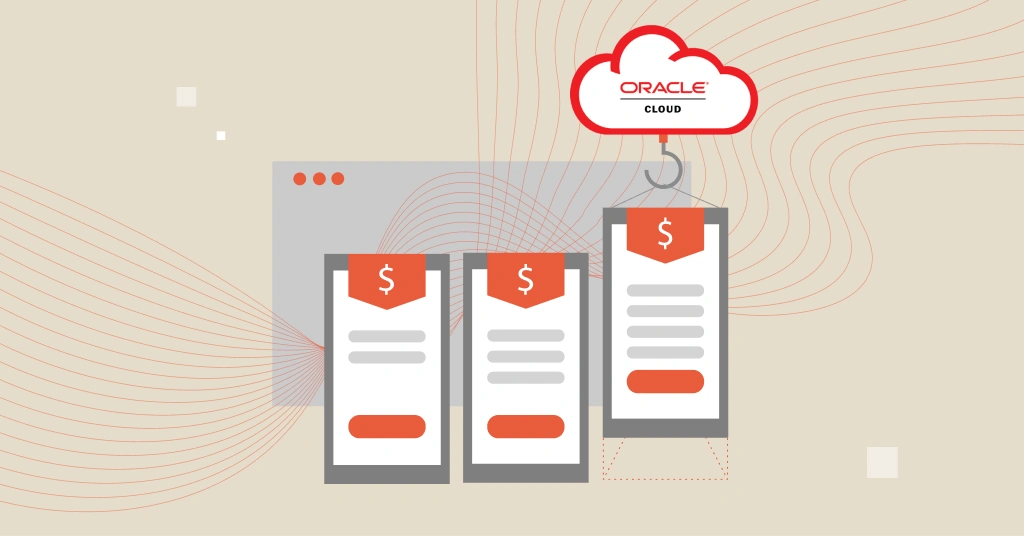
This guide breaks down Oracle Cloud Infrastructure (OCI) pricing at the model level — including how OCPUs, memory, storage, networking, database licensing, and committed spend are actually priced, how those costs scale in real environments, and where OCI’s pricing mechanics differ materially from AWS and Azure.
How Oracle Cloud Pricing Works
Oracle Cloud Infrastructure (OCI) pricing is based on consumption. You pay for the infrastructure resources you provision and run, measured in units such as OCPU hours, memory GB-hours, storage GB-months, and network port hours.
Oracle Cloud pricing models
Primary Oracle Cloud cost drivers include:
- Compute usage measured in OCPU hours and memory GB-hours
- Storage consumption across block, object, file, and archive tiers
- Network egress and connectivity services
- Database deployment model and license approach (license-included vs BYOL)
- Committed spend through Universal Credits
Oracle offers several pricing models:
Pay-As-You-Go (PAYGO)
You pay standard rates for the resources you use, with no long-term commitment. Charges accrue based on actual consumption, such as OCPU hours, storage used, and network traffic.
This model offers maximum flexibility, though it does not include committed-spend discounts.
Pay-As-You-Go is typically used for short-lived, variable, or experimental workloads, but is more expensive than Universal Credits for steady-state production usage.
Universal credits (committed spend)
You commit to spending a fixed amount on Oracle Cloud over a set term in exchange for discounted rates. These credits can be used across most OCI services.
Credits are flexible across workloads but expire at the end of the commitment period if unused.
Universal Credits are Oracle’s primary discount mechanism and apply across most OCI services, rather than being tied to specific instance families or service types.
Volume discounts
As usage increases, Oracle applies lower effective rates to some services. These discounts are reflected automatically based on consumption levels or contract terms.
They reward steady, large-scale usage rather than short bursts.
Bring Your Own License (BYOL)
For eligible services, you can apply existing Oracle software licenses to reduce cloud costs. Infrastructure is billed separately from the license.
This model can lower total spend for organizations with existing entitlements.
Always Free Resources
Oracle offers a set of services that remain free within defined limits, including limited compute, storage, and networking resources.
These services are intended for development, testing, and small workloads, not production-scale systems.
Report
Finance needs to prove AI’s return: CloudZero report
260 senior finance leaders (more than half CFOs) told us why the speed of seeing AI spend, not the size of it, separates who pulls ahead on AI from who gets burned.
Oracle Cloud Infrastructure Service Pricing
Each Oracle cloud service has its own billing units, rates, and cost drivers. Your total cloud bill is the sum of how these services are provisioned and consumed.
Oracle Cloud compute pricing
Compute pricing is based on OCPUs and memory and is billed per hour.
OCI compute pricing separates CPU and memory, allowing teams to size each independently instead of purchasing fixed instance bundles.
One OCPU represents one physical CPU core, which maps to two vCPUs on x86 processors. CPU and memory are priced separately on most flexible VM shapes.
List pricing for standard x86 virtual machines is $0.0255 per OCPU hour, with memory priced at $0.0015 per GB hour.
Example: A VM with 1 OCPU and 8 GB of RAM will cost $0.0375 per hour at list rates.
OCPU: 1 × $0.0255 = $0.0255/hour
Memory: 8 × $0.0015 = $0.0120/hour
Total: $0.0375 per hour
This pricing structure is often more cost-efficient for memory-heavy or database-driven workloads than bundled instance pricing models.
Oracle offers flexible virtual machines, bare metal instances, Arm-based Ampere shapes, and GPU configurations. Eligible Ampere A1 Arm instances are included in the Always Free tier, which provides up to 3,000 OCPU hours and 18,000 GB memory hours per month.
Note: Compute pricing is consistent across all Oracle Cloud regions.
Oracle Cloud storage pricing
OCI provides several options for cloud storage:
|
Storage type |
What is used for |
Pricing |
|
Block volumes |
Persistent block storage for databases, file systems, and low-latency workloads attached to compute instances |
0.0255 per GB-month (performance scales via VPUs) |
|
Object storage (standard) |
Frequently accessed unstructured data, such as backups, logs, media, and analytics datasets |
0.0255 per GB-month |
|
Object storage (infrequent access) |
Data accessed less often, but still needs durability and availability |
$0.01 per GB-month (retrieval fees apply) |
|
Archive storage |
Long-term retention for rarely accessed data, such as compliance records and cold backups — typically used for compliance, long-term retention, and disaster recovery where speed is secondary to cost |
$0.0026 per GB-month (slower retrieval) |
|
File storage |
Shared file systems using NFS for applications requiring file-level access |
$0.30 per GB-month |
See the detailed Oracle Cloud storage pricing here.
Oracle Cloud networking pricing
OCI networking costs cover data transfer and traffic management services.
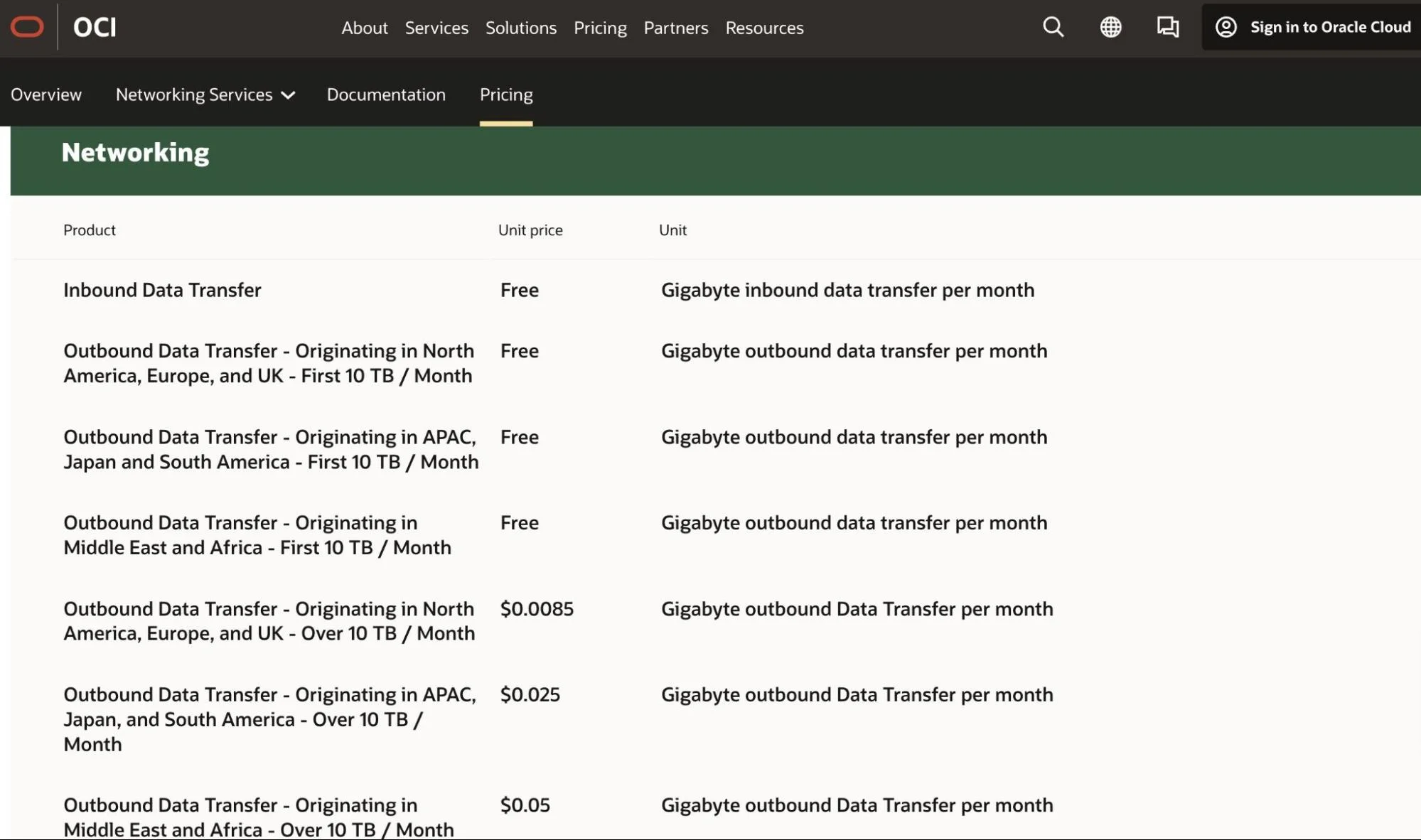
OCI networking uses fewer pricing variables than AWS and Azure, which makes network costs easier to forecast in data-intensive architectures.
Other networking components include:
|
Service |
Use |
Price |
|
DNS |
Managed DNS resolution for OCI resources |
$0.85 per 1,000,000 queries |
|
OCI email delivery |
Transactional and bulk email sending |
First 1,000 emails free; additional emails billed per email sent (rate not publicly listed by Oracle) |
|
FastConnect |
Dedicated private connectivity to OCI |
• 1 Gbps: $0.2125 per port hour • 10 Gbps: $1.275 per port hour • 100 Gbps: $10.75 per port hour (No inbound or outbound data charges on private virtual circuits) |
|
Load Balancer |
Distributes traffic across backend services |
$0.0113 per hour (base instance) + $0.0001 per Mbps per hour (bandwidth) Network Load Balancer: Free |
Oracle database pricing
Oracle database pricing is determined by deployment model and license approach. Customers either purchase databases with included licenses or apply existing licenses via BYOL.
Infrastructure and software costs are clearly separated. This separation makes database licensing a core pricing decision in OCI, rather than an embedded or opaque cost.
Autonomous database (license included)
Autonomous database pricing is billed per OCPU-hour and per GB of storage per month
- Database compute: $0.1125 per OCPU hour
- Database storage: $0.0255 per GB per month
Auto-scaling can increase OCPU usage when enabled, which directly increases cost during peak demand.
Without active monitoring, database auto-scaling can materially increase OCI costs during sustained peak usage.
Autonomous database (BYOL)
For customers with existing Oracle Database licenses, Autonomous Database can be deployed under BYOL pricing, reducing the hourly rate.
- Database compute (BYOL): $0.075 per OCPU hour
- Database storage: $0.0255 per GB per month
BYOL customers are responsible for maintaining valid licenses and support contracts.
Oracle database cloud service (DB systems – license included)
Database cloud service runs Oracle databases on VM or bare-metal infrastructure, with the license included.
- Database compute: $0.1125 per OCPU hour
- Storage: $0.0255 per GB per month
- Additional infrastructure (VMs, networking): billed separately at standard OCI rates
This option is commonly used for workloads requiring OS-level control.
Oracle database cloud service (BYOL)
With BYOL, customers pay only for infrastructure while applying existing Oracle database licenses.
- Compute: standard OCI VM or bare metal pricing
- Database license cost: $0 (customer-supplied)
- Storage: $0.0255 per GB per month
Note: License-to-OCPU conversion rules apply and must match Oracle licensing terms.
Oracle Kubernetes Engine (OKE) pricing
Oracle Kubernetes Engine (OKE) pricing depends on the cluster type you choose and the infrastructure resources your workloads consume. OKE combines a low-cost or free control plane with standard OCI infrastructure pricing, simplifying Kubernetes cost modeling.
Oracle offers a basic cluster option with no control-plane fee and an enhanced option with an SLA-backed control-plane charge.
|
Kubernetes component |
What it is |
Pricing |
|
OKE control plane (Enhanced cluster) |
Enhanced cluster with SLA |
$0.10 per cluster per hour (max $74.40/month) |
|
OKE control plane (Basic cluster) |
Basic cluster without SLA or enhanced features |
$0 (control plane fee waived |
|
Virtual nodes |
Serverless-like node for containers |
$0.015 per virtual node per hour |
|
Worker node infrastructure |
Compute and memory for pods |
Priced at OCI Compute OCPU & memory rates (same as regular VM pricing) |
|
Storage (PVCs) |
Persistent volumes for pods |
Billed at OCI storage rates (e.g., $0.0255/GB-month) |
|
Networking egress |
Outbound traffic from pods |
First 10 TB/month free, then standard egress rates |
Useful Kubernetes resources:
- Kubernetes Cost Optimization: 9+ Ways To Lower Costs in 2025
- The Definitive Guide For Kubernetes Namespace
- Kubernetes Node Vs. Pod Vs. Cluster: Key Differences
- Kubernetes For AI: The CTO’s Guide
- 10+ Kubernetes Architecture Best Practices For Performance, Security, And Cost Efficiency
- A Quick Guide To Kubernetes Observability
- The Ultimate Kubernetes Cost Monitoring And Management Guide
- Kubernetes Monitoring 101: 25 Tools And Must-Know Tips
How Oracle Cloud Pricing Differs From AWS And Azure
Oracle Cloud prices compute, storage, and networking in clear units and applies discounts through a single committed-spend model. AWS and Azure use more service-specific pricing and multiple discount programs.
This affects how costs scale and how organizations plan and manage cloud spend.
1. Infrastructure-based pricing vs service-based pricing
OCI prices infrastructure components more directly. Compared to AWS and Azure, OCI prices infrastructure components more directly using consistent infrastructure units. Compute, storage, networking, and databases are billed using the same units, such as OCPUs, GB-months, and port hours.
By contrast, AWS and Azure rely more heavily on layered managed services. Pricing often includes additional abstraction costs that sit above raw infrastructure.
As a result, OCI bills tend to reflect what you provision, while AWS and Azure bills often reflect how services interact.
Related reads:
2. Fewer pricing models, fewer discount layers
AWS and Azure offer multiple overlapping pricing models: on-demand, reserved capacity, savings plans, spot pricing, service-specific discounts, and enterprise agreements. Effective pricing depends on stacking these correctly.
Oracle consolidates discounting through universal credits. You commit to spend, not specific services, and discounts apply across most of the platform.
Read more:
3. Network costs are more predictable
OCI includes generous outbound data allowances and simpler network pricing structures. Main networking services have flat, published rates, and private connectivity does not incur per-GB transfer fees.
AWS and Azure networking costs vary widely by service path, region, and architecture pattern. This variability often makes AWS and Azure networking costs harder to predict at scale than OCI networking.
4. Database pricing is structural, not add-on
Oracle integrates database licensing directly into pricing or allows BYOL with defined OCPU conversion rules. This makes database cost a first-order pricing decision, not a hidden add-on.
In AWS and Azure, database costs are embedded in managed services, with fewer licensing permutations but less flexibility for enterprises with existing entitlements.
5. Global pricing is more consistent
OCI generally applies uniform pricing across regions for the major services. The same compute shape or storage tier costs the same across all geographies.
AWS and Azure frequently price services differently by region, which adds complexity for global architectures and cost forecasting.
Related read: How AWS Regions Affect Cloud Costs (And How To Reduce Fees)
But this doesn’t mean Oracle cloud pricing is “cheaper”
It is different, as we mentioned earlier.
For stable database workloads, OCI can be highly cost-effective. OCI is often most cost-effective for stable, database-centric, network-intensive enterprise workloads. Amazon Aurora, Amazon RDS, and Azure databases tend to be more expensive.
For fast-changing, highly abstracted application stacks, costs can still grow in unexpected ways.
That’s why pricing knowledge alone isn’t enough. Understanding OCI pricing mechanics is necessary, but sustainable cost optimization requires visibility into how infrastructure costs map to real workloads and business outcomes.
Key takeaways:
- OCI pricing is infrastructure-based and consumption-driven
- Universal Credits consolidate committed-spend discounts
- Database licensing structure materially affects total cost
- Network pricing is more predictable than AWS and Azure
- Cost optimization requires mapping spend to workloads, not services
How To Understand And Optimize Oracle Cloud Costs With CloudZero
Optimizing Oracle cloud costs starts with understanding the native cost management tools Oracle provides and where their visibility ends.
- OCI Cost Analysis: Visualizes historical and current spend by service, compartment, and time period. It helps teams answer basic questions such as how much was spent and where costs originated.
- OCI Budgets: Enables teams to set monthly or quarterly spending thresholds and trigger alerts when usage approaches or exceeds those limits.
- Usage Reports: Provides detailed, line-item billing data that can be exported for analysis or reconciliation. Finance teams often use these reports to confirm invoices.
- OCI Rate Cards: Documents list pricing for services, helping teams understand how charges are calculated at a unit level.
Here is the thing: these tools focus on cost reporting, not cost understanding.
OCI native cost tools do not:
- Attribute spend to applications, services, or business units
- Explain why costs changed, only where they appeared
- Track unit economics such as cost per database, service, environment, or customer.
- Proactively surface cost anomalies in complex OCI environments
CloudZero adds the missing layer of context
CloudZero connects OCI billing data to applications, services, teams, environments, and customers, enabling cost optimization beyond raw service-level reporting. It also ingests OCI billing data and maps costs to what actually matters: customers, teams, environments, services, databases, and Kubernetes workloads. Instead of reviewing spend by service name, teams see costs in terms of business impact.
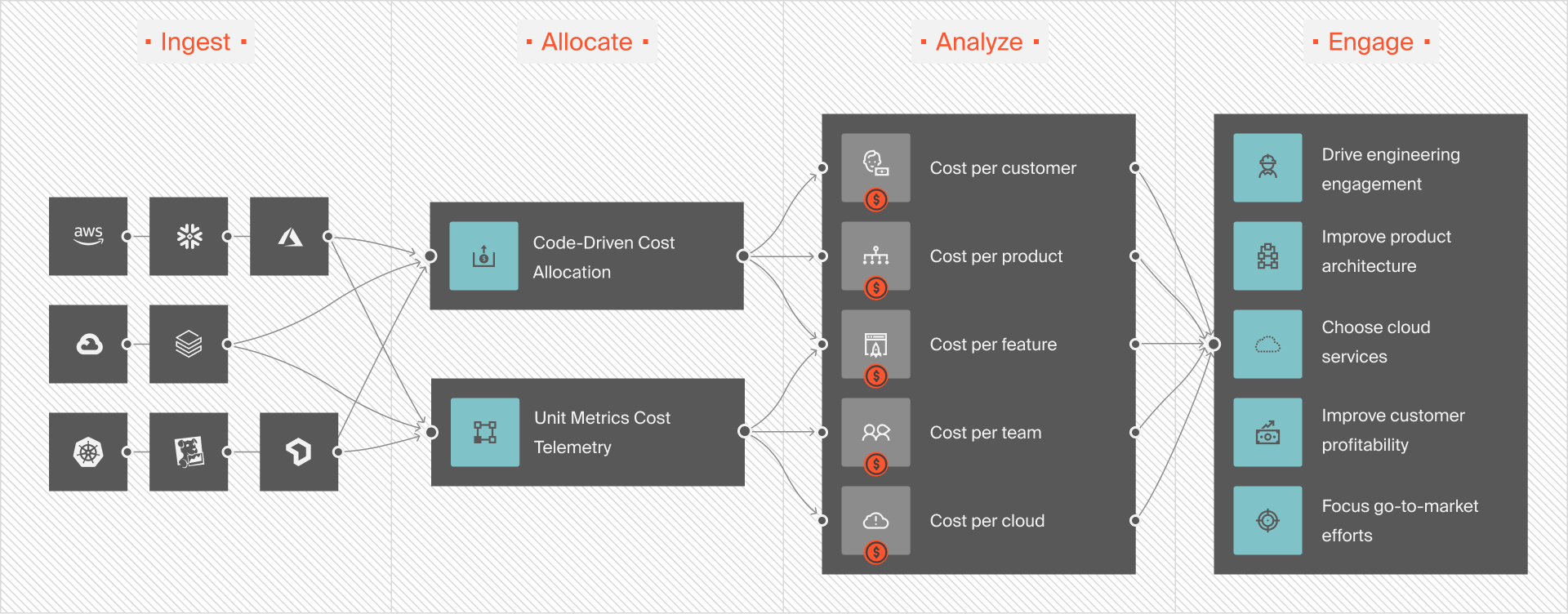
With CloudZero, organizations can finally answer questions such as:
- Which applications or services are driving Oracle Cloud spend?
- How much does each Oracle database actually cost to run?
- What is the cost per environment (production, staging, development)?
- Which teams or business units are responsible for which OCI costs?
- Why did Oracle Cloud costs increase this week or month?
- What is the unit cost of our platform (per service, customer, or workload)?
- Where are we over-provisioning OCPUs, storage, or Kubernetes worker nodes?
- Which workloads consume universal credits the fastest?
- Which Oracle Cloud costs are fixed versus variable?
- How do infrastructure changes translate into cost changes?
- What will Oracle Cloud cost next month if usage continues as-is? etc.
CloudZero already manages over $14 billion in cloud spend for organizations that needed real cloud visibility and accountability. With CloudZero, Upstart reduced loud costs by $20 million. PicPay saved $18.6 million. Drift achieved a $2.4 million reduction in cloud spend. You can achieve outcomes like these, too. Take a product and  to see CloudZero in action.