You can assess your company’s financial health using a number of SaaS metrics, depending on the type of business you are in. Among the most useful is the SaaS Magic Number. So, why is it called the SaaS Magic Number, and how do you calculate it? And why is it so important to track your SaaS Magic Number regularly?
This jargon-free post will answer these questions and more, including:
What Is The SaaS Magic Number?
The SaaS Magic Number measures a SaaS business’s sales efficiency by evaluating the return on investment on sales and marketing spend versus annualized revenue growth.
Essentially, the Magic Number seeks to answer the crucial question: “How much revenue does our company generate for every dollar we spend on acquiring new customers?”
The metric was originally developed by Scale Venture Partners as a way to benchmark sales efficiency across public SaaS companies using publicly available financial data. Because most companies don’t disclose their ARR (Annual Recurring Revenue) in filings, the Magic Number uses quarterly GAAP revenue as a proxy, making it possible to compare competitors and industry peers without requiring access to internal financials.
The SaaS Magic Number helps measure the ratio between the current quarter’s recurring revenue and the last quarter’s marketing costs. It is calculated quarterly because accounting reports sales and marketing expenses quarterly.
Report
Finance needs to prove AI’s return: CloudZero report
260 senior finance leaders (more than half CFOs) told us why the speed of seeing AI spend, not the size of it, separates who pulls ahead on AI from who gets burned.
Why Is The SaaS Magic Number Important?
The SaaS Magic Number compares your annual recurring revenue with sales and marketing spending to determine whether you are making enough money (profit margin) to continue investing in sales and marketing.
If your company’s magic number is 1, it indicates your ratio of dollars spent to dollars earned is 1 to 1, meaning your sales and marketing processes are efficient. That also implies you can recoup one quarter’s S&M spend through the incremental recurring revenue generated over the following four quarters.
A Magic Number below 1 indicates that you should evaluate your SaaS business and see what needs to be improved, including your:
- Product-market fit
- Customer retention strategy
- Conversion rate optimization and
- SaaS pricing (or setting more ideal pricing tiers, plans, etc.)
Other benefits of the SaaS Magic Number include:
- Tracks sales and marketing ROI: Helps tell if you are earning a healthy ROI on your sales and marketing dollars
- Measuring scaling efficiency: Shows whether your company is ready to boost sales and marketing to accelerate growth
- Sales and marketing redesign: Helps you see what sales and marketing techniques are working and which ones you should improve or replace
- Cloud cost optimization: By analyzing your Cost of Goods Sold (COGS), you can determine where to invest more to maximize ROI and reduce costs without hurting revenue to increase gross margins.
- Investor insight: Serves as a benchmark for investors to assess how efficiently your company turns investment into growth.
Limitations Of The SaaS Magic Number
While the SaaS Magic Number is a useful indicator of sales efficiency, it has several nuances worth keeping in mind.
First, the Magic Number measures net revenue growth, not just new bookings. That means churn from existing customers also affects the result. A declining Magic Number could signal a retention problem just as easily as a sales problem, so it’s important not to use the metric to evaluate your go-to-market team in isolation.
Second, the metric works best for SaaS companies with relatively short sales cycles. Because it compares quarter-over-quarter revenue growth to the previous quarter’s S&M spend, the lag between spending and revenue generation needs to be short for the measurement to be meaningful. Enterprise SaaS companies with 6-to-12-month sales cycles may find the Magic Number less actionable and should consider using trailing-twelve-month calculations instead.
Third, the Magic Number doesn’t account for gross margin. A company could show a Magic Number of 1.0 while still losing money on each customer if its cost of delivery is high. Pairing the Magic Number with a gross-margin-adjusted metric like the CAC payback period gives a fuller picture.
A best practice is to use the Magic Number alongside other important SaaS metrics to get a complete view of your business health.
What next?
How To Calculate Your SaaS Magic Number
To determine your SaaS Magic Number, take the current quarter’s recurring revenue and subtract the previous quarter’s recurring revenue. Then, multiply the result by four (to annualize it) and divide it by your sales and marketing costs in the previous quarter.
Here’s the formula:
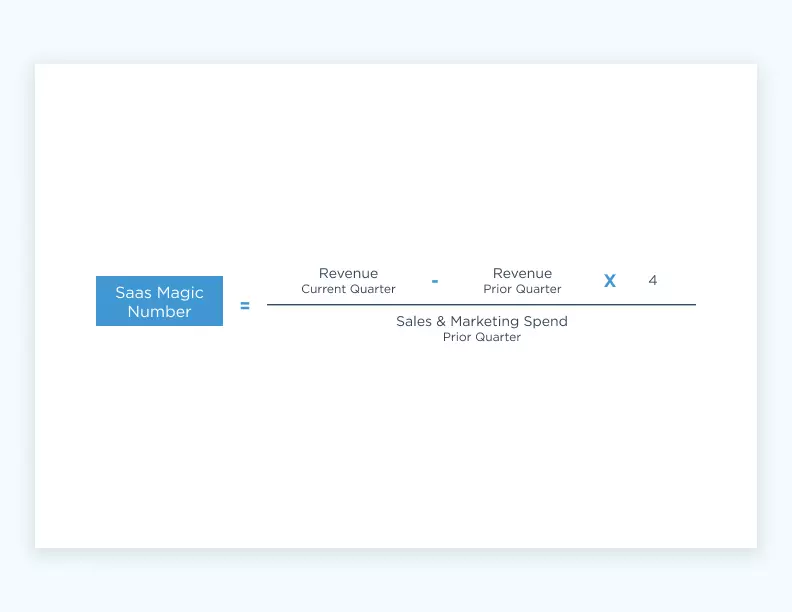
SaaS Magic Number = [(Current Quarter’s GAAP Revenue – Previous Quarter’s GAAP Revenue) X 4] / Previous Quarter’s Cost of Sales and Marketing
The reason the formula uses GAAP revenue rather than ARR is practical: public SaaS companies report GAAP revenue in their filings, while ARR is an internal metric that isn’t always disclosed. Using GAAP revenue allows investors and operators to calculate the Magic Number for any publicly traded SaaS company using income statement data alone. If you do have access to your own company’s ARR data, you can substitute it for a more precise result.
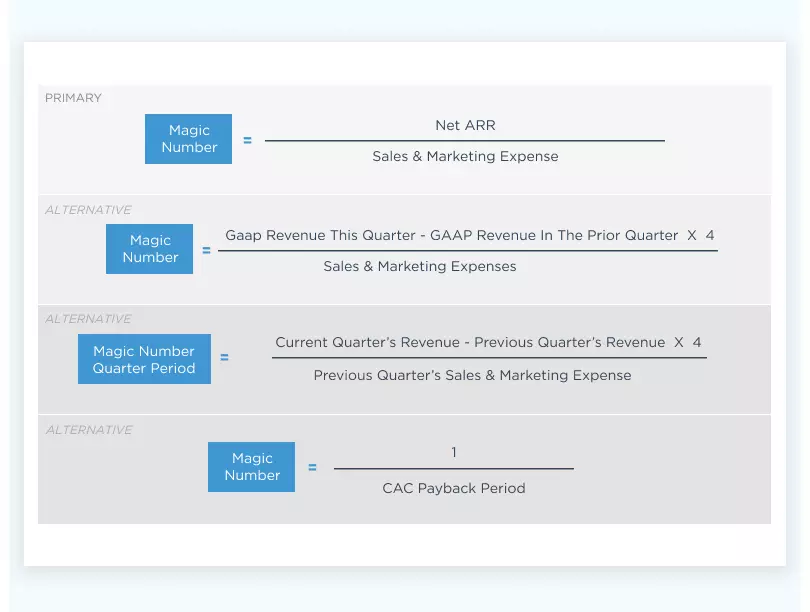
Other formulas for calculating your SaaS Magic Number include:
SaaS Magic Number example:
Company A’s recurring revenue in Q3 is $700,500. Its recurring revenue in Q2 was $550,700. It spent $600,200 on Sales & Marketing in Q2.
Using the SaaS Magic Number formula, Q3’s Magic Number is:
SaaS Magic Number = [($700,500 – $550,700) X 4] / $600,200
SaaS Magic Number = 599,200 / 600,200
Company A Q3 Magic Number is 0.998 or just about 1
You can calculate this number manually. You can also use one of several SaaS Magic Number calculators available today, including Ramp and Klipfolio.
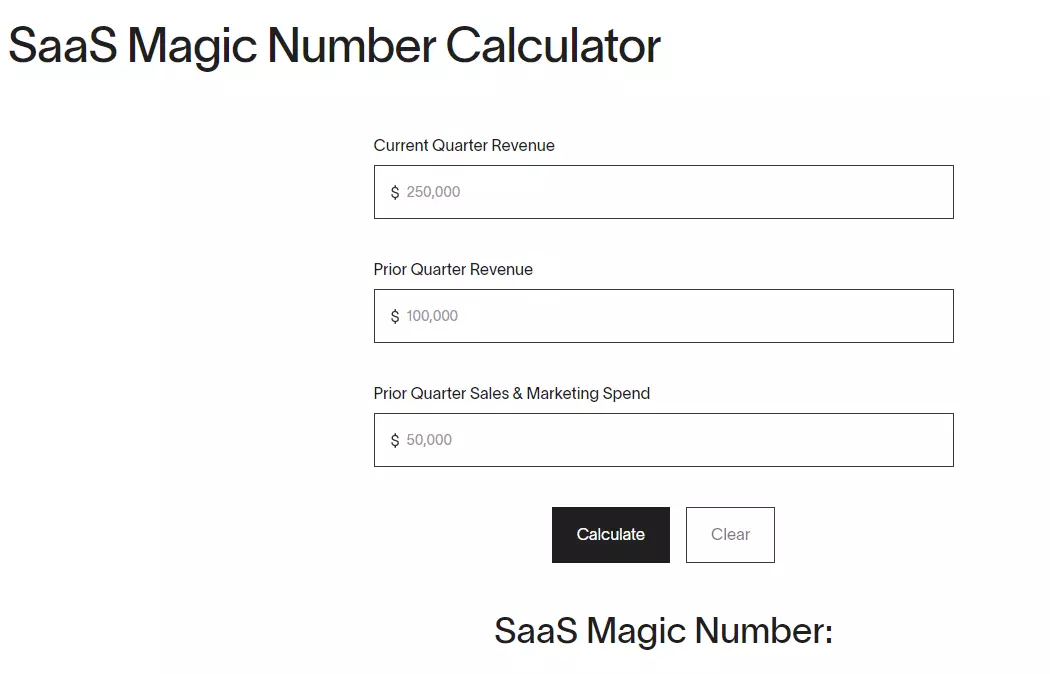
Credit: Ramp
So, is Company A’s Magic Number healthy, or should it work on making its sales and marketing efforts more efficient? And what is a good SaaS Magic Number anyway?
How To Interpret Your SaaS Magic Number
Your Magic Number falls into one of four ranges, each pointing to a different operational reality.
Below 0.5 — A Magic Number this low typically signals a fundamental issue. Your cost of customer acquisition may significantly exceed the revenue those customers generate, or high churn could be eroding your growth. At this level, the priority is to re-examine product-market fit, tighten your ICP (ideal customer profile), and investigate why customers aren’t sticking before investing further in growth.
Between 0.5 and 0.75 — You’re generating returns on your S&M spend, but not enough to justify aggressive scaling. This range can be normal for early-stage companies still refining their go-to-market motion. Focus on improving conversion rates, shortening sales cycles, and reducing churn before increasing spend.
Between 0.75 and 1.0 — The company is on track with efficient sales and marketing. At this level, many operators begin testing incremental increases in S&M spend to see if the efficiency holds at higher volumes. This is typically the threshold where investors view the company as ready to scale.
Above 1.0 — Your strategies are efficient and sustainable. For every dollar of S&M spend, you are generating more than a dollar of annualized recurring revenue. This is also a signal that you may be underinvesting — there could be growth opportunities being left on the table. Consider expanding into new channels or markets while the unit economics are strong.
What Metrics Relate To The SaaS Magic Number?
The Magic Number becomes more useful when paired with metrics that address its blind spots. Here are the most relevant ones and how they connect.
Customer Acquisition Cost (CAC) and CAC Payback Period
Where the Magic Number tells you how much revenue growth each S&M dollar generates, CAC tells you the total cost of acquiring a single customer. The CAC payback period goes one step further by factoring in gross margin to show how many months it takes to recoup that acquisition cost. If your Magic Number looks healthy but your CAC payback exceeds 18 months, your gross margins may be masking an acquisition cost problem.
Monthly and Annual Recurring Revenue (MRR / ARR)
MRR and ARR are the building blocks of the Magic Number’s numerator. Tracking MRR growth alongside the Magic Number helps isolate whether changes in the metric are driven by stronger sales, better retention, or expansion revenue from existing customers. ARR is simply your MRR annualized (MRR × 12).
Churn Rate
Because the Magic Number measures net revenue growth, churn directly affects the result. A company could be closing deals efficiently while still showing a low Magic Number because it’s losing customers at a high rate. Monitoring both revenue churn and logo churn alongside the Magic Number helps identify whether the issue is on the acquisition side, the retention side, or both.
Gross Profit Margin
SaaS Gross Margin measures the difference between revenue and cost of goods sold (COGS). The Magic Number ignores COGS entirely, so a company with a Magic Number of 1.0 but a 50% gross margin is in a very different position than one with the same Magic Number and an 80% margin. Gross margin context is essential for understanding whether your growth is actually profitable.
The Rule of 40
The Rule of 40 states that a SaaS business is healthy when the sum of its growth rate and profit margin exceeds 40%. It complements the Magic Number by balancing growth against profitability — a company could have a strong Magic Number but fail the Rule of 40 if it’s growing fast but burning cash unsustainably.
How To Improve Your SaaS Magic Number?
The following are some common tips for improving your Magic Number:
- Shortening your sales cycle
- Encourage upsells
- Facilitate more cross-selling
- Focus on customer retention/subscription renewals
- Make conversion optimization a priority
- Experiment with different marketing channels to discover the ones with the best price-return ratio
- Do more of what returns the highest sales and marketing ROI
SaaS is a dynamic market, so regardless of your score, you should aim to improve your SaaS Magic Number continuously.
When your Magic Number exceeds 1, it is also an ideal time to experiment with different sales and marketing techniques alongside those already producing a good ROI. You can afford it.
Here are several advanced yet relatively simple ways to improve your SaaS business Magic Number:
Optimally manage your COGS
When you know exactly what’s driving your cost of goods sold, you can cut unnecessary costs and pass the savings on to your customers to encourage renewals. Or, you can keep the increased margins to boost your bottom line and fund further growth.
Maximize ROI by evaluating your unit costs
By understanding where your money is going — the people, products, and processes driving your cloud costs — you can pinpoint where to cut costs and increase investment to improve margins. For a deeper look at how these cost levers connect, see our guide to SaaS unit economics.
Set profitable SaaS pricing
When you know how much you are spending to support each cost center, a specific customer, or a project, you can tell how much you need to charge for each to protect your margin.
Encourage renewals with timely, personalized discounts
Knowing how much you spend to support a specific customer helps you determine how much discount you can give them without hurting your margins or losing them.
Understand your gross margins
The total gross margin does not tell the whole story. Knowing how much gross margin you earn per customer, project, team, software feature, product, etc., is more effective. Taking this approach helps you build a profitable business from day one.
If you are wondering where and how to collect, analyze, and act on this level of SaaS intelligence, CloudZero can help you automate it.
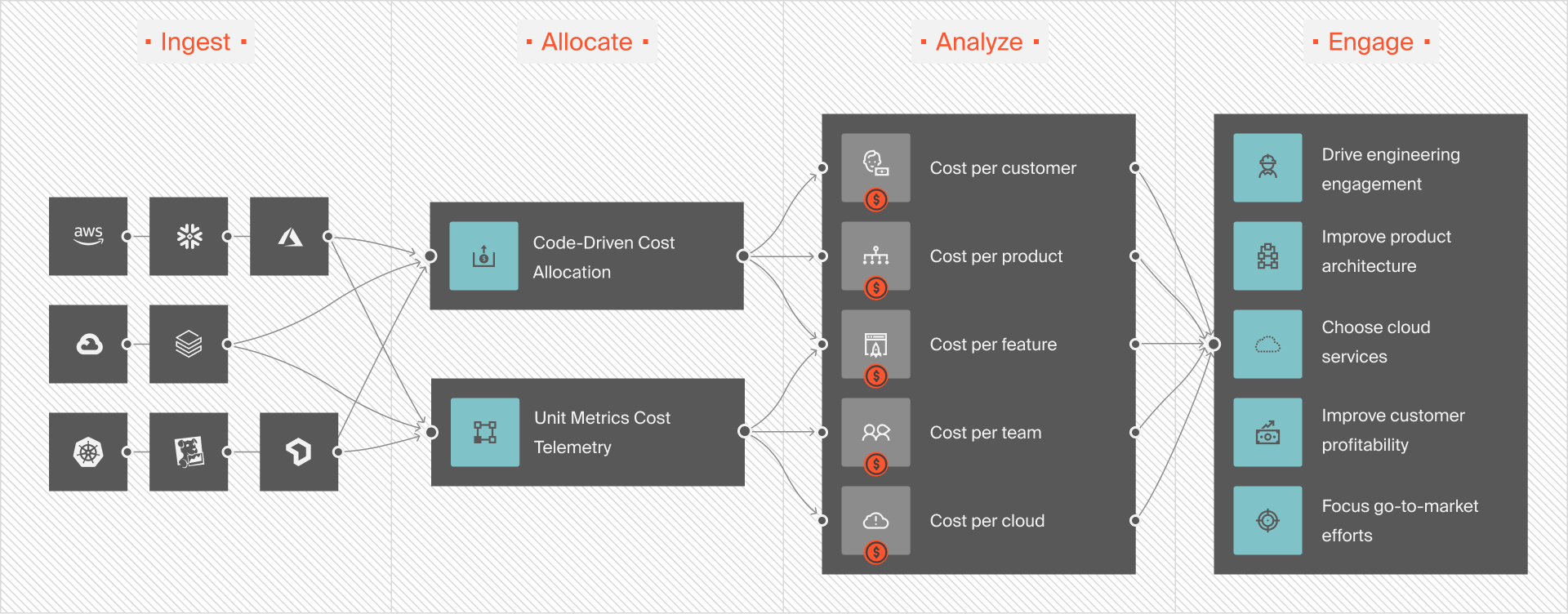
With CloudZero’s Cloud Cost Intelligence approach for SaaS organizations, you can:
- Accurately track and collect the costs of tagged, untagged, and untaggable cloud resources, along with those in shared environments – even if you have imperfect cost allocation tags.
- Simplify your total cloud costs using granular, immediately actionable cost insights, such as your cost per individual customer, project, environment, product, team, product feature, etc.
- Help finance understand your cost per customer to ensure your margins aren’t eroded during pricing negotiations.
- Empower your engineers to track the impact of their activities on costs to make your product more competitive in your market and cost-effective.
- Ensure your FinOps team can better budget, forecast, and allocate costs (showbacks and chargebacks), among other things.
- Take advantage of real-time cost anomaly detection and prevent overspending with timely alerts via Slack, email, etc.
Yet, reading about CloudZero’s capabilities is nothing like seeing them in action.  to increase your SaaS Magic Number in days — not years. Companies like Drift, Remitly, and Malwarebytes are already saving up to $2.4 million annually with CloudZero.