
Customer support no longer runs on fixed schedules or predictable volumes. Call demand shifts daily, agents work from anywhere, and customer expectations keep climbing.
Amazon Connect was built for this environment, giving teams a fully managed contact center that scales on demand.
But that same flexibility changes how support costs behave. Usage now spans voice, agent time, and multiple AWS services, making it harder to explain cost shifts or tie spend to outcomes.
This guide breaks down how Amazon Connect works, what drives its pricing, and how organizations can move from reactive spend tracking to clear cost visibility.
What Is Amazon Connect?
Amazon Connect is a fully managed, cloud-based contact center service from AWS. It enables organizations to run customer support across voice, chat, and tasks without building or maintaining traditional call center infrastructure.
Amazon Connect provides a centralized platform for handling customer interactions. AWS manages scaling, availability, and underlying infrastructure.
A simple way to think about Amazon Connect is this: it’s the control layer for customer support interactions in the cloud. Much like how AWS manages servers so teams can focus on applications, Amazon Connect manages contact center infrastructure so teams can focus on customer experience.
How Amazon Connect works
Users start by creating an Amazon Connect instance. This acts as the control environment for users, channels, and data storage.
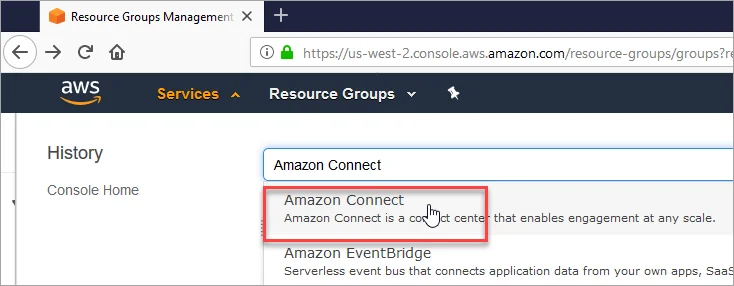
Once the instance is configured, users connect phone numbers to the service. These can be new AWS-provided numbers or existing business numbers ported into Amazon Connect. This is how customers reach the contact center.
Think of phone numbers as the front door to your contact center. Customers call, and Amazon Connect routes those interactions based on your configuration.
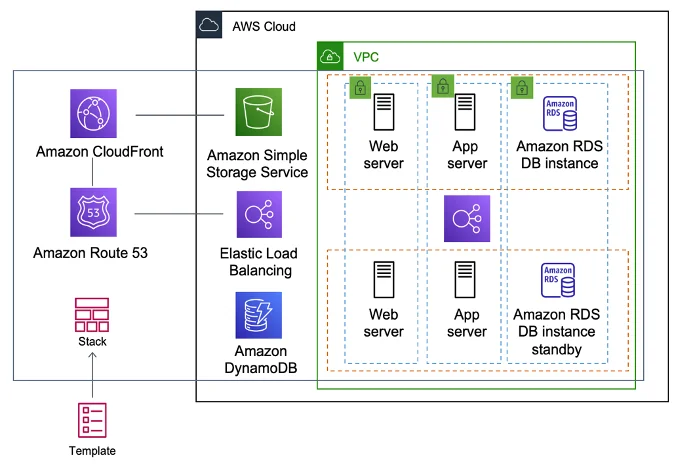
From there, routing logic is defined. Teams create queues, assign operating hours, and specify which agents handle voice, chat, or task-based interactions. These rules determine how incoming requests are prioritized and routed.
Customer interactions then move through contact flows. Contact flows define the steps an interaction follows before reaching an agent. This may include prompts, automated checks, or data lookups. Contact flows can trigger AWS services for advanced routing—like AWS Lambda for business logic, Amazon Lex for chatbots, or Amazon S3 for recording storage.
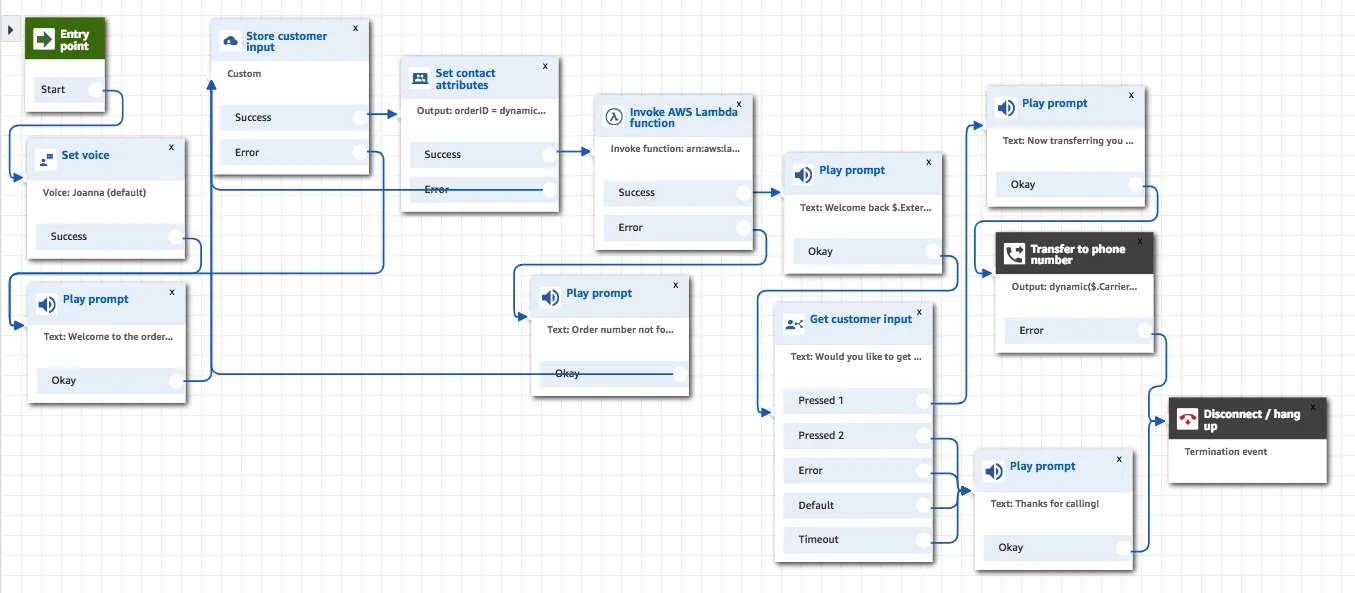
Amazon Connect contact flow
Only after routing and automation are complete is the interaction delivered to the agent through the Amazon Connect Agent Workspace. The agent receives the interaction with the context already applied. This allows them to focus on resolution rather than call handling or system control.
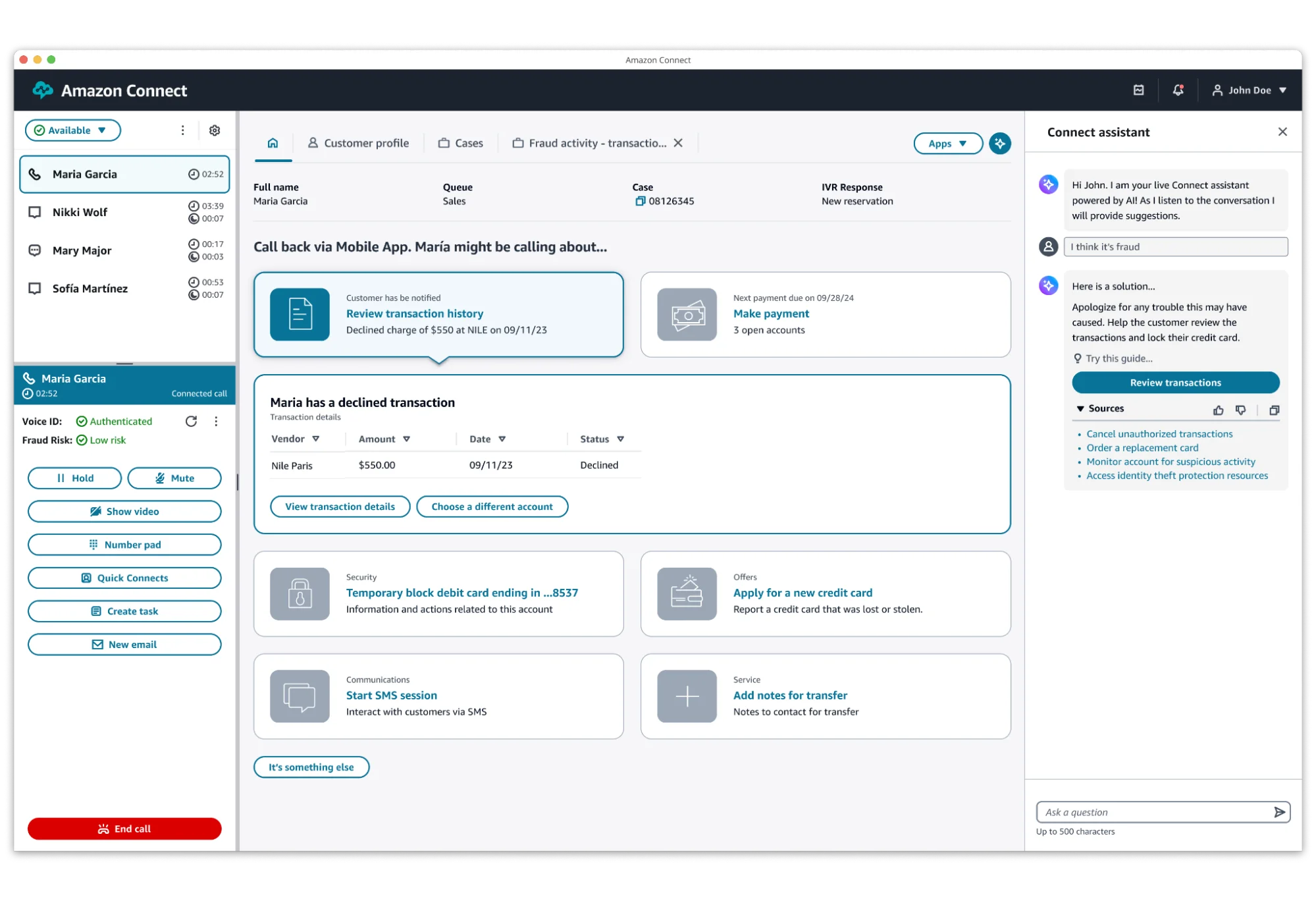
Amazon Connect Agent Workspace delivering interactions with context already applied
Note: Amazon Connect is not just a contact center application. Architecturally, it acts as:
- A real-time interaction ingestion layer
- A routing and orchestration engine
- A data producer for analytics, AI, and external systems
- A managed front end sitting on top of AWS’s streaming, analytics, and AI services
Amazon Connect also integrates with:
- Amazon Kinesis to streams contact and agent events for real-time analytics and downstream processing
- Amazon CloudWatch collects logs and operational metrics for monitoring and troubleshooting
- AWS IAM controls access and permissions across users and service integrations
- AWS KMS to encrypt call recordings, transcripts, and customer data
- Amazon DynamoDB to store fast-access customer or session data used during interactions
- Amazon EventBridge to route all interaction events to external systems like CRMs or workflows
- Amazon QuickSight to visualize contact center metrics and performance data

When To Use Amazon Connect
Amazon Connect is ideal for teams that need flexibility, scale, and control over customer interactions.
It is the best choice for organizations with variable or unpredictable call volumes. Because Amazon Connect scales automatically, teams don’t need to provision capacity in advance or manually manage peak traffic.
Amazon Connect is also a strong fit for remote or distributed support teams. Agents can log in from anywhere using a browser, while routing and availability are managed centrally in AWS.
Most organizations also adopt Amazon Connect to modernize legacy call centers. Moving from on-premise systems to a cloud-based model reduces infrastructure overhead and shortens setup time.
Useful resources:
Amazon Connect also makes sense for organizations already using AWS. Native integrations with other AWS services extend support workflows with automation, data storage, and analytics.
When Amazon Connect may not be the best choice
Amazon Connect isn’t ideal for organizations that need deep on-prem customization or depend on fixed, license-based pricing.
Since its costs scale with usage, teams with variable demand or complex routing logic can see unpredictable billing patterns, making visibility critical.
That’s why understanding Amazon Connect pricing is critical.
How Amazon Connect Pricing Works
Amazon Connect uses pay-as-you-go, à la carte pricing. You pay separately for communication channels, enabled features, and supporting services. There are no licenses and no bundled plans.
Pricing starts with how customers contact you, then layers on what capabilities you add.
Channel usage (base cost)
Every interaction begins with a channel.
Voice
You are charged per minute for:
- The time customers spend in queues
- Time speaking with agents
- Time interacting with automated flows
Voice usage is billed at a per-minute rate, plus telephony charges.
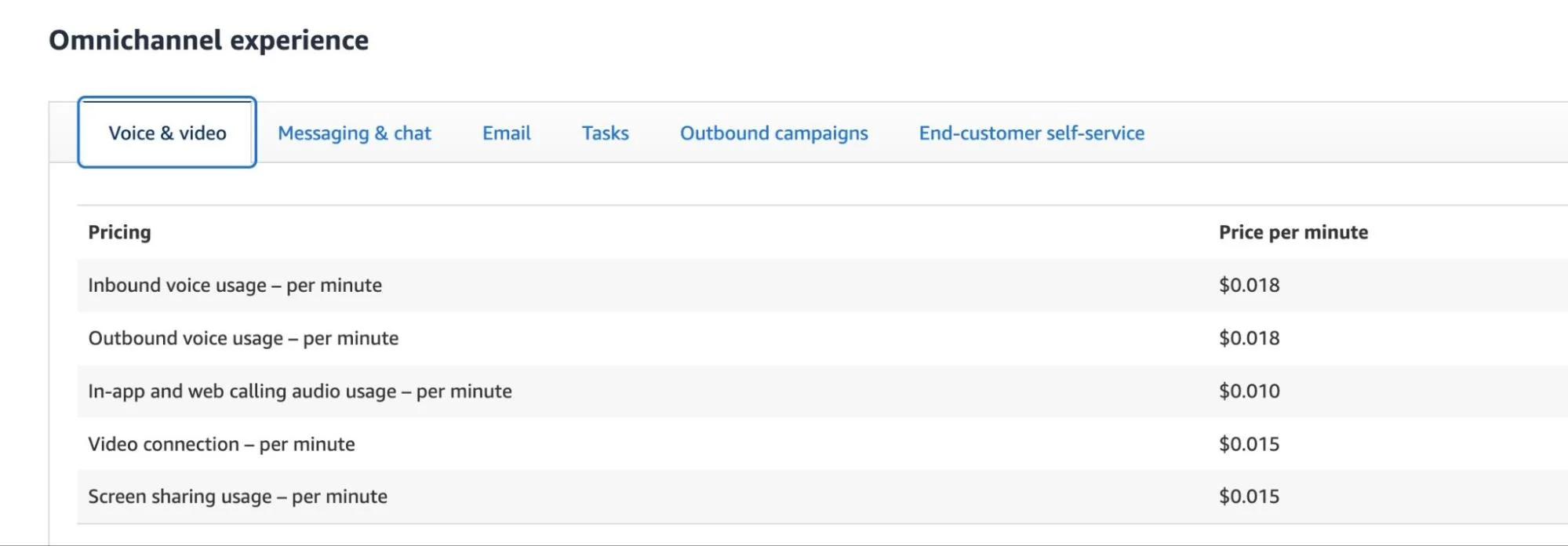
Chat and messaging
Chat and messaging are billed per message. Each message sent or received counts as usage.
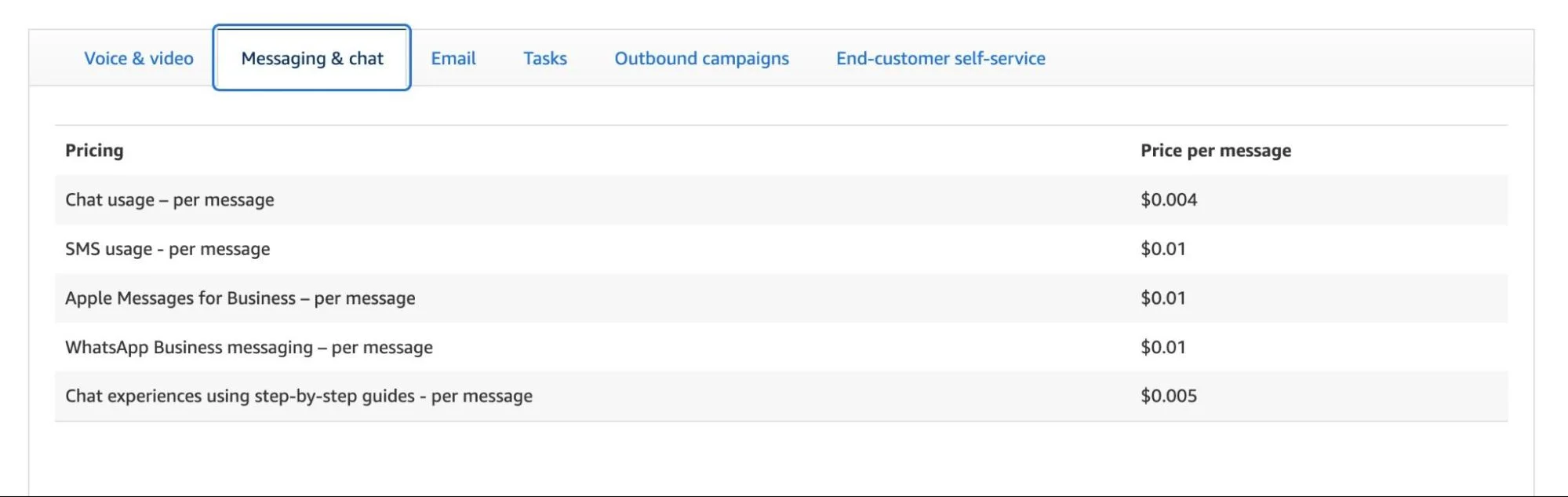
Email interactions are billed per email handled at a cost of $0.05.
Telephony charges (always separate)
Telephony charges are always billed separately. These apply to every voice interaction and are based on telecom usage, not Connect itself.
These charges come directly from telecom usage, not from the contact center service itself.
|
Telephony component |
How it’s billed |
US pricing |
|
Phone numbers |
Daily charge per number |
$0.03 per number per day |
|
Inbound calls |
Per minute |
$0.0022 per minute |
|
Outbound calls |
Per minute |
$0.0048 per minute |
|
Call destination |
Varies by country & carrier |
International rates vary |
Note: Pricing varies by AWS region, country, and number type (DID vs toll-free). See detailed telephony charges by country here.
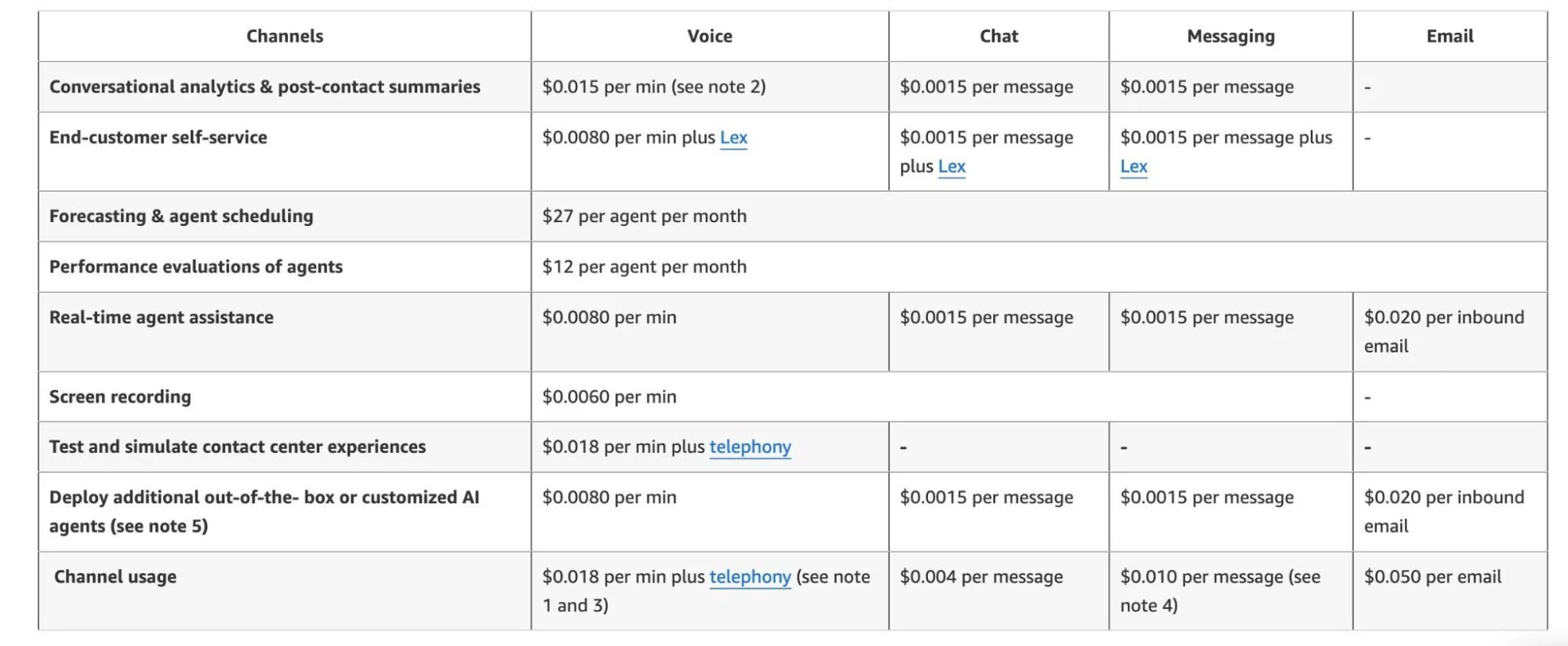
A la carte features (optional, additive)
AWS then charges for features you explicitly turn on. These are not included by default.
Supporting AWS services (often overlooked)
All AWS services used with other AWS services are billed separately. These charges appear outside the Amazon Connect line item on your AWS bill.
Challenges With Amazon Costs
Amazon Connect pricing is fragmented. A single customer call can trigger multiple AWS charges — voice, recording, analytics, and AI — spread across separate services and billing lines. Without context, it’s hard to tie spend to a specific interaction or outcome.
Some Amazon Connect usage is subject to tiered pricing. All usage is billed, but the rate changes at higher volumes. There is no free allowance. This means costs don’t increase at the same rate as usage grows. Two months with similar call volume can still result in different bills depending on how usage crosses pricing tiers.
Helpful resource: What is Tiered Pricing? Definition, Examples, Best Practices
AWS also shows spend, not meaning. Native tools report which services were used and how much was charged. They do not show cost per call, queue, resolved issues, etc. Their visibility is limited; they do not connect usage to outcomes.
CloudZero can help.
How To Optimize Amazon Connect Costs With CloudZero
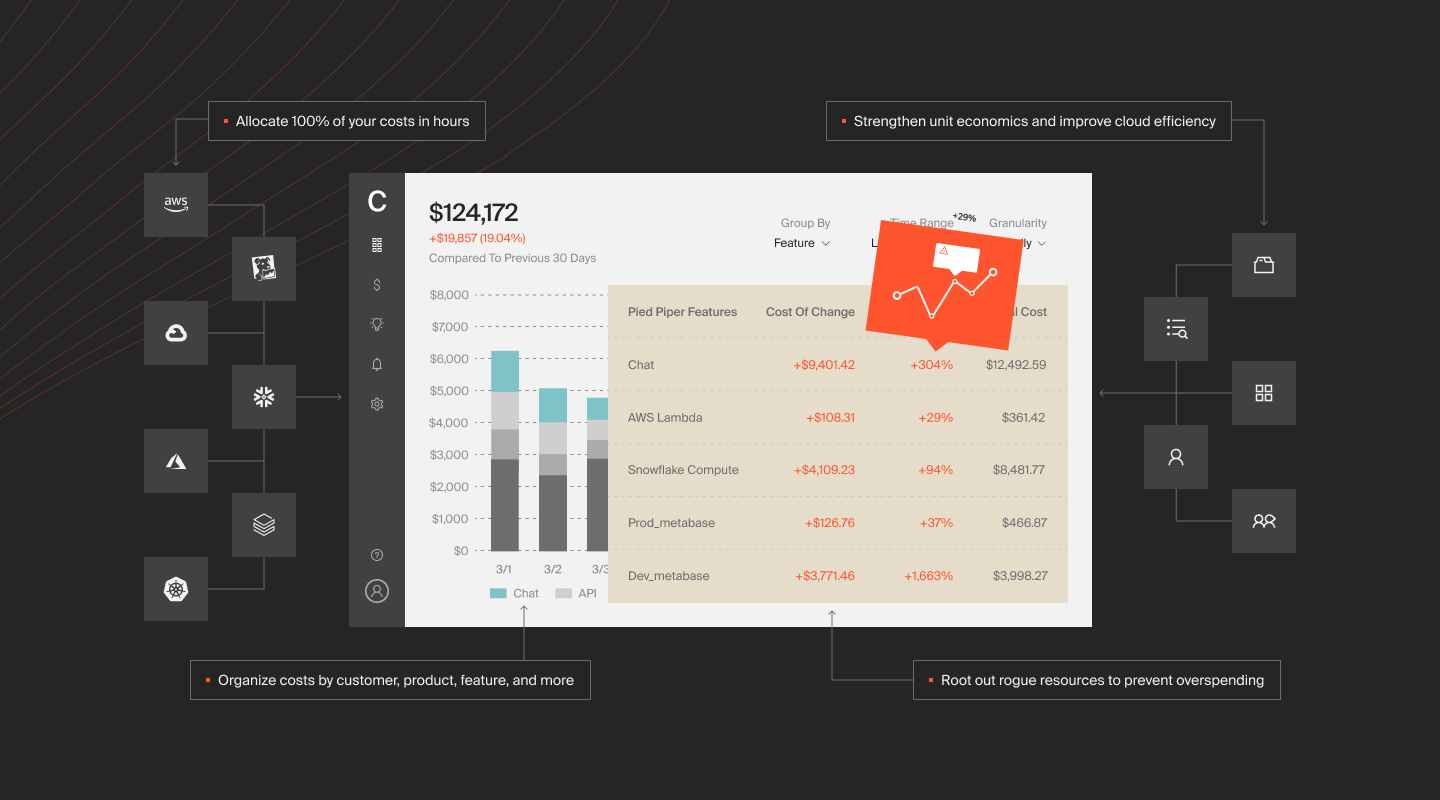
CloudZero doesn’t replace AWS native tools. It adds the missing layer AWS doesn’t provide: business-level cost context.
CloudZero aggregates Amazon Connect, AWS services, and AI workloads into a single cost model. Instead of analyzing spend by service, teams can view costs by queue, channel, customer interaction, or outcome. That makes it possible to answer questions AWS alone can’t, such as “what a resolved call actually costs or which workflows are driving margin erosion.”
Useful resources:
One of the biggest operational gaps in cloud contact centers is the late discovery of issues. By the time teams notice a spike in spend, the cost has already been incurred.
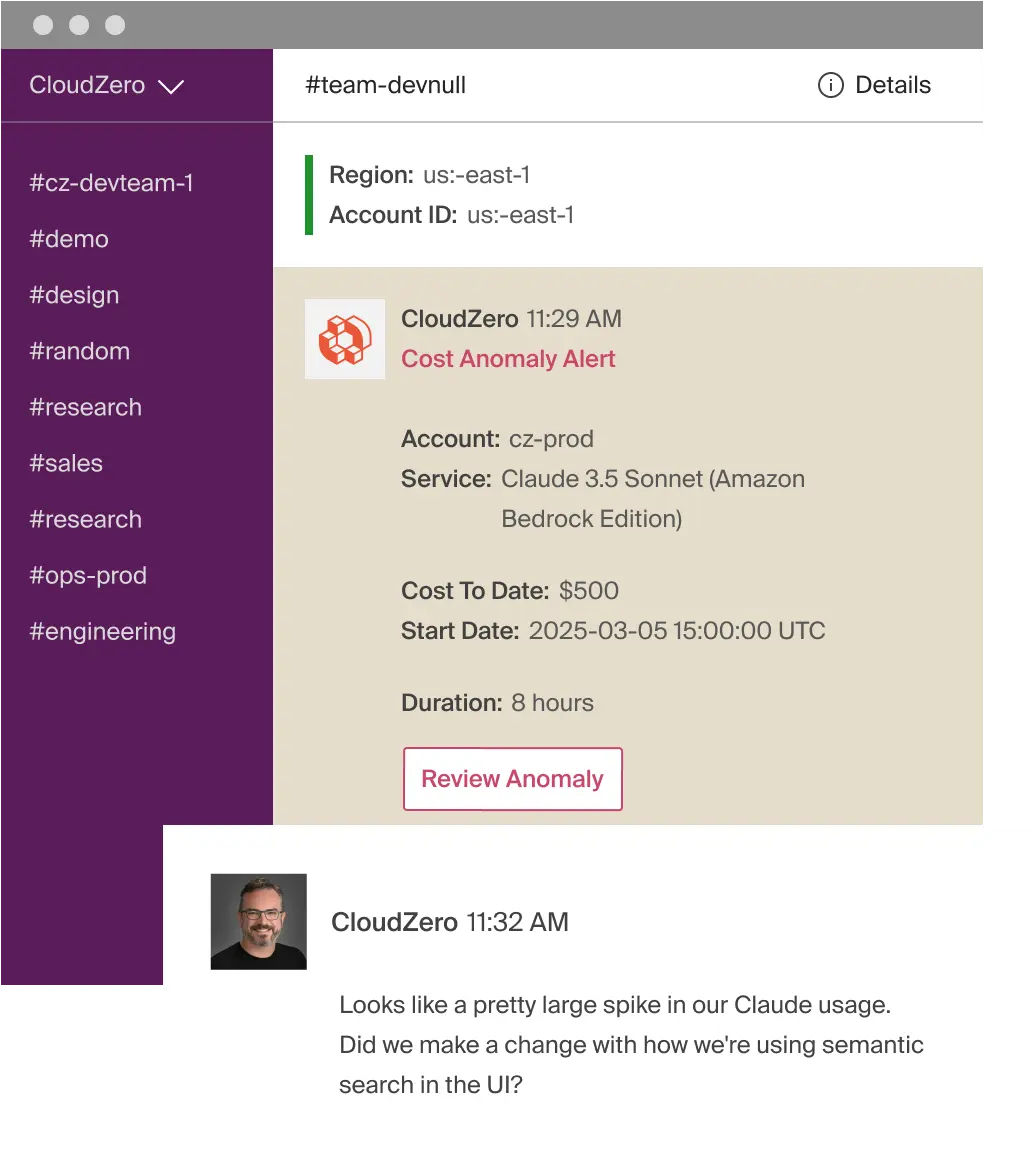
CloudZero detects cost anomalies in real time. When Amazon Connect usage or AI-related spend spikes, teams are immediately notified along with the context explaining what changed. That turns cost management from a monthly post-mortem into a real-time control loop that only CloudZero supports.
Optimizing Amazon Connect is also not about minimizing spend. It’s about ensuring support costs scale in proportion to the value delivered.
CloudZero enables teams to tie contact center costs to unit economics such as cost per interaction, customer, or feature. This allows leaders to confidently grow support operations, knowing which investments improve outcomes and which simply add cost.
AWS is the world’s largest cloud platform, used by thousands of organizations. Leading teams like Duolingo, Grammarly, Toyota, and Skyscanner trust CloudZero to manage AWS costs. You can too.  to see CloudZero in action.
Amazon Connect FAQs
Is Amazon Connect cheaper than running a contact center on-premises?
Often, yes. Amazon Connect eliminates upfront hardware costs, maintenance, and overprovisioned capacity. However, costs shift to usage-based pricing, which requires active cost management as volume grows.
Does Amazon Connect have a free tier?
No. Amazon Connect has no free tier. All usage is billed from the first interaction, though some features use tiered pricing that lowers the per-unit rate at higher volumes.
What drives Amazon Connect costs the most?
The largest cost drivers are voice minutes, agent logged-in time, telephony charges, and enabled features such as analytics, AI assistance, and recordings. AWS services, such as storage, can also increase costs.
How do AI features affect Amazon Connect costs?
AI features such as conversational bots, agent assistance, and post-contact analytics introduce additional usage across multiple AWS services. These costs often scale with interaction volume and are not consolidated into a single line item.
Can AWS tools show cost per call or cost per queue?
Not directly. AWS shows detailed billing per service, but not per call, queue, or resolution. You’ll need a platform like CloudZero to connect those dots.
Can CloudZero detect sudden increases in Amazon Connect spend?
Yes. CloudZero provides real-time cost anomaly detection, alerting teams when Amazon Connect or related AWS costs spike and showing what changed.
Is Amazon Connect suitable for AI-driven contact centers?
Yes. Amazon Connect supports AI-driven capabilities, including self-service bots and agent assistance. However, AI adoption increases cost complexity, making cost visibility essential.
What is the best way to scale Amazon Connect without losing cost control?
The most effective approach is to track unit economics and monitor how changes in volume, routing, or AI usage affect total spend. CloudZero helps teams scale while maintaining financial discipline.


The Cloud Cost Playbook
The step-by-step guide to cost maturity