Things are changing. Technology differences between serverless containers and traditional container-based systems are rapidly blurring. As these models converge, the biggest remaining differences increasingly show up in cost structure, scaling behavior, and operational control.
In 2020, Amazon Web Services (AWS) enabled AWS Lambda to package and deploy functions as container images instead of bundling all of a function’s code and dependencies in a .zip file.
Today, more organizations are increasingly deploying Lambda functions as Docker container images.
These companies want to reap the benefits of serverless computing, containers, and container orchestration. Thus, while AWS Lambda and AWS Fargate are distinct serverless solutions, more companies are using functions (Lambda) with containers, while others want more control over runtime environments using Fargate.
This guide will clarify this shift by comparing AWS Fargate and Lambda in greater detail, considering performance, security, and pricing. We’ll pay particular attention to how each service allocates compute, bills for idle versus active time, and behaves as workloads grow or fluctuate.
What Is AWS Fargate?
The AWS Fargate service allows you to run containerized applications on AWS with minimal infrastructure management.
Fargate is a serverless compute solution that enables you to focus on container-level tasks, such as setting access controls and resource parameters, instead of more time-consuming tasks, like provisioning, setting up, updating, securing, and scaling clusters of Elastic Compute Cloud (EC2) servers or virtual machines.
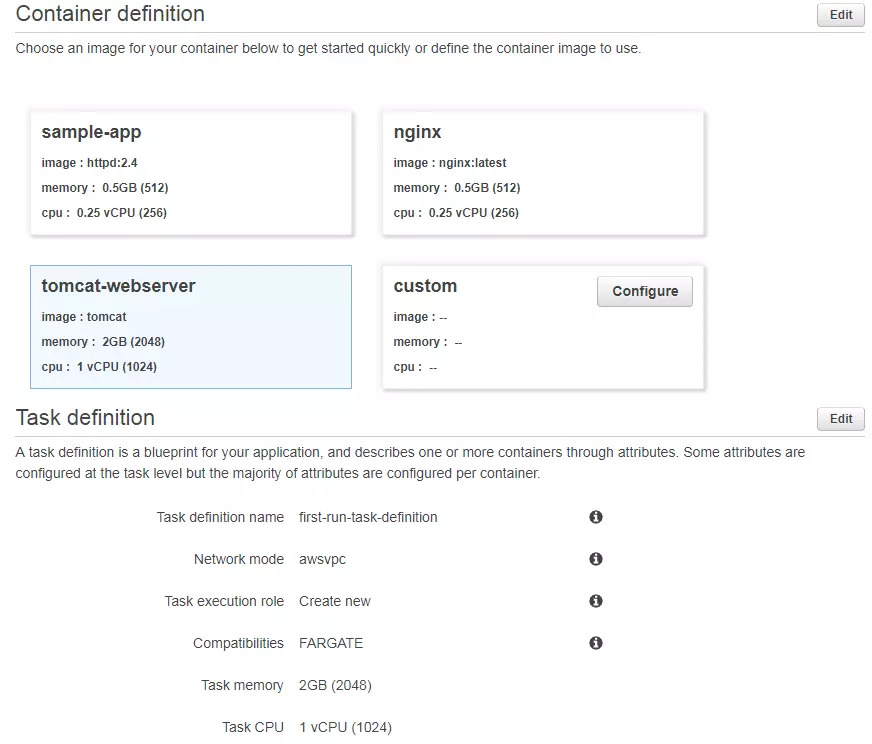
Credit: Define container parameters with Fargate – TechTarget
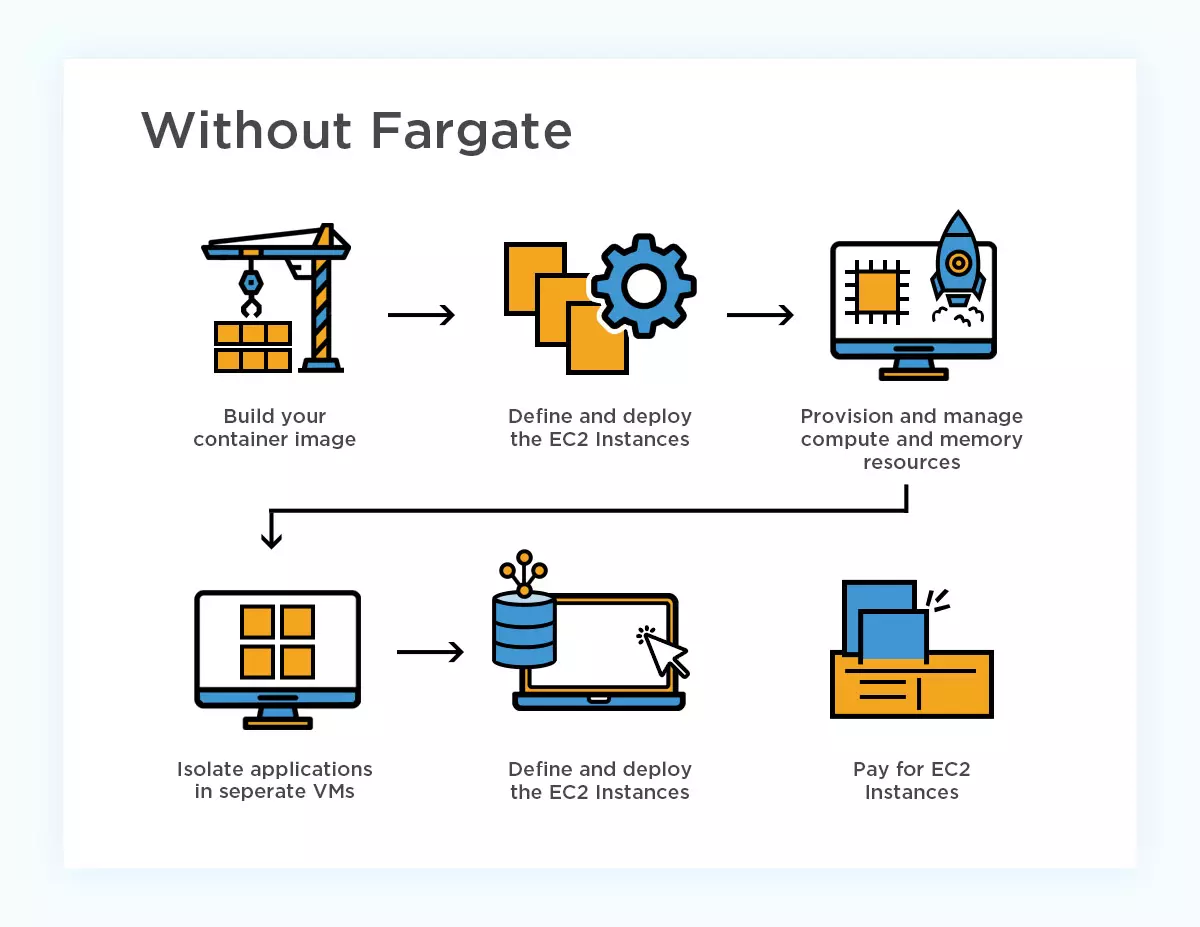
Here’s how running containers in AWS with Elastic Compute Cloud (EC2) instances works:
Now, here’s how AWS Fargate introduces serverless computing into container management in AWS:
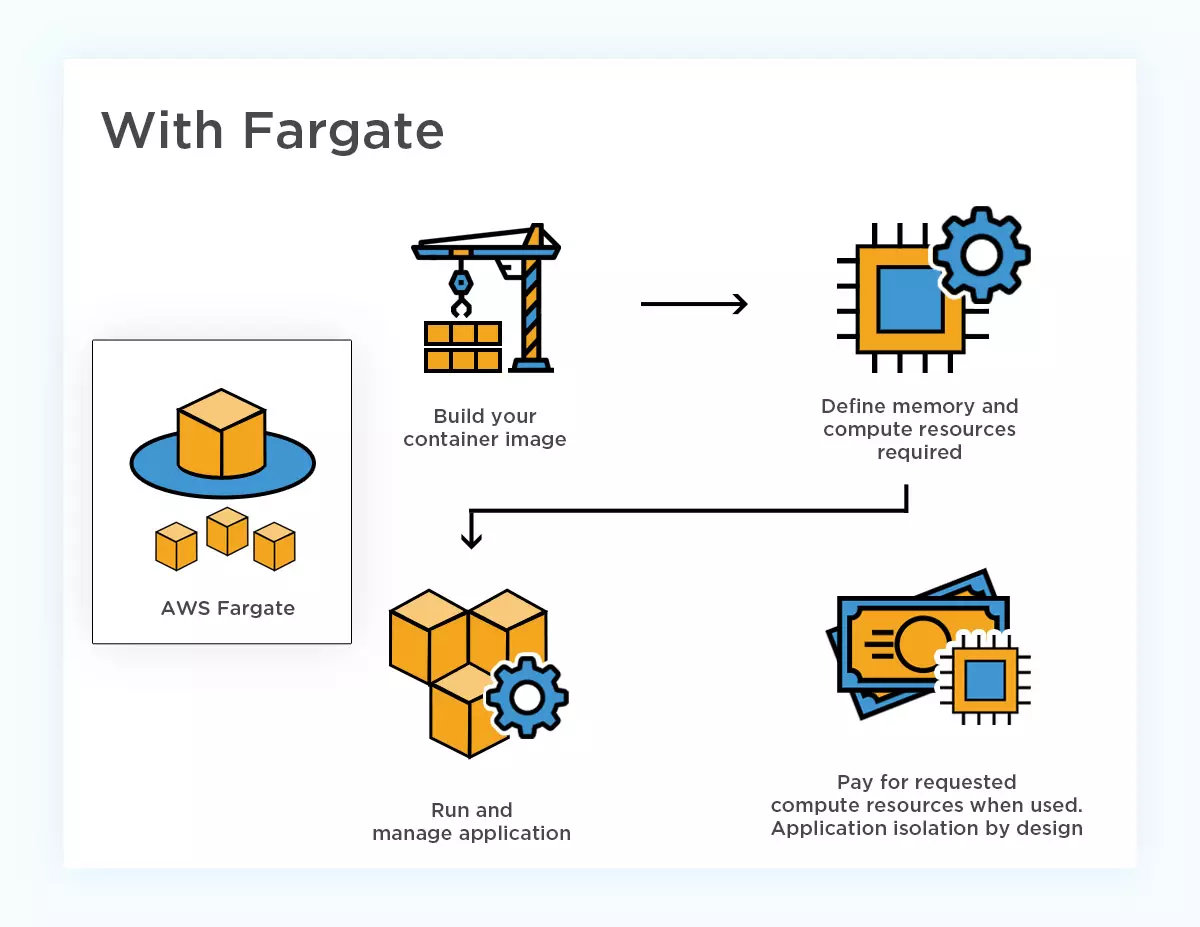
From the image, Fargate abstracts away many of the tasks you’d otherwise need to handle manually.
You don’t need to choose the right server types, manually scale instances, or patch many issues. AWS handles that for you. Your primary focus is optimizing your code for service delivery, which increases productivity, streamlines management, and reduces operational costs. In practice, this also means you control how long compute stays allocated, which directly affects baseline and steady-state costs.
All this also makes Fargate primarily a Container-as-a-Service (CaaS) offering. It works as an operational mode in Amazon Elastic Container Service (ECS) for Docker-based containers.
Fargate also seamlessly integrates with the Elastic Kubernetes Service (Amazon EKS) for Kubernetes-based containers. Each EKS pod or ECS task runs in its own isolated, dedicated runtime environment, further securing it.
Report
Finance needs to prove AI’s return: CloudZero report
260 senior finance leaders (more than half CFOs) told us why the speed of seeing AI spend, not the size of it, separates who pulls ahead on AI from who gets burned.
What Is AWS Lambda?
AWS Lambda is an event-driven, serverless compute service that runs code as functions without requiring you to manage servers. It is commonly categorized as a Function-as-a-Service (FaaS) offering.
Lambda automatically executes code in response to events from AWS services, such as when an object is uploaded to Amazon S3, an API request is received, or a scheduled event is triggered.
Each Lambda function runs in an isolated execution environment. AWS handles infrastructure provisioning, scaling, availability, and patching, while you manage only the function code, configuration, and permissions. This makes Lambda well-suited for short-lived, event-driven workloads. It also means Lambda costs tend to scale with execution frequency and duration, rather than with reserved or continuously running capacity.
Here are more comparisons between Lambda and Fargate.
AWS Fargate Vs. Lambda: Navigating Their Differences
AWS Fargate and AWS Lambda are powerful serverless options that serve different needs.
The most important distinction to keep in mind is that Lambda bills per execution, while Fargate bills for allocated resources over time.
Key differences at a glance:
- AWS Lambda charges per execution and scales to zero when idle
- AWS Fargate charges for allocated CPU and memory while tasks run
- Lambda favors spiky, event-driven workloads with unpredictable traffic
- Fargate favors steady, long-running services with consistent demand
- Cost differences are driven more by workload behavior than service pricing
Here’s how they compare:
Cost
At CloudZero, we treat cost as a first-class metric, so we’ll start with AWS Fargate vs. Lambda pricing — a comparison that trips up many teams. Both services use a pay-as-you-go model, where you pay only for the resources you use — for idle capacity. (See our Lambda pricing guide for a full breakdown of how Lambda billing works.)
Also, note that Fargate and Lambda use entirely different billing models, so comparing them side by side is tricky — but we’ll do our best.
AWS Lambda pricing
AWS Lambda is billed per request and execution duration, measured in milliseconds. Cost scales with how often functions run and how long they execute. When functions are idle, Lambda does not incur compute charges, which is a key driver of its cost efficiency for spiky workloads. Memory allocation determines the amount of CPU assigned to each invocation.
Want to learn more about AWS Lambda billing, including examples and calculations in one place?
Check out our Lambda pricing guide here.
AWS Fargate pricing
AWS Fargate is billed based on the vCPU, memory, operating system, and storage resources allocated to running containers, measured per second with a minimum charge (Linux and Windows differ). You pay for resources while tasks run, regardless of application activity within the container. This means Fargate can incur costs even during low utilization periods if tasks remain running.
Additional costs apply for data transfers. Using other AWS services with Fargate also incurs additional costs, such as monitoring Fargate with Amazon CloudWatch Logs.
Related read: AWS Data Transfer Pricing Guide And How To Reduce Costs
However, Fargate lets you use AWS Savings Plans (up to 50% off Fargate On-Demand pricing) and AWS Fargate Spot (up to 72%).
If you want to learn more about AWS Fargate pricing, we have a guide on how much Fargate really costs here.
At a glance: It is tempting to compare Lambda and Fargate pricing head-to-head. But that might not be the best approach. To determine which service best fits your workload requirements and budget, we recommend reviewing the remaining comparison points below.
Setup and maintenance
With AWS Fargate, you package applications as containers and define operating system, CPU, memory, networking, and IAM permissions. AWS manages the underlying compute infrastructure, including EC2 provisioning, scaling, patching, and availability.
With AWS Lambda, you deploy individual functions. AWS manages the entire runtime environment, scaling behavior, operating system, and infrastructure lifecycle. You only manage function code, configuration, and permissions.
At a glance: AWS Lambda requires much less setup and runtime effort than AWS Fargate. However, Fargate hands you more control over your container runtime than Lambda.
Development
AWS Lambda supports function-based development using managed runtimes, container images, or custom runtimes. Functions are designed to be small, stateless, and event-driven.
You can also deploy Docker images with Lambda.
In addition, you can use other programming languages in Lambda by implementing a custom runtime. A runtime interface handles invocation events and responses in Lambda’s execution environment. You can deploy a custom runtime along with your function code — or as a compute layer.
AWS Fargate supports container-based development using Amazon ECS or Amazon EKS. You define task definitions that specify container images, resource requirements, networking, and operating system options.
At a glance: With Fargate and Lambda, you don’t have to choose the right server types, manually scale instances, or patch many issues in development or production. But if you need more control over your setup, AWS Fargate offers it compared to AWS Lambda.
Performance
AWS Lambda automatically scales in response to events and can scale down to zero when idle. This makes it well-suited for unpredictable traffic patterns, though Lambda cold starts can introduce latency when functions are invoked after periods of inactivity.
AWS Fargate scales by adding or removing container tasks. It does not scale to zero by default, but running tasks remain warm, which avoids cold-start latency for long-running services.
Lambda assigns CPU based on memory configuration and enforces execution time limits. Fargate allows explicit CPU and memory selection and supports significantly larger workloads. From a cost perspective, Lambda emphasizes elasticity and scale-to-zero, while Fargate emphasizes predictability and sustained throughput.
Monitoring
AWS Lambda automatically publishes logs and metrics to Amazon CloudWatch, including invocation counts, duration, errors, and concurrency.
AWS Fargate integrates with CloudWatch and Container Insights to expose container-level CPU, memory, and task metrics. Monitoring requires more configuration but provides deeper visibility into runtime behavior.
Read more: CloudWatch Metrics Your Organization Should Track
Security
Both AWS Lambda and AWS Fargate follow AWS’s shared responsibility model and provide strong isolation by default. For teams building on these services, serverless architecture design patterns can help structure workloads for both security and cost efficiency.
Lambda assigns IAM roles at the function level and runs each function in an isolated execution environment.
Fargate assigns IAM roles to tasks or pods and runs each task in its own isolated compute environment, without sharing CPU, memory, kernel, or networking resources.
At a glance: Lambda and Fargate both offer built-in security. You still need to secure your functions and containers. This is especially true for Fargate because it gives you more control, which can increase the risk of security misconfigurations. Tools like Sysdig can help you secure your Fargate container deployments from source to run.
Use Cases
With time, Fargate and Lambda have become increasingly capable of handling similar workloads. But, as you’ve seen, each is stronger in certain areas.
With Lambda, you get seamless, speedy, and automated scaling, a fully managed serverless solution, out-of-the-box logs monitoring, and a compute solution for temporary tasks, among other Lambda use cases. Yet Lambda’s cold start issue might make it unsuitable for latency-sensitive tasks.
With Fargate, you can run long-running containerized tasks, choose your runtime environment, and experience fewer limitations on vCPU, RAM, and ephemeral storage usage — or explore AWS Fargate alternatives if you need multi-cloud flexibility. That is in exchange for registering and updating containers in Amazon ECS, configuring Fargate resources, and monitoring them yourself.
Although ECS offers maximum configurability, it is also the most complex to implement. At the other end of that spectrum is AWS Lambda, a full-fledged serverless computing service (nearly no management complexity but offers minimal control). AWS Fargate sits somewhere in the middle.
At a glance: Compared to Lambda, Fargate offers more control and lower costs, while AWS does most of the heavy lifting for you.
How To Measure, Monitor, And Control AWS Lambda And Fargate Costs
Using AWS Lambda or AWS Fargate not only relieves you of managing server clusters but can also lower your AWS costs compared to Amazon ECS. The problem with serverless infrastructure is that it’s often difficult to visualize, analyze, and optimize costs.
It’s critical to have a platform that accurately collects, analyzes, and reports serverless resource usage metrics. However, most cost management tools aren’t up to the job; they require you to update cost allocation tags continually.
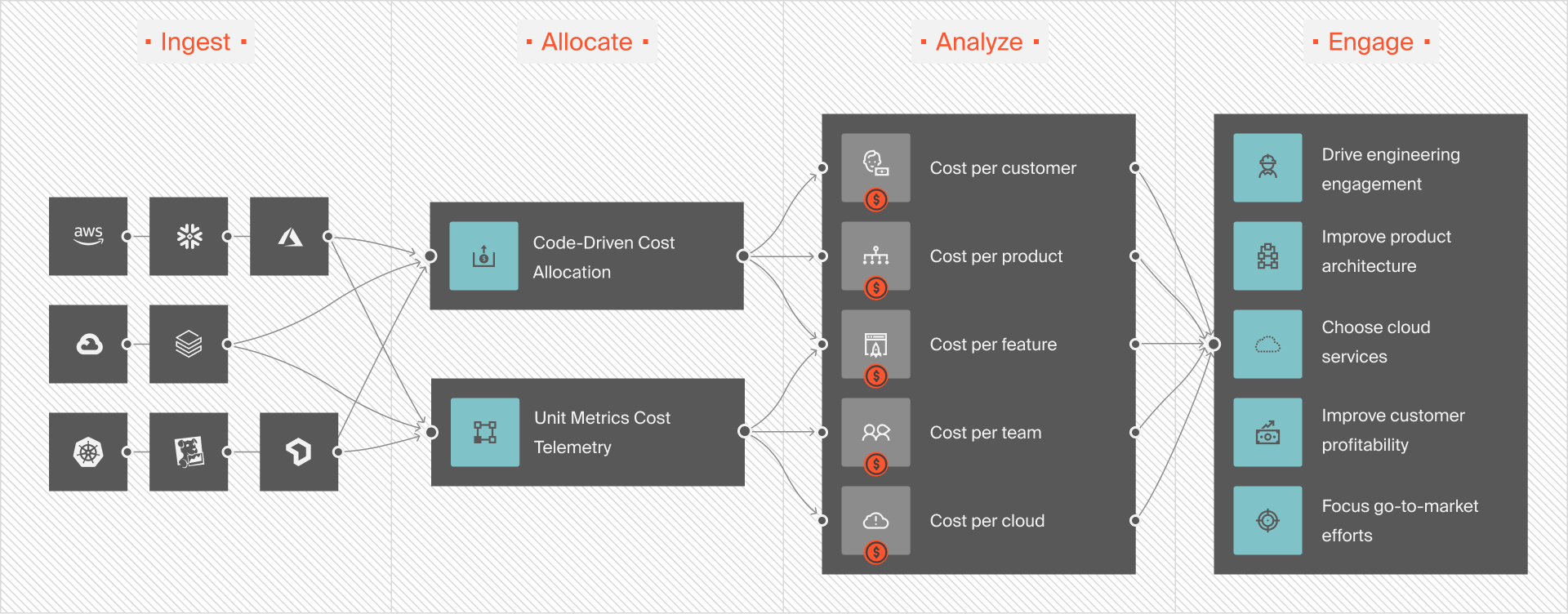
With CloudZero, you can accurately track AWS Lambda or AWS Fargate costs without tagging. We’ve also built CloudZero on serverless infrastructure, treating it as an observability tool rather than a mere cost tool. This provides you with continuous cost insight into metrics you care about: cost per customer, cost per software feature, cost per team, cost per product, and more.
You can also track your containerized and non-containerized costs down to the hour, cluster, namespace, and pod.
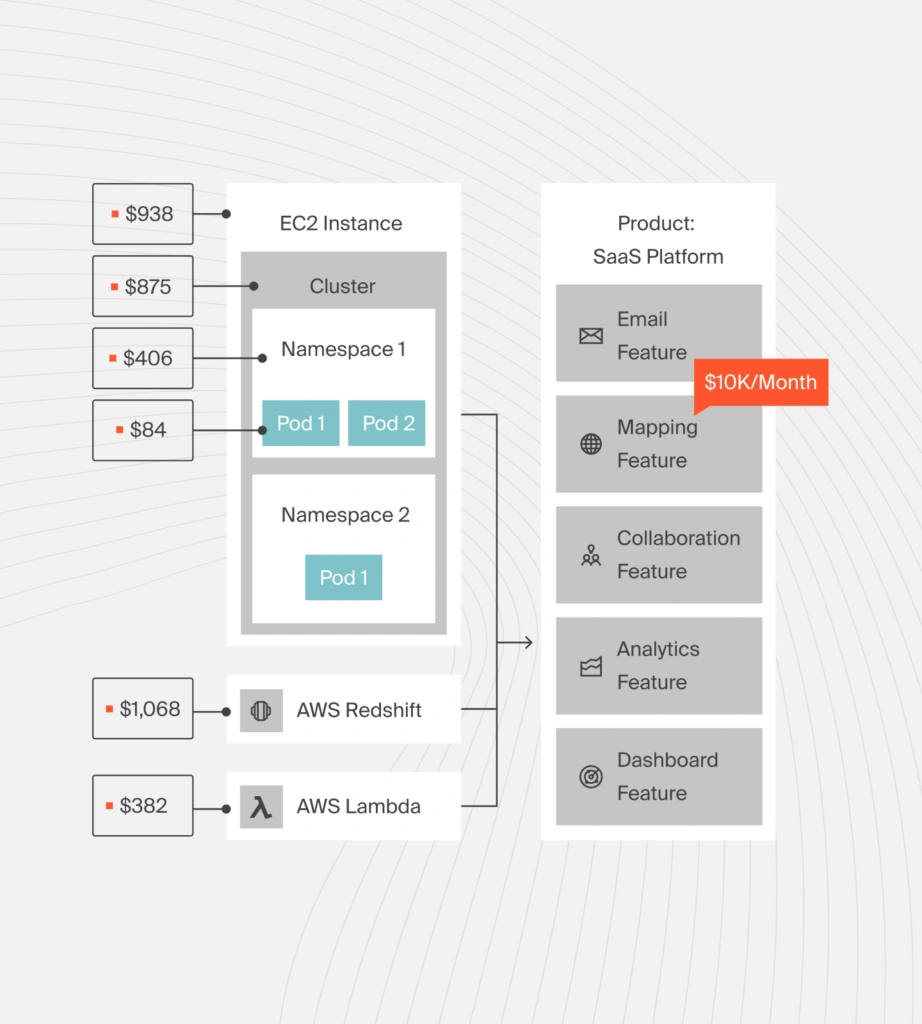
CloudZero maps costs to the people, products, and processes that generate your costs. You can then pinpoint where to optimize costs to improve your margins. CloudZero also monitors your Fargate and Lambda deployments in real time and notifies you of cost anomalies to prevent overspending.
But don’t just take our word for it. Get a product tour or  to see CloudZero in action!
Frequently Asked Questions about Fargate vs. Lambda