Quick Answer
Confluent Cloud pricing follows a consumption-based pricing model billed across four dimensions: Stream (Kafka clusters via eCKUs/CKUs per hour), Connect (connectors per GB + task/hour), Process (Flink via CFUs per minute), and Govern (Schema Registry per environment/hour). A confluent cloud standard cluster pricing tier runs $1,000–$3,000/month for standard production workloads. Confluent cloud dedicated cluster pricing with governance features can reach $50,000–$200,000+ monthly. New accounts receive $400 in free credits valid for 30 days. Understanding Confluent Kafka pricing is critical because costs vary widely by cluster type, throughput, and add-on services.
If your Confluent bill has ever made you question your career choices, you’re in the right place. This guide breaks down every billing dimension, runs a managed Kafka pricing comparison against alternatives, and shows where confluent cloud cost optimization opportunities live, starting with how CloudZero customers track their Confluent spend alongside $15 billion in total managed cloud spend across organizations such as Toyota, Duolingo, Drift, Coinbase, and Skyscanner.
What Is Confluent Cloud And What Does Confluent Do?
For teams evaluating their options: what is Confluent Cloud? It’s a fully managed event streaming platform built on Apache Kafka, offered by Confluent, the company founded by Kafka’s original creators.
What is Confluent Kafka? It’s the commercial, enterprise-grade distribution of open-source Apache Kafka with added tools for governance, connectors, and stream processing.
What does Confluent do differently from self-managed Kafka? It handles the operational burden such as upgrades, patching, scaling, replication, and disaster recovery, so your engineers can focus on building pipelines instead of babysitting brokers. Whether that trade-off is worth the event streaming platform cost depends on your team’s Kafka expertise and your workload profile.
CloudZero tracks Confluent as a first-class cost source via the AnyCost™ API, unifying it with AWS, Azure, GCP, and SaaS spend, because a Kafka cluster never exists in isolation.
Report
Finance needs to prove AI’s return: CloudZero report
260 senior finance leaders (more than half CFOs) told us why the speed of seeing AI spend, not the size of it, separates who pulls ahead on AI from who gets burned.
How Does The Confluent Cloud Pricing Model Work?
The Confluent pricing model is confluent cloud pay as you go; you pay only for what you consume. That sounds simple until you realize “what you consume” is metered across four independent billing dimensions running simultaneously:
- Stream covers your Kafka clusters. This is where most of your kafka streaming cost lives. Clusters are billed for eCKUs or CKUs per hour, networking per GB, and storage per GB-hour.
- Connect charges for managed connectors. Confluent connector pricing, including confluent cloud connector pricing, is based on throughput per GB plus a task base price per task/hour. Ten connectors pulling from databases and Amazon S3 can rival your cluster cost.
- Process covers stream processing via Apache Flink. Confluent cloud flink pricing is calculated in Confluent Flink Units (CFUs) per minute. Continuous 24/7 jobs multiply that small per-minute rate into 43,200 minutes/month.
- Govern bills for Stream Governance features. Confluent schema registry pricing, listed as confluent cloud schema registry pricing, covers data lineage and data quality, charged per environment per hour.
All pricing uses binary gigabytes (1 GB = 2^30 bytes) and varies by cloud region. Confluent cloud billing computations run in UTC.
The multi-dimensional nature of this model is exactly why organizations such as Coinbase use CloudZero’s cost allocation engine to see the full cost of a streaming pipeline, not just the Kafka line item in isolation.
What Are The Confluent Cloud Cluster Types And Their Costs?
Your confluent cluster pricing depends first on which of the five cluster types you choose. Choose wrong, and you’ll either overpay for idle capacity or hit scaling limits at the worst moment.
Here’s the cluster comparison table:
|
Basic |
Standard |
Enterprise |
Freight |
Dedicated | |
|
Best for |
Dev/test |
Production |
Multi-region production |
High-volume batch |
Mission-critical |
|
Billing unit |
eCKU (elastic) |
eCKU (elastic) |
eCKU (elastic) |
eCKU (elastic) |
CKU (fixed) |
|
Max throughput |
100 MB/s |
1 GB/s |
10+ GB/s |
High (batch) |
Scales with CKUs |
|
SLA |
None |
99.95% |
99.95% |
99.95% |
99.95% |
|
Private networking |
No |
No |
Yes — PNI, PrivateLink |
No |
Yes — VPC peering, PrivateLink, Transit Gateway |
|
Pay at zero usage |
$0 |
$0 |
$0 |
$0 |
Full CKU cost |
|
Max CKU limit |
— |
— |
32 eCKU (AWS PNI) |
— |
252 (AWS), 152 (GCP), 100 (Azure) |
Basic, Standard, Enterprise, and Freight clusters are elastic, at zero consumption (no partitions, no topics, no traffic), you pay nothing. Dedicated clusters charge for provisioned CKUs whether you use them or not. That’s the difference between a taxi meter and a monthly car lease.
What Is A CKU In Confluent Cloud?
People frequently ask what is CKU in Confluent Cloud: a CKU (Confluent Unit for Kafka) is a unit of horizontal scaling for Dedicated clusters that provides preallocated compute, throughput, and storage. Confluent CKU pricing accrues hourly based on configured capacity. An eCKU (Elastic CKU) powers the elastic cluster types. It autoscales and only charges for capacity actually consumed, with a minimum charge if there’s any usage.
As of April 2024, Confluent transitioned Basic and Standard clusters from legacy “Base + Partitions” billing to eCKUs. Organizations created before that date may still be on the old model.
CloudZero is the only cloud cost intelligence platform that connects Confluent cluster costs to business outcomes, showing not just “Dedicated costs $X/month” but “this cluster costs $X per pipeline, per team, per customer” using unit economics.
How Much Does Confluent Cloud Cost? Real Estimates by Deployment Size
How much does Confluent Cloud cost? Here are actual numbers from Vendr’s anonymized buyer data and Confluent’s billing documentation.
Monthly cost estimates:
|
Deployment Profile |
Cluster Type |
Estimated Monthly Cost |
|
Dev/test, low traffic |
Basic |
$50–$300 |
|
Small production |
Standard |
$1,000–$3,000 |
|
Mid-size prod + governance |
Enterprise |
$5,000–$20,000 |
|
High-volume batch |
Freight |
$3,000–$15,000 |
|
Private networking, isolation |
Dedicated (2+ CKUs) |
$10,000–$50,000+ |
|
Large-scale multi-cluster |
Multiple Dedicated |
$50,000–$200,000+ |
How much does Kafka cost when self-managed? Confluent platform pricing (self-managed) carries annual subscription licensing of $50,000–$500,000+. Confluent Kafka on premise pricing and confluent on premise pricing require a sales conversation.
Confluent enterprise pricing and confluent cloud enterprise pricing sit in the $5,000–$20,000/month range for most mid-size deployments, much less than dedicated but with features like PNI networking and fast scaling up to 10 eCKUs.
These ranges shift based on throughput, retention period, and add-on services. Tracking actual costs matters more than estimating them, which is why CloudZero maps real spend to business dimensions in real time, not forecasts.
What Are The Hidden Costs In Confluent Cloud?
Every cloud engineer has a war story about the bill that didn’t match expectations. Here’s where the surprises live in Confluent Cloud cost.
1. The 3x storage replication multiplier
Confluent Cloud stores data with a replication factor of three for high availability, and you’re billed for the total post-replication volume. This is not configurable. Write 100 GB, pay for 300 GB. Combine that with a 30-day retention window and the math gets uncomfortable fast.
2. Confluent cloud egress cost and networking
Confluent Cloud egress cost hits per GB of data transferred. Confluent Cloud networking cost escalates further with private networking on Enterprise and Dedicated clusters, VPC peering, PrivateLink, and Transit Gateway each add per-hour and per-GB charges. Cross-region replication amplifies this. It’s the Confluent equivalent of AWS data transfer fees: death by a thousand tiny line items.
3. Connector, ksqlDB, and processing creep
Confluent Cloud ksqlDB pricing and Confluent Flink pricing follow similar patterns, continuous processing jobs at pennies per minute multiply into substantial monthly charges. Stale connectors nobody queries still cost money every hour.
4. Tableflow
Confluent Tableflow pricing, for turning topics into Iceberg or Delta Lake tables, adds its own billing dimension for materialization and storage.
Related: CloudZero’s anomaly detection has surfaced over $20 billion in anomalous spend across customers like Grammarly, Moody’s, and Coinbase, catching runaway connectors and forgotten Flink jobs before they double your bill.
Confluent Cloud Vs Amazon MSK Pricing: How Do They Compare?
The Confluent Cloud vs AWS MSK comparison, also searched as AWS MSK vs Confluent pricing, is the most common evaluation in the managed Kafka pricing comparison space. How expensive is Confluent relative to AWS?
Here’s the confluent pricing comparison side by side.
|
Confluent Cloud |
Amazon MSK Provisioned |
Amazon MSK Serverless | |
|
Billing model |
eCKU/CKU + throughput + storage |
Broker-hour + storage + throughput |
Cluster-hour + throughput + storage + partitions |
|
Production entry cost |
~$1,000–3,000/month |
~$500–2,000/month |
~$300–1,500/month |
|
Free tier |
$400 credit, 30 days |
None |
None |
|
Schema Registry |
Built-in (Govern tier) |
Separate (AWS Glue) |
Separate (AWS Glue) |
|
Managed connectors |
Yes (Connect tier) |
Separate (MSK Connect) |
Separate |
|
Stream processing |
Flink (built-in) |
Separate (Kinesis, Lambda) |
Separate |
|
Private networking |
Enterprise/Dedicated |
All tiers |
All tiers |
When you include Schema Registry, connectors, and stream processing, total pipeline cost between Confluent Cloud and Amazon MSK is often comparable — the difference is what you build yourself versus what comes bundled.
Confluent costs more at the base Kafka level but bundles a broader platform. MSK is cheaper for pure brokering but requires stitching together separate AWS services for equivalent functionality. Which managed Apache Kafka service is best? Teams with less Kafka expertise and spikier workloads favor Confluent. Teams with experienced engineers and steady workloads extract more value from MSK’s lower base cost.
Either way, understanding the full cost of your streaming infrastructure is where CloudZero makes the difference, mapping Confluent, AWS, and all SaaS costs into unit economics like cost per pipeline and cost per event.
What Is The Confluent Cloud Free Tier?
Is Confluent Kafka free to use? Apache Kafka itself is open source and free. Confluent Cloud is a paid managed service. The Confluent Cloud free tier gives new accounts $400 in free credit, valid for 30 days, applied automatically.
During the trial, you get access to Basic clusters (100 MB/s throughput, 5 TB storage), connectors, Schema Registry, and Flink. You must add a payment method to create resources, but you’re not charged until the trial ends. The trial cannot be paused.
After the trial, Basic clusters at zero consumption cost $0. You only pay when data flows.
How Does The Confluent Cloud Pricing Calculator Work?
The Confluent pricing calculator, officially the Confluent Cost Estimator, projects costs based on cluster type, throughput, retention, and add-on services. The Confluent Cloud pricing calculator is useful for ballpark figures, but some configurations require a contact form rather than showing a live estimate.
Real-world costs depend on traffic patterns, consumer fan-out ratios, and connector usage that are hard to predict in advance. For actual post-deployment cost tracking, CloudZero maps real spend to business dimensions, not estimates.
7 Strategies For Confluent Cloud Cost Optimization
Confluent Cloud spend management improves when you treat it as an ongoing FinOps discipline, not a one-time project.
- Right-size your cluster type. Running Dedicated when Enterprise or Standard would suffice is the most expensive mistake. Elastic eCKU clusters eliminate idle capacity charges.
- Shorten retention periods. The 3x replication multiplier means every extra day of retention costs three times what you’d expect. Offload older data to cheaper storage via Tableflow or S3.
- Negotiate committed spend. Confluent cloud committed spend agreements provide discounts across the entire stack. Confluent cloud discount tiers are available for multi-year commitments. Vendr’s data shows buyers commonly achieve below-list pricing.
- Audit connectors and Flink jobs monthly. Stale connectors syncing unused data are the Confluent equivalent of idle EC2 instances.
- Set eCKU ceiling caps. For elastic clusters, set a lower maximum eCKU to cap scaling and spending, the Confluent version of setting a cloud budget with guardrails.
- Consolidate governance environments. Each Stream Governance environment incurs hourly charges. Disable governance in non-production where possible.
- Track spend by business dimension, not just service. This is where most teams hit a wall. CloudZero connects Confluent costs to products, features, teams, and customers, enabling decisions like “is this pipeline worth what it costs per event?” rather than just “how much did Kafka cost?” Drift saved $4 million annually and Upstart cut $20 million using this approach.
How To Track And Allocate Confluent Cloud Costs With CloudZero
Confluent Cloud’s built-in billing dashboard shows spend by cluster and service. That’s useful for “what did Kafka cost this month?” but it can’t answer “which team’s pipeline is driving the spike?” or “what’s our cost per streaming event?”
Kafka clusters are shared infrastructure. Multiple teams and pipelines share the same cluster. Without telemetry-driven allocation, you’re stuck splitting costs evenly, meaning nobody owns the spend and nobody optimizes it.
CloudZero solves this differently. Its patented CostFormation engine allocates 100% of spend, including shared, containerized, multi-tenant, without requiring re-tagging. Remitly, a CloudZero customer allocated 50% more costs without adding a single tag.
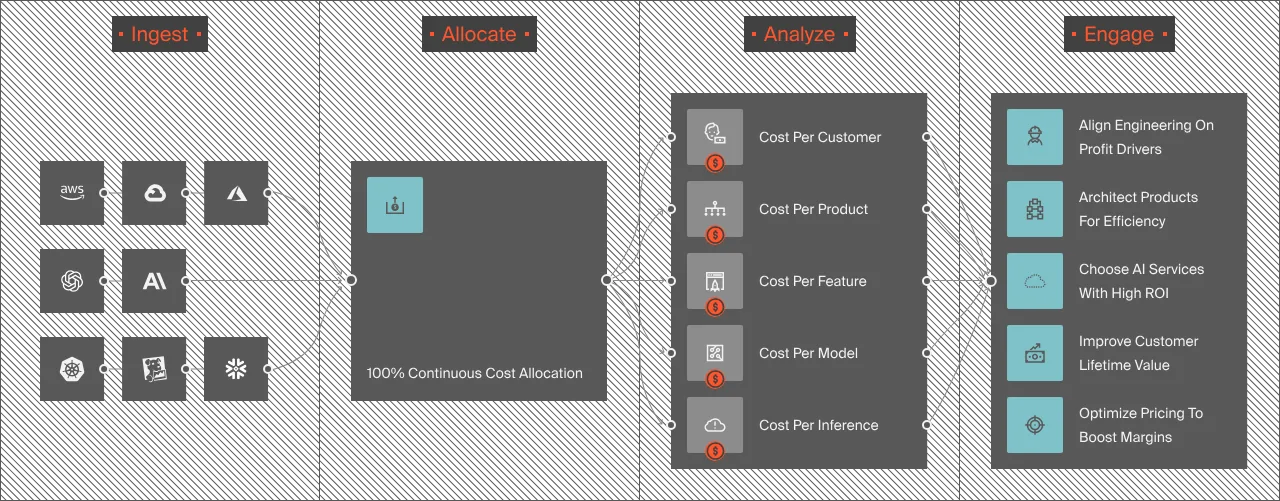
Here’s what CloudZero uniquely delivers for Confluent and Confluent Cloud kafka pricing visibility:
- Cost per pipeline and cost per team. See exactly what each streaming pipeline costs tied to the engineering team that owns it, using CloudZero’s Dimensions framework.
- Cost per customer and cost per feature. A global SaaS platform with 40 million users used CloudZero to drive $1M+ in savings, including a 50%+ reduction in compute spend.
- Native AI cost intelligence. CloudZero integrates OpenAI, Anthropic, and other AI providers alongside infrastructure costs. If your streaming data feeds ML inference pipelines, see cost per token next to cost per Kafka event.
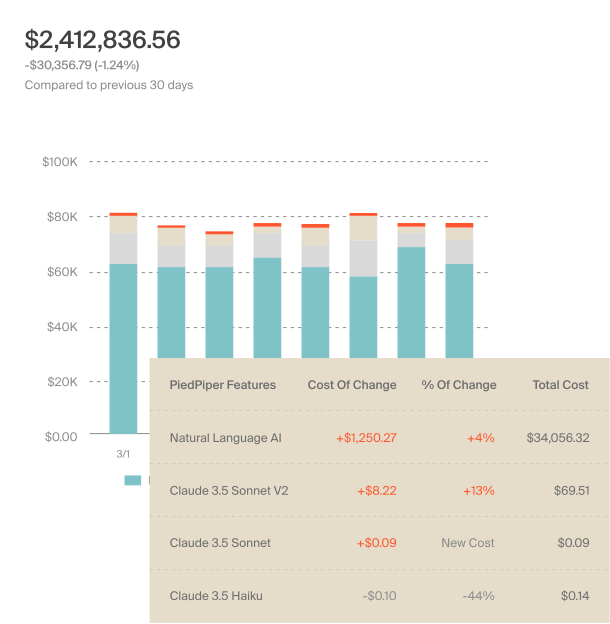
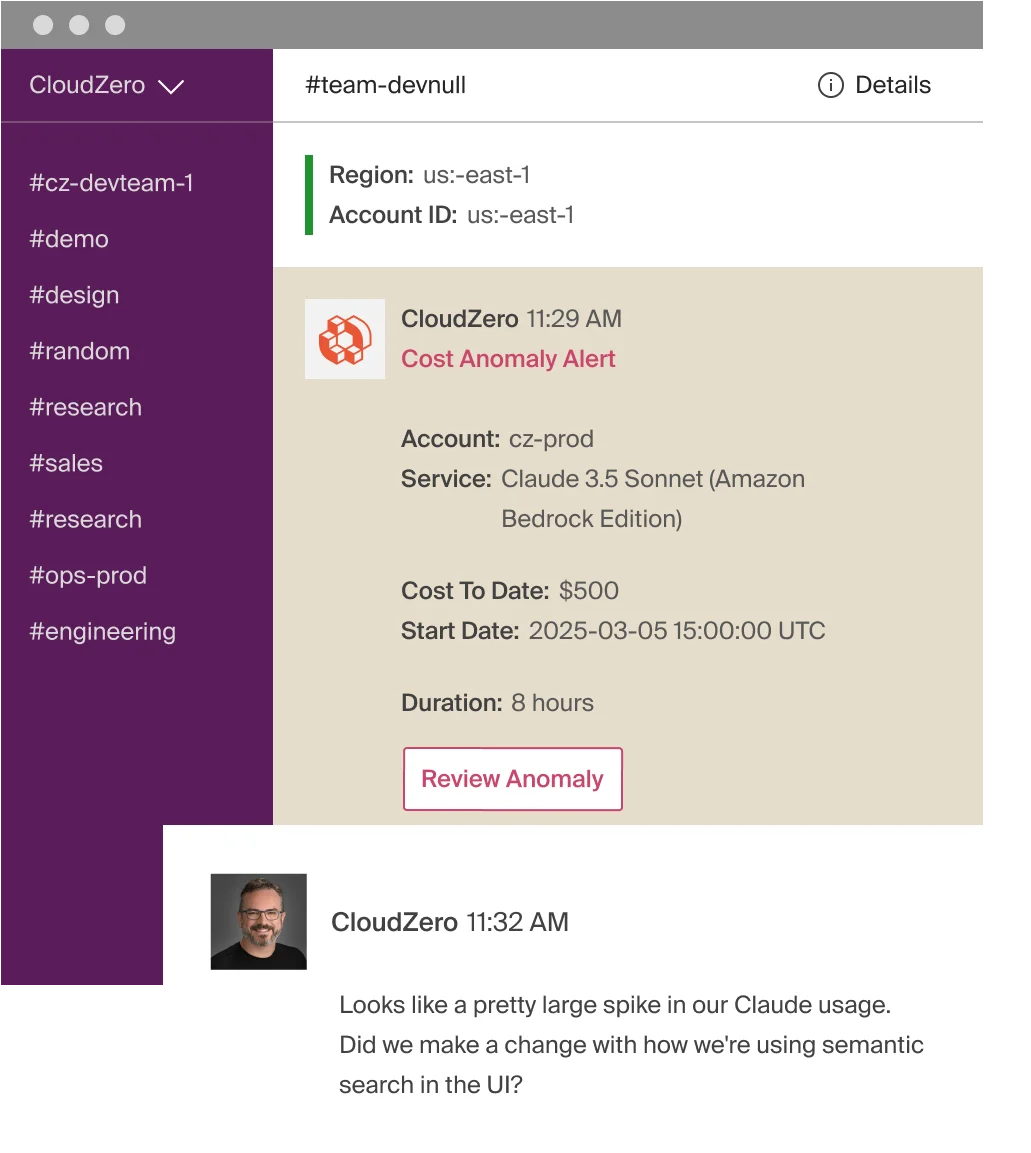
- Real-time anomaly detection. CloudZero has caught over $20 billion in anomalous spend before it hit customer bills, including runaway connectors and forgotten processing jobs.
CloudZero manages over $15 billion in cloud spend across Toyota, Duolingo, Drift, Coinbase, Skyscanner, Wise, Klaviyo, Miro, Rapid7 and more. Customers save an average of 22% in year one and cover their subscription within three months.  to see CloudZero’s Confluent integration in action.
Frequently Asked Questions About Confluent Cloud Pricing