Modern FP&A tools help SaaS businesses analyze financial performance in real time, forecast accurately, and align spend with business priorities — especially cloud spend, which can quickly spiral without visibility.
The tools automate much of the work involved, help you identify where you could be losing money, and reveal additional revenue streams you can capitalize on.
At a time when SaaS competition is at an all-time high, you need all the advantages at your disposal to deliver the most value at the least cost. This can help you improve your margins, attract more investors, and generate enough profits to fund your growth.
In this FP&A software guide, we’ll share solutions to help you address different areas of your SaaS business, including cloud cost optimization, accounting, payroll, budgeting, and forecasting.
What Is Financial Planning And Analysis (FP&A)?
FP&A is a strategic function that connects financial data to business performance. It combines analysis, planning, budgeting, and forecasting, often in close partnership with product, engineering, and cloud operations teams. These practices explain financial performance and uncover growth opportunities.
Financial planning and analysis go beyond simply keeping records to examining why a company’s finances are the way they are and what the future might look like.
FP&A teams analyze economic and industry trends, assess past financial performance, and seek to anticipate challenges before they arise, aiming to forecast and influence the company’s future financial performance.
What is the difference between FP&A and finance?
FP&A differs from traditional finance by taking a more strategic, data-driven approach. In contrast, traditional finance relies on historical data to determine an organization’s current financial health.
Finance has traditionally focused on recordkeeping, accounting, financial compliance, and payroll.
Meanwhile, FP&A teams review a company’s financial activities and create a roadmap. Often, the team works with other teams to achieve company-wide financial goals, such as improving cost efficiency across engineering and product.
Take FP&A analysts at a SaaS company, for example.
They will:
- Assess which customers, products, or software features generate the highest profit (not just revenue) and communicate this to decision-makers.
- Help marketing and customer acquisition teams target this profitable customer segment to grow future margins.
- Or they can recommend retiring unprofitable or least profitable software features to fund the most used and profitable features in their SaaS product.
- Or, they recommend gradually migrating some or all operations to the cloud, rather than on-premises, to improve margins, boost service delivery, and shift from CapEx to OpEx.
FP&A analysts typically report to the Chief Financial Officer (CFO), the person ultimately responsible for managing an organization’s financial health.

FP&A Process: How To Do Financial Planning And Analysis
The FP&A process is very similar to traditional financial activities. However, FP&A work involves more scenario planning, financial modeling, cost-efficiency analyses, capital allocation (rather than just capital reporting), and uncovering new income streams.
Here’s a snapshot of the process.
- Collect data – The team collects all relevant financial data from internal departments and external sources. They consolidate it so it is easy to work with and verify, thereby eliminating errors.
- Plan and forecast – The FP&A team then works with other business units to create forecasts of each unit’s business trajectory and align them with the entire company’s financial trajectory. They can use various techniques, including scenario, driver-based, and predictive planning.
- Budget – Based on the revenue forecast from the strategic plan, FP&A calculates the cost of funding each department/team/unit’s plan.
- Monitor and analyze – Once funded, the FP&A team continuously tracks budget spending, looking for ways to reduce costs while increasing return on investment. Doing this manually can be extremely challenging, so proactive SaaS companies use robust FP&A software to optimize their financial planning.
- Performance reporting – Regularly report on financial performance to measure progress against forecasts and budgets. This includes generating reports on critical metrics and sharing insights with stakeholders. It ensures timely adjustments to stay on track.
Related read: Good Vs. Bad FP&A: 5 FP&A Best Practices You Should Be Using
How To Choose The Right FP&A Solution For Your Business
Here’s a checklist to guide you in choosing the best FP&A solution for your unique business.
- Identify your business needs. Start by determining the core areas you need to address, such as cloud cost management, payroll processing, accounting, or financial modeling. Some tools specialize in specific areas, while others offer a more comprehensive solution. Match the tool’s core functions with your primary pain points.
- Assess integration compatibility. Look for software that integrates with your current systems (ERP, CRM, accounting) to avoid data silos and streamline workflows. Smooth integration reduces the risk of errors and makes data consolidation easier.
- Consider scalability. Choose a platform that scales as your business grows, with options for adding users, features, and data storage. Scalable tools prevent the need for frequent software changes as your requirements evolve.
- Review security standards. Ensure the tool meets security and compliance requirements, especially if handling sensitive financial data. Key features include encryption, access controls, and compliance with relevant regulations (e.g., SOC 2, GDPR).
- Prioritize real-time data access. FP&A involves working closely with different teams. Choose a tool that enables real-time collaboration and offers shared data access. It should also support team transparency to streamline planning and analysis.
- Test usability. A user-friendly interface reduces the learning curve and increases team adoption. Look for a tool with an intuitive design and a robust reputation for usability.
- Look for collaboration features. FP&A often requires input from multiple departments. Tools with shared dashboards, multi-user access, and collaboration features improve alignment and communication.
- Compare pricing models. Review the pricing structures and ensure they align with your budget and usage needs. Some tools offer tiered plans or custom pricing.
- Assess customer support and training. Choose a provider with responsive support and a variety of training options, such as tutorials or webinars.
Pro Tip: If cloud cost visibility is a key driver, prioritize tools that support cost allocation by team, customer, or feature, and integrate with platforms like AWS, GCP, or Kubernetes. Look for platforms that connect technical and financial data in real time.
Below are some of the most widely used FP&A tools for SaaS companies (we’ve organized them into categories).
Cloud Cost Management Software
With more software and tech companies building in the cloud, cloud cost optimization has become an increasingly crucial issue. Although cloud providers like AWS provide flexibility and easy scaling, cloud cost visibility remains hazy.
In addition, Kubernetes, shared costs in multi-tenant applications, and non-taggable AWS spend can all complicate cost allocation. The following cloud cost optimization tools will help you collect, understand, and act on your cloud costs.
1. CloudZero AnyCost – Hybrid cloud cost optimization solution
Best for: Engineering-led FinOps teams seeking real-time cloud cost intelligence
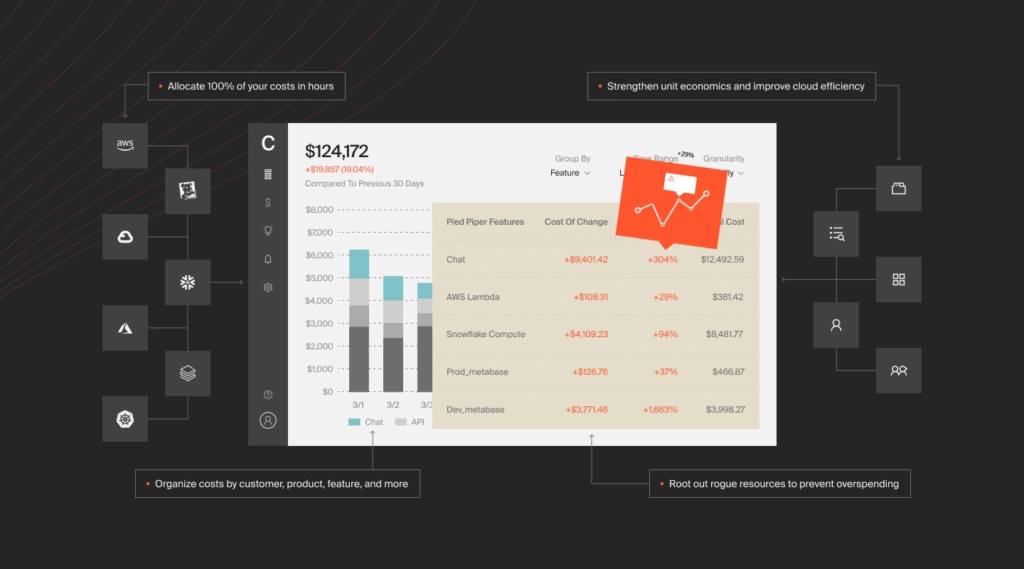
CloudZero is a full-fledged cloud cost intelligence platform for SaaS and tech brands.
With CloudZero, FP&A and finance teams can analyze unit costs in context, connecting spend to specific customers, features, teams, and usage patterns. This allows them to make more informed decisions about pricing, product investment, and margin improvements.
Unlike most cloud cost management tools, CloudZero translates cloud metrics into actionable cost insights that connect to your daily business activities. Check this out:
- Cost per customer – Find out how much you spend to support a specific customer so you can review their contract and develop profitable pricing.
- Unit cost insights – Know how much each product feature, development project, team, etc., costs so you can improve efficiency and achieve economies of scale.
- SaaS COGS analysis and reporting – Understand the cost of goods sold and how to improve your gross margins.
- Kubernetes cost monitoring and reporting – Prevent cost blindspots while you embrace Kubernetes, containerized apps, and multi-tenant infrastructure. No tagging is required.
- Cost anomaly detection and alerting – Leverage real-time anomaly detection to receive timely alerts when CloudZero detects unusual costs, helping prevent overspending.
Using CloudZero AnyCost, you see your cloud costs across AWS, Azure, GCP, Snowflake, Kubernetes, and more. You can tell who, what, and why your costs change, empowering you to tell where to optimize costs or increase investment to improve ROI. Schedule a demo today.
Pricing: Custom to your cloud environment
2. ProsperOps – Autonomous AWS RIs and SP orchestration
Best for: Automated AWS savings and continuous commitment management
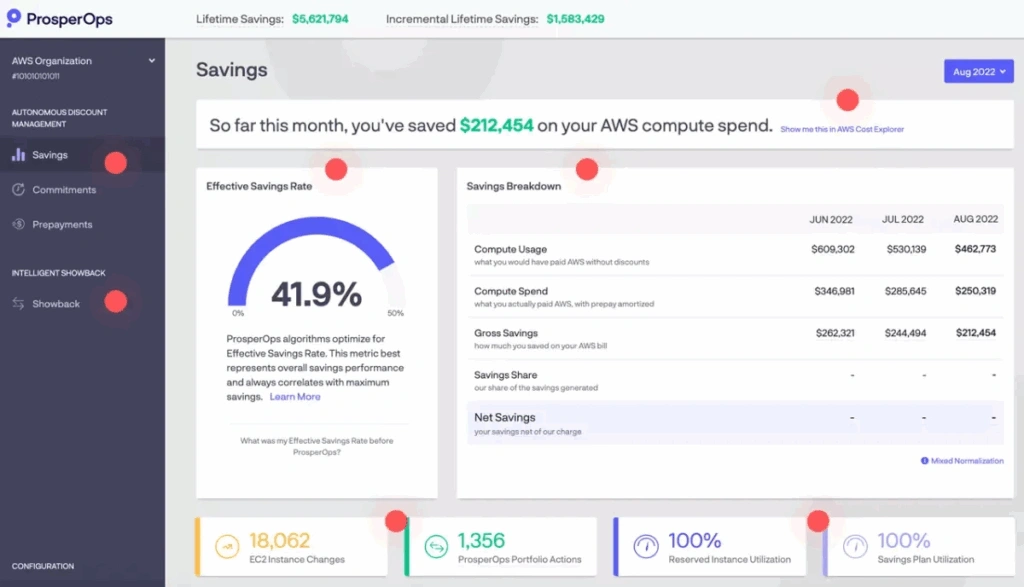
ProsperOps is a cloud financial management tool for companies using Amazon Web Services (AWS). FP&A teams use ProsperOps to leverage discount programs on AWS, such as Savings Plans and Reserved Instances (RIs), by committing to use specific resources for 1 or 3 years.
The tool automatically creates, manages, and optimizes a range of Savings Plans and RIs on your behalf, dynamically adapting them to changes in your cloud environment every hour. This allows you to derisk commitments to use specific AWS services and resources during the contract, even if your consumption patterns change.
And if you’d prefer to use AWS Spot instances — the most affordable option — check out Xosphere.
Pricing: ProsperOps charges a percentage of the savings it generates for you
3. IBM Kubecost – Kubernetes cost management and allocation
Best for: Kubernetes cost visibility and allocation across clusters and teams
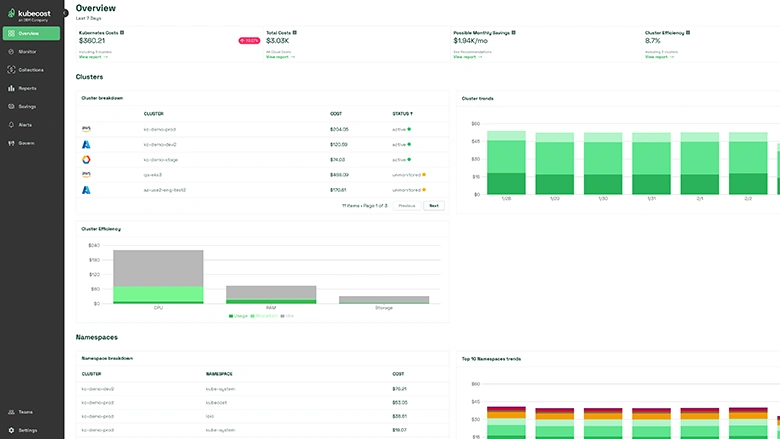
Now part of IBM, Kubecost targets teams that run Kubernetes with a set of K8s cost allocation, monitoring, governance, and optimization tools. With KubeCost, you can break down costs by Kubernetes concepts such as namespaces, services, and deployments, across cloud and on-premises Kubernetes infrastructure.
You can also chargeback or showback costs based on organizational concepts like team, application, project, environment, or department. In addition, you can get recurring cost reports, with costs broken down by namespace, to track trends and efficiency.
Pricing: Team (Free), Business ($449/month – 100 nodes), Enterprise (Upon Request)
4. Harness Cloud Cost Management (HCCM)
Best for: Automating cloud spend optimization and CI/CD cost control
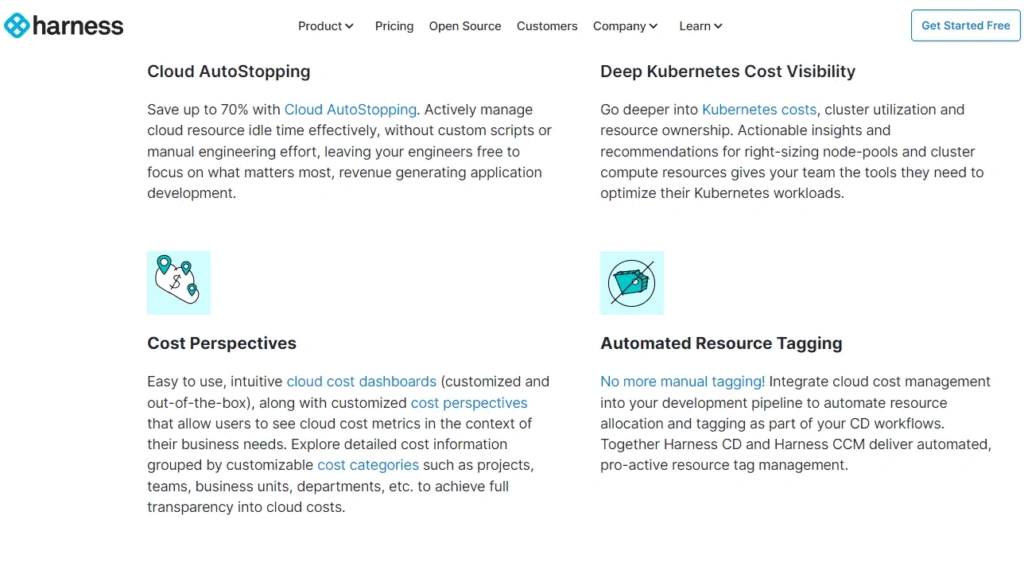
Using tools like the Intelligent Cloud Auto Stopping feature, Harness Cloud Cost Management (HCCM) helps you control costs by dynamically shutting down idle resources. It also provides a Cloud Cost BI solution for monitoring data, resources, databases, and other usage data.
HCCM helps FP&A analysts schedule cloud financial reports, create custom notifications and alerts, and practice cost allocation in the cloud. The platform supports several major cloud services, including AWS, Kubernetes, and Jenkins.
Pricing: Upon Request
Accounting Software
As noted earlier, FP&A covers a lot of traditional financial activities. They do this to gather accurate financial performance data to inform future plans. Here are several accounting software solutions you can look into for your FP&A work.
5. Intuit QuickBooks Online – Accounting software for small and medium-sized businesses
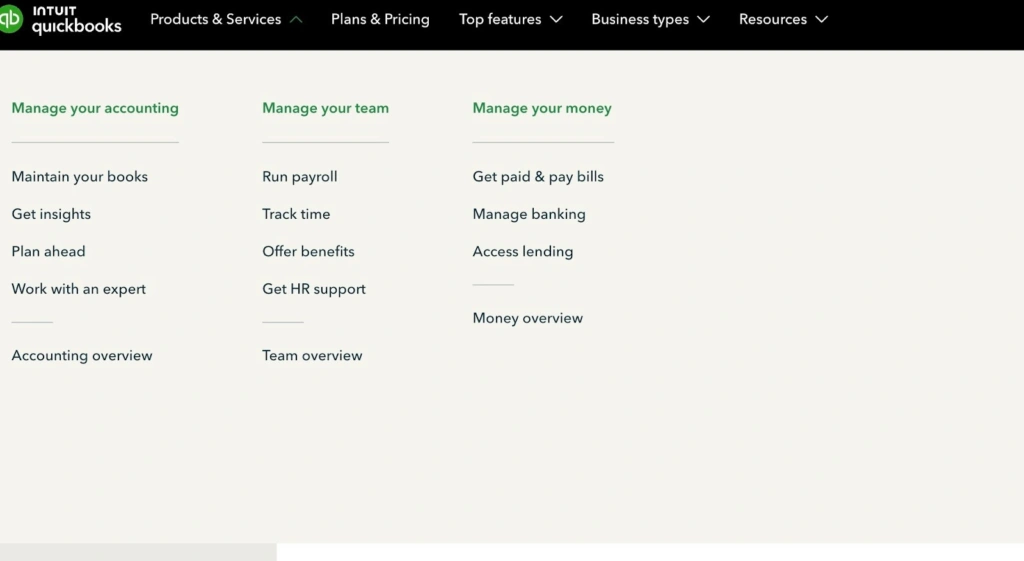
Best for: Small businesses managing budgets, invoices, and simple forecasting
QuickBooks helps small and medium businesses collect, consolidate, and analyze financial performance in one place.
It is a full-featured package with tools for accounting, invoicing, payroll, inventory, and tax filing. It also handles budgeting, payment processing, expense management, bank account management, and reconciliation. Better yet, you can manage your accounts receivable and accounts payable in QuickBooks Online.
Pricing: Simple Start ($8/month), Essential ($12.50/month), Plus ($17/month)
6. NetSuite Cloud Accounting – Oracle’s all-in-one accounting tool
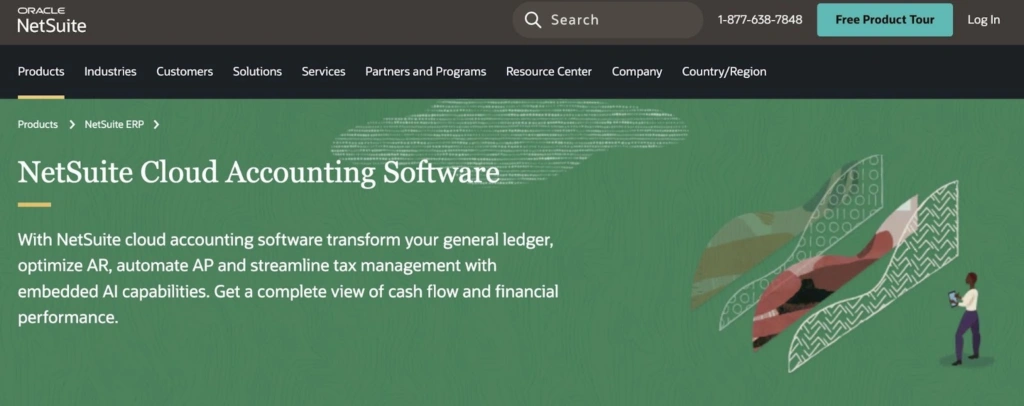
Best for: Enterprises needing a unified system for accounting and financial planning
NetSuite Cloud Accounting offers businesses of all sizes a comprehensive accounting solution. With NetSuite, finance leaders can generate rich, interactive reports on their overall accounting and financial performance.
Using rules-based accounting simplifies data entry, making it more efficient, but NetSuite can also automate and streamline A/P and A/R processes and manage local and international taxes.
Pricing: Upon Request
Budgeting And Forecasting Software
Better financial planning and forecasting begin with budgeting. A budget serves as a yardstick for comparing future performance.
A budget is itself a forecasting tool, but you can also generate individual forecasting reports, such as cash flow forecasts, forecasted income statements, CAPEX budgets, etc. The budget data is carried forward into these individual reports.
The following budgeting and forecasting solutions can help your FP&A team.
7. Drivepoint – Strategic financial planning platform
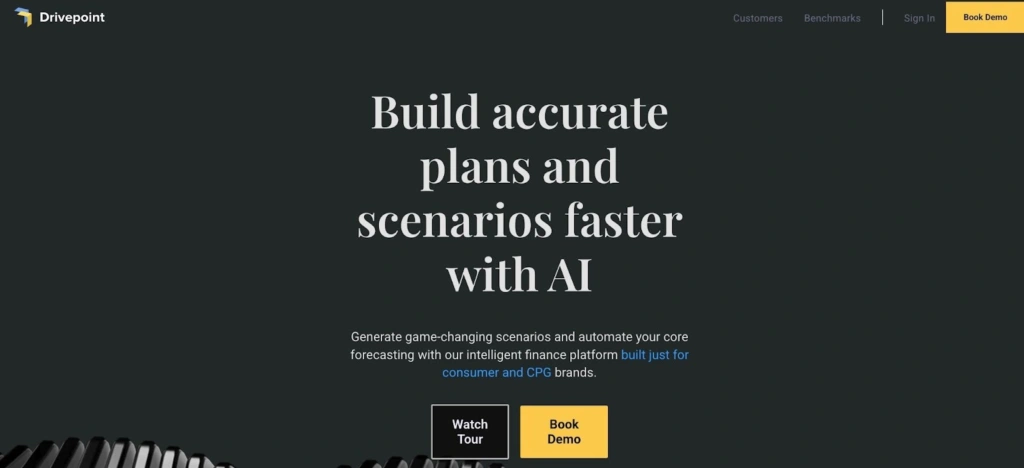
Best for: Collaborative financial planning with real-time data and reporting dashboards
Drivepoint is a dynamic financial planning and analysis platform designed to empower FP&A teams at modern consumer brands. The platform centralizes data to streamline forecasting, budgeting, and scenario modeling. Its SmartModel™ integrates with Shopify, Amazon, and QuickBooks, ensuring accurate, real-time inputs.
Cohort-based forecasting delivers detailed revenue projections by analyzing retention and reorder rates, while cash flow forecasting enhances liquidity planning.
Scenario planning tools empower teams to evaluate the financial impact of changes in pricing, customer acquisition, or expenses, enabling data-driven decision-making. Drivepoint simplifies complex financial processes, helping FP&A teams align strategy with business goals effectively.
8. Cube – User-friendly FP&A solution
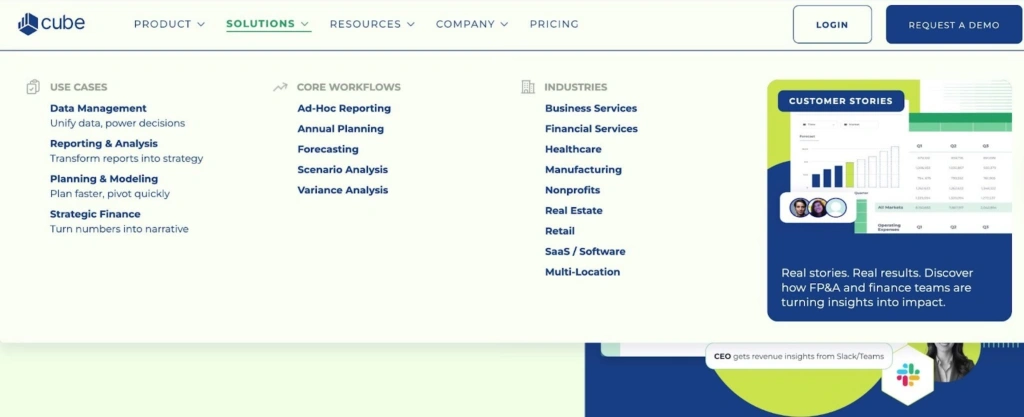
Best for: FP&A teams that want Excel/Sheets familiarity with modern automation
While many advanced FP&A platforms require weeks of initial setup, additional consulting, and constant management, Cube delivers a robust solution in an intuitive package.
Cube includes enterprise-grade financial modeling, security, and on-the-fly consolidation and validation. It also collects data from multiple sources, including ERP, CRM, and HRIS.
It promises that your team will be up and running within 10 days and is fully compatible with your favorite financial management tools (including Excel, Salesforce, Tableau, Xero, Snowflake, QuickBooks).
Pricing: Starts at $1,250/month for 2 contributors and 2 admins, unlimited scenarios, and integrations with ERPs, etc.
9. Centage – For small-sized businesses
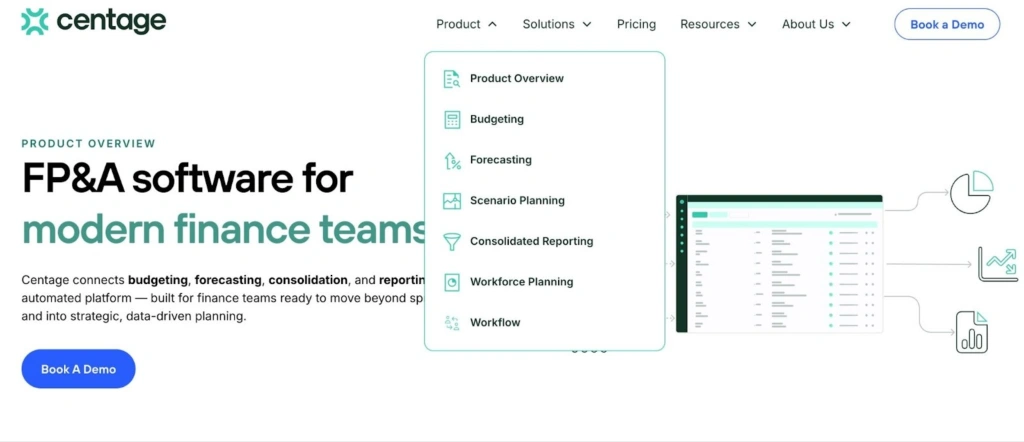
Best for: Mid-market companies needing integrated budgeting and forecasting tools
Centage features a formula-free, drag-and-drop interface that enables the development of comprehensive and accurate budgets accessible anytime, anywhere. It automatically generates forecasted balance sheets and cash flow statements based on different models and assumptions. The platform’s customized financial dashboards also offer insights into the business’s health.
Users can also run dynamic, infinite “what-if” scenarios without coding.
Pricing: Upon Request
10. Vena – Excel-based budgeting and forecasting platform
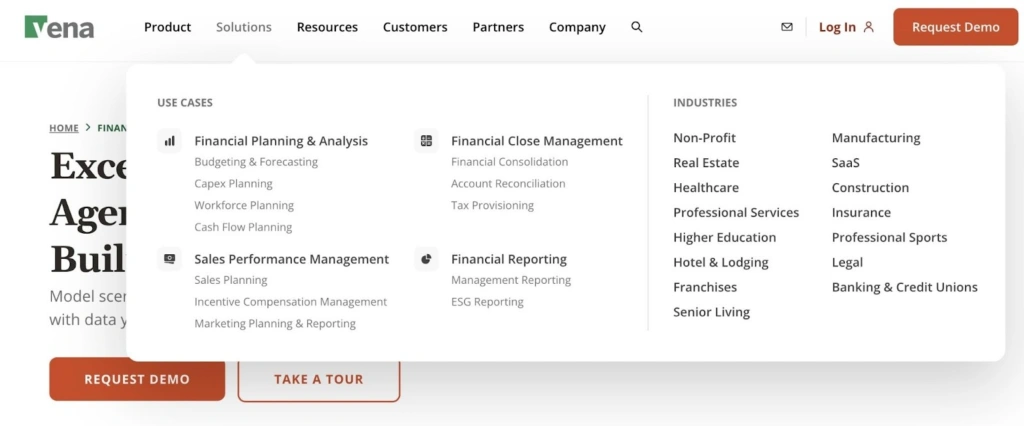
Best for: Enterprise FP&A teams that prefer Excel-based modeling with advanced controls
Vena Budgeting & Forecasting software speeds up your budget creation process by automating tasks, enabling data consolidation, providing templates, and streamlining FP&A workflows. With Vena, you can identify key cost drivers across your business units and create budgets based on that information.
Perhaps the best thing about Vena is its Excel-based interface. Since almost all financial experts use Excel, Vena can be a breeze to use. Using a single source of truth, Vena can create a real-time, long-term forecast that finance teams can analyze in depth and take timely action.
Pricing: Upon Request
11. Anaplan – Enterprise FP&A platform
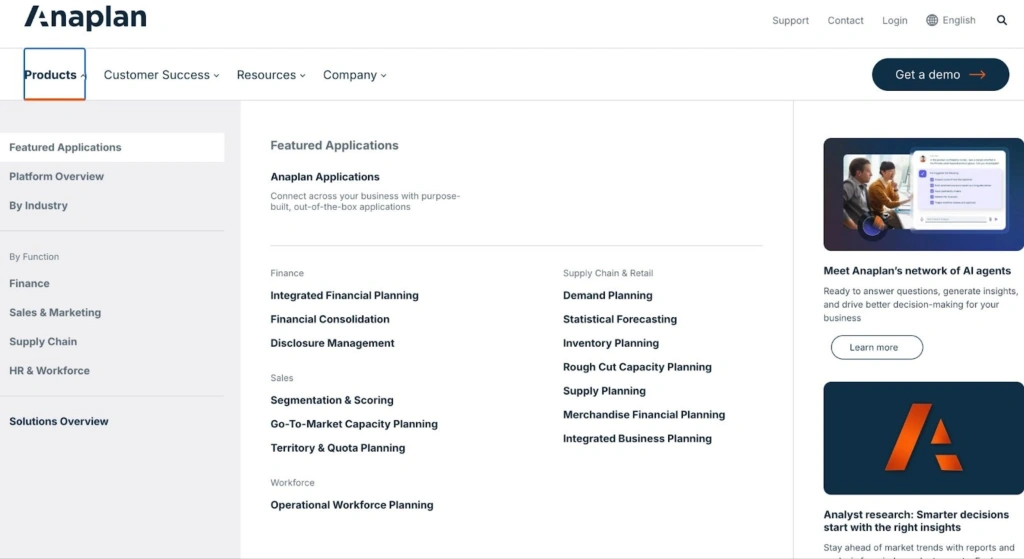
Best for: Global enterprises managing complex, multi-scenario financial planning
Anaplan connects enterprise-wide planning through dynamic models and predictive intelligence. Its AI-driven algorithms enhance scenario modeling, helping finance teams test assumptions, forecast outcomes, and adapt plans in real time as market conditions shift.
Pricing: Custom pricing
12. Mosaic Tech – Agile financial forecasting
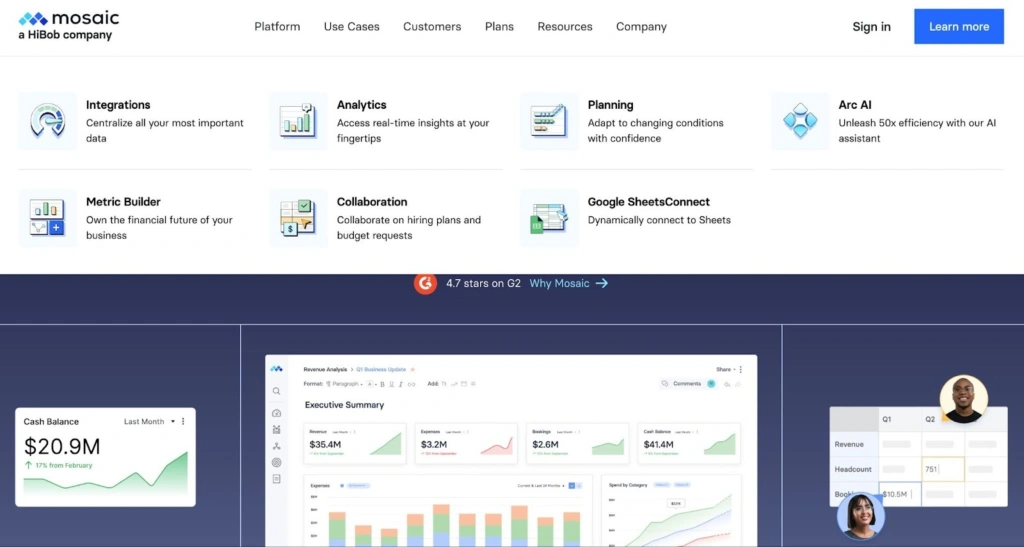
Best for: SaaS finance teams seeking unified planning, reporting, and analytics
Mosaic Tech aggregates financial data with AI-powered forecasting to deliver live, accurate insights. It helps teams spot variances early, refine budgets instantly, and align spending decisions with changing business performance — all from a unified dashboard
Pricing: Upon Request
13. Workday Adaptive Planning – Enterprise planning platform
Best for: Large organizations that need robust, enterprise-grade financial modeling
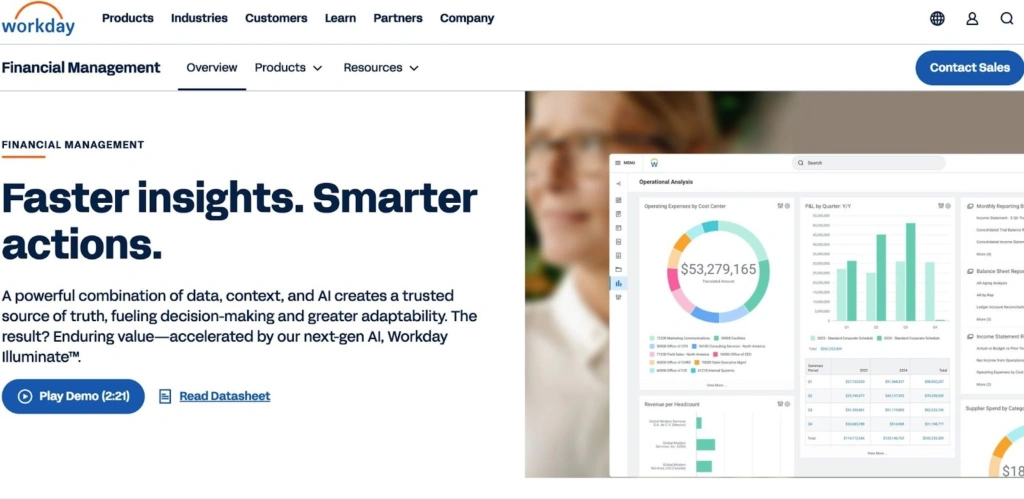
Workday is a popular enterprise-level financial planning platform. Its enterprise management cloud approach covers financial, operational, workforce, and sales planning.
To power these areas, Workday provides a set of tools to create simple to complex models, workflows, and reporting/analytics.
Pricing: Contact sales
Financial Modeling And Analysis Solutions
The following tools combine financial management processes with modern, collaborative, and cloud-based planning workflows for finance professionals.
14. Datarails – Financial analytics software with excel dode
Best for: Small and mid-sized businesses automating Excel-based financial reporting
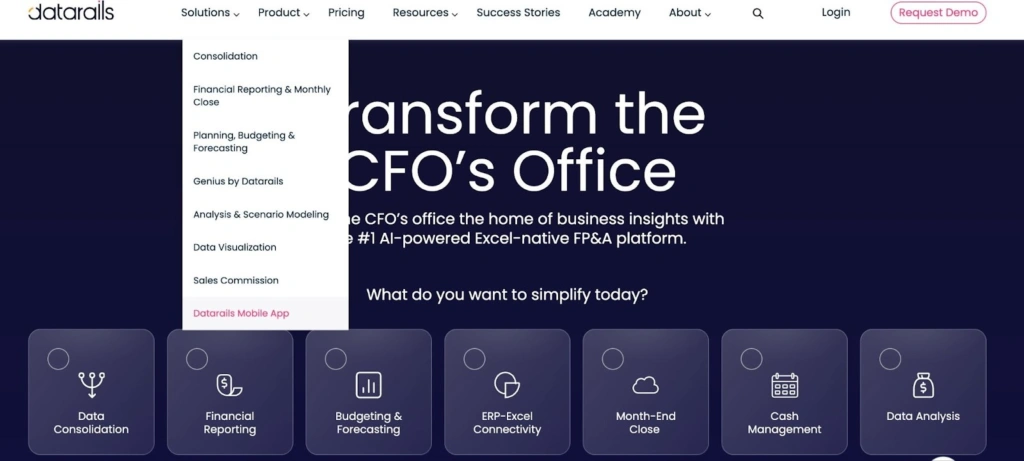
Datarails aims to help FP&A analysts maintain their Excel financial models while automating and improving them. Datarails integrates with many of the major accounting, ERP, CRM, and data warehouse solutions available today.
After consolidating and validating your data, you decide whether to keep rows and columns or use a dashboard to view and share your FP&A insights with stakeholders. Either way, you can quickly zoom into your data to answer specific questions in real time.
Pricing: Custom pricing
15. OneStream – Enterprise FP & A
Best for: Large enterprises needing unified financial consolidation and performance management
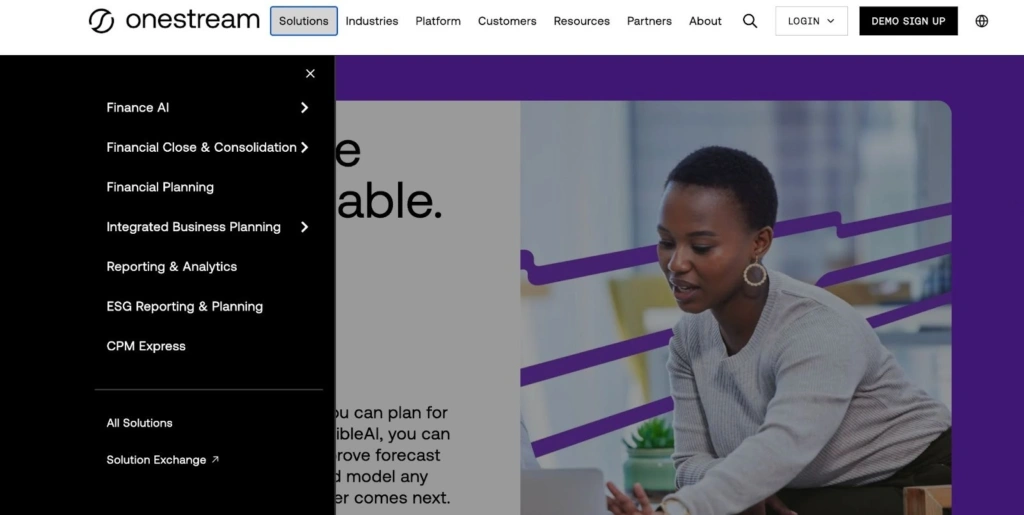
OneStream is ideal for enterprises aiming to eliminate data silos. It unifies financial and operational data into a single, integrated platform, thus replacing fragmented systems and spreadsheets.
OneStream integrates with Microsoft Excel through its Excel Add-In, enabling users to perform ad hoc analysis, create reports, and enter or update data directly within the familiar Excel interface.
Pricing: Custom pricing
16. Planful – Continuous financial planning solution
Best for: Mid-market teams wanting faster budgeting and rolling forecasts
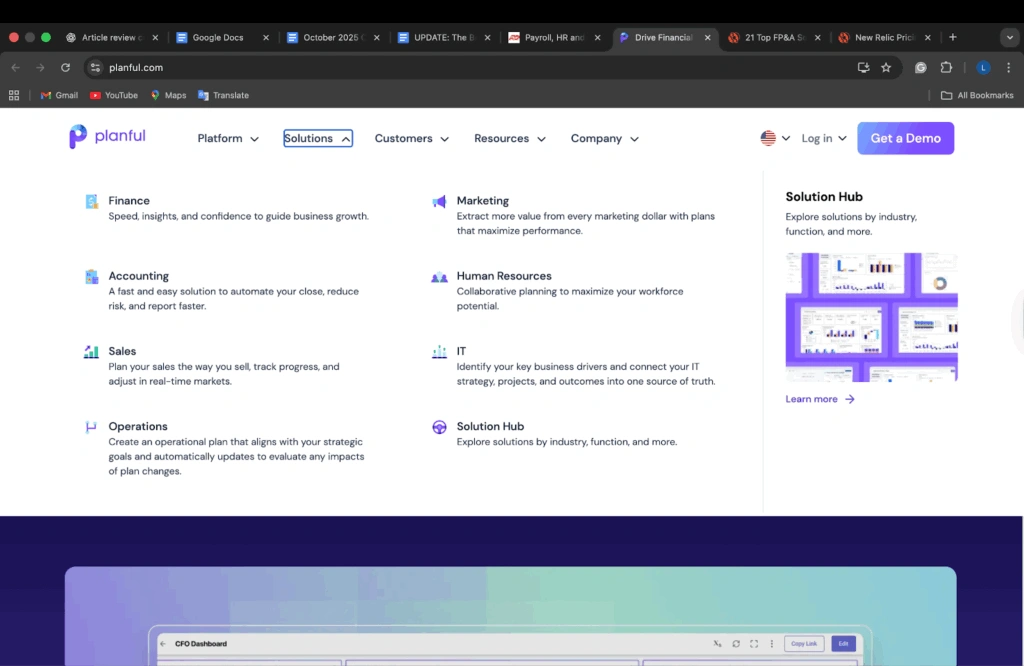
With this feature-rich platform, you can seamlessly integrate business and financial planning. In addition to scenario analysis, Planful emphasizes continuous planning, forecasting, and reporting for marketing, HR, accounting, and FP&A teams.
Planful automates financial planning workflows, enables cross-departmental collaboration, and scales well for large organizations.
Pricing: Upon request by use case
17. Pigment – Cloud-based agile planning platform
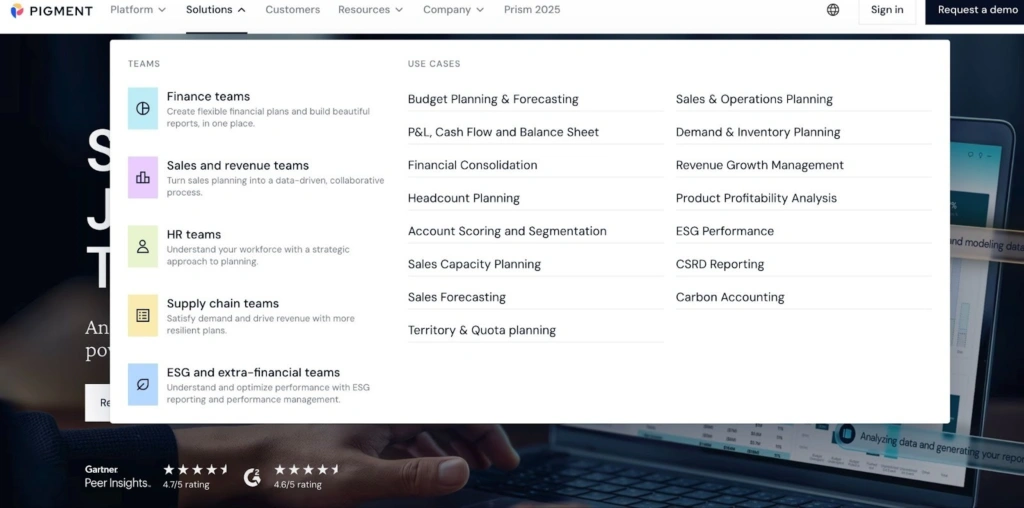
Best for: Modern FP&A teams seeking intuitive, visually rich planning dashboards
Pigment connects finance, sales, HR, and supply chain teams in one system, eliminating silos and aligning everyone toward shared goals.
It combines real-time data with machine-learning insights, helping leaders forecast accurately, test “what-if” scenarios, and act fast on data-driven trends.
Its intuitive interface supports collaboration, transparency, and continuous improvement through dynamic, ML-refined forecasts.
Pricing: Custom
18. Board – Business intelligence solution for FP&A work
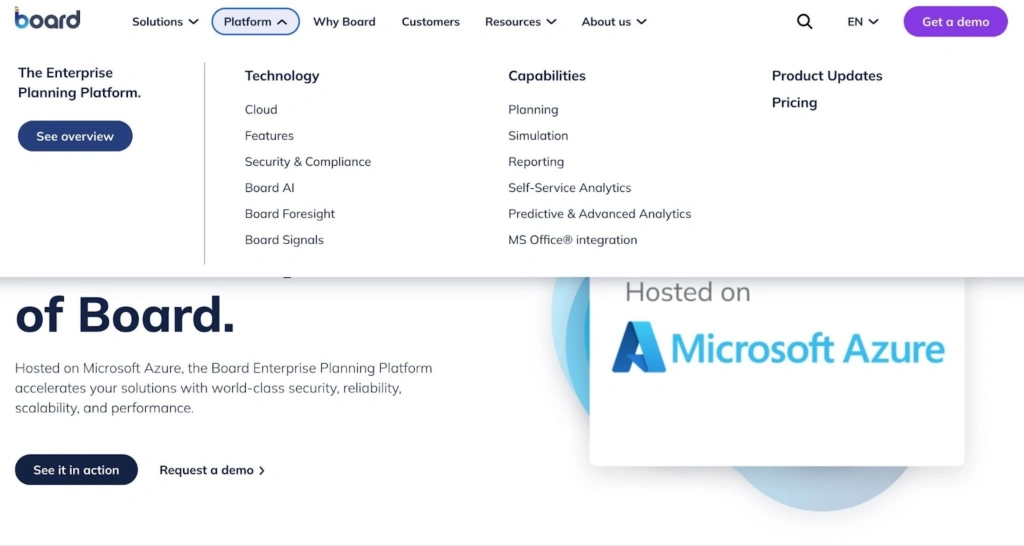
Best for: Organizations that want integrated business intelligence and financial planning in one platform
Board offers a package of software modules and capabilities. Your team can leverage the tools for analytics, business intelligence, and performance management. Its core modules include predictive analytics, dashboards, reports, data discovery, and scorecards.
You can seamlessly integrate Board with systems such as SAP ERP, Microsoft Azure, SQL databases, and data presentation tools.
Pricing: Upon request
Other powerful FP&A tools suitable for planning and analysis include Jedox, Prophix, and Jirav.
Payroll Processing Software
Payroll processing software helps finance teams process employee payrolls and ensure compliant and timely tax filings. It also facilitates tax planning by keeping track of credits and deferred tax payments.
19. Gusto – Payroll and benefits solution
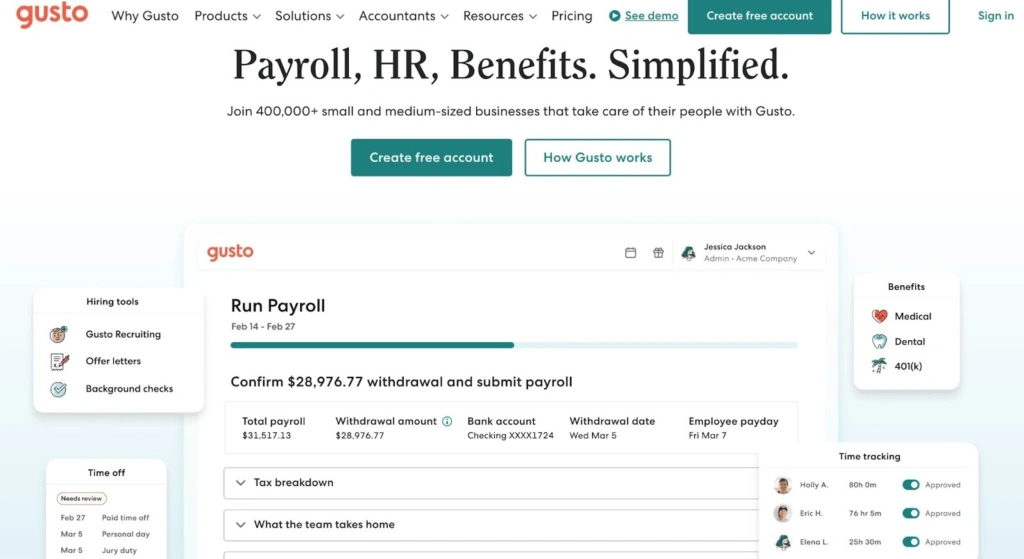
Best for: Startups managing payroll, benefits, and workforce budgeting together
Gusto packs a ton of payroll features, including talent, employee benefits, and time/attendance management. The payroll processing platform also tracks, files, and pays related payroll taxes.
Gusto’s auto calculations eliminate errors, and its integrations with major accounting software help financial leaders review, analyze, and plan their finances with precision. Moreover, your team can create reports on tax credits and deferrals to track savings.
Pricing: Core ($39/month + $6 per person), Complete ($39/month + $12 per person), Concierge ($149/month + $12 per person)
20. ADP – Advanced payroll platform for FP&A work
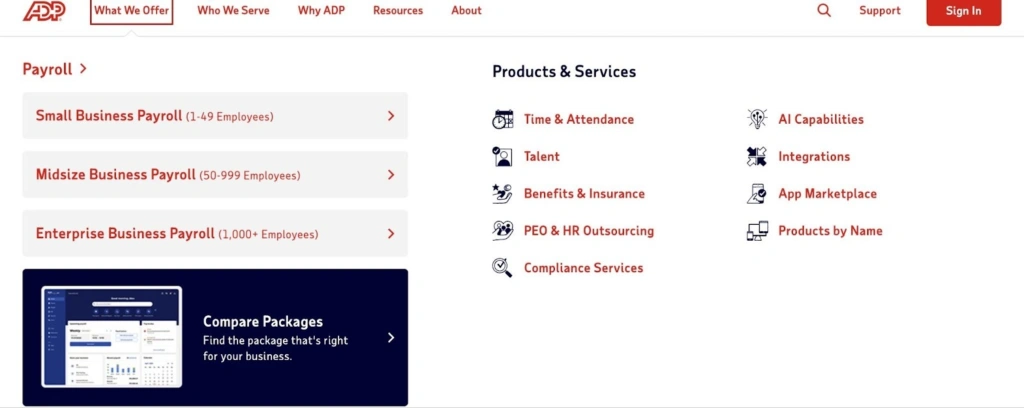
Best for: Global companies requiring scalable payroll and workforce financial planning tools
ADP Payroll is an online platform that provides payroll processing services to small, medium, and large businesses.
ADP also tracks taxes and available employee credits. In addition, ADP Payroll includes tools for computing and planning retirement, insurance, and professional employee organization (PEO) tasks.
Pricing: Upon Request
21. Rippling – Payroll and HR management
Best for: Small to mid-sized teams that want all-in-one HR, IT, and finance management
Rippling manages payroll processing with real-time calculations, ensuring timely payments. It also tracks, files, and pays taxes accurately, keeping the business compliant.
Rippling also integrates with HR and IT systems to ensure a smooth experience for employee onboarding, benefits administration, time and attendance tracking, and compliance monitoring.
Pricing: Upon Request
The Future Of FP&A: Smarter, Predictive, And Connected
AI and ML are redefining how finance teams plan, forecast, and allocate resources.
As these technologies advance, FP&A tools are evolving from reactive reporting to proactive financial intelligence — surfacing trends, anomalies, and recommendations in real time.
This shift helps finance leaders move faster, make sharper decisions, and guide strategy with forward-looking insight rather than static reports.
Understand And Optimize Your Cloud Spend – The Easy Way
FP&A teams rely on accuracy, not averages. CloudZero breaks cloud costs down by customer, product, or feature — so finance leaders can model forecasts and margins with precision.
Take the cost per customer report below. It shows exactly how spend trends by account over time, highlighting both median and mean changes.
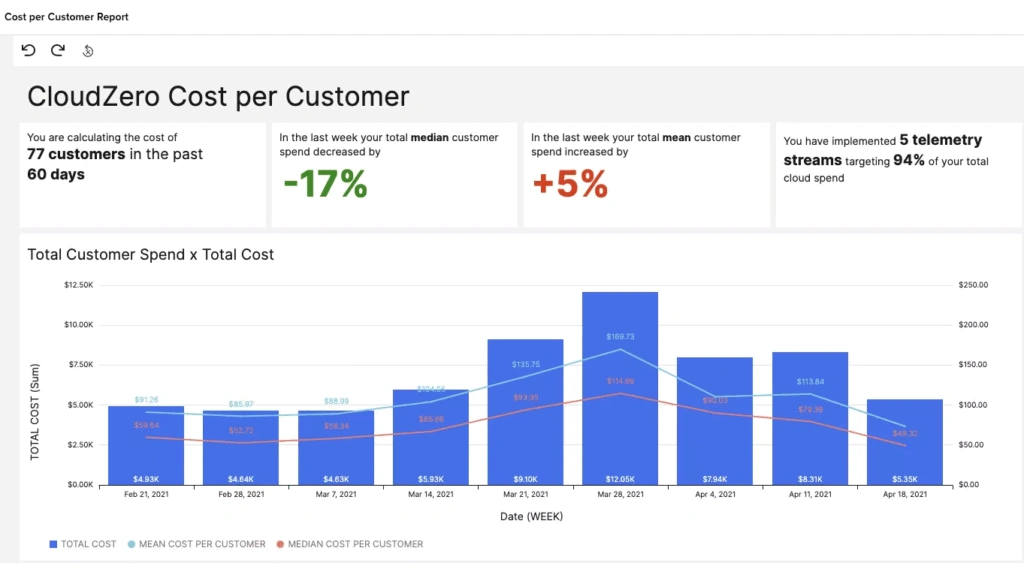
Finance can quickly see where costs rise, which segments remain profitable, and how usage shifts affect overall margin.
This visibility turns cloud data into financial insight. Instead of reactive reporting, FP&A teams can plan, adjust, and forecast confidently — using real usage data from CloudZero’s dashboards.
Schedule a demo today to see how CloudZero can help improve your FP&A program in days, not months.


The Cloud Cost Playbook
The step-by-step guide to cost maturity