Choosing between AWS and OCI is a common decision for organizations moving workloads to the cloud. Both Amazon Web Services and Oracle Cloud Infrastructure offer global infrastructure, robust security, and broad service portfolios. On paper, the platforms can look interchangeable.
They are not. AWS and Oracle Cloud differ in pricing, compute models, storage options, networking, and managed services. These differences affect scalability, reliability, and day-to-day operations — and can dramatically change your cloud total cost of ownership.
This article compares OCI vs AWS across services, performance, security, and cost. It explains where each platform fits best and where tradeoffs appear. For teams assessing AWS vs. OCI for enterprises, it also explains why multi-cloud cost management often matters and where tools like CloudZero come into play.
For most teams, the AWS vs. OCI decision is not about feature parity. For a broader look at how all major cloud providers compare on price, see our cloud pricing comparison. It is about how much abstraction, flexibility, and operational complexity an organization is willing to accept in exchange for speed, scale, and service depth.
As workloads grow and costs scale, differences in architecture, pricing models, and infrastructure behavior become more consequential than service checklists.
Related read: 21+ Top Cloud Service Providers Globally In 2026
Another related read: AWS Vs. Azure: How To Choose The Right Cloud Provider
AWS Vs. OCI Architecture: What Each Cloud Is Optimized For
At a fundamental level, AWS and OCI take different approaches to cloud infrastructure. The difference is not branding or service count. It is the degree of abstraction each platform places between the customer and the underlying infrastructure.
AWS operates as a highly abstracted cloud platform. Most workloads run several layers above the physical infrastructure, through managed services, regional control planes, and tightly integrated service APIs. This model supports rapid service composition, fine-grained configuration, and deep service-to-service integration across regions and availability zones.
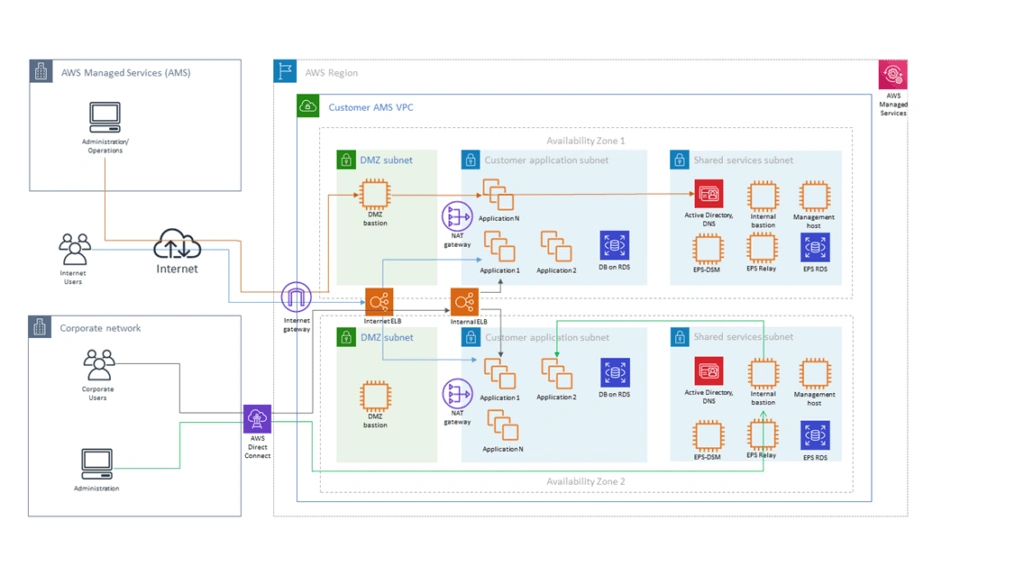
AWS architecture with application workloads running through managed services and regional layers
OCI operates closer to the infrastructure layer. Compute, storage, and networking are exposed with fewer intermediate abstractions. The network fabric is flatter. Many services rely on predictable bandwidth, fixed performance characteristics, and simpler traffic paths between components. This results in behavior that changes less as environments scale.
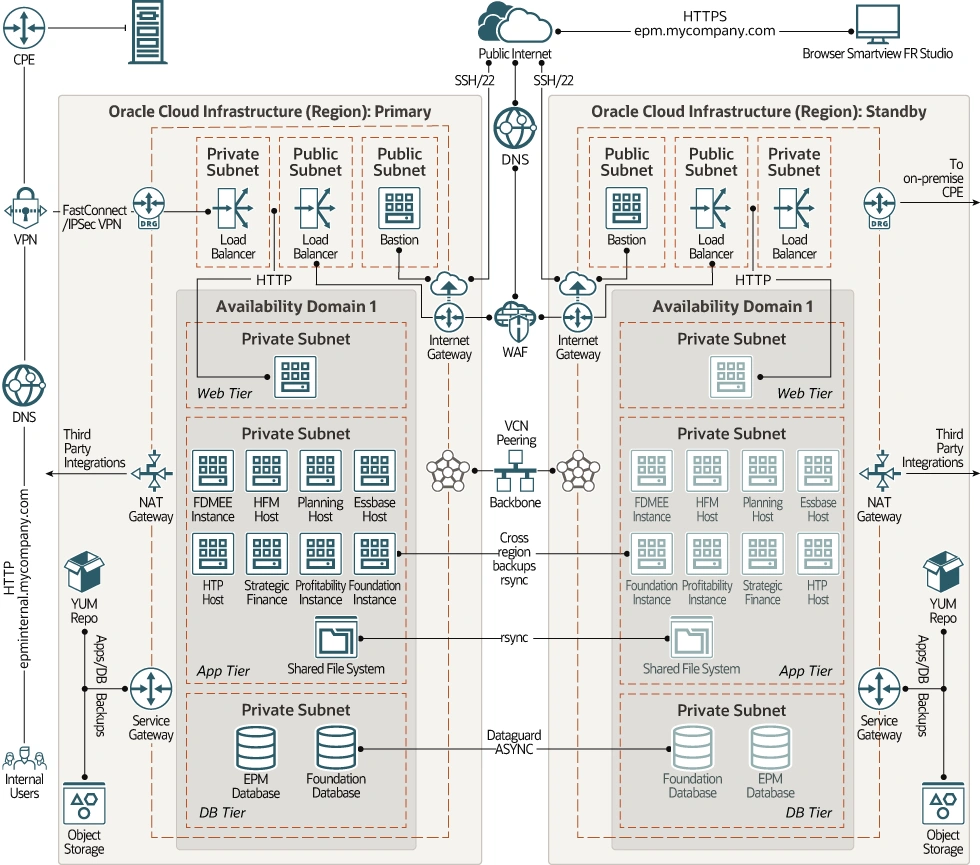
OCI architecture showing Infrastructure tiers and direct network paths
These architectural choices become more visible as workloads scale. AWS environments gain flexibility and service depth but often accumulate operational and billing complexity across services and regions. OCI environments trade some service breadth for more uniform performance behavior and more predictable cost patterns at scale.
For most teams, the AWS vs. OCI decision is not about feature parity. It is about how much abstraction, flexibility, and operational complexity an organization is willing to accept in exchange for speed, scale, and service depth.
As environments grow, differences in architecture directly shape cost behavior, operational overhead, and predictability — often more than individual service choices.
Report
Finance needs to prove AI’s return: CloudZero report
260 senior finance leaders (more than half CFOs) told us why the speed of seeing AI spend, not the size of it, separates who pulls ahead on AI from who gets burned.
Main Cloud Services And Capabilities
Both AWS and OCI offer the same core building blocks: virtual machines, storage, networking, and identity controls.
AWS offers a vast catalog of managed services across databases, analytics, and application integration. Most production architectures rely on these services as core components, resulting in applications built from integrated services.
OCI focuses most deployments on compute, block storage, object storage, and networking. Managed services exist, but they play a more minor role in typical architectures. Applications often rely more heavily on infrastructure primitives and fewer platform-level dependencies.
Here is a quick overview of the major services on AWS and OCI:
| Service | AWS | OCI |
| Compute | Amazon EC2 | OCI Compute |
| Storage | Amazon S3 (Object)Amazon EBS (Block) | OCI Object StorageOCI Block Volumes |
| Networking | Amazon VPC | OCI Virtual Cloud Network (VCN) |
| Database | Amazon RDS | Oracle Autonomous Database / Oracle Database Service |
| Identity and access | AWS IAM | OCI IAM |
Compute services: AWS vs. OCI
Compute on AWS and OCI differ in how capacity is defined and changed. On AWS, compute runs on Amazon EC2 instance families with fixed sizes. CPU, memory, and network limits are bundled. Scaling often means moving between instance types or families.
On OCI, compute runs on shapes, including flexible shapes where CPU (OCPUs) and memory are set independently. Scaling usually means adjusting resources in the same shape.
Here is an in-depth guide to what an Amazon EC2 instance is and how to choose the best option for your workload.
Bare metal also plays a different role on each platform. AWS offers bare-metal instances primarily for specific constraints, such as licensing or low-level hardware access.
OCI treats bare metal as a mainstream option and uses it for high-throughput and database workloads. This difference shapes how teams plan performance isolation and long-running workloads.
Compute pricing models
- Amazon EC2: Multiple pricing models (On-Demand, Savings Plans, Spot) tied to instance families and commitment strategies.
- OCI Compute: OCPU-hour and memory-hour pricing make vertical scaling more transparent.
Useful resources:
Cloud storage options for AWS and OCI
Both AWS and OCI offer object, block, file, and archival storage.
Object storage
Object storage is used to store large volumes of unstructured data, such as backups, media files, and data lake data.
AWS provides Amazon S3, which offers multiple storage classes, including Standard, Infrequent Access, and Glacier. These classes enable users to control cost based on access frequency.
Check out our guide on Amazon’s pricing for S3 and how to calculate your S3 storage costs.
OCI Object Storage serves a similar role, offering standard and archival tiers for active and infrequently accessed data. OCI’s object storage is simpler in structure, with fewer tiers and pricing variables.
Block storage
Block storage supports stateful workloads such as databases and virtual machines.
AWS uses Amazon Elastic Block Store (EBS) for EC2 instances. EBS offers multiple volume types backed by SSDs or HDDs, supporting a wide range of performance needs. It is commonly used for transactional databases and latency-sensitive applications. Here is a simplified guide to Amazon EBS pricing.
OCI provides Block Volumes for its compute instances. OCI block storage emphasizes predictable performance and straightforward pricing, with performance scaling tied closely to volume size. This approach often appeals to teams running steady, long-lived workloads where consistency matters more than fine-grained tuning.
File storage
File storage is used when applications require shared access to data through a traditional file system.
AWS offers Amazon Elastic File System (EFS), a fully managed file system mainly for Linux workloads. It scales automatically and is used for shared application data and content management systems.
OCI File Storage provides shared file systems for OCI compute instances. It is used for lift-and-shift workloads and enterprise applications that expect POSIX-compliant file access, with less emphasis on advanced automation features.
Archival storage
Archival storage supports long-term data retention at low cost.
AWS offers Glacier and Glacier Deep Archive for data that is rarely accessed, with tradeoffs between retrieval time and storage cost. These services are used for compliance and for retaining historical data.
OCI Archive Storage provides low-cost storage for infrequently accessed data with a simpler tiering model. It is often used for backups and regulatory archives where retrieval speed is less critical.
AWS vs. OCI for databases
Both AWS and OCI offer a variety of databases. The difference lies in engine variety versus Oracle-centric integration.
Relational databases
AWS provides Amazon Relational Database Service (RDS), which supports multiple engines. These include MySQL, PostgreSQL, MariaDB, Oracle, SQL Server, and Amazon Aurora. This enables users to run different relational engines under a single managed service model, making AWS well-suited for mixed and cloud-native application stacks.
OCI offers Oracle Autonomous Database and Oracle Database Service. These services are integrated with OCI compute and storage and are used for enterprise transactional workloads.
NoSQL databases
NoSQL databases are used for high-scale, low-latency applications and unstructured data.
AWS offers Amazon DynamoDB. This is a fully managed key-value and document database known for consistent low latency and automatic scaling. It is used for web applications, gaming backends, and event-driven systems.
OCI provides OCI NoSQL Database Cloud Service, which supports key-value and table-based data models. It is often used for applications that need predictable latency and integration with OCI infrastructure, though it offers fewer global distribution features than DynamoDB.
In-memory databases
In-memory databases support workloads that require extremely fast data access.
AWS offers Amazon ElastiCache, which supports Redis and Memcached, for caching, session storage, and real-time analytics.
Related read: Understanding ElastiCache Pricing (And How To Cut Costs)
OCI provides OCI Cache with Redis, which supports Redis-based in-memory caching for low-latency workloads.
Data warehousing
Databases often feed analytics and reporting platforms.
AWS provides Amazon Redshift, a managed data warehouse for large-scale analytics across structured and semi-structured data. It is mainly used for business intelligence and large analytical workloads.
OCI offers OCI Autonomous Data Warehouse. This is optimized for analytics workloads on Oracle databases.
Other database services
AWS also offers specialized databases such as Amazon Timestream for time-series data and Amazon Neptune for graph workloads.
OCI provides more database services for Oracle workloads. These include MySQL HeatWave, which combines transactional processing with in-memory analytics for MySQL-based applications.
AWS vs. OCI for networking
Networking defines how applications communicate, scale, and stay resilient.
Virtual networking
AWS networking is built around Amazon Virtual Private Cloud (VPC). VPCs support subnets, route tables, gateways, and security groups across multiple availability zones.
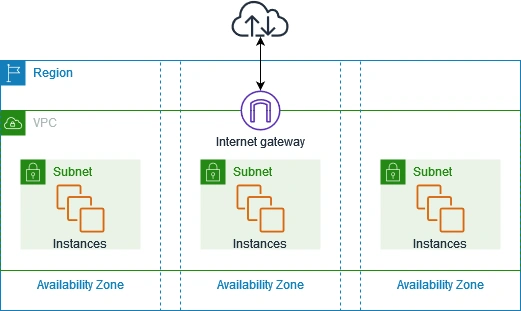
OCI uses Virtual Cloud Network (VCN) as its main networking construct. VCNs also support subnets, routing, and security rules, but the model is flatter, with fewer implicit dependencies between services.
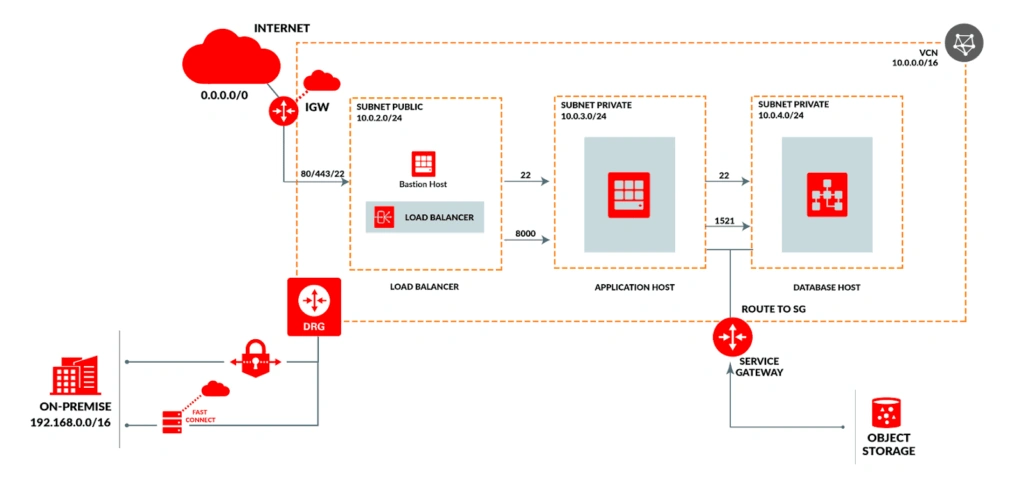
Traffic within regions
AWS architectures distribute workloads across multiple availability zones for resilience. As a result, traffic frequently crosses AZ boundaries, which can introduce additional latency and inter-AZ data transfer costs.
With OCI, traffic between compute instances often remains within the same network fabric, reducing east–west complexity and improving performance consistency.
Load balancing
AWS provides Elastic Load Balancing (ELB) with multiple options, including Application Load Balancer and Network Load Balancer. These services integrate with other AWS components and support complex routing patterns.
OCI offers OCI Load Balancer, which supports both public and private load balancing with a simpler configuration.
Connectivity and hybrid networking
AWS supports hybrid connectivity through AWS Direct Connect, allowing private links between on-premises environments and AWS regions. This is widely used in hybrid and regulated environments.
OCI offers FastConnect, which provides dedicated private connectivity to OCI regions. It is often positioned for enterprise workloads migrating from on-premises Oracle environments.
Security and compliance: AWS vs. OCI
AWS provides highly granular security controls across most services, giving users the flexibility but adding configuration and management complexity.
OCI centralizes more security controls at the platform level, with strong defaults for identity, network isolation, and encryption.
Factors To Consider When Choosing Between AWS And OCI
The choice between AWS and OCI comes down to operational efficiency. Here is what to consider:
- Workload. AWS fits organizations running diverse, fast-changing, or cloud-native workloads that benefit from a wide range of managed services. OCI is well-suited for teams running steady, performance-sensitive, or Oracle-centric workloads where predictability matters more than service variety.
- Operational complexity. AWS environments tend to grow more complex as services and regions accumulate. OCI environments often remain simpler, with fewer service dependencies and more uniform infrastructure patterns.
- Hybrid and multi-cloud strategy. AWS supports hybrid environments through services such as Direct Connect and Outposts, but multi-cloud relies on third-party integrations. OCI also integrates into hybrid environments, especially where on-premises Oracle systems are common, and is often used alongside AWS rather than replacing it.
- Ecosystem and skills. AWS has a larger global ecosystem and talent pool. OCI aligns well with organizations already invested in Oracle technologies and enterprise systems.
- Cost. AWS offers multiple pricing models but calls for active optimization. Oracle Cloud Infrastructure pricing is more linear for core services, making long-term forecasting simpler in stable environments — a key advantage when evaluating total cost of ownership. However, both AWS and OCI share a major challenge: multi-cloud cost management.
When To Choose AWS Vs. OCI
Choose AWS when you need a wide range of managed services, fast iteration, global service coverage, or support for highly dynamic, cloud-native workloads.
Choose OCI when you prioritize predictable performance, linear pricing, Oracle database integration, or long-running enterprise workloads where infrastructure behavior should remain consistent at scale.
How To Understand, Control, And Optimize AWS And OCI Costs With CloudZero
In both AWS and OCI, billing data rarely aligns with how an organization operates — which is why understanding cloud TCO goes beyond what native tools provide. Spend is split across accounts, regions, shared services, and data transfer. Native tools such as AWS Cost Explorer, AWS Cost and Usage Report (CUR), and OCI Cost Analysis show totals and service lines, but they struggle to answer questions such as “Which team caused this?” or “What did this feature cost?” across both clouds.
CloudZero solves the cross-cloud problem by consolidating AWS and OCI costs into a single system and allocating them to business dimensions. CloudZero has an Oracle Cloud Connector built for OCI visibility and allocation, alongside its AWS integration.
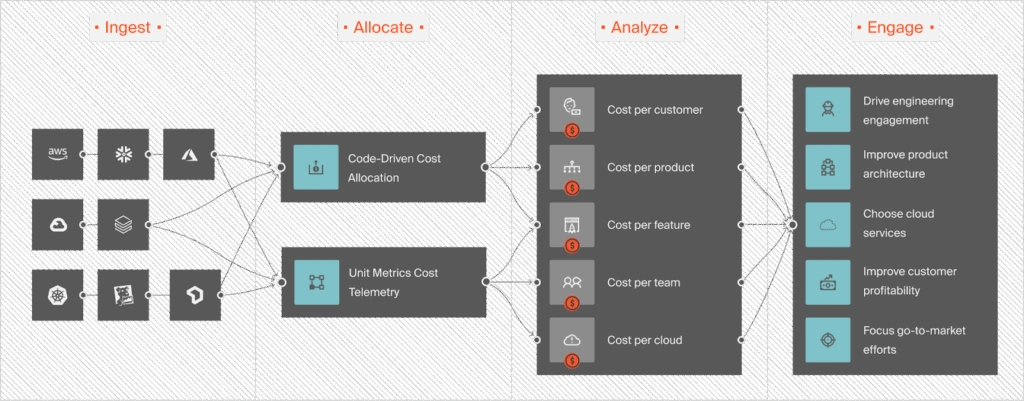
The bigger win is coverage beyond cloud. CloudZero AnyCost ingests IaaS, PaaS, and SaaS billing data into a common data model, including sources such as Snowflake, Datadog, and New Relic, so you can analyze cloud and SaaS in a single view like this:
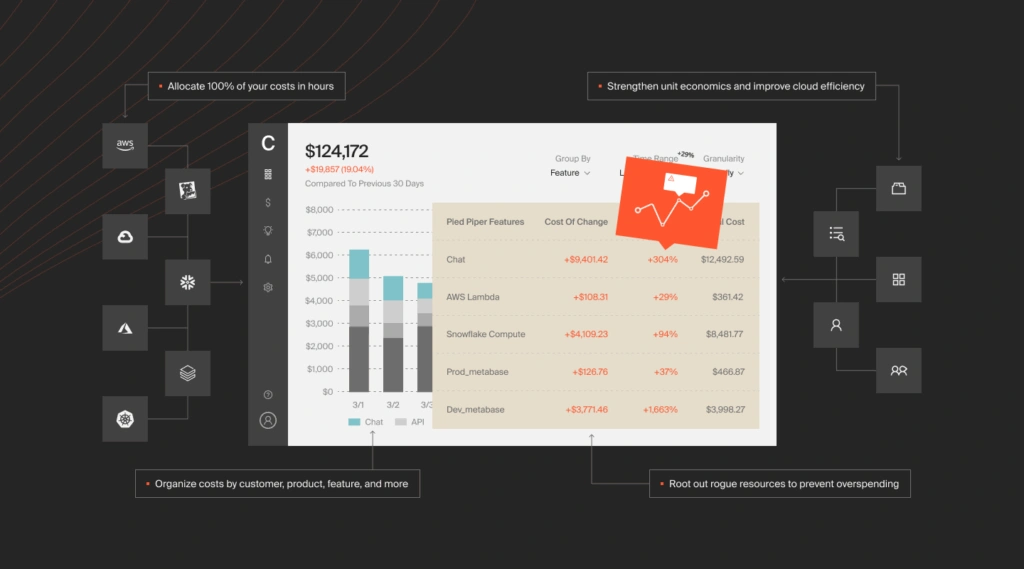
For AI spend, CloudZero is the only FinOps platform that supports native integrations for both Anthropic and OpenAI. Teams can track AI costs by model, feature, or customer. This is critical because AI costs scale with tokens, context size, and request volume, making them harder to predict and control than traditional cloud costs.
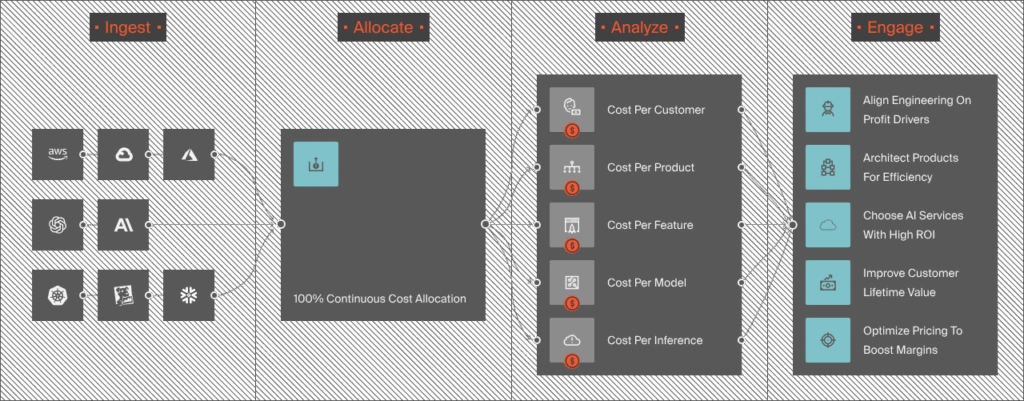
Once everything is normalized, CloudZero shifts reporting from raw spend to unit economics. It supports mapping costs to cost per customer, product, feature, and other metrics so finance and engineering can talk about margin and ROI using the same numbers.
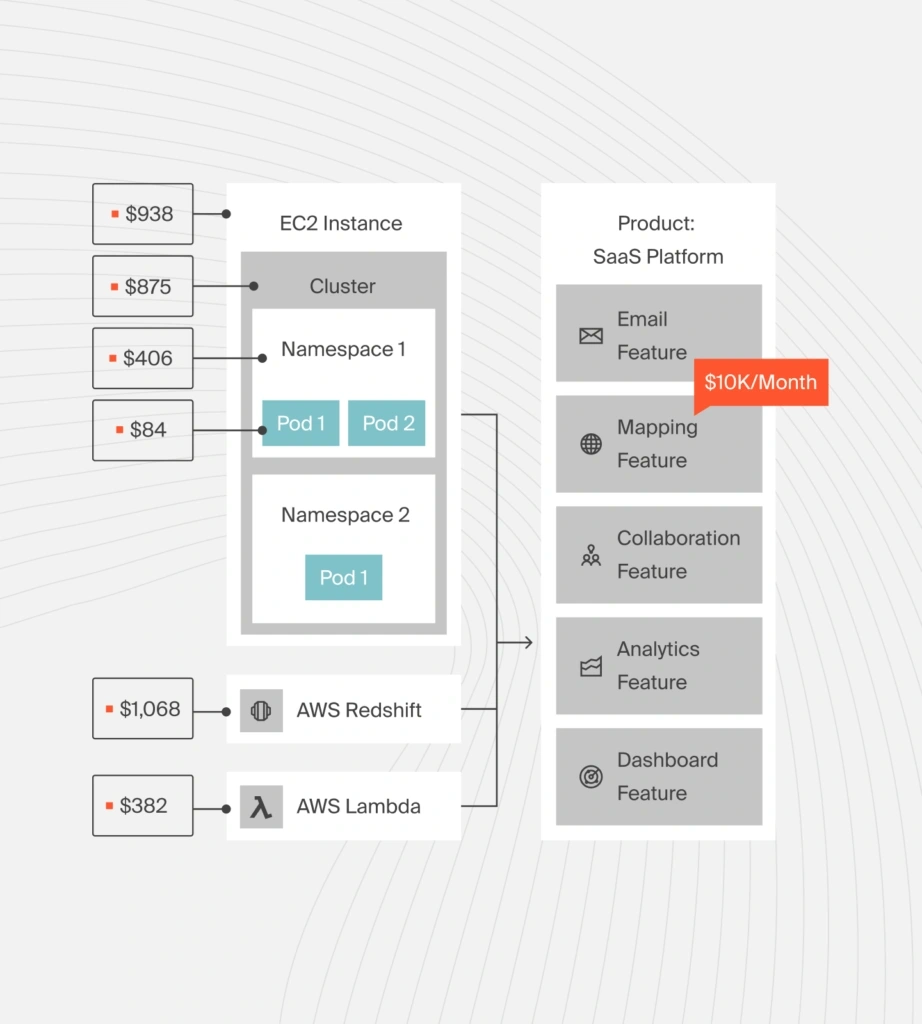
For Kubernetes, CloudZero combines cluster usage with cloud billing and breaks costs down by cluster, namespace, workload, and labels, down to the hour. It correlates pod CPU and memory usage with node costs to produce a granular allocation that teams can act on.
For cost control and planning, CloudZero also supports budgets tied to teams, products, and projects, plus spend tracking and forecasting based on historical patterns. It also flags abnormal spend with cost anomaly detection, which matters when costs spike.
Talking about CloudZero is one thing. Experiencing CloudZero is another. Take a product tour and schedule a demo today to see CloudZero in action.
Frequently Asked Questions about AWS vs. Oracle Cloud